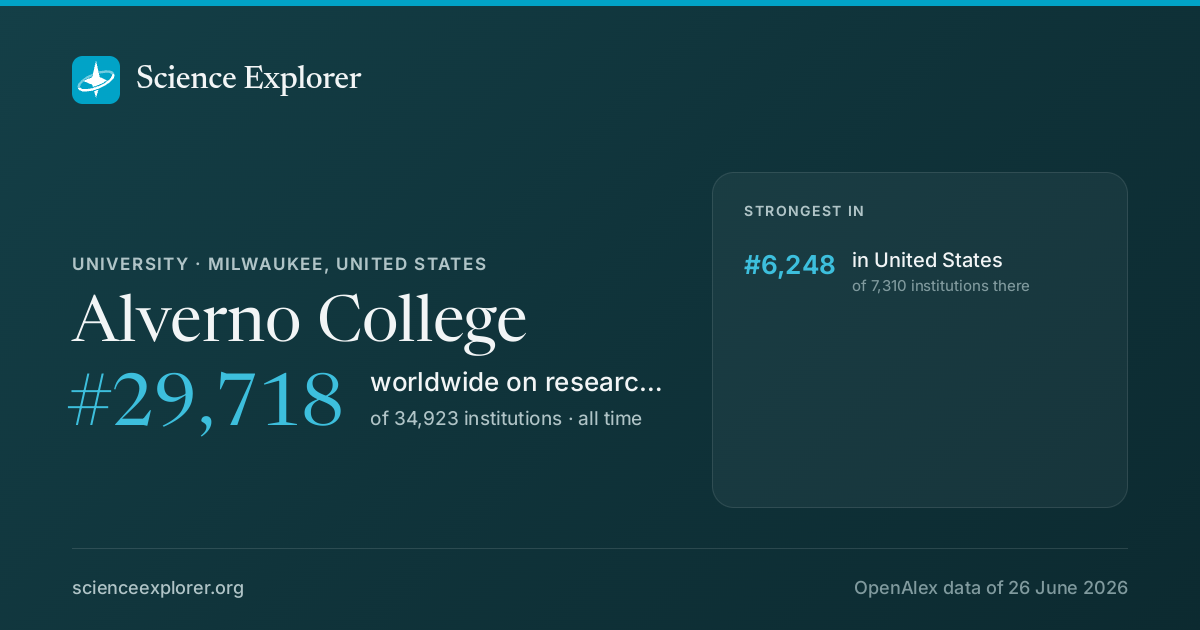
- World rank, all time
- #29,718 of 34,923
- Rank in United States
- #6,248 of 7,310
- Research works
- 161 ▲ 10% vs 2018-21
- Citations
- 4k 24.8 per fractional work
- Top-10% rate
- 10.3% all institutions 10.0%
- vs its own fields
- 1.03× 1.00× is exactly expected
- Open access
- 18% world 40%
- International
- 4% world 18%
Which fields of science does Alverno College work in?
In all years, 72% of research at Alverno College is in Social Sciences, 18% in Health Sciences. Its largest fields are Social Sciences (45%), Psychology (13%), Medicine (8%). It does 3.2× the world's share of Social Sciences.
Each ring splits the one inside it: the four domains of science, their fields, their subfields. Size is fractional works in all years. Every slice is a page; the interactive view zooms down to single topics and colours each by how much more of it this institution does than the world.
Its 4 domains and 22 fields, with their numbers
- Social Sciences11571.5%
- Social Sciences7245.0%
- Psychology2012.7%
- Arts and Humanities127.7%
- Decision Sciences42.4%
- Economics, Econometrics and Finance32.1%
- Business, Management and Accounting31.6%
- Health Sciences2918.1%
- Medicine138.0%
- Health Professions137.8%
- Nursing42.2%
- Veterinary00.0%
- Physical Sciences148.7%
- Mathematics42.2%
- Computer Science32.1%
- Environmental Science31.8%
- Physics and Astronomy20.9%
- Engineering10.8%
- Chemistry10.6%
- Energy00.1%
- Materials Science00.1%
- Earth and Planetary Sciences00.0%
- Life Sciences31.7%
Field profile
Location quotient across every field it publishes in: outside the ring is more than an institution of this size would be expected to publish, inside it is less.
Rings at 0.5×, 1× and 2×. Widest outward: Arts and Humanities, 6.7×. Every wedge is a field page.
All 14 fields, with their numbers
- Arts and Humanities6.73×2 works
- Psychology4.69×2 works
- Chemistry3.55×1 works
- Social Sciences2.75×4 works
- Health Professions1.88×1 works
- Decision Sciences1.83×0 works
- Physics and Astronomy1.79×0 works
- Business, Management and Accounting0.55×0 works
- Medicine0.42×1 works
- Biochemistry, Genetics and Molecular Biology0.29×0 works
- Computer Science0.25×0 works
- Neuroscience0.16×0 works
- Engineering0.09×0 works
- Environmental Science0.07×0 works
- Arts and Humanities 6.7×
- Psychology 4.7×
- Chemistry 3.5×
- Social Sciences 2.8×
- Health Professions 1.9×
- Decision Sciences 1.8×
- Physics and Astronomy 1.8×
- Business, Management and Accounting 0.6×
- Medicine 0.4×
- Biochemistry, Genetics and Molecular Biology 0.3×
- Computer Science 0.2×
- Neuroscience 0.2×
- Engineering 0.1×
- Environmental Science 0.1×
Who are the top researchers at Alverno College?
Ranked on the quality score, Stephen R. Sharkey, Désirée H. Pointer Mace and Mary E. Diez lead among researchers whose main affiliation is Alverno College.
- 1
Stephen R. Sharkey
 United States · #1,166,496 worldwide
2.8k citations · 18 works
- 2
Désirée H. Pointer Mace
United States · #1,456,150 worldwide
625 citations · 24 works
- 3
Mary E. Diez
United States · #1,936,754 worldwide
978 citations · 51 works
- 4
Jean E. Bartels
United States · #1,995,019 worldwide
483 citations · 21 works
- 5
Tim Riordan
United States · #2,254,650 worldwide
438 citations · 18 works
- 6
Marcia Mentkowski
United States · #2,922,196 worldwide
2.3k citations · 63 works
- 7
Paul Chaat Smith
United States · #2,937,957 worldwide
153 citations · 25 works
- 8
Judith Reisetter Hart
United States · #2,971,366 worldwide
370 citations · 17 works
- 9
William H. Rickards
United States · #2,986,252 worldwide
470 citations · 32 works
- 10
Douglas Wile
United States · #3,155,805 worldwide
117 citations · 15 works
Which keywords describe research at Alverno College?
By fractional works in all years, weighted toward what it does more of than the world: Reflective Practice, Higher Education, Student Perceptions, Meta-Analysis, Nursing Education, Faculty Development, Education and Professional Development.
- Professional Identity Formation
- Teaching Methods
- Adult Education
- Journal Writing
- Teacher Education
- Assessment Methods
- Formative Assessment
- Approaches to Learning
- Teacher Professional Development
- History
- Qualitative Research
- Student Engagement
- Critical Thinking Skills
- Competency-Based Education
- Technology Integration
- 21st Century Skills
- Professional Development
- Nursing Education
- Education
- Higher Education
- Reflective Practice
- Student Perceptions
- Meta-Analysis
- Faculty Development
- Teaching Strategies
- Learning Outcomes
- Self-Regulated Learning
- Educational Leadership
- Instructional Interventions
- Identity
- Professional Learning Communities
- Qualitative Research Methods
- Student Perception
- Feedback
- Student Evaluations
- Informal Learning
- Electronic Portfolios
- Academic Achievement
- Lifelong Learning
- Continuing Medical Education
Size is fractional works in all years in the topics tagged with each word; colour is the word's share of this institution's work against its share of the world's. The 40 words are chosen for being large and distinctive. Each links to the topic it comes from most.
All 40 words, with their numbers
- Reflective Practice14▲ 48×6 topics
- Higher Education13▲ 22×8 topics
- Student Perceptions10▲ 45×5 topics
- Education10▲ 4.7×15 topics
- Meta-Analysis8▲ 9.2×7 topics
- Nursing Education8▲ 43×3 topics
- Faculty Development8▲ 64×2 topics
- Professional Development7▲ 26×6 topics
- Teaching Strategies7▲ 25×2 topics
- 21st Century Skills6▲ 26×3 topics
- Learning Outcomes6▲ 17×4 topics
- Technology Integration6▲ 19×3 topics
- Self-Regulated Learning6▲ 129×2 topics
- Competency-Based Education6▲ 44×2 topics
- Educational Leadership6▲ 38×3 topics
- Critical Thinking Skills6▲ 34×1 topic
- Instructional Interventions6▲ 60×1 topic
- Student Engagement6▲ 13×8 topics
- Identity5▲ 4.3×11 topics
- Qualitative Research5▲ 5.5×9 topics
- Professional Learning Communities5▲ 68×2 topics
- History5▲ 3.9×8 topics
- Qualitative Research Methods5▲ 71×1 topic
- Teacher Professional Development5▲ 29×1 topic
- Student Perception5▲ 60×2 topics
- Approaches to Learning4▲ 168×1 topic
- Feedback4▲ 47×1 topic
- Formative Assessment4▲ 76×1 topic
- Student Evaluations4▲ 168×1 topic
- Assessment Methods4▲ 27×3 topics
- Informal Learning4▲ 25×3 topics
- Teacher Education4▲ 26×2 topics
- Electronic Portfolios4▲ 107×1 topic
- Journal Writing4▲ 107×1 topic
- Academic Achievement4▲ 15×6 topics
- Adult Education4▲ 76×2 topics
- Lifelong Learning4▲ 15×4 topics
- Teaching Methods4▲ 17×5 topics
- Continuing Medical Education3▲ 36×1 topic
- Professional Identity Formation3▲ 36×1 topic
Which research topics does Alverno College publish most on?
By volume in 2022-now: Teacher Education and Leadership Studies, Military History and Strategy, Theater, Performance, and Music History and Education Practices and Challenges.
Area is fractional works; colour is the subfield each topic belongs to.
- 1 Teacher Education and Leadership Studies Education 1 works
- 2 Military History and Strategy Political Science and International Relations 1 works
- 3 Theater, Performance, and Music History Music 0 works
- 4 Education Practices and Challenges Philosophy 0 works
- 5 School Health and Nursing Education Speech and Hearing 0 works
- 6 Second Language Learning and Teaching Literature and Literary Theory 0 works
- 7 Education and Critical Thinking Development Education 0 works
- 8 Online and Blended Learning Education 0 works
- 9 Second Language Acquisition and Learning Developmental and Educational Psychology 0 works
- 10 Evaluation of Teaching Practices Education 0 works
How open and international is its research?
Against the world's own shares: the tick on each track. Both are shares of its output, so they sit on one scale and can be read against each other as well as against the world.
World: 40% of research is openly available.
World: 18% is written across borders.
How has Alverno College's research output changed?
Output in 2022-2025 was 10% higher than in 2018-2021.
The same series as a ribbon: one cell per year, darker for more. The line above answers how much; this answers when.
Its share of all research
Growing output can still be a shrinking share: all of science grows. This is Alverno College as a percentage of every work published that year, 0.000033% in 2024.
Fractional works of Alverno College over all fractional works that year. How the balance of science has shifted.
Other research institutions in Milwaukee
- Medical College of Wisconsin
- University of Wisconsin–Milwaukee
- Marquette University
- Rockwell Automation (United States)
- Agricultural & Applied Economics Association
- Versiti Blood Center of Wisconsin
- Aurora St. Luke's Medical Center
- Milwaukee School of Engineering

Share Alverno College's ranking
Badges for a website1Each links back here and updates with every snapshot

Research measures only: rankings here say nothing about teaching, admissions or student experience. Comparable institutions and collaboration partners have tabs of their own, above.
Discussion
Ask a question or share a note about Alverno College. Posts are plain text and can be reported.