Amasya Üniversitesi

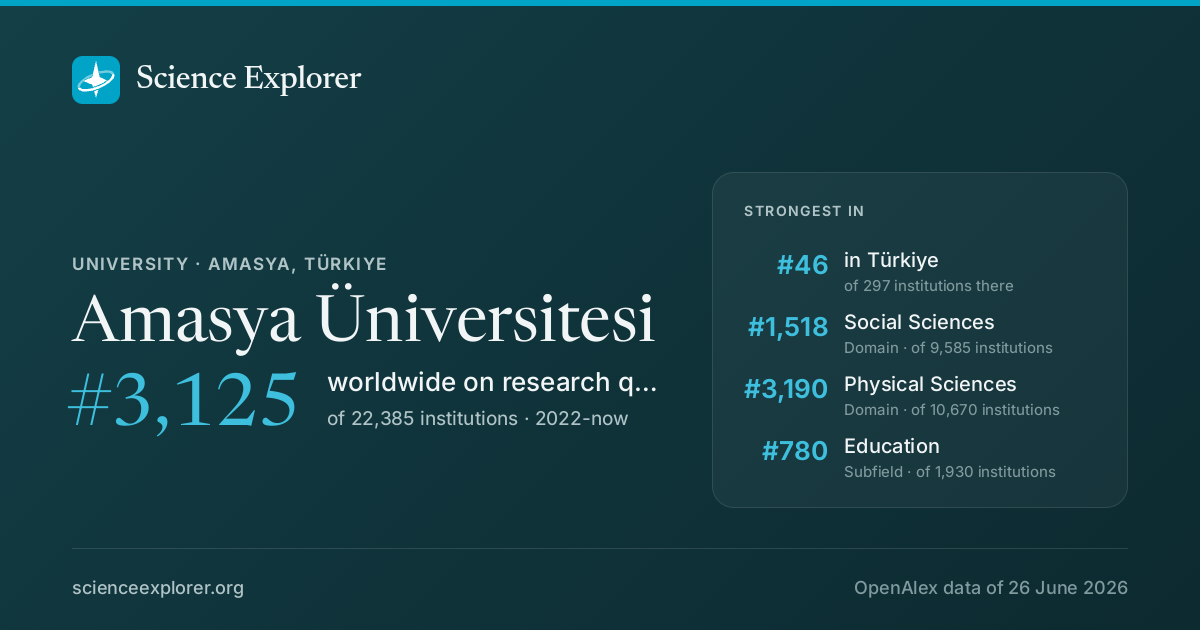
In research, Amasya Üniversitesi stands highest in Social Sciences (#1,518 of 9,585 worldwide), Social Sciences (#1,374 of 5,988 worldwide) and Physical Sciences (#3,190 of 10,670 worldwide), 2022-now. Relative to its size it is most specialised in Museology, Religious studies and Philosophy (Museology is 15.7× its share of world research).
- World rank, 2022-now
- #3,125 of 22,385 · #5,930 all time
- Rank in Türkiye
- #46 of 297
- Research works
- 4.1k ▲ 68% vs 2018-21
- Citations
- 23k 5.7 per fractional work
- Top-10% rate
- 7.6% all institutions 10.0%
- vs its own fields
- 0.76× 1.00× is exactly expected
- Open access
- 78% world 40%
- International
- 6% world 18%
What is Amasya Üniversitesi known for in research?
The fields where it stands highest, 2022-now, ranked among every institution above the floor in each field.
| Field | World rank | Where that sits | Top-10% rate | Works | All time |
|---|---|---|---|---|---|
| Social SciencesDomain | #1,518 of 9,585 | 8.2% | 921 | #2984 | |
| Social SciencesField | #1,374 of 5,988 | 7.8% | 412 | #2696 | |
| Physical SciencesDomain | #3,190 of 10,670 | 8.9% | 504 | #6180 | |
| EducationSubfield | #780 of 1,930 | 10.2% | 169 | #1136 | |
| Arts and HumanitiesField | #866 of 1,896 | 9.6% | 254 | #1654 | |
| PsychologyField | #1,140 of 2,121 | 5.7% | 133 | #2014 | |
| EngineeringField | #3,443 of 5,901 | 6.6% | 155 | #5136 | |
| MathematicsField | #694 of 1,051 | 9.1% | 74 | #1211 | |
| Health SciencesDomain | #6,750 of 9,902 | 5.1% | 366 | #11342 | |
| Computer ScienceField | #3,020 of 4,417 | 15.7% | 110 | #4102 |
Each strip is that field's whole ranked pool, with the notch where Amasya Üniversitesi sits in it, in the colour of the band that rank falls in. The track under the rate is the rate itself: it carries no average mark, because the average differs by field (from about 6% in Dentistry to 21% in Economics).
Which of those standings moved
The same fields on both windows: where it stood over the whole record, and where it stands in 2022-now. The distance is the story, and it is the one thing the two rank columns above cannot show.
- Social Sciences#2,984 #1,518
- Social Sciences#2,696 #1,374
- Physical Sciences#6,180 #3,190
- Education#1,136 #780
- Arts and Humanities#1,654 #866
- Psychology#2,014 #1,140
- Engineering#5,136 #3,443
- Mathematics#1,211 #694
- Health Sciences#11,342 #6,750
- Computer Science#4,102 #3,020
A dot further right is a better standing. Fields it was not ranked in over the whole record are left out.
Which fields of science does Amasya Üniversitesi work in?
In 2022-now, 46% of research at Amasya Üniversitesi is in Social Sciences, 26% in Physical Sciences. Its largest fields are Social Sciences (21%), Medicine (15%), Arts and Humanities (13%). It does 1.9× the world's share of Social Sciences.
Each ring splits the one inside it: the four domains of science, their fields, their subfields. Size is fractional works in 2022-now. Every slice is a page; the interactive view zooms down to single topics and colours each by how much more of it this institution does than the world.
Its 4 domains and 26 fields, with their numbers
- Social Sciences1,02046.5%
- Social Sciences45320.6%
- Arts and Humanities27712.6%
- Psychology1476.7%
- Economics, Econometrics and Finance502.3%
- Decision Sciences482.2%
- Business, Management and Accounting452.0%
- Physical Sciences56025.5%
- Engineering1717.8%
- Computer Science1215.5%
- Mathematics803.6%
- Environmental Science612.8%
- Materials Science391.8%
- Physics and Astronomy341.5%
- Chemistry261.2%
- Energy160.7%
- Earth and Planetary Sciences90.4%
- Chemical Engineering50.2%
- Health Sciences42219.2%
- Medicine32915.0%
- Health Professions683.1%
- Nursing200.9%
- Dentistry30.1%
- Veterinary10.0%
- Life Sciences1928.8%
What does Amasya Üniversitesi specialise in?
Where its research is concentrated relative to its size: Museology takes 15.7× the share of its output that it takes of world research.
- MuseologySubfield · 42.1 works16×
- Religious studiesSubfield · 40.7 works11×
- PhilosophySubfield · 74.4 works7.9×
Location quotient, a volume reading rather than an impact one. It surfaces small, lopsided specialities.
Field profile
Location quotient across every field it publishes in: outside the ring is more than an institution of this size would be expected to publish, inside it is less.
Rings at 0.5×, 1× and 2×. Widest outward: Arts and Humanities, 4.4×. Every wedge is a field page.
All 26 fields, with their numbers
- Arts and Humanities4.37×277 works
- Mathematics3.10×80 works
- Decision Sciences2.28×48 works
- Psychology2.20×147 works
- Nursing1.90×20 works
- Social Sciences1.63×453 works
- Health Professions1.18×68 works
- Agricultural and Biological Sciences1.09×114 works
- Economics, Econometrics and Finance1.07×50 works
- Energy0.78×16 works
- Medicine0.78×329 works
- Chemistry0.74×26 works
- Computer Science0.71×121 works
- Physics and Astronomy0.69×34 works
- Business, Management and Accounting0.63×45 works
- Chemical Engineering0.60×5 works
- Environmental Science0.56×61 works
- Engineering0.52×171 works
- Materials Science0.51×39 works
- Neuroscience0.47×17 works
- Pharmacology, Toxicology and Pharmaceutics0.47×4 works
- Biochemistry, Genetics and Molecular Biology0.43×51 works
- Immunology and Microbiology0.36×8 works
- Veterinary0.34×1 works
- Dentistry0.31×3 works
- Earth and Planetary Sciences0.26×9 works
- Arts and Humanities 4.4×
- Mathematics 3.1×
- Decision Sciences 2.3×
- Psychology 2.2×
- Nursing 1.9×
- Social Sciences 1.6×
- Health Professions 1.2×
- Agricultural and Biological Sciences 1.1×
- Economics, Econometrics and Finance 1.1×
- Energy 0.8×
- Medicine 0.8×
- Chemistry 0.7×
- Computer Science 0.7×
- Physics and Astronomy 0.7×
- Business, Management and Accounting 0.6×
- Chemical Engineering 0.6×
- Environmental Science 0.6×
- Engineering 0.5×
- Materials Science 0.5×
- Neuroscience 0.5×
- Pharmacology, Toxicology and Pharmaceutics 0.5×
- Biochemistry, Genetics and Molecular Biology 0.4×
- Immunology and Microbiology 0.4×
- Veterinary 0.3×
- Dentistry 0.3×
- Earth and Planetary Sciences 0.3×
Who are the top researchers at Amasya Üniversitesi?
Ranked on the quality score, Özgen Korkmaz, Şaban Öztürk and Recep Çakır lead among researchers whose main affiliation is Amasya Üniversitesi.
- 1
Özgen Korkmaz
 Türkiye · #760,623 worldwide
2.7k citations · 204 works
- 2
Şaban Öztürk
Türkiye · #788,518 worldwide
3.1k citations · 99 works
- 3
Recep Çakır
Türkiye · #1,101,976 worldwide
2.9k citations · 189 works
- 4
Aslıhan Sezgin
Türkiye · #1,210,840 worldwide
1.6k citations · 105 works
- 5
Halil Burak Kaybal
Türkiye · #1,290,882 worldwide
1.1k citations · 57 works
- 6
Volkan Kukul
Türkiye · #1,344,239 worldwide
819 citations · 47 works
- 7
Boğaçhan Başaran
Türkiye · #1,388,986 worldwide
602 citations · 33 works
- 8
Hakan Şahin
Türkiye · #1,700,711 worldwide
360 citations · 33 works
- 9
Salih Berkan Aydemı̇r
Türkiye · #1,898,450 worldwide
632 citations · 31 works
- 10
Neslihan Özdemir
Türkiye · #2,088,437 worldwide
179 citations · 18 works
Which keywords describe research at Amasya Üniversitesi?
By fractional works in 2022-now, weighted toward what it does more of than the world: Cultural Heritage, Professional Development, Distance Education, Education, Sufism, Student Perceptions, Qualitative Research and Learning.
- Fuzzy Sets
- Islamic Studies
- Reading Habits
- Turkish Literature
- Genetic Processes
- Bibliometric Analysis
- Folklore
- Mythology
- Therapy
- Public Policy
- Culture
- 21st Century Skills
- Ottoman Empire
- Teacher Perspectives
- Covid-19 Pandemic
- Learning
- Teacher Training
- Distance Education
- Qualitative Research
- Education
- Cultural Heritage
- Mental Health
- Professional Development
- Sufism
- Student Perceptions
- Teaching
- Metaphors
- Meta-Analysis
- Educational Research
- Ethnography
- Content Analysis
- Language Teaching
- Psychological Functioning
- Storytelling
- Turkish Culture
- Family Constellations
- Divan Poetry
- Curriculum Evaluation
- Theology
- Religious Language
Size is fractional works in 2022-now in the topics tagged with each word; colour is the word's share of this institution's work against its share of the world's. The 40 words are chosen for being large and distinctive. Each links to the topic it comes from most.
All 40 words, with their numbers
- Cultural Heritage148▲ 13×14 topics
- Education120▲ 3.2×38 topics
- Mental Health99▲ 3.1×34 topics
- Qualitative Research90▲ 4.8×11 topics
- Professional Development84▲ 19×9 topics
- Distance Education79▲ 19×4 topics
- Sufism76▲ 75×2 topics
- Teacher Training76▲ 5.6×12 topics
- Student Perceptions75▲ 19×7 topics
- Learning72▲ 11×4 topics
- Teaching72▲ 25×3 topics
- Covid-19 Pandemic69▲ 23×2 topics
- Metaphors69▲ 97×1 topic
- Teacher Perspectives69▲ 81×1 topic
- Meta-Analysis56▲ 4.4×18 topics
- Ottoman Empire53▲ 34×3 topics
- Educational Research50▲ 17×4 topics
- 21st Century Skills50▲ 8.0×5 topics
- Ethnography47▲ 12×5 topics
- Culture47▲ 4.1×10 topics
- Content Analysis46▲ 17×7 topics
- Public Policy46▲ 4.4×7 topics
- Language Teaching44▲ 7.5×5 topics
- Therapy42▲ 9.9×4 topics
- Psychological Functioning42▲ 24×2 topics
- Mythology42▲ 38×2 topics
- Storytelling42▲ 39×2 topics
- Folklore42▲ 37×1 topic
- Turkish Culture42▲ 60×1 topic
- Bibliometric Analysis41▲ 34×2 topics
- Family Constellations41▲ 64×1 topic
- Genetic Processes41▲ 64×1 topic
- Divan Poetry39▲ 70×1 topic
- Turkish Literature39▲ 70×1 topic
- Curriculum Evaluation39▲ 95×1 topic
- Reading Habits39▲ 52×1 topic
- Theology38▲ 19×2 topics
- Islamic Studies37▲ 60×1 topic
- Religious Language37▲ 81×1 topic
- Fuzzy Sets36▲ 31×2 topics
Which research topics does Amasya Üniversitesi publish most on?
By volume in 2022-now: Education Practices and Challenges, Cultural and Sociopolitical Studies, Families in Therapy and Culture and Turkish Literature and Culture.
Area is fractional works; colour is the subfield each topic belongs to.
- 1 Education Practices and Challenges Philosophy 69 works
- 2 Cultural and Sociopolitical Studies Museology 42 works
- 3 Families in Therapy and Culture Social Psychology 41 works
- 4 Turkish Literature and Culture Literature and Literary Theory 39 works
- 5 Educational Methods and Analysis Education 39 works
- 6 Islamic Thought and Society Studies Religious studies 37 works
- 7 Fuzzy and Soft Set Theory Management Science and Operations Research 27 works
- 8 Ottoman and Turkish Studies History 21 works
- 9 Historical Turkish Studies Political Science and International Relations 21 works
- 10 Linguistics and Cultural Studies Language and Linguistics 17 works
How open and international is its research?
Against the world's own shares: the tick on each track. Both are shares of its output, so they sit on one scale and can be read against each other as well as against the world.
World: 40% of research is openly available.
World: 18% is written across borders.
How has Amasya Üniversitesi's research output changed?
Output in 2022-2025 was 68% higher than in 2018-2021.
The same series as a ribbon: one cell per year, darker for more. The line above answers how much; this answers when.
Its share of all research
Growing output can still be a shrinking share: all of science grows. This is Amasya Üniversitesi as a percentage of every work published that year, 0.0091% in 2024.
Fractional works of Amasya Üniversitesi over all fractional works that year. How the balance of science has shifted.
How much of it reaches the world top 10%
Year by year, against all institutions in the same year.
Of each year's output, the share that reached the world's 10% most cited for its field and year. Peak 30.6% in 2011.
Share Amasya Üniversitesi's ranking
Badges for a website1Each links back here and updates with every snapshot

Research measures only: rankings here say nothing about teaching, admissions or student experience. Comparable institutions and collaboration partners have tabs of their own, above.
Discussion
Ask a question or share a note about Amasya Üniversitesi. Posts are plain text and can be reported.