Science Explorer Back to mapMap
Discussion
Company · Roseland · United States

Automatic Data Processing (United States)

World rank, all time
#30,368
of 34,923
Rank in United States
#6,407
of 7,310
Research works
146
▲ 196% vs 2018-21
Citations
1.4k
9.7 per fractional work
Top-10% rate
9.1%
all institutions 10.0%
vs its own fields
0.91×
1.00× is exactly expected
Open access
30%
world 40%
International
25%
world 18%

Which fields of science does Automatic Data Processing (United States) work in?

In 2022-now, 66% of research at Automatic Data Processing (United States) is in Physical Sciences, 23% in Social Sciences. Its largest fields are Computer Science (48%), Business, Management and Accounting (12%), Engineering (11%). It does 1.5× the world's share of Physical Sciences.

Physical Sciences: 16 fractional works · 65.7% of its workComputer Science: 12 fractional works · 47.8% of its workInformation Systems: 4 fractional works · 15.0% of its workArtificial Intelligence: 4 fractional works · 14.8% of its workComputer Networks and Communications: 3 fractional works · 10.5% of its workComputer Vision and Pattern Recognition: 1 fractional works · 2.9% of its workComputational Theory and Mathematics: 0 fractional works · 1.6% of its workSignal Processing: 0 fractional works · 0.9% of its workComputer Science Applications: 0 fractional works · 0.7% of its workHuman-Computer Interaction: 0 fractional works · 0.7% of its workSoftware: 0 fractional works · 0.7% of its workEngineering: 3 fractional works · 10.8% of its workControl and Systems Engineering: 1 fractional works · 3.7% of its workComputational Mechanics: 0 fractional works · 1.7% of its workAutomotive Engineering: 0 fractional works · 1.4% of its workIndustrial and Manufacturing Engineering: 0 fractional works · 1.3% of its workBiomedical Engineering: 0 fractional works · 1.0% of its workCivil and Structural Engineering: 0 fractional works · 0.7% of its workMedia Technology: 0 fractional works · 0.3% of its workMechanical Engineering: 0 fractional works · 0.3% of its workMechanics of Materials: 0 fractional works · 0.3% of its workOcean Engineering: 0 fractional works · 0.3% of its workEnergy: 1 fractional works · 2.8% of its workRenewable Energy, Sustainability and the Environment: 1 fractional works · 2.8% of its workEnvironmental Science: 1 fractional works · 2.7% of its workEnvironmental Engineering: 0 fractional works · 1.4% of its workPollution: 0 fractional works · 0.6% of its workHealth, Toxicology and Mutagenesis: 0 fractional works · 0.5% of its workSmaller subfields together: 0 fractional works · 0.3% of its workEarth and Planetary Sciences: 0 fractional works · 1.4% of its workGeology: 0 fractional works · 1.4% of its workMaterials Science: 0 fractional works · 0.3% of its workSurfaces, Coatings and Films: 0 fractional works · 0.3% of its workSocial Sciences: 6 fractional works · 23.1% of its workBusiness, Management and Accounting: 3 fractional works · 11.8% of its workAccounting: 1 fractional works · 4.8% of its workManagement Information Systems: 1 fractional works · 4.0% of its workManagement of Technology and Innovation: 0 fractional works · 2.1% of its workStrategy and Management: 0 fractional works · 0.9% of its workEconomics, Econometrics and Finance: 1 fractional works · 6.1% of its workEconomics and Econometrics: 1 fractional works · 3.3% of its workFinance: 0 fractional works · 2.1% of its workGeneral Economics, Econometrics and Finance: 0 fractional works · 0.7% of its workSocial Sciences: 1 fractional works · 2.9% of its workSociology and Political Science: 0 fractional works · 1.3% of its workLaw: 0 fractional works · 0.9% of its workHealth: 0 fractional works · 0.4% of its workEducation: 0 fractional works · 0.3% of its workDecision Sciences: 0 fractional works · 1.7% of its workInformation Systems and Management: 0 fractional works · 1.7% of its workPsychology: 0 fractional works · 0.5% of its workDevelopmental and Educational Psychology: 0 fractional works · 0.3% of its workExperimental and Cognitive Psychology: 0 fractional works · 0.3% of its workHealth Sciences: 2 fractional works · 9.5% of its workMedicine: 2 fractional works · 8.6% of its workPhysiology: 1 fractional works · 2.5% of its workPublic Health, Environmental and Occupational Health: 0 fractional works · 1.1% of its workHealth Informatics: 0 fractional works · 0.9% of its workHematology: 0 fractional works · 0.7% of its workInfectious Diseases: 0 fractional works · 0.6% of its workPulmonary and Respiratory Medicine: 0 fractional works · 0.5% of its workRadiology, Nuclear Medicine and Imaging: 0 fractional works · 0.5% of its workEpidemiology: 0 fractional works · 0.3% of its workOncology: 0 fractional works · 0.3% of its workRheumatology: 0 fractional works · 0.3% of its workOrthopedics and Sports Medicine: 0 fractional works · 0.3% of its workSmaller subfields together: 0 fractional works · 0.5% of its workHealth Professions: 0 fractional works · 0.9% of its workGeneral Health Professions: 0 fractional works · 0.9% of its workLife Sciences: 0 fractional works · 1.7% of its workBiochemistry, Genetics and Molecular Biology: 0 fractional works · 1.7% of its workMolecular Biology: 0 fractional works · 1.1% of its workPhysiology: 0 fractional works · 0.3% of its workCancer Research: 0 fractional works · 0.3% of its workALL ITS WORKAutomatic DataProcessing…24fractional works, 2022-now
Life Sciences2%Physical Sciences66%Health Sciences9%Social Sciences23%

Each ring splits the one inside it: the four domains of science, their fields, their subfields. Size is fractional works in 2022-now. Every slice is a page; the interactive view zooms down to single topics and colours each by how much more of it this institution does than the world.

Its 4 domains and 14 fields, with their numbers
    1. Computer Science1247.8%
    2. Engineering310.8%
    3. Energy12.8%
    4. Environmental Science12.7%
    5. Earth and Planetary Sciences01.4%
    6. Materials Science00.3%
    1. Business, Management and Accounting311.8%
    2. Economics, Econometrics and Finance16.1%
    3. Social Sciences12.9%
    4. Decision Sciences01.7%
    5. Psychology00.5%
    1. Medicine28.6%
    2. Health Professions00.9%
    1. Biochemistry, Genetics and Molecular Biology01.7%
All of science, and how each field's share has moved since 1950: the Science domain explorer

Field profile

Location quotient across every field it publishes in: outside the ring is more than an institution of this size would be expected to publish, inside it is less.

Biochemistry, Genetics and Molecular Biology: 0.32× its world share, 0 worksBiochemistry, Geneti…Computer Science: 6.14× its world share, 12 worksComputer ScienceEarth and Planetary Sciences: 0.88× its world share, 0 worksEarth and Planetary …Energy: 3.00× its world share, 1 worksEnergyEngineering: 0.72× its world share, 3 worksEngineeringEnvironmental Science: 0.55× its world share, 1 worksEnvironmental ScienceMaterials Science: 0.10× its world share, 0 worksMaterials ScienceHealth Professions: 0.35× its world share, 0 worksHealth ProfessionsMedicine: 0.44× its world share, 2 worksMedicineBusiness, Management and Accounting: 3.66× its world share, 3 worksBusiness, Management…Decision Sciences: 1.78× its world share, 0 worksDecision SciencesEconomics, Econometrics and Finance: 2.83× its world share, 2 worksEconomics, Econometr…Psychology: 0.18× its world share, 0 worksPsychologySocial Sciences: 0.23× its world share, 1 worksSocial Sciences1×world share
more than its size predictsabout as predictedless

Rings at 0.5×, 1× and 2×. Widest outward: Computer Science, 6.1×. Every wedge is a field page.

All 14 fields, with their numbers
  1. Computer Science6.14×12 works
  2. Business, Management and Accounting3.66×3 works
  3. Energy3.00×1 works
  4. Economics, Econometrics and Finance2.83×2 works
  5. Decision Sciences1.78×0 works
  6. Earth and Planetary Sciences0.88×0 works
  7. Engineering0.72×3 works
  8. Environmental Science0.55×1 works
  9. Medicine0.44×2 works
  10. Health Professions0.35×0 works
  11. Biochemistry, Genetics and Molecular Biology0.32×0 works
  12. Social Sciences0.23×1 works
  13. Psychology0.18×0 works
  14. Materials Science0.10×0 works

Who are the top researchers at Automatic Data Processing (United States)?

Ranked on the quality score, Ganapati Srinivasa and Melvin Lathara lead among researchers whose main affiliation is Automatic Data Processing (United States).

  1. 1 Ganapati Srinivasa United States · #2,453,322 worldwide 296 citations · 34 works
  2. 2 Melvin Lathara United States · #3,259,824 worldwide 191 citations · 22 works
All ranked researchers at Automatic Data Processing (United States)

What are the most cited papers from Automatic Data Processing (United States)?

The most cited paper from Automatic Data Processing (United States) is "A Genetic Algorithm for the Set Covering Problem" (K. S. Al-Sultan, Mohammed Faiz Hussain, J. S. Nizami, 1996), with 536 citations. Next come "Aggregate Nominal Wage Adjustments: New Evidence from Administrative Payroll Data" (223) and "A case‐control study of diet and colo‐rectal cancer in Northern Italy" (210).

Most cited papers
#PaperReleasedCitations
1 A Genetic Algorithm for the Set Covering Problem K. S. Al-Sultan, Mohammed Faiz Hussain, J. S. Nizami · Journal of the Operational Research Society May 1996 536
2 Aggregate Nominal Wage Adjustments: New Evidence from Administrative Payroll Data John Grigsby, Erik G. Hurst, Ahu Yildirmaz · American Economic Review 28 Jan 2021 223
3 A case‐control study of diet and colo‐rectal cancer in Northern Italy Carlo La Vecchia, Eva Negri, Adriano Decarli et al. · International Journal of Cancer 15 Apr 1988 210
4 Organ Weights in Primates and Other Mammals Walter R. Stahl · Science 19 Nov 1965 190
5 The U.S. Labor Market During the Beginning of the Pandemic Recession Tomaz Cajner, Leland D. Crane, Ryan A. Decker et al. · SSRN Electronic Journal PreprintOpen access 2020 135
All 62 most cited papers, with filters and sorting

Which keywords describe research at Automatic Data Processing (United States)?

By fractional works in 2022-now, weighted toward what it does more of than the world: Machine Learning, Big Data, Deep Learning, Cybersecurity, Anomaly Detection, Data Mining, Artificial Intelligence and Classification.

▲ more of its work than of the world's◆ about the world's share▼ less than the world's

Size is fractional works in 2022-now in the topics tagged with each word; colour is the word's share of this institution's work against its share of the world's. The 14 words are chosen for being large and distinctive. Each links to the topic it comes from most.

All 14 words, with their numbers
  1. Machine Learning5▲ 6.0×18 topics
  2. Deep Learning3▲ 3.8×15 topics
  3. Big Data2▲ 9.9×9 topics
  4. Artificial Intelligence2▲ 5.5×11 topics
  5. Cybersecurity2▲ 31×5 topics
  6. Anomaly Detection2▲ 23×3 topics
  7. Data Mining2▲ 9.1×4 topics
  8. Classification1▲ 12×3 topics
  9. Healthcare1▲ 4.6×6 topics
  10. Security1▲ 8.2×6 topics
  11. IoT Security1▲ 16×3 topics
  12. Neural Networks1▲ 3.0×4 topics
  13. Digital Transformation1▲ 7.7×5 topics
  14. Supply Chain Management1▲ 4.6×2 topics

Which research topics does Automatic Data Processing (United States) publish most on?

By volume in 2022-now: Network Security and Intrusion Detection, Imbalanced Data Classification Techniques, Spam and Phishing Detection and Software System Performance and Reliability.

  1. 1 Network Security and Intrusion Detection Computer Networks and Communications 1 works
  2. 2 Imbalanced Data Classification Techniques Artificial Intelligence 1 works
  3. 3 Spam and Phishing Detection Information Systems 1 works
  4. 4 Software System Performance and Reliability Computer Networks and Communications 1 works
  5. 5 Smoking Behavior and Cessation Physiology 0 works
  6. 6 Financial Distress and Bankruptcy Prediction Accounting 0 works
  7. 7 Advanced Control Systems Optimization Control and Systems Engineering 0 works
  8. 8 Machine Learning and Data Classification Artificial Intelligence 0 works
  9. 9 Advanced Data Storage Technologies Computer Networks and Communications 0 works
  10. 10 Big Data and Business Intelligence Management Information Systems 0 works

How open and international is its research?

Against the world's own shares: the tick on each track. Both are shares of its output, so they sit on one scale and can be read against each other as well as against the world.

openly available29.8%not open70.2%

World: 40% of research is openly available.

with international co-authors24.7%domestic only75.3%

World: 18% is written across borders.

How has Automatic Data Processing (United States)'s research output changed?

Output in 2022-2025 was 196% higher than in 2018-2021.

still counting1990200020102020
grewheldshrank

The same series as a ribbon: one cell per year, darker for more. The line above answers how much; this answers when.

Its share of all research

Growing output can still be a shrinking share: all of science grows. This is Automatic Data Processing (United States) as a percentage of every work published that year, 0.000049% in 2024.

still counting0.00050%0.0010%0.0015%Automatic Data Processing (United States)0.00026% in 202519801990200020102020

Fractional works of Automatic Data Processing (United States) over all fractional works that year. How the balance of science has shifted.

Other research institutions in Roseland

All research institutions in Roseland

Share Automatic Data Processing (United States)'s ranking
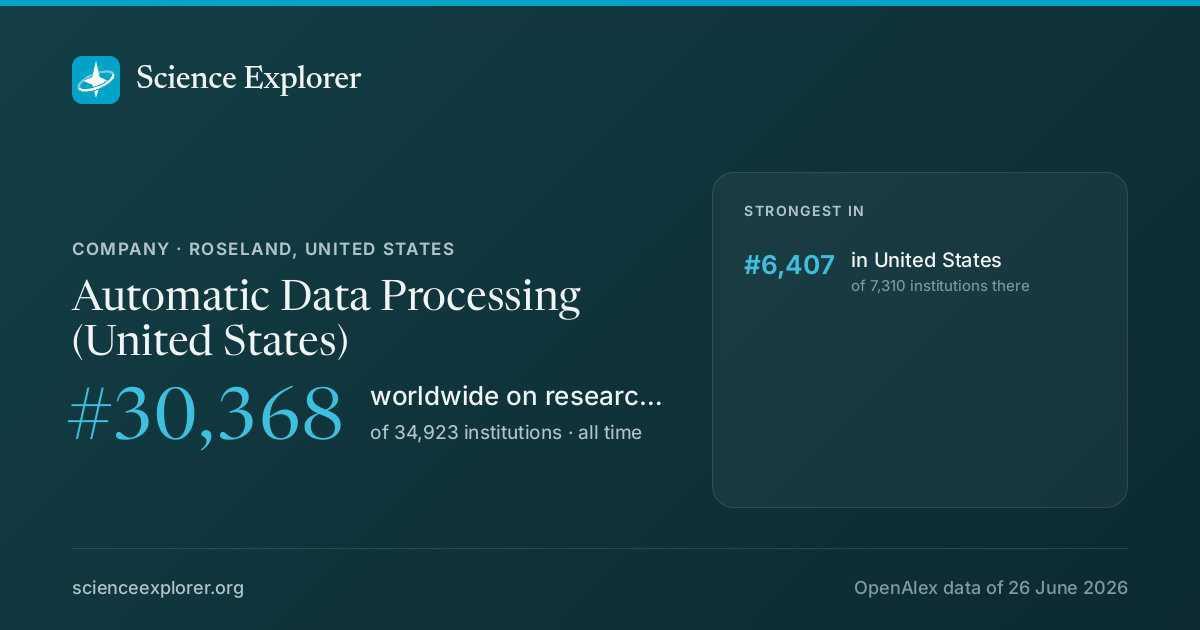
Automatic Data Processing (United States) on Science Explorer

A card with Automatic Data Processing (United States)'s standing and the fields it leads in, for a post or a slide. A link to this page previews as the same card.

Download the card

1200 × 630 PNG, sized for social posts, drawn from the latest snapshot.

Badges for a website1Each links back here and updates with every snapshot

Research measures only: rankings here say nothing about teaching, admissions or student experience. Comparable institutions and collaboration partners have tabs of their own, above.

Discussion

Ask a question or share a note about Automatic Data Processing (United States). Keep it to the research: no personal attacks, advertising or links. Any reader can report a post, which collapses it for everyone until it is opened.
