Science Explorer Back to mapMap
Discussion
Company · Roseland · United States

Emisphere Technologies (United States)

World rank, all time
#32,249
of 34,923
Rank in United States
#6,787
of 7,310
Research works
139
▲ 92% vs 2018-21
Citations
3.9k
27.8 per fractional work
Top-10% rate
20.2%
all institutions 10.0%
vs its own fields
1.00×
1.00× is exactly expected
Open access
14%
world 40%
International
11%
world 18%

Which fields of science does Emisphere Technologies (United States) work in?

In all years, 38% of research at Emisphere Technologies (United States) is in Life Sciences, 32% in Health Sciences. Its largest fields are Medicine (29%), Biochemistry, Genetics and Molecular Biology (22%), Pharmacology, Toxicology and Pharmaceutics (11%). It does 2.4× the world's share of Life Sciences.

Life Sciences: 53 fractional works · 38.4% of its workBiochemistry, Genetics and Molecular Biology: 31 fractional works · 22.0% of its workMolecular Biology: 24 fractional works · 17.5% of its workCell Biology: 2 fractional works · 1.6% of its workGenetics: 1 fractional works · 1.0% of its workMolecular Medicine: 1 fractional works · 0.7% of its workBiotechnology: 0 fractional works · 0.4% of its workBiophysics: 0 fractional works · 0.2% of its workCancer Research: 0 fractional works · 0.2% of its workClinical Biochemistry: 0 fractional works · 0.2% of its workSmaller subfields together: 0 fractional works · 0.1% of its workPharmacology, Toxicology and Pharmaceutics: 16 fractional works · 11.4% of its workPharmaceutical Science: 16 fractional works · 11.1% of its workPharmacology: 0 fractional works · 0.2% of its workAgricultural and Biological Sciences: 4 fractional works · 2.8% of its workFood Science: 2 fractional works · 1.4% of its workPlant Science: 2 fractional works · 1.1% of its workSmaller subfields together: 0 fractional works · 0.3% of its workNeuroscience: 2 fractional works · 1.2% of its workCellular and Molecular Neuroscience: 1 fractional works · 0.8% of its workNeurology: 0 fractional works · 0.2% of its workSmaller subfields together: 0 fractional works · 0.2% of its workImmunology and Microbiology: 1 fractional works · 1.0% of its workImmunology: 1 fractional works · 0.9% of its workSmaller subfields together: 0 fractional works · 0.2% of its workHealth Sciences: 44 fractional works · 31.6% of its workMedicine: 41 fractional works · 29.2% of its workOncology: 9 fractional works · 6.6% of its workSurgery: 5 fractional works · 3.3% of its workEndocrinology, Diabetes and Metabolism: 3 fractional works · 2.4% of its workPulmonary and Respiratory Medicine: 3 fractional works · 2.0% of its workRadiology, Nuclear Medicine and Imaging: 2 fractional works · 1.6% of its workCardiology and Cardiovascular Medicine: 2 fractional works · 1.5% of its workPhysiology: 2 fractional works · 1.4% of its workEpidemiology: 2 fractional works · 1.3% of its workRheumatology: 2 fractional works · 1.2% of its workHematology: 2 fractional works · 1.1% of its workInternal Medicine: 1 fractional works · 1.0% of its workPharmacology: 1 fractional works · 1.0% of its workInfectious Diseases: 1 fractional works · 0.8% of its workPediatrics, Perinatology and Child Health: 1 fractional works · 0.8% of its workNeurology: 1 fractional works · 0.7% of its workImmunology and Allergy: 1 fractional works · 0.4% of its workOrthopedics and Sports Medicine: 0 fractional works · 0.4% of its workEmergency Medicine: 0 fractional works · 0.3% of its workPublic Health, Environmental and Occupational Health: 0 fractional works · 0.3% of its workHepatology: 0 fractional works · 0.3% of its workDermatology: 0 fractional works · 0.2% of its workPathology and Forensic Medicine: 0 fractional works · 0.2% of its workSmaller subfields together: 0 fractional works · 0.2% of its workNursing: 2 fractional works · 1.1% of its workNutrition and Dietetics: 2 fractional works · 1.1% of its workHealth Professions: 1 fractional works · 0.8% of its workHealth Information Management: 1 fractional works · 0.5% of its workEmergency Medical Services: 0 fractional works · 0.2% of its workSmaller subfields together: 0 fractional works · 0.1% of its workDentistry: 0 fractional works · 0.2% of its workPeriodontics: 0 fractional works · 0.2% of its workVeterinary: 0 fractional works · 0.2% of its workSmall Animals: 0 fractional works · 0.2% of its workPhysical Sciences: 37 fractional works · 26.8% of its workEngineering: 11 fractional works · 8.1% of its workBiomedical Engineering: 6 fractional works · 4.5% of its workAerospace Engineering: 2 fractional works · 1.4% of its workMechanical Engineering: 2 fractional works · 1.2% of its workElectrical and Electronic Engineering: 1 fractional works · 0.5% of its workSmaller subfields together: 1 fractional works · 0.5% of its workChemistry: 10 fractional works · 7.1% of its workOrganic Chemistry: 6 fractional works · 4.2% of its workSpectroscopy: 2 fractional works · 1.4% of its workAnalytical Chemistry: 1 fractional works · 0.8% of its workPhysical and Theoretical Chemistry: 1 fractional works · 0.5% of its workInorganic Chemistry: 0 fractional works · 0.2% of its workMaterials Science: 6 fractional works · 4.3% of its workBiomaterials: 4 fractional works · 2.7% of its workMaterials Chemistry: 1 fractional works · 1.0% of its workSurfaces, Coatings and Films: 0 fractional works · 0.2% of its workSmaller subfields together: 0 fractional works · 0.3% of its workEnvironmental Science: 3 fractional works · 2.1% of its workEcology: 1 fractional works · 0.7% of its workGlobal and Planetary Change: 0 fractional works · 0.3% of its workHealth, Toxicology and Mutagenesis: 0 fractional works · 0.3% of its workIndustrial and Manufacturing Engineering: 0 fractional works · 0.2% of its workSmaller subfields together: 1 fractional works · 0.5% of its workEarth and Planetary Sciences: 3 fractional works · 2.1% of its workAtmospheric Science: 2 fractional works · 1.6% of its workOceanography: 1 fractional works · 0.5% of its workComputer Science: 2 fractional works · 1.4% of its workArtificial Intelligence: 1 fractional works · 0.6% of its workComputer Vision and Pattern Recognition: 1 fractional works · 0.4% of its workComputational Theory and Mathematics: 0 fractional works · 0.2% of its workComputer Networks and Communications: 0 fractional works · 0.2% of its workPhysics and Astronomy: 1 fractional works · 1.0% of its workAstronomy and Astrophysics: 1 fractional works · 0.5% of its workAtomic and Molecular Physics, and Optics: 0 fractional works · 0.4% of its workSmaller subfields together: 0 fractional works · 0.2% of its workEnergy: 1 fractional works · 0.5% of its workNuclear Energy and Engineering: 0 fractional works · 0.2% of its workEnergy Engineering and Power Technology: 0 fractional works · 0.2% of its workChemical Engineering: 0 fractional works · 0.2% of its workMathematics: 0 fractional works · 0.1% of its workSocial Sciences: 4 fractional works · 3.2% of its workSocial Sciences: 2 fractional works · 1.2% of its workSociology and Political Science: 1 fractional works · 0.5% of its workPolitical Science and International Relations: 0 fractional works · 0.3% of its workSmaller subfields together: 0 fractional works · 0.4% of its workDecision Sciences: 1 fractional works · 0.8% of its workManagement Science and Operations Research: 1 fractional works · 0.5% of its workStatistics, Probability and Uncertainty: 0 fractional works · 0.4% of its workEconomics, Econometrics and Finance: 1 fractional works · 0.5% of its workEconomics and Econometrics: 1 fractional works · 0.5% of its workArts and Humanities: 0 fractional works · 0.3% of its workLiterature and Literary Theory: 0 fractional works · 0.3% of its workSmaller subfields together: 0 fractional works · 0.0% of its workBusiness, Management and Accounting: 0 fractional works · 0.2% of its workManagement of Technology and Innovation: 0 fractional works · 0.2% of its workPsychology: 0 fractional works · 0.1% of its workALL ITS WORKEmisphereTechnologies…139fractional works, all years
Life Sciences38%Physical Sciences27%Health Sciences32%Social Sciences3%

Each ring splits the one inside it: the four domains of science, their fields, their subfields. Size is fractional works in all years. Every slice is a page; the interactive view zooms down to single topics and colours each by how much more of it this institution does than the world.

Its 4 domains and 26 fields, with their numbers
    1. Biochemistry, Genetics and Molecular Biology3122.0%
    2. Pharmacology, Toxicology and Pharmaceutics1611.4%
    3. Agricultural and Biological Sciences42.8%
    4. Neuroscience21.2%
    5. Immunology and Microbiology11.0%
    1. Medicine4129.2%
    2. Nursing21.1%
    3. Health Professions10.8%
    4. Dentistry00.2%
    5. Veterinary00.2%
    1. Engineering118.1%
    2. Chemistry107.1%
    3. Materials Science64.3%
    4. Environmental Science32.1%
    5. Earth and Planetary Sciences32.1%
    6. Computer Science21.4%
    7. Physics and Astronomy11.0%
    8. Energy10.5%
    9. Chemical Engineering00.2%
    10. Mathematics00.1%
    1. Social Sciences21.2%
    2. Decision Sciences10.8%
    3. Economics, Econometrics and Finance10.5%
    4. Arts and Humanities00.3%
    5. Business, Management and Accounting00.2%
    6. Psychology00.1%
All of science, and how each field's share has moved since 1950: the Science domain explorer

Field profile

Location quotient across every field it publishes in: outside the ring is more than an institution of this size would be expected to publish, inside it is less.

Agricultural and Biological Sciences: 0.43× its world share, 0 worksAgricultural and Bio…Immunology and Microbiology: 0.67× its world share, 0 worksImmunology and Micro…Computer Science: 2.99× its world share, 1 worksComputer ScienceEarth and Planetary Sciences: 3.90× its world share, 0 worksEarth and Planetary …Engineering: 1.24× its world share, 1 worksEngineeringEnvironmental Science: 1.64× its world share, 0 worksEnvironmental SciencePhysics and Astronomy: 1.03× its world share, 0 worksPhysics and AstronomyHealth Professions: 4.64× its world share, 1 worksHealth ProfessionsMedicine: 0.47× its world share, 0 worksMedicineDecision Sciences: 12.65× its world share, 1 worksDecision SciencesSocial Sciences: 0.42× its world share, 0 worksSocial Sciences1×world share
more than its size predictsabout as predictedless

Rings at 0.5×, 1× and 2×. Widest outward: Decision Sciences, 12.7×. Every wedge is a field page.

All 11 fields, with their numbers
  1. Decision Sciences12.65×1 works
  2. Health Professions4.64×1 works
  3. Earth and Planetary Sciences3.90×0 works
  4. Computer Science2.99×1 works
  5. Environmental Science1.64×0 works
  6. Engineering1.24×1 works
  7. Physics and Astronomy1.03×0 works
  8. Immunology and Microbiology0.67×0 works
  9. Medicine0.47×0 works
  10. Agricultural and Biological Sciences0.43×0 works
  11. Social Sciences0.42×0 works

Who are the top researchers at Emisphere Technologies (United States)?

Ranked on the quality score, Isabel Gómez-Orellana, Duncan R. Paton and Frenel DeMorin lead among researchers whose main affiliation is Emisphere Technologies (United States).

  1. 1 Isabel Gómez-Orellana United States · #2,716,943 worldwide 1.2k citations · 19 works
  2. 2 Duncan R. Paton United States · #3,755,008 worldwide 622 citations · 18 works
  3. 3 Frenel DeMorin United States · #3,825,172 worldwide 359 citations · 16 works
  4. 4 Doris C. O'Toole United States · #3,939,895 worldwide 231 citations · 15 works
  5. 5 Steven M. Dinh United States · #4,239,401 worldwide 1.3k citations · 45 works
  6. 6 R Baughman United States · #4,280,356 worldwide 2k citations · 90 works
  7. 7 Andrea Leone‐Bay United States · #4,878,228 worldwide 1.3k citations · 61 works
  8. 8 Mariacristina Castelli United States · #5,002,081 worldwide 525 citations · 30 works
  9. 9 Sam Milstein United States · #5,078,522 worldwide 546 citations · 33 works
  10. 10 Donald Sarubbi United States · #5,270,763 worldwide 428 citations · 18 works
All ranked researchers at Emisphere Technologies (United States)

What are the most cited papers from Emisphere Technologies (United States)?

The most cited paper from Emisphere Technologies (United States) is "Challenges for the oral delivery of macromolecules" (Michael F. Goldberg, Isabel Gómez-Orellana, 2003), with 548 citations. Next come "Homogeneous detection of unamplified genomic DNA sequences based on colorimetric scatter of gold nanoparticle probes" (547) and "Gold nanoparticle-based detection of genomic DNA targets on microarrays using a novel optical detection system" (265).

Most cited papers
#PaperReleasedCitations
1 Challenges for the oral delivery of macromolecules Michael F. Goldberg, Isabel Gómez-Orellana · Nature Reviews Drug Discovery Review Apr 2003 548
2 Homogeneous detection of unamplified genomic DNA sequences based on colorimetric scatter of gold nanoparticle probes James Justin Storhoff, Adam Lucas, G. Viswanadham et al. · Nature Biotechnology Open access 30 May 2004 547
3 Gold nanoparticle-based detection of genomic DNA targets on microarrays using a novel optical detection system James Justin Storhoff, Sudhakar S. Marla, Paul Bao et al. · Biosensors and Bioelectronics 27 Oct 2003 265
4 SNP identification in unamplified human genomic DNA with gold nanoparticle probes Yan-Wen Bao · Nucleic Acids Research Open access 19 Jan 2005 168
5 Executive summary. The National Academy of Clinical Biochemistry Laboratory Medicine Practice Guideline: Evidence-based practice for point-of-care testing James H. Nichols, Robert H. Christenson, William Clarke et al. · Clinica Chimica Acta 16 Jan 2007 168
All 60 most cited papers, with filters and sorting

Which keywords describe research at Emisphere Technologies (United States)?

By fractional works in all years, weighted toward what it does more of than the world: Nanoparticles, Drug Delivery, Protein, Chitosan, Mucosal, Pharmacokinetics, Cyclodextrins and Solid Dispersions.

▲ more of its work than of the world's◆ about the world's share▼ less than the world's

Size is fractional works in all years in the topics tagged with each word; colour is the word's share of this institution's work against its share of the world's. The 40 words are chosen for being large and distinctive. Each links to the topic it comes from most.

All 40 words, with their numbers
  1. Nanoparticles24▲ 13×14 topics
  2. Drug Delivery12▲ 19×6 topics
  3. Protein9▲ 41×2 topics
  4. Chitosan8▲ 105×1 topic
  5. Mucosal8▲ 208×1 topic
  6. Pharmacokinetics6▲ 16×4 topics
  7. Biosensors6▲ 7.5×3 topics
  8. Cyclodextrins6▲ 187×1 topic
  9. Solid Dispersions6▲ 187×1 topic
  10. Biomedical Applications6▲ 3.7×9 topics
  11. Photodynamic Therapy6▲ 25×2 topics
  12. Biospectroscopic Study5▲ 499×1 topic
  13. Cancer Cells5▲ 499×1 topic
  14. Drug Discovery5▲ 8.7×4 topics
  15. Biopharmaceuticals4▲ 46×3 topics
  16. Diagnosis4▲ 3.1×9 topics
  17. Self-Assembly4▲ 8.0×4 topics
  18. Cancer Therapy4▲ 4.8×5 topics
  19. Monoclonal Antibodies4▲ 22×3 topics
  20. High-Throughput Analysis4▲ 65×2 topics
  21. Microfluidic Devices4▲ 36×2 topics
  22. Immunogenicity4▲ 56×3 topics
  23. Recombinant Proteins4▲ 52×2 topics
  24. Lab-on-a-Chip4▲ 20×3 topics
  25. Multiplexed Assays4▲ 138×1 topic
  26. Protein Microarrays4▲ 138×1 topic
  27. Therapeutic Antibodies4▲ 21×2 topics
  28. Biomolecular Interactions4▲ 21×2 topics
  29. Protein Aggregation3▲ 31×1 topic
  30. Stability3▲ 13×1 topic
  31. Point-of-Care Diagnostics3▲ 28×2 topics
  32. Foldamers3▲ 28×1 topic
  33. Peptide Synthesis3▲ 28×1 topic
  34. Hydrogels3▲ 16×3 topics
  35. DNA nanotechnology3▲ 21×1 topic
  36. aptamers3▲ 21×1 topic
  37. Tumor Targeting3▲ 16×2 topics
  38. Loop-Mediated Isothermal Amplification3▲ 54×1 topic
  39. Nanocarriers3▲ 46×1 topic
  40. Paper-Based Microfluidics3▲ 54×1 topic

Which research topics does Emisphere Technologies (United States) publish most on?

By volume in 2022-now: Data Quality and Management, Electronic Health Records Systems, Data Analysis with R and Video Analysis and Summarization.

  1. 1 Data Quality and Management Management Science and Operations Research 1 works
  2. 2 Electronic Health Records Systems Health Information Management 1 works
  3. 3 Data Analysis with R Artificial Intelligence 1 works
  4. 4 Video Analysis and Summarization Computer Vision and Pattern Recognition 0 works
  5. 5 Marine and coastal ecosystems Oceanography 0 works
  6. 6 Water Quality Monitoring and Analysis Industrial and Manufacturing Engineering 0 works
  7. 7 Calibration and Measurement Techniques Aerospace Engineering 0 works
  8. 8 Reproductive Biology and Fertility Public Health, Environmental and Occupational Health 0 works
  9. 9 Advanced Optical Sensing Technologies Instrumentation 0 works
  10. 10 CCD and CMOS Imaging Sensors Electrical and Electronic Engineering 0 works

How open and international is its research?

Against the world's own shares: the tick on each track. Both are shares of its output, so they sit on one scale and can be read against each other as well as against the world.

openly available13.7%not open86.3%

World: 40% of research is openly available.

with international co-authors11.2%domestic only88.8%

World: 18% is written across borders.

How has Emisphere Technologies (United States)'s research output changed?

Output in 2022-2025 was 92% higher than in 2018-2021.

still counting200020102020
grewheldshrank

The same series as a ribbon: one cell per year, darker for more. The line above answers how much; this answers when.

Its share of all research

Growing output can still be a shrinking share: all of science grows. This is Emisphere Technologies (United States) as a percentage of every work published that year, 0.0000042% in 2024.

still counting0.00050%0.0010%0.0015%Emisphere Technologies (United States)0.000059% in 2025200020102020

Fractional works of Emisphere Technologies (United States) over all fractional works that year. How the balance of science has shifted.

Other research institutions in Roseland

All research institutions in Roseland

Share Emisphere Technologies (United States)'s ranking
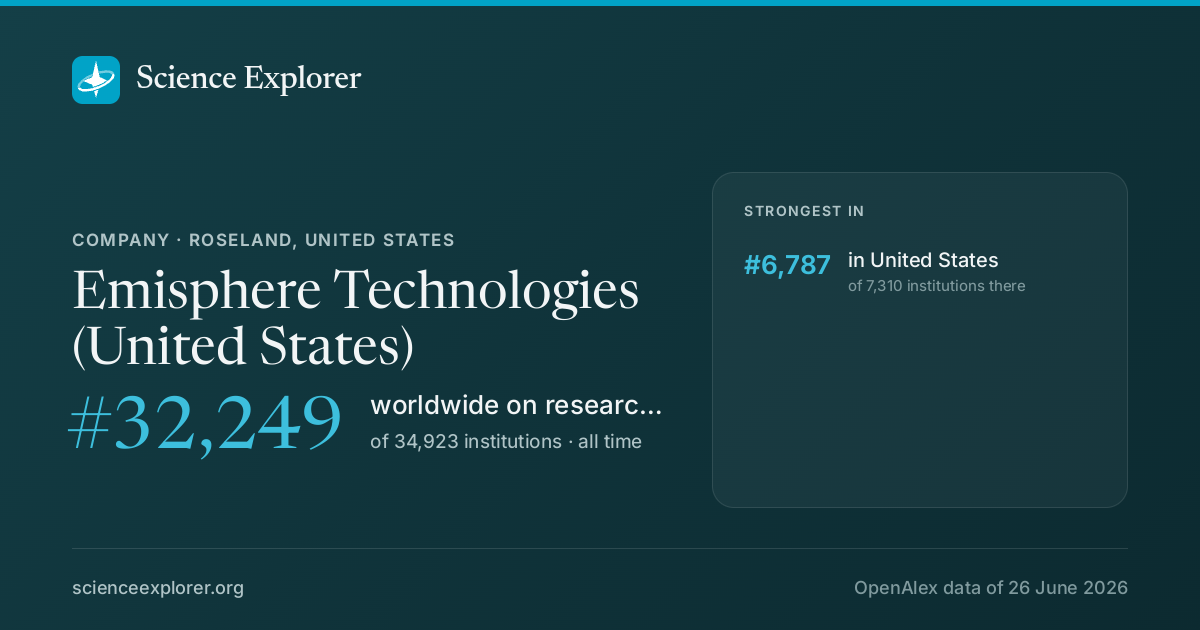
Emisphere Technologies (United States) on Science Explorer

A card with Emisphere Technologies (United States)'s standing and the fields it leads in, for a post or a slide. A link to this page previews as the same card.

Download the card

1200 × 630 PNG, sized for social posts, drawn from the latest snapshot.

Badges for a website1Each links back here and updates with every snapshot

Research measures only: rankings here say nothing about teaching, admissions or student experience. Comparable institutions and collaboration partners have tabs of their own, above.

Discussion

Ask a question or share a note about Emisphere Technologies (United States). Keep it to the research: no personal attacks, advertising or links. Any reader can report a post, which collapses it for everyone until it is opened.
