Bank Indonesia
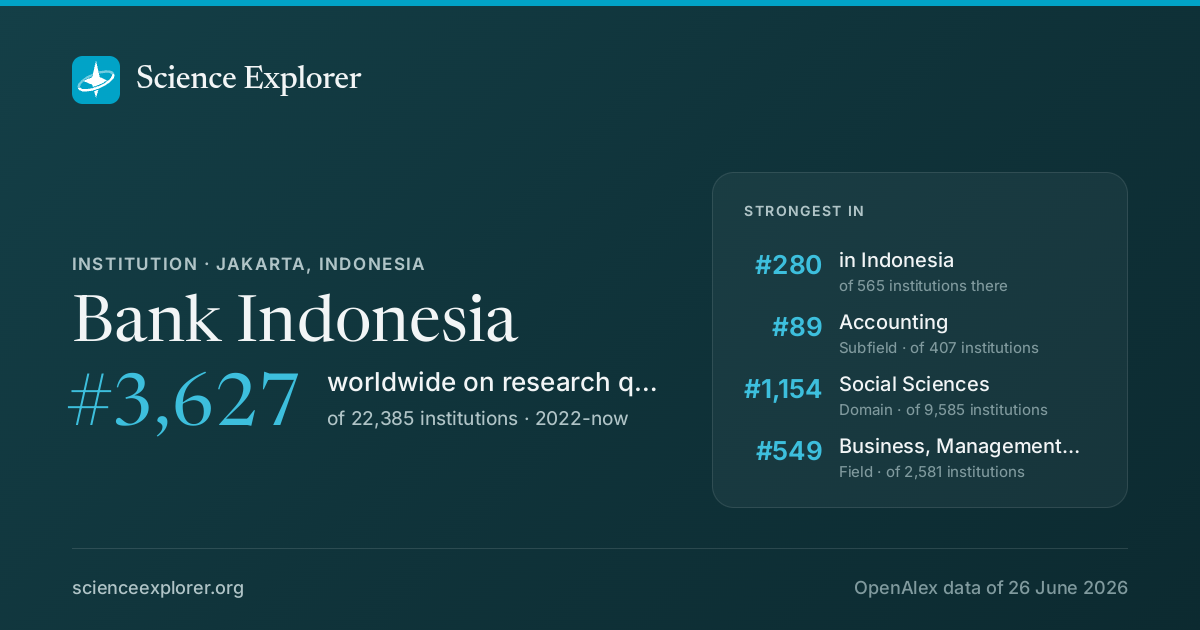
In research, Bank Indonesia stands highest in Social Sciences (#1,154 of 9,585 worldwide), Business, Management and Accounting (#549 of 2,581 worldwide) and Accounting (#89 of 407 worldwide), 2022-now. Relative to its size it is most specialised in Human Factors and Ergonomics, Accounting and Demography (Human Factors and Ergonomics is 25.7× its share of world research).
- World rank, 2022-now
- #3,627 of 22,385 · #5,976 all time
- Rank in Indonesia
- #280 of 565
- Research works
- 2.8k ▲ 67% vs 2018-21
- Citations
- 12k 4.4 per fractional work
- Top-10% rate
- 9.4% all institutions 10.0%
- vs its own fields
- 0.70× 1.00× is exactly expected
- Open access
- 87% world 40%
- International
- 10% world 18%
What is Bank Indonesia known for in research?
The fields where it stands highest, 2022-now, ranked among every institution above the floor in each field.
| Field | World rank | Where that sits | Top-10% rate | Works | All time |
|---|---|---|---|---|---|
| Social SciencesDomain | #1,154 of 9,585 | 9.9% | 1,029 | #1510 | |
| Business, Management and AccountingField | #549 of 2,581 | 8.6% | 448 | #766 | |
| AccountingSubfield | #89 of 407 | 8.6% | 207 | #204 | |
| Social SciencesField | #1,364 of 5,988 | 11.6% | 412 | #1750 | |
| DemographySubfield | #104 of 434 | 14.1% | 141 | #246 | |
| Economics, Econometrics and FinanceField | #589 of 1,798 | 10.8% | 133 | #853 | |
| Strategy and ManagementSubfield | #300 of 668 | 7.3% | 96 | #736 | |
| Physical SciencesDomain | #4,794 of 10,670 | 8.3% | 170 | #8746 | |
| Economics and EconometricsSubfield | #618 of 1,307 | 11.4% | 93 | #830 | |
| Sociology and Political ScienceSubfield | #1,288 of 2,526 | 9.4% | 133 | #1415 |
Each strip is that field's whole ranked pool, with the notch where Bank Indonesia sits in it, in the colour of the band that rank falls in. The track under the rate is the rate itself: it carries no average mark, because the average differs by field (from about 6% in Dentistry to 21% in Economics).
Which of those standings moved
The same fields on both windows: where it stood over the whole record, and where it stands in 2022-now. The distance is the story, and it is the one thing the two rank columns above cannot show.
- Social Sciences#1,510 #1,154
- Business, Management and Accounting#766 #549
- Accounting#204 #89
- Social Sciences#1,750 #1,364
- Demography#246 #104
- Economics, Econometrics and Finance#853 #589
- Strategy and Management#736 #300
- Physical Sciences#8,746 #4,794
- Economics and Econometrics#830 #618
- Sociology and Political Science#1,415 #1,288
A dot further right is a better standing. Fields it was not ranked in over the whole record are left out.
Which fields of science does Bank Indonesia work in?
In 2022-now, 78% of research at Bank Indonesia is in Social Sciences, 13% in Physical Sciences. Its largest fields are Business, Management and Accounting (34%), Social Sciences (31%), Economics, Econometrics and Finance (10%). It does 3.1× the world's share of Social Sciences.
Each ring splits the one inside it: the four domains of science, their fields, their subfields. Size is fractional works in 2022-now. Every slice is a page; the interactive view zooms down to single topics and colours each by how much more of it this institution does than the world.
Its 4 domains and 24 fields, with their numbers
- Social Sciences1,11777.9%
- Business, Management and Accounting49134.2%
- Social Sciences44130.7%
- Economics, Econometrics and Finance1429.9%
- Decision Sciences221.5%
- Arts and Humanities161.1%
- Psychology60.4%
- Physical Sciences18512.9%
- Computer Science775.3%
- Engineering634.4%
- Environmental Science271.9%
- Energy70.5%
- Materials Science40.3%
- Earth and Planetary Sciences30.2%
- Physics and Astronomy20.1%
- Mathematics20.1%
- Chemistry10.1%
- Chemical Engineering00.0%
- Health Sciences916.3%
- Health Professions714.9%
- Medicine181.3%
- Nursing20.1%
- Life Sciences412.9%
What does Bank Indonesia specialise in?
Where its research is concentrated relative to its size: Human Factors and Ergonomics takes 25.7× the share of its output that it takes of world research.
- Human Factors and ErgonomicsSubfield · 41.0 works26×
- AccountingSubfield · 221.5 works25×
- DemographySubfield · 144.0 works15×
- Business, Management and AccountingField · 490.7 works11×
- MarketingSubfield · 62.0 works10×
- Organizational Behavior and Human Resource ManagementSubfield · 62.5 works9.1×
- Strategy and ManagementSubfield · 101.0 works8.1×
- Health Information ManagementSubfield · 28.2 works7.7×
Location quotient, a volume reading rather than an impact one. It surfaces small, lopsided specialities.
Field profile
Location quotient across every field it publishes in: outside the ring is more than an institution of this size would be expected to publish, inside it is less.
Rings at 0.5×, 1× and 2×. Widest outward: Business, Management and Accounting, 10.6×. Every wedge is a field page.
All 24 fields, with their numbers
- Business, Management and Accounting10.62×491 works
- Economics, Econometrics and Finance4.62×142 works
- Social Sciences2.43×441 works
- Health Professions1.88×71 works
- Decision Sciences1.56×22 works
- Computer Science0.69×77 works
- Energy0.57×8 works
- Agricultural and Biological Sciences0.55×38 works
- Arts and Humanities0.39×16 works
- Environmental Science0.38×27 works
- Engineering0.29×63 works
- Nursing0.27×2 works
- Earth and Planetary Sciences0.14×3 works
- Psychology0.13×6 works
- Mathematics0.09×2 works
- Materials Science0.07×4 works
- Medicine0.07×18 works
- Neuroscience0.06×2 works
- Physics and Astronomy0.06×2 works
- Chemistry0.04×1 works
- Pharmacology, Toxicology and Pharmaceutics0.03×0 works
- Chemical Engineering0.03×0 works
- Biochemistry, Genetics and Molecular Biology0.02×2 works
- Immunology and Microbiology0.01×0 works
- Business, Management and Accounting 10.6×
- Economics, Econometrics and Finance 4.6×
- Social Sciences 2.4×
- Health Professions 1.9×
- Decision Sciences 1.6×
- Computer Science 0.7×
- Energy 0.6×
- Agricultural and Biological Sciences 0.6×
- Arts and Humanities 0.4×
- Environmental Science 0.4×
- Engineering 0.3×
- Nursing 0.3×
- Earth and Planetary Sciences 0.1×
- Psychology 0.1×
- Mathematics 0.1×
- Materials Science 0.1×
- Medicine 0.1×
- Neuroscience 0.1×
- Physics and Astronomy 0.1×
- Chemistry 0.0×
- Pharmacology, Toxicology and Pharmaceutics 0.0×
- Chemical Engineering 0.0×
- Biochemistry, Genetics and Molecular Biology 0.0×
- Immunology and Microbiology 0.0×
Who are the top researchers at Bank Indonesia?
Ranked on the quality score, Vivi Alatas, Solikin M. Juhro and Masagus M. Ridhwan lead among researchers whose main affiliation is Bank Indonesia.
- 1
Vivi Alatas
 Indonesia · #208,644 worldwide
1.8k citations · 325 works
- 2
Solikin M. Juhro
Indonesia · #574,016 worldwide
849 citations · 128 works
- 3
Masagus M. Ridhwan
Indonesia · #708,756 worldwide
339 citations · 46 works
- 4
Ali Mursid
Indonesia · #983,266 worldwide
355 citations · 34 works
- 5
Yoga Affandi
Indonesia · #1,095,625 worldwide
612 citations · 21 works
- 6
Scott Guggenheim
Indonesia · #1,430,340 worldwide
1.1k citations · 35 works
- 7
Donni Fajar Anugrah
Indonesia · #1,434,067 worldwide
229 citations · 15 works
- 8
Wimboh Santoso
Indonesia · #1,476,250 worldwide
497 citations · 37 works
- 9
Ascarya
Indonesia · #1,581,885 worldwide
697 citations · 36 works
- 10
Adiwarman A. Karim
Indonesia · #1,697,260 worldwide
1.3k citations · 30 works
Which keywords describe research at Bank Indonesia?
By fractional works in 2022-now, weighted toward what it does more of than the world: Corporate Governance, Social Media, Financial Performance, E-commerce, Islamic Banking, COVID-19, Pandemic and Indonesia.
- Job Satisfaction
- Ethical Identity
- Performance Analysis
- Hoax Communication
- Financial Stability
- Leadership
- Risk Management
- Investment Analysis
- Digital Literacy
- Market Analysis
- Capital Structure
- Media Literacy
- Stock Market
- Customer Satisfaction
- Consumer Behavior
- Economic Impact
- Indonesia
- COVID-19
- E-commerce
- Social Media
- Corporate Governance
- Financial Performance
- Islamic Banking
- Pandemic
- SMEs
- Digital Marketing
- UMKM
- Community Empowerment
- Profitability
- Corporate Finance
- Supply Chain Management
- Financial Analysis
- Finance
- Portfolio Management
- Pandemic Response
- Service Quality
- Cultural Identity
- Youth Engagement
- Global Financial Crisis
- Shariah Supervision
Size is fractional works in 2022-now in the topics tagged with each word; colour is the word's share of this institution's work against its share of the world's. The 40 words are chosen for being large and distinctive. Each links to the topic it comes from most.
All 40 words, with their numbers
- Corporate Governance280▲ 27×16 topics
- Social Media233▲ 12×14 topics
- Financial Performance216▲ 27×11 topics
- E-commerce182▲ 22×8 topics
- Islamic Banking173▲ 32×3 topics
- COVID-19154▲ 8.3×12 topics
- Pandemic152▲ 11×8 topics
- Indonesia142▲ 23×5 topics
- SMEs141▲ 30×4 topics
- Economic Impact140▲ 18×4 topics
- Digital Marketing136▲ 24×2 topics
- Consumer Behavior136▲ 15×12 topics
- UMKM135▲ 35×1 topic
- Customer Satisfaction110▲ 24×7 topics
- Community Empowerment109▲ 11×10 topics
- Stock Market106▲ 33×3 topics
- Profitability95▲ 55×3 topics
- Media Literacy95▲ 13×3 topics
- Corporate Finance95▲ 59×2 topics
- Capital Structure93▲ 43×2 topics
- Supply Chain Management91▲ 7.1×19 topics
- Market Analysis91▲ 59×2 topics
- Financial Analysis90▲ 56×3 topics
- Digital Literacy90▲ 11×6 topics
- Finance90▲ 34×4 topics
- Investment Analysis90▲ 84×1 topic
- Portfolio Management90▲ 84×1 topic
- Risk Management89▲ 13×12 topics
- Pandemic Response88▲ 27×3 topics
- Leadership86▲ 12×8 topics
- Service Quality85▲ 22×6 topics
- Financial Stability84▲ 30×5 topics
- Cultural Identity83▲ 12×2 topics
- Hoax Communication82▲ 38×1 topic
- Youth Engagement82▲ 26×1 topic
- Performance Analysis79▲ 27×3 topics
- Global Financial Crisis79▲ 43×2 topics
- Ethical Identity79▲ 48×1 topic
- Shariah Supervision79▲ 48×1 topic
- Job Satisfaction78▲ 12×8 topics
Which research topics does Bank Indonesia publish most on?
By volume in 2022-now: SMEs Development and Digital Marketing, Financial Analysis and Corporate Governance, Islamic Finance and Communication and Islamic Finance and Banking Studies.
Area is fractional works; colour is the subfield each topic belongs to.
- 1 SMEs Development and Digital Marketing Demography 135 works
- 2 Financial Analysis and Corporate Governance Accounting 90 works
- 3 Islamic Finance and Communication Sociology and Political Science 82 works
- 4 Islamic Finance and Banking Studies Accounting 79 works
- 5 Consumer Behavior and Marketing Influence Marketing 52 works
- 6 Corporate Governance and Financial Management Strategy and Management 49 works
- 7 Employee Performance and Management Human Factors and Ergonomics 41 works
- 8 Economic Growth and Fiscal Policies Economics and Econometrics 39 works
- 9 Employee Performance and Leadership Organizational Behavior and Human Resource Management 34 works
- 10 Management and Optimization Techniques Strategy and Management 32 works
How open and international is its research?
Against the world's own shares: the tick on each track. Both are shares of its output, so they sit on one scale and can be read against each other as well as against the world.
World: 40% of research is openly available.
World: 18% is written across borders.
How has Bank Indonesia's research output changed?
Output in 2022-2025 was 67% higher than in 2018-2021.
The same series as a ribbon: one cell per year, darker for more. The line above answers how much; this answers when.
Its share of all research
Growing output can still be a shrinking share: all of science grows. This is Bank Indonesia as a percentage of every work published that year, 0.0053% in 2024.
Fractional works of Bank Indonesia over all fractional works that year. How the balance of science has shifted.
How much of it reaches the world top 10%
Year by year, against all institutions in the same year.
Of each year's output, the share that reached the world's 10% most cited for its field and year. Peak 15.8% in 2013.
Other research institutions in Jakarta
- Binus University
- State University of Jakarta
- Tarumanagara University
- Universitas Trisakti
- Mercu Buana University
- Universitas Nahdlatul Ulama Indonesia
- Indonesian Institute of Sciences
- Universitas Indraprasta PGRI


Share Bank Indonesia's ranking
Badges for a website1Each links back here and updates with every snapshot

Research measures only: rankings here say nothing about teaching, admissions or student experience. Comparable institutions and collaboration partners have tabs of their own, above.
Discussion
Ask a question or share a note about Bank Indonesia. Posts are plain text and can be reported.