Science Explorer Back to mapMap
Discussion
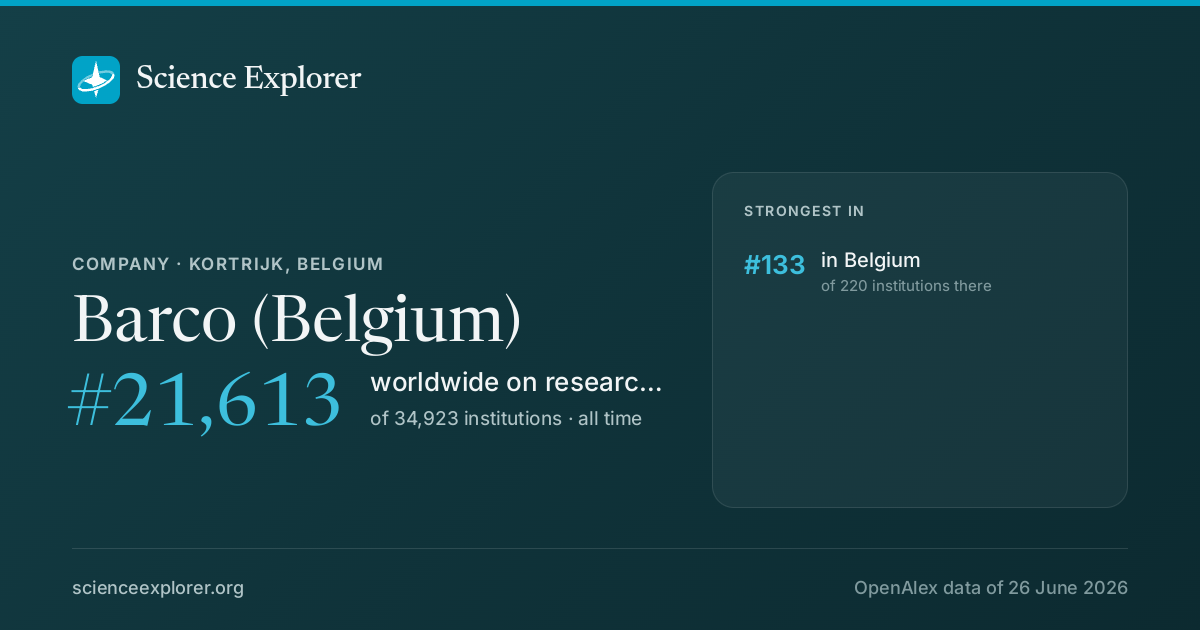
Company · Kortrijk · Belgium

Barco (Belgium)

World rank, all time
#21,613
of 34,923
Rank in Belgium
#133
of 220
Research works
221
▲ 23% vs 2018-21
Citations
2.3k
10.6 per fractional work
Top-10% rate
6.8%
all institutions 10.0%
vs its own fields
0.88×
1.00× is exactly expected
Open access
36%
world 40%
International
39%
world 18%

Which fields of science does Barco (Belgium) work in?

In 2022-now, 46% of research at Barco (Belgium) is in Physical Sciences, 29% in Health Sciences. Its largest fields are Medicine (26%), Engineering (19%), Computer Science (9%).

Physical Sciences: 18 fractional works · 45.5% of its workEngineering: 7 fractional works · 18.9% of its workBiomedical Engineering: 3 fractional works · 7.6% of its workMedia Technology: 2 fractional works · 3.9% of its workElectrical and Electronic Engineering: 1 fractional works · 2.8% of its workComputational Mechanics: 1 fractional works · 2.2% of its workAutomotive Engineering: 0 fractional works · 1.0% of its workAerospace Engineering: 0 fractional works · 0.4% of its workMechanics of Materials: 0 fractional works · 0.4% of its workIndustrial and Manufacturing Engineering: 0 fractional works · 0.3% of its workMechanical Engineering: 0 fractional works · 0.3% of its workComputer Science: 4 fractional works · 9.3% of its workArtificial Intelligence: 2 fractional works · 4.2% of its workComputer Vision and Pattern Recognition: 1 fractional works · 2.2% of its workComputer Graphics and Computer-Aided Design: 0 fractional works · 0.9% of its workComputer Networks and Communications: 0 fractional works · 0.9% of its workComputational Theory and Mathematics: 0 fractional works · 0.4% of its workHuman-Computer Interaction: 0 fractional works · 0.4% of its workSignal Processing: 0 fractional works · 0.3% of its workEarth and Planetary Sciences: 2 fractional works · 4.8% of its workGeophysics: 1 fractional works · 3.5% of its workEarth-Surface Processes: 0 fractional works · 0.4% of its workGeochemistry and Petrology: 0 fractional works · 0.4% of its workPaleontology: 0 fractional works · 0.4% of its workMaterials Science: 2 fractional works · 3.9% of its workBiomaterials: 1 fractional works · 3.3% of its workSurfaces, Coatings and Films: 0 fractional works · 0.3% of its workMaterials Chemistry: 0 fractional works · 0.2% of its workSmaller subfields together: 0 fractional works · 0.1% of its workPhysics and Astronomy: 1 fractional works · 3.3% of its workAtomic and Molecular Physics, and Optics: 1 fractional works · 3.3% of its workEnvironmental Science: 1 fractional works · 3.2% of its workManagement, Monitoring, Policy and Law: 1 fractional works · 1.7% of its workEcology: 0 fractional works · 0.6% of its workHealth, Toxicology and Mutagenesis: 0 fractional works · 0.4% of its workEnvironmental Engineering: 0 fractional works · 0.2% of its workSmaller subfields together: 0 fractional works · 0.2% of its workChemistry: 1 fractional works · 2.1% of its workPhysical and Theoretical Chemistry: 1 fractional works · 1.7% of its workOrganic Chemistry: 0 fractional works · 0.3% of its workHealth Sciences: 11 fractional works · 28.7% of its workMedicine: 10 fractional works · 25.7% of its workSurgery: 2 fractional works · 4.7% of its workPulmonary and Respiratory Medicine: 1 fractional works · 3.7% of its workPublic Health, Environmental and Occupational Health: 1 fractional works · 3.6% of its workRadiology, Nuclear Medicine and Imaging: 1 fractional works · 3.5% of its workGenetics: 1 fractional works · 1.4% of its workOphthalmology: 0 fractional works · 1.3% of its workOncology: 0 fractional works · 1.2% of its workEpidemiology: 0 fractional works · 1.0% of its workHealth Informatics: 0 fractional works · 0.9% of its workPsychiatry and Mental health: 0 fractional works · 0.8% of its workPhysiology: 0 fractional works · 0.7% of its workRheumatology: 0 fractional works · 0.5% of its workGastroenterology: 0 fractional works · 0.4% of its workDermatology: 0 fractional works · 0.4% of its workInternal Medicine: 0 fractional works · 0.3% of its workPathology and Forensic Medicine: 0 fractional works · 0.2% of its workReproductive Medicine: 0 fractional works · 0.2% of its workSmaller subfields together: 0 fractional works · 0.9% of its workHealth Professions: 0 fractional works · 1.3% of its workGeneral Health Professions: 0 fractional works · 0.9% of its workSpeech and Hearing: 0 fractional works · 0.3% of its workSmaller subfields together: 0 fractional works · 0.1% of its workVeterinary: 0 fractional works · 1.2% of its workSmall Animals: 0 fractional works · 1.2% of its workDentistry: 0 fractional works · 0.4% of its workOral Surgery: 0 fractional works · 0.4% of its workLife Sciences: 6 fractional works · 16.0% of its workBiochemistry, Genetics and Molecular Biology: 4 fractional works · 9.1% of its workGenetics: 1 fractional works · 3.1% of its workMolecular Biology: 1 fractional works · 2.9% of its workCell Biology: 0 fractional works · 1.3% of its workMolecular Medicine: 0 fractional works · 0.9% of its workBiophysics: 0 fractional works · 0.4% of its workCancer Research: 0 fractional works · 0.4% of its workAgricultural and Biological Sciences: 2 fractional works · 4.7% of its workPlant Science: 1 fractional works · 1.7% of its workInsect Science: 0 fractional works · 1.1% of its workEcology, Evolution, Behavior and Systematics: 0 fractional works · 0.9% of its workFood Science: 0 fractional works · 0.6% of its workSmaller subfields together: 0 fractional works · 0.4% of its workNeuroscience: 1 fractional works · 1.8% of its workNeurology: 0 fractional works · 0.9% of its workCellular and Molecular Neuroscience: 0 fractional works · 0.4% of its workCognitive Neuroscience: 0 fractional works · 0.3% of its workSensory Systems: 0 fractional works · 0.2% of its workImmunology and Microbiology: 0 fractional works · 0.4% of its workParasitology: 0 fractional works · 0.2% of its workSmaller subfields together: 0 fractional works · 0.2% of its workSocial Sciences: 4 fractional works · 9.8% of its workSocial Sciences: 2 fractional works · 5.1% of its workUrban Studies: 1 fractional works · 1.5% of its workEducation: 0 fractional works · 0.6% of its workLaw: 0 fractional works · 0.6% of its workSociology and Political Science: 0 fractional works · 0.5% of its workAnthropology: 0 fractional works · 0.4% of its workCommunication: 0 fractional works · 0.4% of its workPolitical Science and International Relations: 0 fractional works · 0.3% of its workSafety Research: 0 fractional works · 0.3% of its workSmaller subfields together: 0 fractional works · 0.3% of its workEconomics, Econometrics and Finance: 1 fractional works · 2.4% of its workEconomics and Econometrics: 1 fractional works · 2.4% of its workBusiness, Management and Accounting: 1 fractional works · 1.6% of its workManagement of Technology and Innovation: 0 fractional works · 1.3% of its workStrategy and Management: 0 fractional works · 0.3% of its workArts and Humanities: 0 fractional works · 0.7% of its workHistory: 0 fractional works · 0.4% of its workLanguage and Linguistics: 0 fractional works · 0.3% of its workALL ITS WORKBarco (Belgium)39fractional works, 2022-now
Life Sciences16%Physical Sciences46%Health Sciences29%Social Sciences10%

Each ring splits the one inside it: the four domains of science, their fields, their subfields. Size is fractional works in 2022-now. Every slice is a page; the interactive view zooms down to single topics and colours each by how much more of it this institution does than the world.

Its 4 domains and 19 fields, with their numbers
    1. Engineering718.9%
    2. Computer Science49.3%
    3. Earth and Planetary Sciences24.8%
    4. Materials Science23.9%
    5. Physics and Astronomy13.3%
    6. Environmental Science13.2%
    7. Chemistry12.1%
    1. Medicine1025.7%
    2. Health Professions01.3%
    3. Veterinary01.2%
    4. Dentistry00.4%
    1. Biochemistry, Genetics and Molecular Biology49.1%
    2. Agricultural and Biological Sciences24.7%
    3. Neuroscience11.8%
    4. Immunology and Microbiology00.4%
    1. Social Sciences25.1%
    2. Economics, Econometrics and Finance12.4%
    3. Business, Management and Accounting11.6%
    4. Arts and Humanities00.7%
All of science, and how each field's share has moved since 1950: the Science domain explorer

Field profile

Location quotient across every field it publishes in: outside the ring is more than an institution of this size would be expected to publish, inside it is less.

Agricultural and Biological Sciences: 1.00× its world share, 2 worksAgricultural and Bio…Biochemistry, Genetics and Molecular Biology: 1.71× its world share, 4 worksBiochemistry, Geneti…Immunology and Microbiology: 0.36× its world share, 0 worksImmunology and Micro…Neuroscience: 1.09× its world share, 1 worksNeuroscienceChemistry: 1.32× its world share, 1 worksChemistryComputer Science: 1.20× its world share, 4 worksComputer ScienceEarth and Planetary Sciences: 3.03× its world share, 2 worksEarth and Planetary …Engineering: 1.26× its world share, 7 worksEngineeringEnvironmental Science: 0.64× its world share, 1 worksEnvironmental ScienceMaterials Science: 1.13× its world share, 2 worksMaterials SciencePhysics and Astronomy: 1.49× its world share, 1 worksPhysics and AstronomyDentistry: 0.89× its world share, 0 worksDentistryHealth Professions: 0.49× its world share, 0 worksHealth ProfessionsMedicine: 1.34× its world share, 10 worksMedicineVeterinary: 9.24× its world share, 0 worksVeterinaryArts and Humanities: 0.24× its world share, 0 worksArts and HumanitiesBusiness, Management and Accounting: 0.50× its world share, 1 worksBusiness, Management…Economics, Econometrics and Finance: 1.11× its world share, 1 worksEconomics, Econometr…Social Sciences: 0.40× its world share, 2 worksSocial Sciences1×world share
more than its size predictsabout as predictedless

Rings at 0.5×, 1× and 2×. Widest outward: Veterinary, 9.2×. Every wedge is a field page.

All 19 fields, with their numbers
  1. Veterinary9.24×0 works
  2. Earth and Planetary Sciences3.03×2 works
  3. Biochemistry, Genetics and Molecular Biology1.71×4 works
  4. Physics and Astronomy1.49×1 works
  5. Medicine1.34×10 works
  6. Chemistry1.32×1 works
  7. Engineering1.26×7 works
  8. Computer Science1.20×4 works
  9. Materials Science1.13×2 works
  10. Economics, Econometrics and Finance1.11×1 works
  11. Neuroscience1.09×1 works
  12. Agricultural and Biological Sciences1.00×2 works
  13. Dentistry0.89×0 works
  14. Environmental Science0.64×1 works
  15. Business, Management and Accounting0.50×1 works
  16. Health Professions0.49×0 works
  17. Social Sciences0.40×2 works
  18. Immunology and Microbiology0.36×0 works
  19. Arts and Humanities0.24×0 works

Who are the top researchers at Barco (Belgium)?

Ranked on the quality score, T. De Reijke, Barbara J. Divine and Albert Xthona lead among researchers whose main affiliation is Barco (Belgium).

  1. 1 T. De Reijke Belgium · #2,729,754 worldwide 185 citations · 18 works
  2. 2 Barbara J. Divine Belgium · #3,364,796 worldwide 543 citations · 16 works
  3. 3 Albert Xthona Belgium · #4,795,442 worldwide 562 citations · 30 works
  4. 4 Bastian Piepers Belgium · #4,936,240 worldwide 90 citations · 15 works
  5. 5 Bart Diricx Belgium · #5,074,545 worldwide 59 citations · 16 works
  6. 6 Ali R. N. Avanaki Belgium · #5,140,770 worldwide 121 citations · 19 works
  7. 7 Jacques Laffineur Belgium · #5,213,941 worldwide 1 citations · 32 works
  8. 8 Kathryn S. Espig Belgium · #5,240,594 worldwide 125 citations · 21 works
  9. 9 Michael Honoré Belgium · #5,584,801 worldwide 12 citations · 33 works
  10. 10 Cédric Marchessoux Belgium · #5,891,054 worldwide 138 citations · 42 works
All ranked researchers at Barco (Belgium)

What are the most cited papers from Barco (Belgium)?

The most cited paper from Barco (Belgium) is "Optical Fiber Sensors Embedded Into Medical Textiles for Healthcare Monitoring" (A. Grillet, Damien Kinet, J. Witt et al., 2008), with 235 citations. Next come "Therapeutic Role of Deep Eutectic Solvents Based on Menthol and Saturated Fatty Acids on Wound Healing" (214) and "Recent progress in gellan gum hydrogels provided by functionalization strategies" (184).

Most cited papers
#PaperReleasedCitations
1 Optical Fiber Sensors Embedded Into Medical Textiles for Healthcare Monitoring A. Grillet, Damien Kinet, J. Witt et al. · IEEE Sensors Journal Jul 2008 235
2 Therapeutic Role of Deep Eutectic Solvents Based on Menthol and Saturated Fatty Acids on Wound Healing Joana M. Silva, Carolina V. Pereira, Francisca Mano et al. · ACS Applied Bio Materials Open access 26 Aug 2019 214
3 Recent progress in gellan gum hydrogels provided by functionalization strategies Ana H. Bacelar, Joana Silva‐Correia, Joaquím M. Oliveira et al. · Journal of Materials Chemistry B Open access 2016 184
4 DNA barcoding a regional bee (Hymenoptera: Apoidea) fauna and its potential for ecological studies Cory Silas Sheffield, Paul D. N. Hebert, Peter G. Kevan et al. · Molecular Ecology Resources Open access 16 Apr 2009 167
5 Increasing the Number of Gray Shades in Medical Display Systems—How Much is Enough? Tom R. L. Kimpe, Tom Tuytschaever · Journal of Imaging Informatics in Medicine Open access 29 Dec 2006 163
All 61 most cited papers, with filters and sorting

Which keywords describe research at Barco (Belgium)?

By fractional works in 2022-now, weighted toward what it does more of than the world: Tissue Engineering, Biomedical Applications, Biomaterials, Drug Delivery, Evolution, Regenerative Medicine, Color Constancy and Colorimetry.

▲ more of its work than of the world's◆ about the world's share▼ less than the world's

Size is fractional works in 2022-now in the topics tagged with each word; colour is the word's share of this institution's work against its share of the world's. The 17 words are chosen for being large and distinctive. Each links to the topic it comes from most.

All 17 words, with their numbers
  1. Tissue Engineering2▲ 11×10 topics
  2. Biomedical Applications2▲ 4.8×11 topics
  3. Deep Learning2▲ 1.50×13 topics
  4. Machine Learning2▲ 1.45×7 topics
  5. Neural Networks1▲ 2.4×5 topics
  6. Biomaterials1▲ 14×4 topics
  7. Drug Delivery1▲ 6.2×6 topics
  8. Epidemiology1▼ 0.82×13 topics
  9. Inflammation1▲ 1.55×10 topics
  10. Evolution1▲ 11×2 topics
  11. Immunotherapy1▲ 3.8×4 topics
  12. Regenerative Medicine1▲ 11×4 topics
  13. Color Constancy1▲ 240×1 topic
  14. Colorimetry1▲ 240×1 topic
  15. Nanoparticles1▲ 2.1×4 topics
  16. Yersinia pestis1▲ 169×1 topic
  17. plague1▲ 169×1 topic

Which research topics does Barco (Belgium) publish most on?

By volume in 2022-now: Color Science and Applications, Yersinia bacterium, plague, ectoparasites research, Advanced Optical Imaging Technologies and Seismic Imaging and Inversion Techniques.

  1. 1 Color Science and Applications Atomic and Molecular Physics, and Optics 1 works
  2. 2 Yersinia bacterium, plague, ectoparasites research Genetics 1 works
  3. 3 Advanced Optical Imaging Technologies Media Technology 1 works
  4. 4 Seismic Imaging and Inversion Techniques Geophysics 1 works
  5. 5 High-pressure geophysics and materials Geophysics 1 works
  6. 6 Advanced Physical and Chemical Molecular Interactions Physical and Theoretical Chemistry 1 works
  7. 7 Digital Radiography and Breast Imaging Pulmonary and Respiratory Medicine 1 works
  8. 8 Digital Imaging in Medicine Public Health, Environmental and Occupational Health 1 works
  9. 9 Laser Material Processing Techniques Computational Mechanics 0 works
  10. 10 Ocular and Laser Science Research Ophthalmology 0 works

How open and international is its research?

Against the world's own shares: the tick on each track. Both are shares of its output, so they sit on one scale and can be read against each other as well as against the world.

openly available36.4%not open63.6%

World: 40% of research is openly available.

with international co-authors39.3%domestic only60.7%

World: 18% is written across borders.

How has Barco (Belgium)'s research output changed?

Output in 2022-2025 was 23% higher than in 2018-2021.

still counting1990200020102020
grewheldshrank

The same series as a ribbon: one cell per year, darker for more. The line above answers how much; this answers when.

Its share of all research

Growing output can still be a shrinking share: all of science grows. This is Barco (Belgium) as a percentage of every work published that year, 0.00012% in 2024.

still counting0.00020%0.00040%0.00060%Barco (Belgium)0.00016% in 202519801990200020102020

Fractional works of Barco (Belgium) over all fractional works that year. How the balance of science has shifted.

Other research institutions in Kortrijk

All research institutions in Kortrijk

Share Barco (Belgium)'s ranking

Barco (Belgium) on Science Explorer

A card with Barco (Belgium)'s standing and the fields it leads in, for a post or a slide. A link to this page previews as the same card.

Download the card

1200 × 630 PNG, sized for social posts, drawn from the latest snapshot.

Badges for a website1Each links back here and updates with every snapshot

Research measures only: rankings here say nothing about teaching, admissions or student experience. Comparable institutions and collaboration partners have tabs of their own, above.

Discussion

Ask a question or share a note about Barco (Belgium). Posts are plain text and can be reported.