Science Explorer Back to mapMap
Discussion
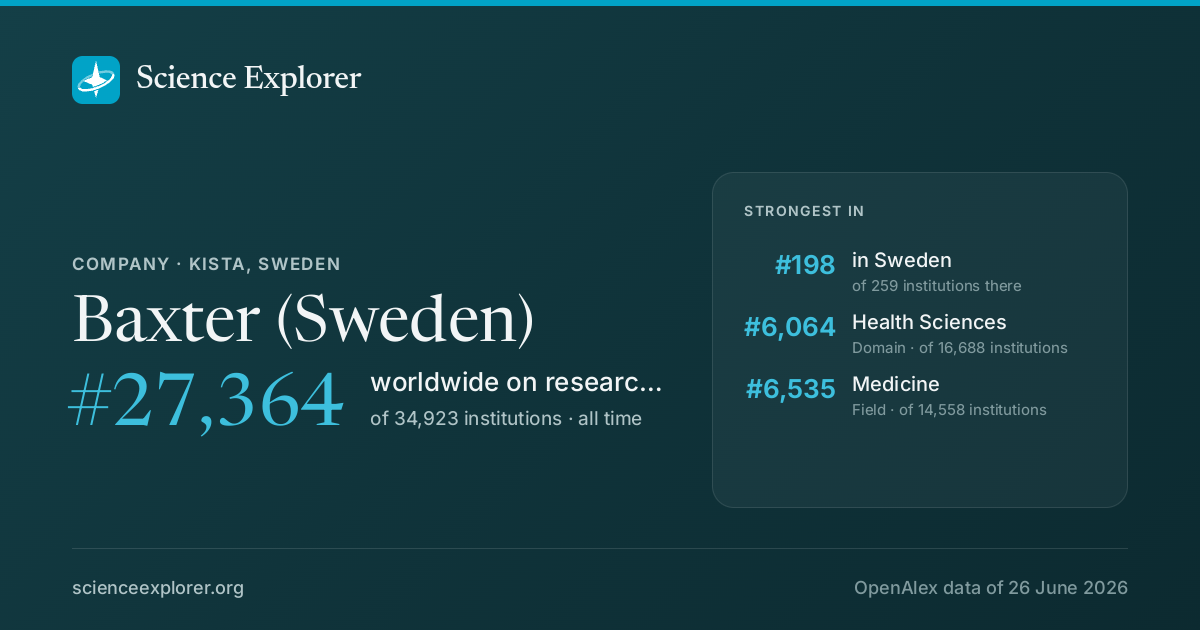
Company · Kista · Sweden

Baxter (Sweden)

In research, Baxter (Sweden) stands highest in Health Sciences (#6,064 of 16,688 worldwide) and Medicine (#6,535 of 14,558 worldwide), over all time.

World rank, all time
#27,364
of 34,923
Rank in Sweden
#198
of 259
Research works
193
▼ 36% vs 2018-21
Citations
8.4k
43.7 per fractional work
Top-10% rate
23.4%
all institutions 10.0%
vs its own fields
1.15×
1.00× is exactly expected
Open access
43%
world 40%
International
66%
world 18%

What is Baxter (Sweden) known for in research?

The fields where it stands highest, over all time, ranked among every institution above the floor in each field.

FieldWorld rankWhere that sitsTop-10% rateWorks
Health SciencesDomain #6,064 of 16,688 19.2%162
MedicineField #6,535 of 14,558 19.0%151

Each strip is that field's whole ranked pool, with the notch where Baxter (Sweden) sits in it, in the colour of the band that rank falls in. The track under the rate is the rate itself: it carries no average mark, because the average differs by field (from about 6% in Dentistry to 21% in Economics).

Which fields of science does Baxter (Sweden) work in?

In 2022-now, 82% of research at Baxter (Sweden) is in Health Sciences, 14% in Life Sciences. Its largest fields are Medicine (77%), Biochemistry, Genetics and Molecular Biology (11%), Health Professions (3%). It does 2.7× the world's share of Health Sciences.

Health Sciences: 20 fractional works · 82.0% of its workMedicine: 18 fractional works · 76.8% of its workNephrology: 7 fractional works · 30.5% of its workPhysiology: 3 fractional works · 10.8% of its workPulmonary and Respiratory Medicine: 1 fractional works · 5.2% of its workPublic Health, Environmental and Occupational Health: 1 fractional works · 5.0% of its workSurgery: 1 fractional works · 4.8% of its workCardiology and Cardiovascular Medicine: 0 fractional works · 2.0% of its workEndocrinology, Diabetes and Metabolism: 0 fractional works · 1.9% of its workEpidemiology: 0 fractional works · 1.8% of its workRheumatology: 0 fractional works · 1.7% of its workRadiology, Nuclear Medicine and Imaging: 0 fractional works · 1.6% of its workPediatrics, Perinatology and Child Health: 0 fractional works · 1.3% of its workGeriatrics and Gerontology: 0 fractional works · 1.2% of its workTransplantation: 0 fractional works · 1.2% of its workHematology: 0 fractional works · 1.1% of its workOncology: 0 fractional works · 1.1% of its workInfectious Diseases: 0 fractional works · 0.9% of its workEmergency Medicine: 0 fractional works · 0.7% of its workHepatology: 0 fractional works · 0.7% of its workPharmacology: 0 fractional works · 0.6% of its workCritical Care and Intensive Care Medicine: 0 fractional works · 0.5% of its workBiochemistry: 0 fractional works · 0.3% of its workFamily Practice: 0 fractional works · 0.3% of its workGenetics: 0 fractional works · 0.3% of its workOrthopedics and Sports Medicine: 0 fractional works · 0.3% of its workOtorhinolaryngology: 0 fractional works · 0.3% of its workPathology and Forensic Medicine: 0 fractional works · 0.3% of its workObstetrics and Gynecology: 0 fractional works · 0.3% of its workRehabilitation: 0 fractional works · 0.2% of its workHealth Professions: 1 fractional works · 2.8% of its workEmergency Medical Services: 0 fractional works · 1.0% of its workGeneral Health Professions: 0 fractional works · 1.0% of its workHealth Information Management: 0 fractional works · 0.3% of its workSmaller subfields together: 0 fractional works · 0.4% of its workNursing: 1 fractional works · 2.3% of its workNutrition and Dietetics: 1 fractional works · 2.3% of its workLife Sciences: 3 fractional works · 14.5% of its workBiochemistry, Genetics and Molecular Biology: 3 fractional works · 11.3% of its workMolecular Biology: 1 fractional works · 3.9% of its workGenetics: 1 fractional works · 3.6% of its workCancer Research: 0 fractional works · 1.2% of its workClinical Biochemistry: 0 fractional works · 1.2% of its workAging: 0 fractional works · 0.7% of its workCell Biology: 0 fractional works · 0.4% of its workBiochemistry: 0 fractional works · 0.3% of its workImmunology and Microbiology: 1 fractional works · 2.4% of its workImmunology: 1 fractional works · 2.4% of its workNeuroscience: 0 fractional works · 0.8% of its workNeurology: 0 fractional works · 0.8% of its workPhysical Sciences: 1 fractional works · 2.6% of its workEngineering: 0 fractional works · 1.0% of its workElectrical and Electronic Engineering: 0 fractional works · 0.5% of its workBiomedical Engineering: 0 fractional works · 0.4% of its workSmaller subfields together: 0 fractional works · 0.1% of its workEnvironmental Science: 0 fractional works · 1.0% of its workEcology: 0 fractional works · 0.4% of its workHealth, Toxicology and Mutagenesis: 0 fractional works · 0.4% of its workPollution: 0 fractional works · 0.3% of its workPhysics and Astronomy: 0 fractional works · 0.3% of its workCondensed Matter Physics: 0 fractional works · 0.3% of its workComputer Science: 0 fractional works · 0.3% of its workSocial Sciences: 0 fractional works · 0.9% of its workEconomics, Econometrics and Finance: 0 fractional works · 0.6% of its workEconomics and Econometrics: 0 fractional works · 0.6% of its workPsychology: 0 fractional works · 0.3% of its workClinical Psychology: 0 fractional works · 0.3% of its workALL ITS WORKBaxter (Sweden)24fractional works, 2022-now
Life Sciences14%Physical Sciences3%Health Sciences82%Social Sciences1%

Each ring splits the one inside it: the four domains of science, their fields, their subfields. Size is fractional works in 2022-now. Every slice is a page; the interactive view zooms down to single topics and colours each by how much more of it this institution does than the world.

Its 4 domains and 12 fields, with their numbers
    1. Medicine1876.8%
    2. Health Professions12.8%
    3. Nursing12.3%
    1. Biochemistry, Genetics and Molecular Biology311.3%
    2. Immunology and Microbiology12.4%
    3. Neuroscience00.8%
    1. Engineering01.0%
    2. Environmental Science01.0%
    3. Physics and Astronomy00.3%
    4. Computer Science00.3%
    1. Economics, Econometrics and Finance00.6%
    2. Psychology00.3%
All of science, and how each field's share has moved since 1950: the Science domain explorer

Field profile

Location quotient across every field it publishes in: outside the ring is more than an institution of this size would be expected to publish, inside it is less.

Biochemistry, Genetics and Molecular Biology: 2.11× its world share, 3 worksBiochemistry, Geneti…Immunology and Microbiology: 2.42× its world share, 1 worksImmunology and Micro…Neuroscience: 0.50× its world share, 0 worksNeuroscienceComputer Science: 0.03× its world share, 0 worksComputer ScienceEngineering: 0.07× its world share, 0 worksEngineeringEnvironmental Science: 0.21× its world share, 0 worksEnvironmental SciencePhysics and Astronomy: 0.13× its world share, 0 worksPhysics and AstronomyHealth Professions: 1.08× its world share, 1 worksHealth ProfessionsMedicine: 3.99× its world share, 18 worksMedicineNursing: 4.73× its world share, 1 worksNursingEconomics, Econometrics and Finance: 0.29× its world share, 0 worksEconomics, Econometr…Psychology: 0.10× its world share, 0 worksPsychology1×world share
more than its size predictsabout as predictedless

Rings at 0.5×, 1× and 2×. Widest outward: Nursing, 4.7×. Every wedge is a field page.

All 12 fields, with their numbers
  1. Nursing4.73×1 works
  2. Medicine3.99×18 works
  3. Immunology and Microbiology2.42×1 works
  4. Biochemistry, Genetics and Molecular Biology2.11×3 works
  5. Health Professions1.08×1 works
  6. Neuroscience0.50×0 works
  7. Economics, Econometrics and Finance0.29×0 works
  8. Environmental Science0.21×0 works
  9. Physics and Astronomy0.13×0 works
  10. Psychology0.10×0 works
  11. Engineering0.07×0 works
  12. Computer Science0.03×0 works

What are the most cited papers from Baxter (Sweden)?

The most cited paper from Baxter (Sweden) is "A proposed nomenclature and diagnostic criteria for protein–energy wasting in acute and chronic kidney disease" (Denis P. Fouque, Kamyar Kalantar‐Zadeh, Joel D. Kopple et al., 2007), with 2,009 citations. Next come "IL-10, IL-6, and TNF-α: Central factors in the altered cytokine network of uremia—The good, the bad, and the ugly" (935) and "Factors predicting malnutrition in hemodialysis patients: A cross-sectional study" (594).

Most cited papers
#PaperReleasedCitations
1 A proposed nomenclature and diagnostic criteria for protein–energy wasting in acute and chronic kidney disease Denis P. Fouque, Kamyar Kalantar‐Zadeh, Joel D. Kopple et al. · Kidney International Open access 19 Dec 2007 2,009
2 IL-10, IL-6, and TNF-α: Central factors in the altered cytokine network of uremia—The good, the bad, and the ugly Peter Stenvinkel, Markus Ketteler, Richard J. Johnson et al. · Kidney International Open access 12 Mar 2005 935
3 Factors predicting malnutrition in hemodialysis patients: A cross-sectional study Abdul Rashid Qureshi, Anders Alvestrand, Anders Danielsson et al. · Kidney International Open access Mar 1998 594
4 Serum Albumin, C-Reactive Protein, Interleukin 6, and Fetuin A as Predictors of Malnutrition, Cardiovascular Disease, and Mortality in Patients With ESRD Hirokazu Honda, Abdul Rashid Qureshi, Olof Heimbürger et al. · American Journal of Kidney Diseases 23 Dec 2005 522
5 Sarcopenia in chronic kidney disease: what have we learned so far? Alice Sabatino, Lílian Cuppari, Peter Stenvinkel et al. · Journal of Nephrology Open access 2 Sep 2020 517
All 60 most cited papers, with filters and sorting

Which keywords describe research at Baxter (Sweden)?

By fractional works in 2022-now, weighted toward what it does more of than the world: Chronic Kidney Disease, Inflammation, Cardiovascular Disease, Hemodialysis, Quality of Life, Nutrition, Mortality and Dialysis.

▲ more of its work than of the world's◆ about the world's share▼ less than the world's

Size is fractional works in 2022-now in the topics tagged with each word; colour is the word's share of this institution's work against its share of the world's. The 25 words are chosen for being large and distinctive. Each links to the topic it comes from most.

All 25 words, with their numbers
  1. Chronic Kidney Disease8▲ 133×7 topics
  2. Inflammation8▲ 16×18 topics
  3. Cardiovascular Disease7▲ 25×14 topics
  4. Hemodialysis5▲ 232×2 topics
  5. Quality of Life4▲ 12×8 topics
  6. Nutrition4▲ 36×2 topics
  7. Dialysis4▲ 314×1 topic
  8. Mortality4▲ 28×2 topics
  9. Peritoneal Dialysis4▲ 314×1 topic
  10. Prognosis2▲ 29×3 topics
  11. Aging2▲ 15×5 topics
  12. Metabolic Syndrome2▲ 9.1×7 topics
  13. Muscle Mass2▲ 66×2 topics
  14. Cancer Cachexia1▲ 66×1 topic
  15. FGF231▲ 164×1 topic
  16. Heart Failure1▲ 13×6 topics
  17. Obesity1▲ 7.3×7 topics
  18. Sarcopenia1▲ 66×1 topic
  19. phosphate1▲ 164×1 topic
  20. Treatment1▲ 4.3×10 topics
  21. Acute Kidney Injury1▲ 85×2 topics
  22. Biomarkers1▲ 6.9×5 topics
  23. Critical Care1▲ 19×3 topics
  24. Renal Failure1▲ 95×2 topics
  25. Sepsis1▲ 25×4 topics

Which research topics does Baxter (Sweden) publish most on?

By volume in 2022-now: Dialysis and Renal Disease Management, Parathyroid Disorders and Treatments, Nutrition and Health in Aging and Chronic Kidney Disease and Diabetes.

  1. 1 Dialysis and Renal Disease Management Nephrology 4 works
  2. 2 Parathyroid Disorders and Treatments Nephrology 1 works
  3. 3 Nutrition and Health in Aging Physiology 1 works
  4. 4 Chronic Kidney Disease and Diabetes Nephrology 1 works
  5. 5 Acute Kidney Injury Research Nephrology 1 works
  6. 6 Nutritional Studies and Diet Public Health, Environmental and Occupational Health 1 works
  7. 7 Potassium and Related Disorders Pulmonary and Respiratory Medicine 1 works
  8. 8 Consumer Attitudes and Food Labeling Public Health, Environmental and Occupational Health 0 works
  9. 9 Diet and metabolism studies Physiology 0 works
  10. 10 Genetic and Kidney Cyst Diseases Genetics 0 works

How open and international is its research?

Against the world's own shares: the tick on each track. Both are shares of its output, so they sit on one scale and can be read against each other as well as against the world.

openly available43.3%not open56.7%

World: 40% of research is openly available.

with international co-authors66.4%domestic only33.6%

World: 18% is written across borders.

How has Baxter (Sweden)'s research output changed?

Output in 2022-2025 was 36% lower than in 2018-2021.

still counting200020102020
grewheldshrank

The same series as a ribbon: one cell per year, darker for more. The line above answers how much; this answers when.

Its share of all research

Growing output can still be a shrinking share: all of science grows. This is Baxter (Sweden) as a percentage of every work published that year, 0.00014% in 2024.

still counting0.00020%0.00040%Baxter (Sweden)0.000082% in 2025200020102020

Fractional works of Baxter (Sweden) over all fractional works that year. How the balance of science has shifted.

Other research institutions in Kista

All research institutions in Kista

Share Baxter (Sweden)'s ranking

Baxter (Sweden) on Science Explorer

A card with Baxter (Sweden)'s standing and the fields it leads in, for a post or a slide. A link to this page previews as the same card.

Download the card

1200 × 630 PNG, sized for social posts, drawn from the latest snapshot.

Badges for a website1Each links back here and updates with every snapshot

Research measures only: rankings here say nothing about teaching, admissions or student experience. Comparable institutions and collaboration partners have tabs of their own, above.

Discussion

Ask a question or share a note about Baxter (Sweden). Posts are plain text and can be reported.