Behringwerke (Germany)
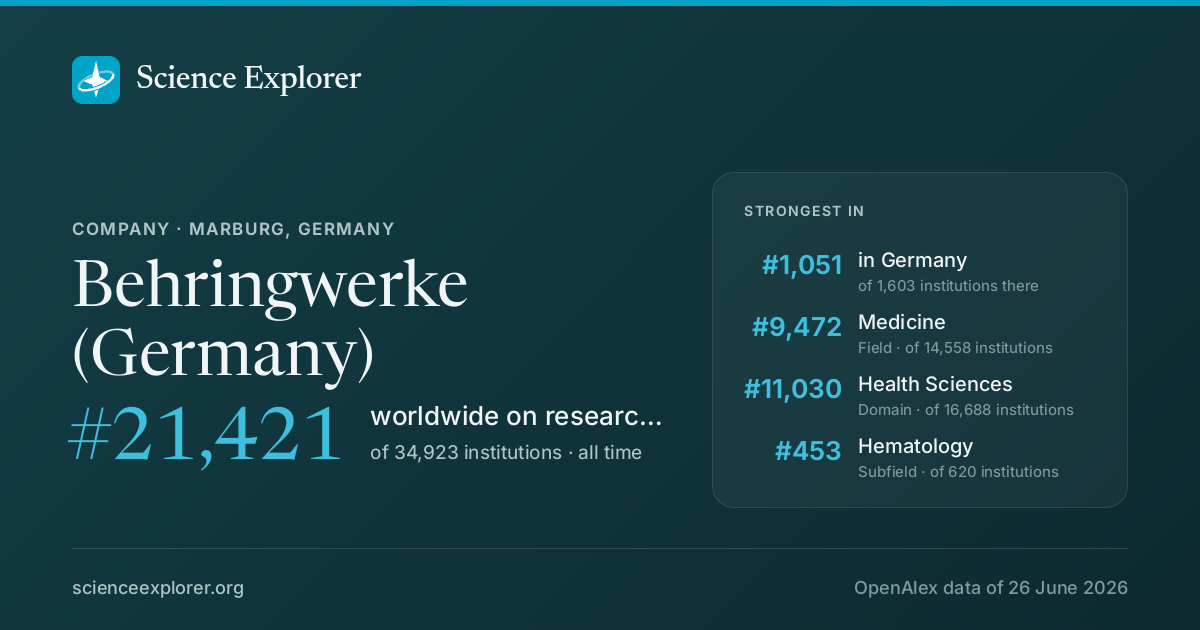
In research, Behringwerke (Germany) stands highest in Medicine (#9,472 of 14,558 worldwide), Health Sciences (#11,030 of 16,688 worldwide) and Hematology (#453 of 620 worldwide), over all time.
- World rank, all time
- #21,421 of 34,923
- Rank in Germany
- #1,051 of 1,603
- Research works
- 1.4k ▼ 48% vs 2018-21
- Citations
- 30k 21.9 per fractional work
- Top-10% rate
- 12.9% all institutions 10.0%
- vs its own fields
- 0.85× 1.00× is exactly expected
- Open access
- 14% world 40%
- International
- 17% world 18%
What is Behringwerke (Germany) known for in research?
The fields where it stands highest, over all time, ranked among every institution above the floor in each field.
| Field | World rank | Where that sits | Top-10% rate | Works |
|---|---|---|---|---|
| MedicineField | #9,472 of 14,558 | 6.6% | 679 | |
| Health SciencesDomain | #11,030 of 16,688 | 6.7% | 714 | |
| HematologySubfield | #453 of 620 | 8.1% | 135 | |
| Biochemistry, Genetics and Molecular BiologyField | #4,468 of 5,801 | 5.3% | 280 | |
| Immunology and MicrobiologyField | #1,247 of 1,587 | 4.3% | 166 | |
| Life SciencesDomain | #8,950 of 11,023 | 5.0% | 493 | |
| Molecular BiologySubfield | #3,073 of 3,729 | 4.2% | 180 | |
| ImmunologySubfield | #946 of 1,141 | 4.6% | 131 |
Each strip is that field's whole ranked pool, with the notch where Behringwerke (Germany) sits in it, in the colour of the band that rank falls in. The track under the rate is the rate itself: it carries no average mark, because the average differs by field (from about 6% in Dentistry to 21% in Economics).
Which fields of science does Behringwerke (Germany) work in?
In 2022-now, 62% of research at Behringwerke (Germany) is in Health Sciences, 32% in Life Sciences. Its largest fields are Medicine (59%), Biochemistry, Genetics and Molecular Biology (21%), Immunology and Microbiology (9%). It does 2.0× the world's share of Health Sciences.
Each ring splits the one inside it: the four domains of science, their fields, their subfields. Size is fractional works in 2022-now. Every slice is a page; the interactive view zooms down to single topics and colours each by how much more of it this institution does than the world.
Its 4 domains and 18 fields, with their numbers
- Health Sciences1362.1%
- Medicine1259.3%
- Health Professions01.5%
- Veterinary00.8%
- Nursing00.5%
- Life Sciences731.7%
- Physical Sciences14.5%
- Mathematics01.6%
- Engineering01.0%
- Computer Science00.5%
- Materials Science00.5%
- Physics and Astronomy00.5%
- Environmental Science00.4%
- Social Sciences01.7%
Field profile
Location quotient across every field it publishes in: outside the ring is more than an institution of this size would be expected to publish, inside it is less.
Rings at 0.5×, 1× and 2×. Widest outward: Immunology and Microbiology, 8.8×. Every wedge is a field page.
All 18 fields, with their numbers
- Immunology and Microbiology8.85×2 works
- Veterinary5.84×0 works
- Biochemistry, Genetics and Molecular Biology3.93×4 works
- Medicine3.08×12 works
- Pharmacology, Toxicology and Pharmaceutics2.63×0 works
- Mathematics1.35×0 works
- Nursing1.08×0 works
- Health Professions0.57×0 works
- Neuroscience0.38×0 works
- Business, Management and Accounting0.25×0 works
- Economics, Econometrics and Finance0.25×0 works
- Physics and Astronomy0.24×0 works
- Materials Science0.15×0 works
- Psychology0.13×0 works
- Environmental Science0.08×0 works
- Computer Science0.07×0 works
- Engineering0.07×0 works
- Agricultural and Biological Sciences0.06×0 works
- Immunology and Microbiology 8.8×
- Veterinary 5.8×
- Biochemistry, Genetics and Molecular Biology 3.9×
- Medicine 3.1×
- Pharmacology, Toxicology and Pharmaceutics 2.6×
- Mathematics 1.4×
- Nursing 1.1×
- Health Professions 0.6×
- Neuroscience 0.4×
- Business, Management and Accounting 0.2×
- Economics, Econometrics and Finance 0.2×
- Physics and Astronomy 0.2×
- Materials Science 0.1×
- Psychology 0.1×
- Environmental Science 0.1×
- Computer Science 0.1×
- Engineering 0.1×
- Agricultural and Biological Sciences 0.1×
Who are the top researchers at Behringwerke (Germany)?
Ranked on the quality score, Peter C. Kiessling, Eva Herzog and Marc Wolfgang Nolte lead among researchers whose main affiliation is Behringwerke (Germany).
- 1
Peter C. Kiessling
 Germany · #562,266 worldwide
2.5k citations · 47 works
- 2
Eva Herzog
Germany · #1,604,860 worldwide
3.7k citations · 109 works
- 3
Marc Wolfgang Nolte
Germany · #1,640,954 worldwide
1.8k citations · 52 works
- 4
Jürgen Frisch
Germany · #1,909,299 worldwide
2.5k citations · 34 works
- 5
Heinz HAUPT
Germany · #1,978,706 worldwide
3.3k citations · 98 works
- 6
Bernhard Knapp
Germany · #2,024,848 worldwide
5.4k citations · 177 works
- 7
Frauke May
Germany · #2,028,676 worldwide
1.4k citations · 23 works
- 8
Thomas Machnig
Germany · #2,121,972 worldwide
11k citations · 92 works
- 9
Hermann E. Schultze
Germany · #2,194,736 worldwide
2.7k citations · 97 works
- 10
Uwe Nicolay
Germany · #2,305,143 worldwide
1.6k citations · 45 works
Which keywords describe research at Behringwerke (Germany)?
By fractional works in 2022-now, weighted toward what it does more of than the world: Thrombosis, Gene Therapy, Monoclonal Antibodies, Glycosylation, Hereditary Angioedema, Kinin Receptor Family, Prophylaxis and Recombinant Factor VIIa.
- Diagnosis
- Hemophilia
- Recombinant Factor VIIa
- Inflammation
- Hereditary Angioedema
- Glycosylation
- Gene Therapy
- Thrombosis
- Epidemiology
- Monoclonal Antibodies
- Kinin Receptor Family
- Prophylaxis
- Factor VIII
- Therapeutic Antibodies
Size is fractional works in 2022-now in the topics tagged with each word; colour is the word's share of this institution's work against its share of the world's. The 14 words are chosen for being large and distinctive. Each links to the topic it comes from most.
All 14 words, with their numbers
- Thrombosis3▲ 47×5 topics
- Gene Therapy2▲ 61×3 topics
- Epidemiology2▲ 2.2×11 topics
- Glycosylation2▲ 77×3 topics
- Monoclonal Antibodies2▲ 97×3 topics
- Hereditary Angioedema2▲ 408×1 topic
- Kinin Receptor Family2▲ 408×1 topic
- Inflammation1▲ 3.2×10 topics
- Prophylaxis1▲ 52×2 topics
- Recombinant Factor VIIa1▲ 138×2 topics
- Factor VIII1▲ 428×1 topic
- Hemophilia1▲ 428×1 topic
- Therapeutic Antibodies1▲ 91×2 topics
- Diagnosis1▲ 5.3×8 topics
Which research topics does Behringwerke (Germany) publish most on?
By volume in 2022-now: Coagulation, Bradykinin, Polyphosphates, and Angioedema, Hemophilia Treatment and Research, Monoclonal and Polyclonal Antibodies Research and Virus-based gene therapy research.
Area is fractional works; colour is the subfield each topic belongs to.
- 1 Coagulation, Bradykinin, Polyphosphates, and Angioedema Genetics 2 works
- 2 Hemophilia Treatment and Research Hematology 1 works
- 3 Monoclonal and Polyclonal Antibodies Research Radiology, Nuclear Medicine and Imaging 1 works
- 4 Virus-based gene therapy research Genetics 1 works
- 5 Complement system in diseases Immunology 1 works
- 6 Viral Infectious Diseases and Gene Expression in Insects Molecular Biology 1 works
- 7 Biosimilars and Bioanalytical Methods Immunology 0 works
- 8 Pharmaceutical studies and practices Pediatrics, Perinatology and Child Health 0 works
- 9 Platelet Disorders and Treatments Hematology 0 works
- 10 Heparin-Induced Thrombocytopenia and Thrombosis Surgery 0 works
How open and international is its research?
Against the world's own shares: the tick on each track. Both are shares of its output, so they sit on one scale and can be read against each other as well as against the world.
World: 40% of research is openly available.
World: 18% is written across borders.
How has Behringwerke (Germany)'s research output changed?
Output in 2022-2025 was 48% lower than in 2018-2021.
The same series as a ribbon: one cell per year, darker for more. The line above answers how much; this answers when.
Its share of all research
Growing output can still be a shrinking share: all of science grows. This is Behringwerke (Germany) as a percentage of every work published that year, 0.00010% in 2024.
Fractional works of Behringwerke (Germany) over all fractional works that year. How the balance of science has shifted.
How much of it reaches the world top 10%
Year by year, against all institutions in the same year.
Of each year's output, the share that reached the world's 10% most cited for its field and year. Peak 8.6% in 2009.
Other research institutions in Marburg
- Philipps University of Marburg
- Loewe Center for Synthetic Microbiology
- Vitos
- Sterna Biologicals (Germany)
- Rechenkraft.net
- Archives School Marburg
- Norgine (Germany)
- Von Behring-Röntgen-Stiftung
Share Behringwerke (Germany)'s ranking
Badges for a website1Each links back here and updates with every snapshot

Research measures only: rankings here say nothing about teaching, admissions or student experience. Comparable institutions and collaboration partners have tabs of their own, above.
Discussion
Ask a question or share a note about Behringwerke (Germany). Posts are plain text and can be reported.