Science Explorer Back to mapMap
University · Green Bay · United States

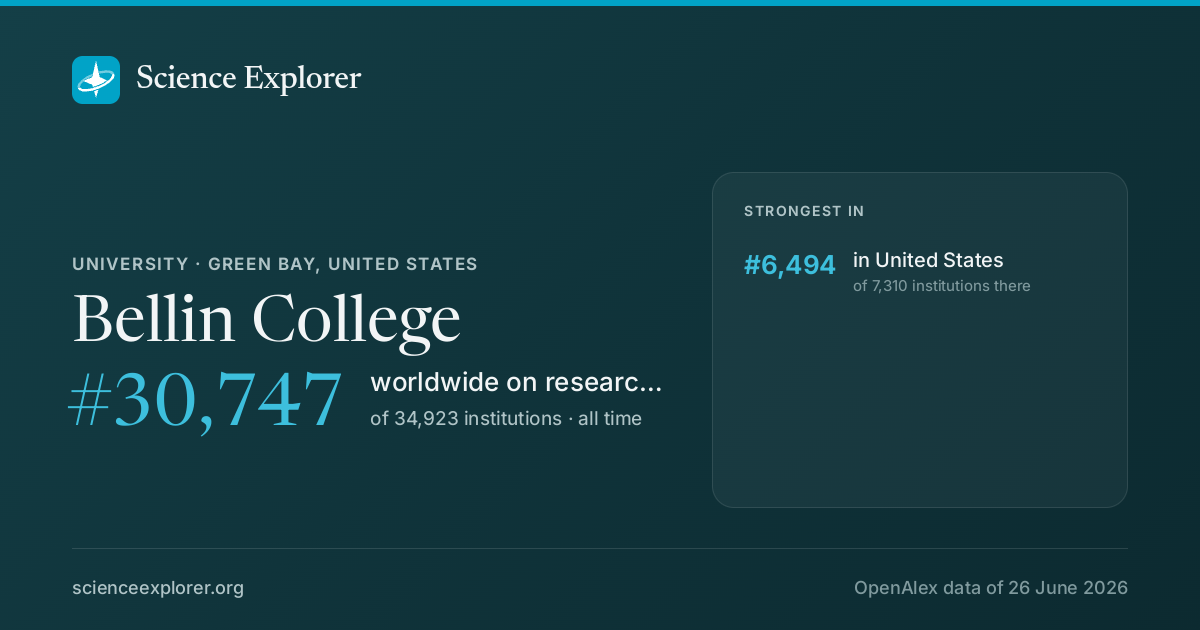
Bellin College

World rank, all time
#30,747
of 34,923
Rank in United States
#6,494
of 7,310
Research works
133
▲ 87% vs 2018-21
Citations
966
7.3 per fractional work
Top-10% rate
8.0%
all institutions 10.0%
vs its own fields
0.95×
1.00× is exactly expected
Open access
38%
world 40%
International
10%
world 18%

Which fields of science does Bellin College work in?

In 2022-now, 48% of research at Bellin College is in Health Sciences, 33% in Social Sciences. Its largest fields are Medicine (41%), Psychology (8%), Social Sciences (8%). It does 1.9× the world's share of Health Sciences.

Health Sciences: 24 fractional works · 48.1% of its workMedicine: 21 fractional works · 40.6% of its workPharmacology: 4 fractional works · 7.7% of its workSurgery: 3 fractional works · 6.7% of its workOrthopedics and Sports Medicine: 2 fractional works · 4.5% of its workRehabilitation: 2 fractional works · 3.7% of its workPublic Health, Environmental and Occupational Health: 2 fractional works · 3.1% of its workRheumatology: 1 fractional works · 2.9% of its workComplementary and alternative medicine: 1 fractional works · 1.8% of its workPsychiatry and Mental health: 1 fractional works · 1.6% of its workPhysiology: 1 fractional works · 1.4% of its workPulmonary and Respiratory Medicine: 1 fractional works · 1.2% of its workPathology and Forensic Medicine: 1 fractional works · 1.2% of its workCardiology and Cardiovascular Medicine: 0 fractional works · 0.9% of its workFamily Practice: 0 fractional works · 0.7% of its workEpidemiology: 0 fractional works · 0.7% of its workAnesthesiology and Pain Medicine: 0 fractional works · 0.6% of its workPediatrics, Perinatology and Child Health: 0 fractional works · 0.5% of its workRadiology, Nuclear Medicine and Imaging: 0 fractional works · 0.5% of its workCritical Care and Intensive Care Medicine: 0 fractional works · 0.4% of its workEndocrinology, Diabetes and Metabolism: 0 fractional works · 0.2% of its workSmaller subfields together: 0 fractional works · 0.4% of its workHealth Professions: 4 fractional works · 7.4% of its workGeneral Health Professions: 2 fractional works · 3.9% of its workOccupational Therapy: 1 fractional works · 2.2% of its workRadiological and Ultrasound Technology: 0 fractional works · 0.6% of its workPhysical Therapy, Sports Therapy and Rehabilitation: 0 fractional works · 0.3% of its workEmergency Medical Services: 0 fractional works · 0.2% of its workSmaller subfields together: 0 fractional works · 0.2% of its workNursing: 0 fractional works · 0.2% of its workSocial Sciences: 17 fractional works · 32.6% of its workPsychology: 4 fractional works · 8.0% of its workSocial Psychology: 2 fractional works · 4.1% of its workExperimental and Cognitive Psychology: 1 fractional works · 1.9% of its workClinical Psychology: 0 fractional works · 0.9% of its workApplied Psychology: 0 fractional works · 0.8% of its workDevelopmental and Educational Psychology: 0 fractional works · 0.3% of its workSocial Sciences: 4 fractional works · 7.9% of its workEducation: 1 fractional works · 2.5% of its workSociology and Political Science: 1 fractional works · 1.9% of its workPolitical Science and International Relations: 0 fractional works · 1.0% of its workAnthropology: 0 fractional works · 0.6% of its workGeography, Planning and Development: 0 fractional works · 0.6% of its workHealth: 0 fractional works · 0.3% of its workLaw: 0 fractional works · 0.3% of its workSafety Research: 0 fractional works · 0.3% of its workGender Studies: 0 fractional works · 0.3% of its workBusiness, Management and Accounting: 3 fractional works · 5.8% of its workStrategy and Management: 2 fractional works · 3.0% of its workManagement Information Systems: 1 fractional works · 2.0% of its workMarketing: 0 fractional works · 0.6% of its workAccounting: 0 fractional works · 0.2% of its workArts and Humanities: 2 fractional works · 3.9% of its workPhilosophy: 1 fractional works · 2.0% of its workMusic: 1 fractional works · 1.3% of its workLanguage and Linguistics: 0 fractional works · 0.6% of its workEconomics, Econometrics and Finance: 2 fractional works · 3.9% of its workEconomics and Econometrics: 2 fractional works · 3.9% of its workDecision Sciences: 2 fractional works · 3.1% of its workStatistics, Probability and Uncertainty: 1 fractional works · 1.9% of its workManagement Science and Operations Research: 1 fractional works · 1.2% of its workPhysical Sciences: 7 fractional works · 13.3% of its workComputer Science: 3 fractional works · 5.6% of its workArtificial Intelligence: 1 fractional works · 2.7% of its workInformation Systems: 1 fractional works · 1.8% of its workComputer Networks and Communications: 0 fractional works · 0.6% of its workComputer Vision and Pattern Recognition: 0 fractional works · 0.3% of its workSmaller subfields together: 0 fractional works · 0.1% of its workEngineering: 1 fractional works · 2.3% of its workBiomedical Engineering: 1 fractional works · 1.7% of its workMechanical Engineering: 0 fractional works · 0.3% of its workBuilding and Construction: 0 fractional works · 0.2% of its workEnvironmental Science: 1 fractional works · 2.2% of its workNature and Landscape Conservation: 0 fractional works · 1.0% of its workEcology: 0 fractional works · 0.8% of its workEcological Modeling: 0 fractional works · 0.2% of its workGlobal and Planetary Change: 0 fractional works · 0.2% of its workPhysics and Astronomy: 1 fractional works · 2.0% of its workAstronomy and Astrophysics: 0 fractional works · 0.6% of its workNuclear and High Energy Physics: 0 fractional works · 0.6% of its workStatistical and Nonlinear Physics: 0 fractional works · 0.6% of its workSmaller subfields together: 0 fractional works · 0.0% of its workMathematics: 0 fractional works · 0.4% of its workStatistics and Probability: 0 fractional works · 0.4% of its workChemical Engineering: 0 fractional works · 0.3% of its workFluid Flow and Transfer Processes: 0 fractional works · 0.3% of its workChemistry: 0 fractional works · 0.2% of its workOrganic Chemistry: 0 fractional works · 0.2% of its workEarth and Planetary Sciences: 0 fractional works · 0.2% of its workEarth-Surface Processes: 0 fractional works · 0.2% of its workLife Sciences: 3 fractional works · 6.0% of its workBiochemistry, Genetics and Molecular Biology: 1 fractional works · 2.2% of its workCell Biology: 1 fractional works · 2.0% of its workSmaller subfields together: 0 fractional works · 0.3% of its workNeuroscience: 1 fractional works · 2.1% of its workCognitive Neuroscience: 1 fractional works · 2.0% of its workSmaller subfields together: 0 fractional works · 0.0% of its workAgricultural and Biological Sciences: 1 fractional works · 1.3% of its workPlant Science: 0 fractional works · 0.9% of its workEcology, Evolution, Behavior and Systematics: 0 fractional works · 0.2% of its workFood Science: 0 fractional works · 0.2% of its workSmaller subfields together: 0 fractional works · 0.0% of its workPharmacology, Toxicology and Pharmaceutics: 0 fractional works · 0.3% of its workPharmacology: 0 fractional works · 0.3% of its workALL ITS WORKBellin College51fractional works, 2022-now
Life Sciences6%Physical Sciences13%Health Sciences48%Social Sciences33%

Each ring splits the one inside it: the four domains of science, their fields, their subfields. Size is fractional works in 2022-now. Every slice is a page; the interactive view zooms down to single topics and colours each by how much more of it this institution does than the world.

Its 4 domains and 21 fields, with their numbers
    1. Medicine2140.6%
    2. Health Professions47.4%
    3. Nursing00.2%
    1. Psychology48.0%
    2. Social Sciences47.9%
    3. Business, Management and Accounting35.8%
    4. Arts and Humanities23.9%
    5. Economics, Econometrics and Finance23.9%
    6. Decision Sciences23.1%
    1. Computer Science35.6%
    2. Engineering12.3%
    3. Environmental Science12.2%
    4. Physics and Astronomy12.0%
    5. Mathematics00.4%
    6. Chemical Engineering00.3%
    7. Chemistry00.2%
    8. Earth and Planetary Sciences00.2%
    1. Biochemistry, Genetics and Molecular Biology12.2%
    2. Neuroscience12.1%
    3. Agricultural and Biological Sciences11.3%
    4. Pharmacology, Toxicology and Pharmaceutics00.3%
All of science, and how each field's share has moved since 1950: the Science domain explorer

Field profile

Location quotient across every field it publishes in: outside the ring is more than an institution of this size would be expected to publish, inside it is less.

Agricultural and Biological Sciences: 0.28× its world share, 1 worksAgricultural and Bio…Biochemistry, Genetics and Molecular Biology: 0.42× its world share, 1 worksBiochemistry, Geneti…Neuroscience: 1.28× its world share, 1 worksNeurosciencePharmacology, Toxicology and Pharmaceutics: 0.93× its world share, 0 worksPharmacology, Toxico…Chemical Engineering: 0.94× its world share, 0 worksChemical EngineeringChemistry: 0.14× its world share, 0 worksChemistryComputer Science: 0.72× its world share, 3 worksComputer ScienceEarth and Planetary Sciences: 0.14× its world share, 0 worksEarth and Planetary …Engineering: 0.15× its world share, 1 worksEngineeringEnvironmental Science: 0.44× its world share, 1 worksEnvironmental ScienceMathematics: 0.34× its world share, 0 worksMathematicsPhysics and Astronomy: 0.89× its world share, 1 worksPhysics and AstronomyHealth Professions: 2.79× its world share, 4 worksHealth ProfessionsMedicine: 2.11× its world share, 21 worksMedicineNursing: 0.33× its world share, 0 worksNursingArts and Humanities: 1.36× its world share, 2 worksArts and HumanitiesBusiness, Management and Accounting: 1.80× its world share, 3 worksBusiness, Management…Decision Sciences: 3.26× its world share, 2 worksDecision SciencesEconomics, Econometrics and Finance: 1.81× its world share, 2 worksEconomics, Econometr…Psychology: 2.62× its world share, 4 worksPsychologySocial Sciences: 0.62× its world share, 4 worksSocial Sciences1×world share
more than its size predictsabout as predictedless

Rings at 0.5×, 1× and 2×. Widest outward: Decision Sciences, 3.3×. Every wedge is a field page.

All 21 fields, with their numbers
  1. Decision Sciences3.26×2 works
  2. Health Professions2.79×4 works
  3. Psychology2.62×4 works
  4. Medicine2.11×21 works
  5. Economics, Econometrics and Finance1.81×2 works
  6. Business, Management and Accounting1.80×3 works
  7. Arts and Humanities1.36×2 works
  8. Neuroscience1.28×1 works
  9. Chemical Engineering0.94×0 works
  10. Pharmacology, Toxicology and Pharmaceutics0.93×0 works
  11. Physics and Astronomy0.89×1 works
  12. Computer Science0.72×3 works
  13. Social Sciences0.62×4 works
  14. Environmental Science0.44×1 works
  15. Biochemistry, Genetics and Molecular Biology0.42×1 works
  16. Mathematics0.34×0 works
  17. Nursing0.33×0 works
  18. Agricultural and Biological Sciences0.28×1 works
  19. Engineering0.15×1 works
  20. Chemistry0.14×0 works
  21. Earth and Planetary Sciences0.14×0 works

Who are the top researchers at Bellin College?

Ranked on the quality score, Amanda Hogan, Jodi L. Young and Mark H. Shepherd lead among researchers whose main affiliation is Bellin College.

  1. 1 Amanda Hogan United States · #2,531,058 worldwide 81 citations · 18 works
  2. 2 Jodi L. Young United States · #2,640,353 worldwide 1.2k citations · 107 works
  3. 3 Mark H. Shepherd United States · #3,355,922 worldwide 221 citations · 27 works
  4. 4 Casey Rentmeester United States · #3,495,112 worldwide 175 citations · 43 works
All ranked researchers at Bellin College

What are the most cited papers from Bellin College?

The most cited paper from Bellin College is "Incidence of Lower Extremity Injury in the National Football League: 2015 to 2018" (Christina DeFilippo Mack, Richard W. Kent, Michael J. Coughlin et al., 2020), with 100 citations. Next come "A Clinician’s Guide for Trending Cardiovascular Nutrition Controversies" (89) and "Diabetic nephropathy: newer therapeutic perspectives" (70).

Most cited papers
#PaperReleasedCitations
1 Incidence of Lower Extremity Injury in the National Football League: 2015 to 2018 Christina DeFilippo Mack, Richard W. Kent, Michael J. Coughlin et al. · The American Journal of Sports Medicine 2 Jun 2020 100
2 A Clinician’s Guide for Trending Cardiovascular Nutrition Controversies Andrew M. Freeman, Pamela Bowe Morris, Karen E. Aspry et al. · Journal of the American College of Cardiology Open access Jul 2018 89
3 Diabetic nephropathy: newer therapeutic perspectives Krishna Keri, Naga Swetha Samji, Samuel S. Blumenthal · Journal of Community Hospital Internal Medicine Perspectives Open access 4 Jul 2018 70
4 A Prospective Study of Injury Patterns in High School Pole Vaulters Gregory S. Rebella, Jamie O. Edwards, Joseph J. Greene et al. · The American Journal of Sports Medicine 7 Mar 2008 68
5 HIV Outcomes in Hepatitis B Virus Coinfected Individuals on HAART Helen M. Chun, Octavio Mesner, Chloe L. Thio et al. · JAIDS Journal of Acquired Immune Deficiency Syndromes Open access 2 Apr 2014 64
All 60 most cited papers, with filters and sorting

Which keywords describe research at Bellin College?

By fractional works in 2022-now, weighted toward what it does more of than the world: Epidemiology, Clinical Trials, Low Back Pain, Chronic Pain, Global Burden, Psychological Factors, Disability and Measurement Properties.

▲ more of its work than of the world's◆ about the world's share▼ less than the world's

Size is fractional works in 2022-now in the topics tagged with each word; colour is the word's share of this institution's work against its share of the world's. The 40 words are chosen for being large and distinctive. Each links to the topic it comes from most.

All 40 words, with their numbers
  1. Epidemiology8▲ 4.0×16 topics
  2. Clinical Trials5▲ 15×6 topics
  3. Chronic Pain4▲ 40×4 topics
  4. Low Back Pain4▲ 52×2 topics
  5. Global Burden4▲ 15×3 topics
  6. Psychological Factors4▲ 39×2 topics
  7. Disability4▲ 72×1 topic
  8. Measurement Properties4▲ 105×1 topic
  9. Evidence-Based Practice2▲ 30×4 topics
  10. Medical Education2▲ 14×5 topics
  11. Regeneration2▲ 18×2 topics
  12. Rehabilitation2▲ 9.5×5 topics
  13. Knowledge Sharing2▲ 23×2 topics
  14. Osteoarthritis2▲ 26×4 topics
  15. Arthroplasty2▲ 31×2 topics
  16. Healthcare2▲ 2.8×8 topics
  17. Meta-Analysis2▲ 5.5×5 topics
  18. Pain Management2▲ 13×5 topics
  19. Business Networks2▲ 171×1 topic
  20. Coopetition2▲ 171×1 topic
  21. Ethics2▲ 5.8×4 topics
  22. Cartilage1▲ 54×1 topic
  23. Chondrocyte1▲ 54×1 topic
  24. Curriculum1▲ 26×1 topic
  25. Musculoskeletal Medicine1▲ 188×1 topic
  26. Patient Satisfaction1▲ 9.1×4 topics
  27. Primary Care1▲ 7.6×2 topics
  28. Well-being1▲ 7.2×4 topics
  29. Biomechanics1▲ 7.9×3 topics
  30. Pharmaceutical Industry1▲ 63×2 topics
  31. Quality Assessment1▲ 13×2 topics
  32. Athletic Training1▲ 24×2 topics
  33. Publication Bias1▲ 44×2 topics
  34. Analytics1▲ 22×1 topic
  35. Business Intelligence1▲ 22×1 topic
  36. Drug Development Costs1▲ 78×1 topic
  37. Environmental Ethics1▲ 30×2 topics
  38. Muscle Injuries1▲ 31×1 topic
  39. Shoulder Function1▲ 23×2 topics
  40. Sports Injury1▲ 31×1 topic

Which research topics does Bellin College publish most on?

By volume in 2022-now: Musculoskeletal pain and rehabilitation, Business Strategy and Innovation, Musculoskeletal Disorders and Rehabilitation and Osteoarthritis Treatment and Mechanisms.

  1. 1 Musculoskeletal pain and rehabilitation Pharmacology 4 works
  2. 2 Business Strategy and Innovation Strategy and Management 2 works
  3. 3 Musculoskeletal Disorders and Rehabilitation Rehabilitation 1 works
  4. 4 Osteoarthritis Treatment and Mechanisms Rheumatology 1 works
  5. 5 Sports injuries and prevention Orthopedics and Sports Medicine 1 works
  6. 6 Total Knee Arthroplasty Outcomes Surgery 1 works
  7. 7 Occupational Therapy Practice and Research Occupational Therapy 1 works
  8. 8 Big Data and Business Intelligence Management Information Systems 1 works
  9. 9 Pharmaceutical Economics and Policy Economics and Econometrics 1 works
  10. 10 Shoulder Injury and Treatment Surgery 1 works

How open and international is its research?

Against the world's own shares: the tick on each track. Both are shares of its output, so they sit on one scale and can be read against each other as well as against the world.

openly available37.7%not open62.3%

World: 40% of research is openly available.

with international co-authors10.2%domestic only89.8%

World: 18% is written across borders.

How has Bellin College's research output changed?

Output in 2022-2025 was 87% higher than in 2018-2021.

still counting1990200020102020
grewheldshrank

The same series as a ribbon: one cell per year, darker for more. The line above answers how much; this answers when.

Its share of all research

Growing output can still be a shrinking share: all of science grows. This is Bellin College as a percentage of every work published that year, 0.00011% in 2024.

still counting0.00020%0.00040%0.00060%Bellin College0.00024% in 202519801990200020102020

Fractional works of Bellin College over all fractional works that year. How the balance of science has shifted.

Other research institutions in Green Bay

All research institutions in Green Bay

Share Bellin College's ranking

Bellin College on Science Explorer

A card with Bellin College's standing and the fields it leads in, for a post or a slide. A link to this page previews as the same card.

Download the card

1200 × 630 PNG, sized for social posts, drawn from the latest snapshot.

Badges for a website1Each links back here and updates with every snapshot

Research measures only: rankings here say nothing about teaching, admissions or student experience. Comparable institutions and collaboration partners have tabs of their own, above.

Discussion

Ask a question or share a note about Bellin College. Keep it to the research: no personal attacks, advertising or links. Any reader can report a post, which collapses it for everyone until it is opened.