Science Explorer Back to mapMap
Discussion
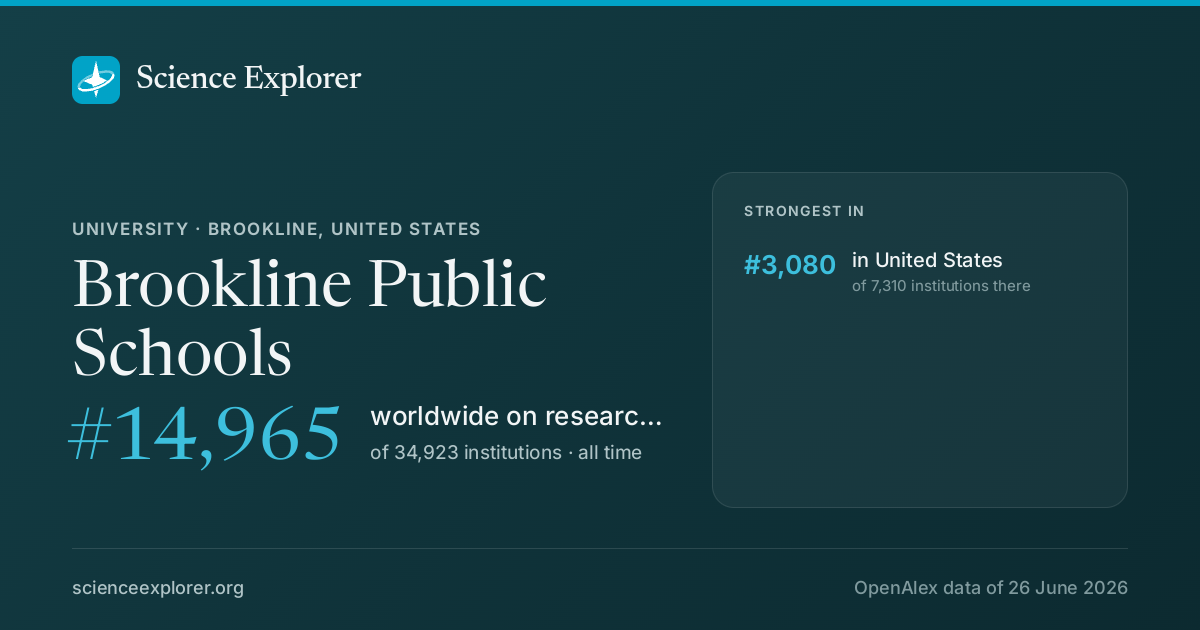
University · Brookline · United States

Brookline Public Schools

World rank, all time
#14,965
of 34,923
Rank in United States
#3,080
of 7,310
Research works
290
▲ 119% vs 2018-21
Citations
4.5k
15.6 per fractional work
Top-10% rate
10.3%
all institutions 10.0%
vs its own fields
1.06×
1.00× is exactly expected
Open access
21%
world 40%
International
8%
world 18%

Which fields of science does Brookline Public Schools work in?

In 2022-now, 37% of research at Brookline Public Schools is in Social Sciences, 29% in Physical Sciences. Its largest fields are Medicine (21%), Social Sciences (19%), Engineering (10%). It does 1.4× the world's share of Social Sciences.

Social Sciences: 15 fractional works · 37.5% of its workSocial Sciences: 8 fractional works · 18.9% of its workSociology and Political Science: 2 fractional works · 5.6% of its workEducation: 2 fractional works · 4.6% of its workPolitical Science and International Relations: 1 fractional works · 3.3% of its workDemography: 1 fractional works · 3.1% of its workHealth: 0 fractional works · 0.9% of its workTransportation: 0 fractional works · 0.8% of its workSafety Research: 0 fractional works · 0.4% of its workHuman Factors and Ergonomics: 0 fractional works · 0.2% of its workSmaller subfields together: 0 fractional works · 0.1% of its workPsychology: 2 fractional works · 6.0% of its workClinical Psychology: 1 fractional works · 3.4% of its workSocial Psychology: 1 fractional works · 1.9% of its workApplied Psychology: 0 fractional works · 0.4% of its workSmaller subfields together: 0 fractional works · 0.3% of its workBusiness, Management and Accounting: 2 fractional works · 4.5% of its workStrategy and Management: 1 fractional works · 3.3% of its workMarketing: 0 fractional works · 1.1% of its workSmaller subfields together: 0 fractional works · 0.1% of its workArts and Humanities: 2 fractional works · 3.9% of its workHistory and Philosophy of Science: 0 fractional works · 0.8% of its workPhilosophy: 0 fractional works · 0.8% of its workVisual Arts and Performing Arts: 0 fractional works · 0.8% of its workMuseology: 0 fractional works · 0.6% of its workConservation: 0 fractional works · 0.4% of its workMusic: 0 fractional works · 0.4% of its workEconomics, Econometrics and Finance: 1 fractional works · 2.7% of its workEconomics and Econometrics: 1 fractional works · 1.9% of its workFinance: 0 fractional works · 0.8% of its workDecision Sciences: 1 fractional works · 1.5% of its workManagement Science and Operations Research: 0 fractional works · 1.1% of its workInformation Systems and Management: 0 fractional works · 0.4% of its workPhysical Sciences: 12 fractional works · 28.8% of its workEngineering: 4 fractional works · 10.4% of its workMechanical Engineering: 1 fractional works · 2.7% of its workBiomedical Engineering: 1 fractional works · 2.3% of its workControl and Systems Engineering: 1 fractional works · 1.5% of its workElectrical and Electronic Engineering: 1 fractional works · 1.5% of its workAutomotive Engineering: 0 fractional works · 0.5% of its workMedia Technology: 0 fractional works · 0.4% of its workArchitecture: 0 fractional works · 0.4% of its workBuilding and Construction: 0 fractional works · 0.4% of its workIndustrial and Manufacturing Engineering: 0 fractional works · 0.4% of its workMechanics of Materials: 0 fractional works · 0.2% of its workComputer Science: 4 fractional works · 8.8% of its workArtificial Intelligence: 1 fractional works · 2.5% of its workInformation Systems: 1 fractional works · 2.4% of its workHuman-Computer Interaction: 1 fractional works · 1.4% of its workComputational Theory and Mathematics: 0 fractional works · 1.1% of its workComputer Vision and Pattern Recognition: 0 fractional works · 0.7% of its workComputer Networks and Communications: 0 fractional works · 0.3% of its workComputer Science Applications: 0 fractional works · 0.2% of its workSoftware: 0 fractional works · 0.2% of its workSmaller subfields together: 0 fractional works · 0.0% of its workMaterials Science: 1 fractional works · 3.4% of its workMaterials Chemistry: 1 fractional works · 2.7% of its workElectronic, Optical and Magnetic Materials: 0 fractional works · 0.7% of its workSmaller subfields together: 0 fractional works · 0.1% of its workEnvironmental Science: 1 fractional works · 2.0% of its workEcology: 0 fractional works · 1.2% of its workEnvironmental Engineering: 0 fractional works · 0.4% of its workHealth, Toxicology and Mutagenesis: 0 fractional works · 0.3% of its workSmaller subfields together: 0 fractional works · 0.1% of its workPhysics and Astronomy: 1 fractional works · 1.4% of its workRadiation: 0 fractional works · 1.1% of its workCondensed Matter Physics: 0 fractional works · 0.2% of its workSmaller subfields together: 0 fractional works · 0.1% of its workChemical Engineering: 0 fractional works · 1.1% of its workFluid Flow and Transfer Processes: 0 fractional works · 1.1% of its workMathematics: 0 fractional works · 0.9% of its workApplied Mathematics: 0 fractional works · 0.4% of its workStatistics and Probability: 0 fractional works · 0.4% of its workSmaller subfields together: 0 fractional works · 0.0% of its workEnergy: 0 fractional works · 0.8% of its workEnergy Engineering and Power Technology: 0 fractional works · 0.4% of its workRenewable Energy, Sustainability and the Environment: 0 fractional works · 0.4% of its workHealth Sciences: 9 fractional works · 23.2% of its workMedicine: 9 fractional works · 21.0% of its workSurgery: 2 fractional works · 4.0% of its workInfectious Diseases: 1 fractional works · 2.7% of its workDermatology: 1 fractional works · 1.9% of its workPhysiology: 1 fractional works · 1.6% of its workPsychiatry and Mental health: 1 fractional works · 1.4% of its workEndocrinology, Diabetes and Metabolism: 0 fractional works · 1.2% of its workEpidemiology: 0 fractional works · 1.0% of its workPharmacology: 0 fractional works · 1.0% of its workOncology: 0 fractional works · 0.9% of its workReproductive Medicine: 0 fractional works · 0.8% of its workPulmonary and Respiratory Medicine: 0 fractional works · 0.7% of its workPublic Health, Environmental and Occupational Health: 0 fractional works · 0.6% of its workEmergency Medicine: 0 fractional works · 0.5% of its workRadiology, Nuclear Medicine and Imaging: 0 fractional works · 0.4% of its workCardiology and Cardiovascular Medicine: 0 fractional works · 0.4% of its workCritical Care and Intensive Care Medicine: 0 fractional works · 0.4% of its workGenetics: 0 fractional works · 0.4% of its workUrology: 0 fractional works · 0.4% of its workBiochemistry: 0 fractional works · 0.3% of its workAnesthesiology and Pain Medicine: 0 fractional works · 0.2% of its workSmaller subfields together: 0 fractional works · 0.4% of its workHealth Professions: 1 fractional works · 2.2% of its workGeneral Health Professions: 0 fractional works · 1.1% of its workEmergency Medical Services: 0 fractional works · 0.4% of its workOccupational Therapy: 0 fractional works · 0.3% of its workSmaller subfields together: 0 fractional works · 0.4% of its workLife Sciences: 4 fractional works · 10.4% of its workNeuroscience: 2 fractional works · 4.7% of its workCognitive Neuroscience: 1 fractional works · 3.6% of its workCellular and Molecular Neuroscience: 0 fractional works · 0.5% of its workNeurology: 0 fractional works · 0.5% of its workSmaller subfields together: 0 fractional works · 0.1% of its workBiochemistry, Genetics and Molecular Biology: 1 fractional works · 2.4% of its workMolecular Biology: 1 fractional works · 1.6% of its workBiophysics: 0 fractional works · 0.3% of its workGenetics: 0 fractional works · 0.3% of its workSmaller subfields together: 0 fractional works · 0.2% of its workPharmacology, Toxicology and Pharmaceutics: 1 fractional works · 1.5% of its workPharmacology: 0 fractional works · 0.9% of its workToxicology: 0 fractional works · 0.6% of its workAgricultural and Biological Sciences: 0 fractional works · 1.2% of its workEcology, Evolution, Behavior and Systematics: 0 fractional works · 1.2% of its workImmunology and Microbiology: 0 fractional works · 0.7% of its workImmunology: 0 fractional works · 0.5% of its workSmaller subfields together: 0 fractional works · 0.2% of its workALL ITS WORKBrookline PublicSchools41fractional works, 2022-now
Life Sciences10%Physical Sciences29%Health Sciences23%Social Sciences37%

Each ring splits the one inside it: the four domains of science, their fields, their subfields. Size is fractional works in 2022-now. Every slice is a page; the interactive view zooms down to single topics and colours each by how much more of it this institution does than the world.

Its 4 domains and 21 fields, with their numbers
    1. Social Sciences818.9%
    2. Psychology26.0%
    3. Business, Management and Accounting24.5%
    4. Arts and Humanities23.9%
    5. Economics, Econometrics and Finance12.7%
    6. Decision Sciences11.5%
    1. Engineering410.4%
    2. Computer Science48.8%
    3. Materials Science13.4%
    4. Environmental Science12.0%
    5. Physics and Astronomy11.4%
    6. Chemical Engineering01.1%
    7. Mathematics00.9%
    8. Energy00.8%
    1. Medicine921.0%
    2. Health Professions12.2%
    1. Neuroscience24.7%
    2. Biochemistry, Genetics and Molecular Biology12.4%
    3. Pharmacology, Toxicology and Pharmaceutics11.5%
    4. Agricultural and Biological Sciences01.2%
    5. Immunology and Microbiology00.7%
All of science, and how each field's share has moved since 1950: the Science domain explorer

Field profile

Location quotient across every field it publishes in: outside the ring is more than an institution of this size would be expected to publish, inside it is less.

Agricultural and Biological Sciences: 0.26× its world share, 0 worksAgricultural and Bio…Biochemistry, Genetics and Molecular Biology: 0.44× its world share, 1 worksBiochemistry, Geneti…Immunology and Microbiology: 0.67× its world share, 0 worksImmunology and Micro…Neuroscience: 2.90× its world share, 2 worksNeurosciencePharmacology, Toxicology and Pharmaceutics: 4.18× its world share, 1 worksPharmacology, Toxico…Chemical Engineering: 3.12× its world share, 0 worksChemical EngineeringComputer Science: 1.13× its world share, 4 worksComputer ScienceEnergy: 0.89× its world share, 0 worksEnergyEngineering: 0.69× its world share, 4 worksEngineeringEnvironmental Science: 0.41× its world share, 1 worksEnvironmental ScienceMaterials Science: 0.98× its world share, 1 worksMaterials ScienceMathematics: 0.75× its world share, 0 worksMathematicsPhysics and Astronomy: 0.62× its world share, 1 worksPhysics and AstronomyHealth Professions: 0.84× its world share, 1 worksHealth ProfessionsMedicine: 1.09× its world share, 9 worksMedicineArts and Humanities: 1.35× its world share, 2 worksArts and HumanitiesBusiness, Management and Accounting: 1.39× its world share, 2 worksBusiness, Management…Decision Sciences: 1.55× its world share, 1 worksDecision SciencesEconomics, Econometrics and Finance: 1.28× its world share, 1 worksEconomics, Econometr…Psychology: 1.97× its world share, 2 worksPsychologySocial Sciences: 1.49× its world share, 8 worksSocial Sciences1×world share
more than its size predictsabout as predictedless

Rings at 0.5×, 1× and 2×. Widest outward: Pharmacology, Toxicology and Pharmaceutics, 4.2×. Every wedge is a field page.

All 21 fields, with their numbers
  1. Pharmacology, Toxicology and Pharmaceutics4.18×1 works
  2. Chemical Engineering3.12×0 works
  3. Neuroscience2.90×2 works
  4. Psychology1.97×2 works
  5. Decision Sciences1.55×1 works
  6. Social Sciences1.49×8 works
  7. Business, Management and Accounting1.39×2 works
  8. Arts and Humanities1.35×2 works
  9. Economics, Econometrics and Finance1.28×1 works
  10. Computer Science1.13×4 works
  11. Medicine1.09×9 works
  12. Materials Science0.98×1 works
  13. Energy0.89×0 works
  14. Health Professions0.84×1 works
  15. Mathematics0.75×0 works
  16. Engineering0.69×4 works
  17. Immunology and Microbiology0.67×0 works
  18. Physics and Astronomy0.62×1 works
  19. Biochemistry, Genetics and Molecular Biology0.44×1 works
  20. Environmental Science0.41×1 works
  21. Agricultural and Biological Sciences0.26×0 works

Who are the top researchers at Brookline Public Schools?

Ranked on the quality score, Caroline G. Soule, John C. Packard and Margaret Treece Metzger lead among researchers whose main affiliation is Brookline Public Schools.

  1. 1 Caroline G. Soule United States · #2,393,435 worldwide 76 citations · 65 works
  2. 2 John C. Packard United States · #2,708,221 worldwide 15 citations · 42 works
  3. 3 Margaret Treece Metzger United States · #3,386,999 worldwide 216 citations · 16 works
  4. 4 Robert G. Andree United States · #4,786,098 worldwide 13 citations · 26 works
All ranked researchers at Brookline Public Schools

What are the most cited papers from Brookline Public Schools?

The most cited paper from Brookline Public Schools is "Fungal microbiota dysbiosis in IBD" (Harry Sokol, Valentin Leducq, Hugues Aschard et al., 2016), with 1,375 citations. Next come "A Hypothesis: Nonsteroidal Anti-Inflammatory Drugs Reduce the Incidence of Large-Bowel Cancer" (506) and "The impact and recovery of asteroid 2008 TC3" (379).

Most cited papers
#PaperReleasedCitations
1 Fungal microbiota dysbiosis in IBD Harry Sokol, Valentin Leducq, Hugues Aschard et al. · Gut Open access 3 Feb 2016 1,375
2 A Hypothesis: Nonsteroidal Anti-Inflammatory Drugs Reduce the Incidence of Large-Bowel Cancer Lynn A. Rosenberg, Julie R. Palmer, Ann Graham Zauber et al. · JNCI Journal of the National Cancer Institute 6 Mar 1991 506
3 The impact and recovery of asteroid 2008 TC3 Peter M. Jenniskens et al. · Nature Mar 2009 379
4 An Empirical Analysis of Traceability in the Monero Blockchain Malte Möser, Kyle Soska, Ethan Heilman et al. · DOAJ (DOAJ: Directory of Open Access Journals) Jun 2018 267
5 Imaging of Inflamed and Vulnerable Plaque in Coronary Arteries with 18F-FDG PET/CT in Patients with Suppression of Myocardial Uptake Using a Low-Carbohydrate, High-Fat Preparation Joanna J. Wykrzykowska, Sanaz Lehman, Gethin Williams et al. · Journal of Nuclear Medicine Open access 16 Mar 2009 265
All 59 most cited papers, with filters and sorting

Which keywords describe research at Brookline Public Schools?

By fractional works in 2022-now, weighted toward what it does more of than the world: Social Support, SARS-CoV-2, Diplomacy, Early Modern, European Company Law, Gear Dynamics, Lifestyle Migration and Mesh Stiffness.

▲ more of its work than of the world's◆ about the world's share▼ less than the world's

Size is fractional works in 2022-now in the topics tagged with each word; colour is the word's share of this institution's work against its share of the world's. The 22 words are chosen for being large and distinctive. Each links to the topic it comes from most.

All 22 words, with their numbers
  1. Epidemiology2◆ 1.06×17 topics
  2. Deep Learning2◆ 1.07×13 topics
  3. Social Support1▲ 6.5×7 topics
  4. COVID-191▲ 2.2×7 topics
  5. Clinical Trials1▲ 4.5×7 topics
  6. Economic Growth1▲ 3.8×3 topics
  7. Machine Learning1◆ 0.90×6 topics
  8. Meta-Analysis1▲ 4.9×3 topics
  9. Neural Networks1▲ 1.86×5 topics
  10. Pandemic1▲ 2.9×5 topics
  11. Education1▲ 1.55×3 topics
  12. Quality of Life1▲ 1.89×10 topics
  13. SARS-CoV-21▲ 8.7×3 topics
  14. Diplomacy1▲ 26×1 topic
  15. Early Modern1▲ 215×1 topic
  16. European Company Law1▲ 195×1 topic
  17. Gear Dynamics1▲ 78×1 topic
  18. Lifestyle Migration1▲ 112×1 topic
  19. Mental Health1▲ 1.79×12 topics
  20. Mesh Stiffness1▲ 78×1 topic
  21. Regulatory Competition1▲ 195×1 topic
  22. Retirement Migration1▲ 112×1 topic

Which research topics does Brookline Public Schools publish most on?

By volume in 2022-now: Gear and Bearing Dynamics Analysis, Historical Influence and Diplomacy, Migration, Aging, and Tourism Studies and Corporate Governance and Law.

  1. 1 Gear and Bearing Dynamics Analysis Mechanical Engineering 1 works
  2. 2 Historical Influence and Diplomacy Political Science and International Relations 1 works
  3. 3 Migration, Aging, and Tourism Studies Demography 1 works
  4. 4 Corporate Governance and Law Strategy and Management 1 works
  5. 5 Advancements in Solid Oxide Fuel Cells Materials Chemistry 1 works
  6. 6 Regional Development and Environment Sociology and Political Science 0 works
  7. 7 Agriculture, Soil, Plant Science Ecology, Evolution, Behavior and Systematics 0 works
  8. 8 Agriculture Sustainability and Environmental Impact Ecology 0 works
  9. 9 Advanced Radiotherapy Techniques Radiation 0 works
  10. 10 Stock Market Forecasting Methods Management Science and Operations Research 0 works

How open and international is its research?

Against the world's own shares: the tick on each track. Both are shares of its output, so they sit on one scale and can be read against each other as well as against the world.

openly available21.2%not open78.8%

World: 40% of research is openly available.

with international co-authors8.2%domestic only91.8%

World: 18% is written across borders.

How has Brookline Public Schools's research output changed?

Output in 2022-2025 was 119% higher than in 2018-2021.

still counting1990200020102020
grewheldshrank

The same series as a ribbon: one cell per year, darker for more. The line above answers how much; this answers when.

Its share of all research

Growing output can still be a shrinking share: all of science grows. This is Brookline Public Schools as a percentage of every work published that year, 0.000065% in 2024.

still counting0.0010%0.0020%Brookline Public Schools0.00023% in 202519801990200020102020

Fractional works of Brookline Public Schools over all fractional works that year. How the balance of science has shifted.

Other research institutions in Brookline

All research institutions in Brookline

Share Brookline Public Schools's ranking

Brookline Public Schools on Science Explorer

A card with Brookline Public Schools's standing and the fields it leads in, for a post or a slide. A link to this page previews as the same card.

Download the card

1200 × 630 PNG, sized for social posts, drawn from the latest snapshot.

Badges for a website1Each links back here and updates with every snapshot

Research measures only: rankings here say nothing about teaching, admissions or student experience. Comparable institutions and collaboration partners have tabs of their own, above.

Discussion

Ask a question or share a note about Brookline Public Schools. Posts are plain text and can be reported.

