Newbury College
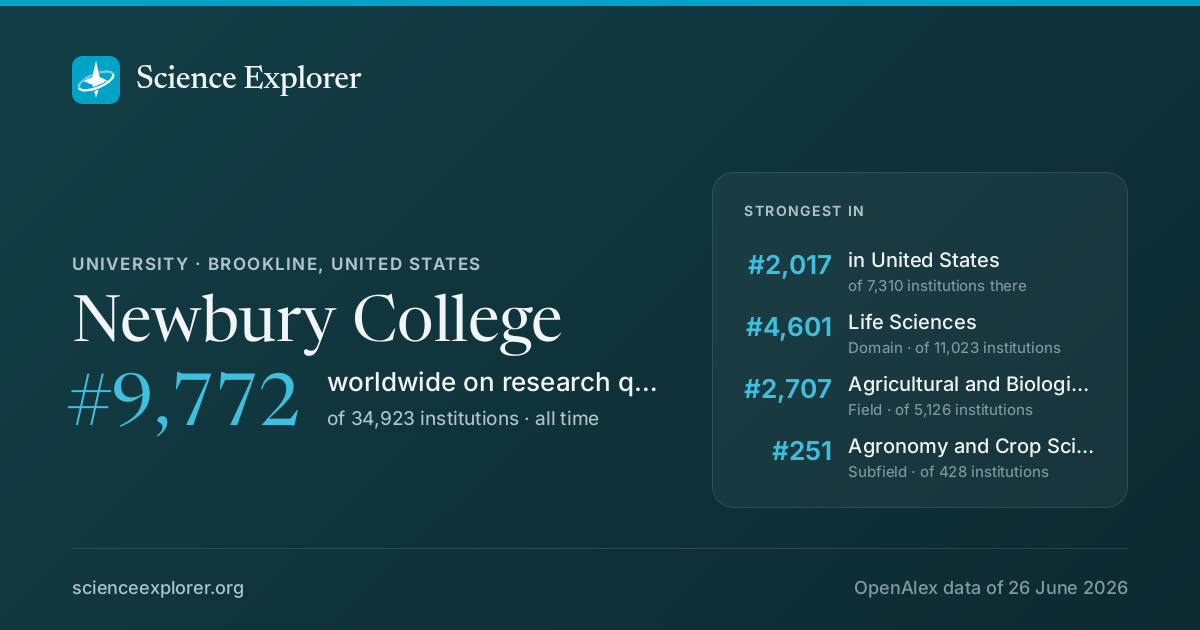
In research, Newbury College stands highest in Life Sciences (#4,601 of 11,023 worldwide), Agricultural and Biological Sciences (#2,707 of 5,126 worldwide) and Agronomy and Crop Science (#251 of 428 worldwide), over all time.
- World rank, all time
- #9,772 of 34,923
- Rank in United States
- #2,017 of 7,310
- Research works
- 1.7k ▼ 40% vs 2018-21
- Citations
- 50k 30.1 per fractional work
- Top-10% rate
- 10.1% all institutions 10.0%
- vs its own fields
- 1.08× 1.00× is exactly expected
- Open access
- 20% world 40%
- International
- 31% world 18%
What is Newbury College known for in research?
The fields where it stands highest, over all time, ranked among every institution above the floor in each field.
| Field | World rank | Where that sits | Top-10% rate | Works |
|---|---|---|---|---|
| Life SciencesDomain | #4,601 of 11,023 | 10.4% | 797 | |
| Agricultural and Biological SciencesField | #2,707 of 5,126 | 11.7% | 369 | |
| Agronomy and Crop ScienceSubfield | #251 of 428 | 10.8% | 134 | |
| Health SciencesDomain | #9,830 of 16,688 | 9.8% | 473 | |
| Biochemistry, Genetics and Molecular BiologyField | #3,792 of 5,801 | 10.1% | 232 | |
| MedicineField | #9,718 of 14,558 | 10.8% | 318 | |
| Immunology and MicrobiologyField | #1,067 of 1,587 | 8.6% | 176 | |
| Physical SciencesDomain | #14,557 of 17,446 | 7.6% | 290 |
Each strip is that field's whole ranked pool, with the notch where Newbury College sits in it, in the colour of the band that rank falls in. The track under the rate is the rate itself: it carries no average mark, because the average differs by field (from about 6% in Dentistry to 21% in Economics).
Which fields of science does Newbury College work in?
In 2022-now, 47% of research at Newbury College is in Health Sciences, 20% in Physical Sciences. Its largest fields are Medicine (30%), Veterinary (16%), Engineering (10%). It does 1.8× the world's share of Health Sciences.
Each ring splits the one inside it: the four domains of science, their fields, their subfields. Size is fractional works in 2022-now. Every slice is a page; the interactive view zooms down to single topics and colours each by how much more of it this institution does than the world.
Its 4 domains and 20 fields, with their numbers
- Health Sciences1947.4%
- Medicine1229.8%
- Veterinary615.6%
- Health Professions12.0%
- Physical Sciences820.1%
- Engineering49.9%
- Environmental Science25.3%
- Computer Science11.8%
- Materials Science11.5%
- Energy00.8%
- Earth and Planetary Sciences00.5%
- Chemistry00.4%
- Life Sciences716.9%
- Social Sciences615.6%
- Psychology37.1%
- Arts and Humanities26.1%
- Social Sciences11.8%
- Decision Sciences00.5%
- Business, Management and Accounting00.1%
Field profile
Location quotient across every field it publishes in: outside the ring is more than an institution of this size would be expected to publish, inside it is less.
Rings at 0.5×, 1× and 2×. Widest outward: Veterinary, 114.6×. Every wedge is a field page.
All 20 fields, with their numbers
- Veterinary114.60×6 works
- Pharmacology, Toxicology and Pharmaceutics3.64×0 works
- Neuroscience3.00×2 works
- Immunology and Microbiology2.80×1 works
- Psychology2.32×3 works
- Arts and Humanities2.10×2 works
- Medicine1.55×12 works
- Environmental Science1.06×2 works
- Biochemistry, Genetics and Molecular Biology1.03×2 works
- Energy0.84×0 works
- Health Professions0.75×1 works
- Engineering0.66×4 works
- Decision Sciences0.53×0 works
- Agricultural and Biological Sciences0.52×1 works
- Materials Science0.44×1 works
- Earth and Planetary Sciences0.29×0 works
- Chemistry0.25×0 works
- Computer Science0.23×1 works
- Social Sciences0.15×1 works
- Business, Management and Accounting0.04×0 works
- Veterinary 114.6×
- Pharmacology, Toxicology and Pharmaceutics 3.6×
- Neuroscience 3.0×
- Immunology and Microbiology 2.8×
- Psychology 2.3×
- Arts and Humanities 2.1×
- Medicine 1.6×
- Environmental Science 1.1×
- Biochemistry, Genetics and Molecular Biology 1.0×
- Energy 0.8×
- Health Professions 0.8×
- Engineering 0.7×
- Decision Sciences 0.5×
- Agricultural and Biological Sciences 0.5×
- Materials Science 0.4×
- Earth and Planetary Sciences 0.3×
- Chemistry 0.2×
- Computer Science 0.2×
- Social Sciences 0.1×
- Business, Management and Accounting 0.0×
Who are the top researchers at Newbury College?
Ranked on the quality score, John B. Patterson, J. C. Bridger and James C. Anderson lead among researchers whose main affiliation is Newbury College.
- 1
John B. Patterson
 United States · #104,277 worldwide
5.4k citations · 82 works
- 2
J. C. Bridger
United States · #901,656 worldwide
4.4k citations · 79 works
- 3
James C. Anderson
United States · #1,185,425 worldwide
84k citations · 332 works
- 4
R.H. Kimberlin
United States · #1,260,406 worldwide
4.7k citations · 77 works
- 5
R. A. Gibbons
United States · #1,424,622 worldwide
2.5k citations · 62 works
- 6
Dave Cavanagh
United States · #1,697,841 worldwide
3.1k citations · 43 works
- 7
D.A. Haig
United States · #1,843,463 worldwide
2.4k citations · 47 works
- 8
Lawrence Davis
United States · #2,045,656 worldwide
13k citations · 46 works
- 9
G. D. Baird
United States · #2,372,030 worldwide
1.9k citations · 38 works
- 10
Phillip W. Jones
United States · #2,393,638 worldwide
2k citations · 62 works
Which keywords describe research at Newbury College?
By fractional works in 2022-now, weighted toward what it does more of than the world: Equine Health, Welfare Assessment, Pain Assessment, Adventure Education, Experiential Learning, Philosophy of Science, Immunotherapy and Analgesia.
- Inflammatory Disease
- Biomarkers
- Multijunction Solar Cells
- Treatment
- Inflammation
- Obesity
- Anesthesia
- Machine Learning
- Logical Empiricism
- Analgesia
- Immunotherapy
- Pain Assessment
- Adventure Education
- Equine Health
- Epidemiology
- Welfare Assessment
- Experiential Learning
- Philosophy of Science
- Oxidative Stress
- Postoperative Pain
- Vienna Circle
- Pharmacokinetics
- Clinical Trials
- Tramadol
- Osteoarthritis
- High Efficiency
- Prostate Cancer
- Energy Balance
- Prurigo Pigmentosa
Size is fractional works in 2022-now in the topics tagged with each word; colour is the word's share of this institution's work against its share of the world's. The 29 words are chosen for being large and distinctive. Each links to the topic it comes from most.
All 29 words, with their numbers
- Epidemiology3▲ 1.98×12 topics
- Equine Health3▲ 579×1 topic
- Welfare Assessment3▲ 579×1 topic
- Adventure Education2▲ 830×1 topic
- Experiential Learning2▲ 97×1 topic
- Pain Assessment2▲ 239×2 topics
- Philosophy of Science2▲ 156×2 topics
- Immunotherapy2▲ 6.5×7 topics
- Oxidative Stress2▲ 2.7×14 topics
- Analgesia2▲ 64×2 topics
- Postoperative Pain2▲ 45×2 topics
- Logical Empiricism2▲ 498×1 topic
- Vienna Circle2▲ 498×1 topic
- Machine Learning1◆ 1.02×7 topics
- Pharmacokinetics1▲ 13×3 topics
- Anesthesia1▲ 44×1 topic
- Clinical Trials1▲ 5.0×6 topics
- Obesity1▲ 4.1×5 topics
- Tramadol1▲ 293×1 topic
- Inflammation1▲ 1.42×9 topics
- Osteoarthritis1▲ 22×3 topics
- Treatment1▲ 2.5×3 topics
- High Efficiency1▲ 74×1 topic
- Multijunction Solar Cells1▲ 143×1 topic
- Prostate Cancer1▲ 20×3 topics
- Biomarkers1▲ 3.7×3 topics
- Energy Balance1▲ 43×2 topics
- Inflammatory Disease1▲ 52×1 topic
- Prurigo Pigmentosa1▲ 251×1 topic
Which research topics does Newbury College publish most on?
By volume in 2022-now: Veterinary Equine Medical Research, Outdoor and Experiential Education, Philosophy, Science, and History and Veterinary Pharmacology and Anesthesia.
Area is fractional works; colour is the subfield each topic belongs to.
- 1 Veterinary Equine Medical Research Equine 3 works
- 2 Outdoor and Experiential Education Social Psychology 2 works
- 3 Philosophy, Science, and History History and Philosophy of Science 2 works
- 4 Veterinary Pharmacology and Anesthesia Small Animals 1 works
- 5 solar cell performance optimization Electrical and Electronic Engineering 1 works
- 6 Medicine and Dermatology Studies History Dermatology 1 works
- 7 Veterinary Orthopedics and Neurology Small Animals 1 works
- 8 Reproductive Physiology in Livestock Agronomy and Crop Science 1 works
- 9 Animal health and immunology Small Animals 0 works
- 10 Prostate Cancer Treatment and Research Pulmonary and Respiratory Medicine 0 works
How open and international is its research?
Against the world's own shares: the tick on each track. Both are shares of its output, so they sit on one scale and can be read against each other as well as against the world.
World: 40% of research is openly available.
World: 18% is written across borders.
How has Newbury College's research output changed?
Output in 2022-2025 was 40% lower than in 2018-2021.
The same series as a ribbon: one cell per year, darker for more. The line above answers how much; this answers when.
Its share of all research
Growing output can still be a shrinking share: all of science grows. This is Newbury College as a percentage of every work published that year, 0.000073% in 2024.
Fractional works of Newbury College over all fractional works that year. How the balance of science has shifted.
How much of it reaches the world top 10%
Year by year, against all institutions in the same year.
Of each year's output, the share that reached the world's 10% most cited for its field and year. Peak 23.0% in 2001.
Other research institutions in Brookline
- Policy Analysis (United States)
- Hebrew College
- New England Institute of Art
- Brookline Public Schools
- Hellenic College Holy Cross Greek Orthodox School of Theology
- Boston Graduate School of Psychoanalysis
- International Society for Infectious Diseases
- Lown Institute
Share Newbury College's ranking
Badges for a website1Each links back here and updates with every snapshot

Research measures only: rankings here say nothing about teaching, admissions or student experience. Comparable institutions and collaboration partners have tabs of their own, above.
Discussion
Ask a question or share a note about Newbury College. Posts are plain text and can be reported.