Brooklyn Law School
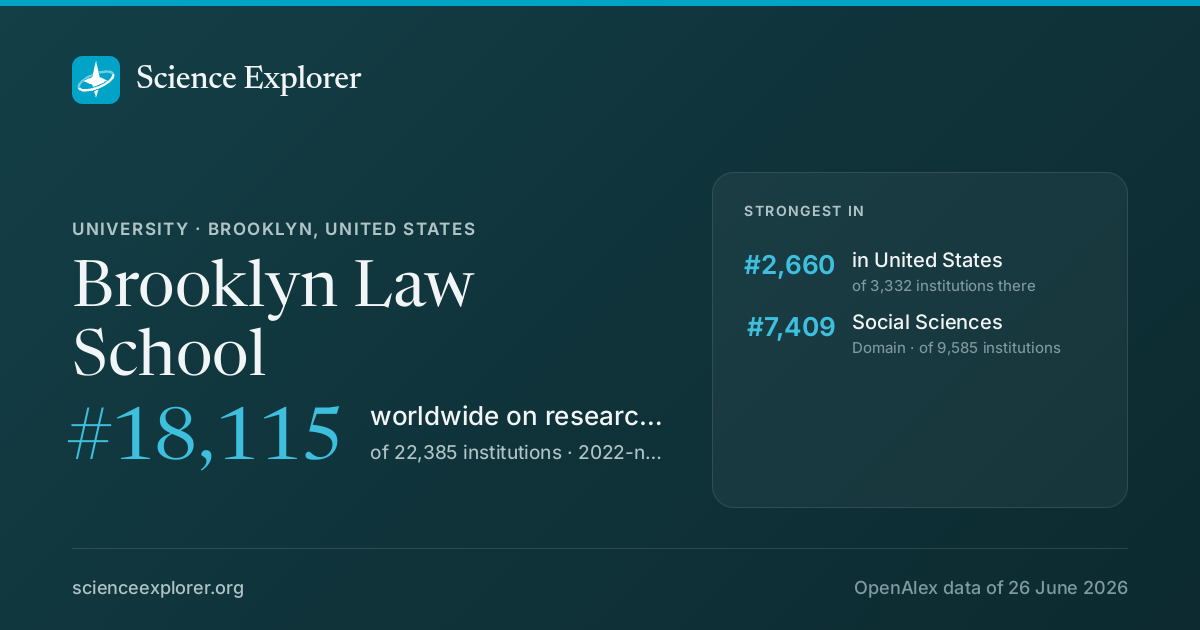
In research, Brooklyn Law School stands highest in Social Sciences (#7,409 of 9,585 worldwide), 2022-now.
- World rank, 2022-now
- #18,115 of 22,385 · #11,599 all time
- Rank in United States
- #2,660 of 3,332
- Research works
- 2.2k ▼ 53% vs 2018-21
- Citations
- 11k 5.1 per fractional work
- Top-10% rate
- 5.5% all institutions 10.0%
- vs its own fields
- 0.89× 1.00× is exactly expected
- Open access
- 76% world 40%
- International
- 2% world 18%
What is Brooklyn Law School known for in research?
The fields where it stands highest, 2022-now, ranked among every institution above the floor in each field.
| Field | World rank | Where that sits | Top-10% rate | Works | All time |
|---|---|---|---|---|---|
| Social SciencesDomain | #7,409 of 9,585 | 5.6% | 89 | #2835 |
Each strip is that field's whole ranked pool, with the notch where Brooklyn Law School sits in it, in the colour of the band that rank falls in. The track under the rate is the rate itself: it carries no average mark, because the average differs by field (from about 6% in Dentistry to 21% in Economics).
Which fields of science does Brooklyn Law School work in?
In 2022-now, 78% of research at Brooklyn Law School is in Social Sciences, 11% in Physical Sciences. Its largest fields are Social Sciences (48%), Business, Management and Accounting (12%), Economics, Econometrics and Finance (10%). It does 3.0× the world's share of Social Sciences.
Each ring splits the one inside it: the four domains of science, their fields, their subfields. Size is fractional works in 2022-now. Every slice is a page; the interactive view zooms down to single topics and colours each by how much more of it this institution does than the world.
Its 4 domains and 20 fields, with their numbers
- Social Sciences9478.4%
- Social Sciences5747.8%
- Business, Management and Accounting1412.0%
- Economics, Econometrics and Finance1210.4%
- Psychology54.0%
- Arts and Humanities43.5%
- Decision Sciences10.7%
- Physical Sciences1411.5%
- Computer Science108.0%
- Physics and Astronomy11.1%
- Environmental Science11.0%
- Engineering10.4%
- Chemical Engineering00.3%
- Chemistry00.3%
- Materials Science00.3%
- Energy00.1%
- Health Sciences86.9%
- Medicine64.6%
- Health Professions32.3%
- Life Sciences43.3%
Field profile
Location quotient across every field it publishes in: outside the ring is more than an institution of this size would be expected to publish, inside it is less.
Rings at 0.5×, 1× and 2×. Widest outward: Economics, Econometrics and Finance, 4.9×. Every wedge is a field page.
All 20 fields, with their numbers
- Economics, Econometrics and Finance4.86×12 works
- Social Sciences3.78×57 works
- Business, Management and Accounting3.73×14 works
- Pharmacology, Toxicology and Pharmaceutics2.38×1 works
- Psychology1.32×5 works
- Arts and Humanities1.20×4 works
- Computer Science1.03×10 works
- Neuroscience0.97×2 works
- Health Professions0.86×3 works
- Chemical Engineering0.80×0 works
- Decision Sciences0.72×1 works
- Physics and Astronomy0.50×1 works
- Medicine0.24×6 works
- Environmental Science0.20×1 works
- Chemistry0.18×0 works
- Agricultural and Biological Sciences0.11×1 works
- Energy0.10×0 works
- Materials Science0.08×0 works
- Biochemistry, Genetics and Molecular Biology0.06×0 works
- Engineering0.03×0 works
- Economics, Econometrics and Finance 4.9×
- Social Sciences 3.8×
- Business, Management and Accounting 3.7×
- Pharmacology, Toxicology and Pharmaceutics 2.4×
- Psychology 1.3×
- Arts and Humanities 1.2×
- Computer Science 1.0×
- Neuroscience 1.0×
- Health Professions 0.9×
- Chemical Engineering 0.8×
- Decision Sciences 0.7×
- Physics and Astronomy 0.5×
- Medicine 0.2×
- Environmental Science 0.2×
- Chemistry 0.2×
- Agricultural and Biological Sciences 0.1×
- Energy 0.1×
- Materials Science 0.1×
- Biochemistry, Genetics and Molecular Biology 0.1×
- Engineering 0.0×
Who are the top researchers at Brooklyn Law School?
Ranked on the quality score, David J. Reiss, Frank Pasquale and Lawrence M. Solan lead among researchers whose main affiliation is Brooklyn Law School.
- 1
David J. Reiss
 United States · #550,722 worldwide
30k citations · 297 works
- 2
Frank Pasquale
United States · #1,065,531 worldwide
7.7k citations · 175 works
- 3
Lawrence M. Solan
United States · #1,276,933 worldwide
2.8k citations · 182 works
- 4
K. Sabeel Rahman
United States · #1,557,620 worldwide
1.2k citations · 73 works
- 5
Julian Arato
United States · #1,700,123 worldwide
364 citations · 33 works
- 6
Norman S. Poser
United States · #1,981,505 worldwide
532 citations · 42 works
- 7
Gregg P. Macey
United States · #2,200,286 worldwide
470 citations · 41 works
- 8
Geoffrey Canada
United States · #2,201,410 worldwide
277 citations · 21 works
- 9
Elizabeth M. Schneider
United States · #2,394,455 worldwide
1.8k citations · 185 works
- 10
Andrew S. Gold
United States · #2,446,776 worldwide
331 citations · 106 works
Which keywords describe research at Brooklyn Law School?
By fractional works in 2022-now, weighted toward what it does more of than the world: Human Rights, International Law, Global Governance, Property Rights, Regulation, Corporate Governance, Democracy and Security Council.
- United Nations
- Responsibility to Protect
- Ethical Issues
- Environmental Law
- International Trade Law
- Exclusionary Rule
- First Amendment
- Humanitarian Intervention
- Tax Avoidance
- Privacy Rights
- Discrimination
- Constitutional Law
- Intellectual Property
- Sovereignty
- Equality
- Artificial Intelligence
- Democracy
- Corporate Governance
- Global Governance
- International Law
- Human Rights
- Globalization
- Property Rights
- Regulation
- Security Council
- Surveillance
- Criminal Justice
- State Sovereignty
- Judicial Review
- Neoliberalism
- Civil Rights
- Financial Reporting
- Criminal Trials
- Privacy
- Freedom of Speech
- Human Rights Act
- Public Opinion
- Regulatory Challenges
- Legal System
- Social Responsibility
Size is fractional works in 2022-now in the topics tagged with each word; colour is the word's share of this institution's work against its share of the world's. The 40 words are chosen for being large and distinctive. Each links to the topic it comes from most.
All 40 words, with their numbers
- Human Rights20▲ 16×19 topics
- International Law9▲ 23×11 topics
- Globalization7▲ 3.2×14 topics
- Global Governance7▲ 24×6 topics
- Property Rights6▲ 82×4 topics
- Corporate Governance6▲ 7.1×7 topics
- Regulation6▲ 9.3×6 topics
- Democracy6▲ 14×4 topics
- Security Council6▲ 97×2 topics
- Artificial Intelligence6▲ 3.3×11 topics
- Surveillance5▲ 16×4 topics
- Equality5▲ 72×4 topics
- Criminal Justice5▲ 18×4 topics
- Sovereignty5▲ 45×3 topics
- State Sovereignty5▲ 88×2 topics
- Intellectual Property5▲ 34×4 topics
- Judicial Review4▲ 44×3 topics
- Constitutional Law4▲ 27×2 topics
- Neoliberalism4▲ 9.7×6 topics
- Discrimination4▲ 16×2 topics
- Civil Rights4▲ 47×2 topics
- Privacy Rights4▲ 297×2 topics
- Financial Reporting4▲ 25×2 topics
- Tax Avoidance4▲ 77×2 topics
- Criminal Trials4▲ 252×2 topics
- Humanitarian Intervention4▲ 85×2 topics
- Privacy4▲ 10×2 topics
- First Amendment3▲ 628×1 topic
- Freedom of Speech3▲ 628×1 topic
- Exclusionary Rule3▲ 330×1 topic
- Human Rights Act3▲ 330×1 topic
- International Trade Law3▲ 20×2 topics
- Public Opinion3▲ 22×4 topics
- Environmental Law3▲ 12×4 topics
- Regulatory Challenges3▲ 28×4 topics
- Ethical Issues3▲ 23×4 topics
- Legal System3▲ 26×2 topics
- Responsibility to Protect3▲ 88×1 topic
- Social Responsibility3▲ 11×2 topics
- United Nations3▲ 88×1 topic
Which research topics does Brooklyn Law School publish most on?
By volume in 2022-now: Law, Rights, and Freedoms, Criminal Law and Evidence, Global Peace and Security Dynamics and World Trade Organization Law.
Area is fractional works; colour is the subfield each topic belongs to.
- 1 Law, Rights, and Freedoms Sociology and Political Science 3 works
- 2 Criminal Law and Evidence Law 3 works
- 3 Global Peace and Security Dynamics Political Science and International Relations 3 works
- 4 World Trade Organization Law Political Science and International Relations 3 works
- 5 International Law and Human Rights Political Science and International Relations 3 works
- 6 Legal Systems and Judicial Processes Political Science and International Relations 2 works
- 7 Criminal Justice and Corrections Analysis Sociology and Political Science 2 works
- 8 Law, AI, and Intellectual Property Artificial Intelligence 2 works
- 9 Corporate Taxation and Avoidance Accounting 2 works
- 10 International Arbitration and Investment Law Strategy and Management 2 works
How open and international is its research?
Against the world's own shares: the tick on each track. Both are shares of its output, so they sit on one scale and can be read against each other as well as against the world.
World: 40% of research is openly available.
World: 18% is written across borders.
How has Brooklyn Law School's research output changed?
Output in 2022-2025 was 53% lower than in 2018-2021.
The same series as a ribbon: one cell per year, darker for more. The line above answers how much; this answers when.
Its share of all research
Growing output can still be a shrinking share: all of science grows. This is Brooklyn Law School as a percentage of every work published that year, 0.00048% in 2024.
Fractional works of Brooklyn Law School over all fractional works that year. How the balance of science has shifted.
How much of it reaches the world top 10%
Year by year, against all institutions in the same year.
Of each year's output, the share that reached the world's 10% most cited for its field and year. Peak 12.9% in 2018.
Other research institutions in Brooklyn
- SUNY Downstate Health Sciences University
- ASA College
- Pratt Institute
- Kings County Hospital Center
- St. Francis College
- Center for Brooklyn History
- Coney Island Hospital
- Lutheran Medical Center

Share Brooklyn Law School's ranking
Badges for a website1Each links back here and updates with every snapshot

Research measures only: rankings here say nothing about teaching, admissions or student experience. Comparable institutions and collaboration partners have tabs of their own, above.
Discussion
Ask a question or share a note about Brooklyn Law School. Posts are plain text and can be reported.