Science Explorer Back to mapMap
Discussion
University · Kyoto · Japan

Bukkyo University

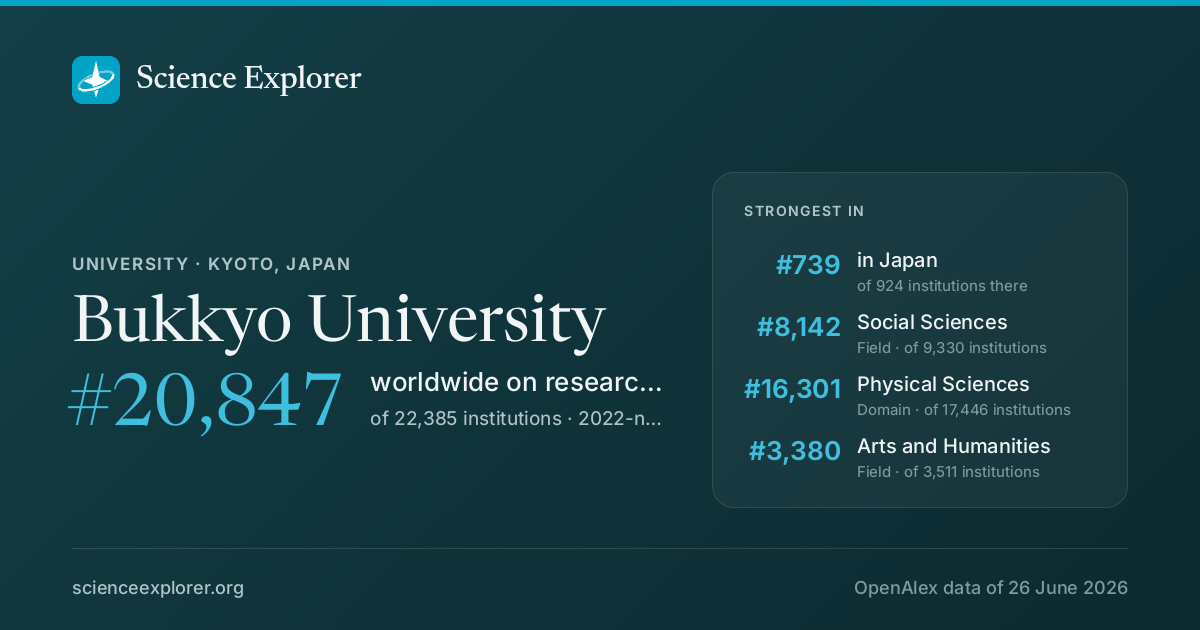
In research, Bukkyo University stands highest in Social Sciences (#8,142 of 9,330 worldwide), Social Sciences (#13,588 of 14,833 worldwide) and Physical Sciences (#16,301 of 17,446 worldwide), over all time.

World rank, 2022-now
#20,847
of 22,385 · #25,657 all time
Rank in Japan
#739
of 924
Research works
666
▲ 17% vs 2018-21
Citations
1.1k
1.7 per fractional work
Top-10% rate
4.1%
all institutions 10.0%
vs its own fields
0.94×
1.00× is exactly expected
Open access
85%
world 40%
International
4%
world 18%

What is Bukkyo University known for in research?

The fields where it stands highest, over all time, ranked among every institution above the floor in each field.

FieldWorld rankWhere that sitsTop-10% rateWorks
Social SciencesField #8,142 of 9,330 1.1%242
Social SciencesDomain #13,588 of 14,833 1.1%420
Physical SciencesDomain #16,301 of 17,446 2.1%127
Arts and HumanitiesField #3,380 of 3,511 0.4%141

Each strip is that field's whole ranked pool, with the notch where Bukkyo University sits in it, in the colour of the band that rank falls in. The track under the rate is the rate itself: it carries no average mark, because the average differs by field (from about 6% in Dentistry to 21% in Economics).

Which fields of science does Bukkyo University work in?

In 2022-now, 47% of research at Bukkyo University is in Health Sciences, 23% in Social Sciences. Its largest fields are Medicine (34%), Health Professions (13%), Psychology (11%). It does 1.9× the world's share of Health Sciences.

Health Sciences: 31 fractional works · 47.1% of its workMedicine: 22 fractional works · 33.5% of its workPharmacology: 3 fractional works · 4.3% of its workSurgery: 2 fractional works · 3.8% of its workOrthopedics and Sports Medicine: 2 fractional works · 3.6% of its workPhysiology: 2 fractional works · 3.0% of its workPsychiatry and Mental health: 2 fractional works · 2.6% of its workPublic Health, Environmental and Occupational Health: 2 fractional works · 2.5% of its workRehabilitation: 2 fractional works · 2.4% of its workReproductive Medicine: 2 fractional works · 2.4% of its workRheumatology: 1 fractional works · 1.6% of its workPediatrics, Perinatology and Child Health: 1 fractional works · 1.1% of its workPathology and Forensic Medicine: 1 fractional works · 1.0% of its workEpidemiology: 1 fractional works · 0.9% of its workPulmonary and Respiratory Medicine: 1 fractional works · 0.9% of its workEndocrinology, Diabetes and Metabolism: 0 fractional works · 0.6% of its workGeriatrics and Gerontology: 0 fractional works · 0.4% of its workComplementary and alternative medicine: 0 fractional works · 0.4% of its workOncology: 0 fractional works · 0.3% of its workCardiology and Cardiovascular Medicine: 0 fractional works · 0.3% of its workObstetrics and Gynecology: 0 fractional works · 0.3% of its workRadiology, Nuclear Medicine and Imaging: 0 fractional works · 0.3% of its workSmaller subfields together: 0 fractional works · 0.8% of its workHealth Professions: 9 fractional works · 13.2% of its workPhysical Therapy, Sports Therapy and Rehabilitation: 3 fractional works · 4.7% of its workGeneral Health Professions: 3 fractional works · 4.4% of its workSpeech and Hearing: 1 fractional works · 1.2% of its workEmergency Medical Services: 0 fractional works · 0.6% of its workRadiological and Ultrasound Technology: 0 fractional works · 0.6% of its workOccupational Therapy: 0 fractional works · 0.6% of its workMedical Laboratory Technology: 0 fractional works · 0.4% of its workComplementary and Manual Therapy: 0 fractional works · 0.3% of its workHealth Information Management: 0 fractional works · 0.3% of its workSmaller subfields together: 0 fractional works · 0.1% of its workNursing: 0 fractional works · 0.4% of its workResearch and Theory: 0 fractional works · 0.3% of its workSmaller subfields together: 0 fractional works · 0.2% of its workSocial Sciences: 15 fractional works · 22.9% of its workPsychology: 7 fractional works · 10.8% of its workClinical Psychology: 3 fractional works · 4.0% of its workDevelopmental and Educational Psychology: 2 fractional works · 3.6% of its workSocial Psychology: 1 fractional works · 1.9% of its workExperimental and Cognitive Psychology: 1 fractional works · 0.8% of its workApplied Psychology: 0 fractional works · 0.2% of its workNeuropsychology and Physiological Psychology: 0 fractional works · 0.2% of its workSocial Sciences: 5 fractional works · 7.9% of its workSociology and Political Science: 2 fractional works · 3.1% of its workEducation: 2 fractional works · 2.6% of its workPolitical Science and International Relations: 0 fractional works · 0.8% of its workSafety Research: 0 fractional works · 0.4% of its workHealth: 0 fractional works · 0.3% of its workDemography: 0 fractional works · 0.3% of its workGender Studies: 0 fractional works · 0.3% of its workSmaller subfields together: 0 fractional works · 0.2% of its workEconomics, Econometrics and Finance: 2 fractional works · 2.4% of its workEconomics and Econometrics: 1 fractional works · 1.9% of its workFinance: 0 fractional works · 0.6% of its workArts and Humanities: 1 fractional works · 1.5% of its workArcheology: 0 fractional works · 0.5% of its workLanguage and Linguistics: 0 fractional works · 0.3% of its workLiterature and Literary Theory: 0 fractional works · 0.3% of its workReligious studies: 0 fractional works · 0.3% of its workSmaller subfields together: 0 fractional works · 0.3% of its workBusiness, Management and Accounting: 0 fractional works · 0.2% of its workDecision Sciences: 0 fractional works · 0.1% of its workPhysical Sciences: 13 fractional works · 19.9% of its workEngineering: 4 fractional works · 6.4% of its workBiomedical Engineering: 3 fractional works · 4.4% of its workSafety, Risk, Reliability and Quality: 0 fractional works · 0.6% of its workControl and Systems Engineering: 0 fractional works · 0.5% of its workAerospace Engineering: 0 fractional works · 0.3% of its workMedia Technology: 0 fractional works · 0.3% of its workSmaller subfields together: 0 fractional works · 0.4% of its workEnvironmental Science: 4 fractional works · 6.2% of its workManagement, Monitoring, Policy and Law: 2 fractional works · 2.6% of its workNature and Landscape Conservation: 1 fractional works · 1.8% of its workHealth, Toxicology and Mutagenesis: 1 fractional works · 1.0% of its workGlobal and Planetary Change: 1 fractional works · 0.9% of its workMathematics: 2 fractional works · 3.1% of its workGeometry and Topology: 1 fractional works · 1.4% of its workMathematical Physics: 1 fractional works · 1.2% of its workTheoretical Computer Science: 0 fractional works · 0.3% of its workSmaller subfields together: 0 fractional works · 0.2% of its workPhysics and Astronomy: 2 fractional works · 2.3% of its workStatistical and Nonlinear Physics: 1 fractional works · 1.1% of its workNuclear and High Energy Physics: 1 fractional works · 1.0% of its workSmaller subfields together: 0 fractional works · 0.2% of its workComputer Science: 1 fractional works · 1.2% of its workComputer Vision and Pattern Recognition: 0 fractional works · 0.7% of its workArtificial Intelligence: 0 fractional works · 0.3% of its workInformation Systems: 0 fractional works · 0.2% of its workEnergy: 0 fractional works · 0.3% of its workEnergy Engineering and Power Technology: 0 fractional works · 0.3% of its workMaterials Science: 0 fractional works · 0.3% of its workMaterials Chemistry: 0 fractional works · 0.3% of its workChemistry: 0 fractional works · 0.2% of its workOrganic Chemistry: 0 fractional works · 0.2% of its workLife Sciences: 7 fractional works · 10.1% of its workNeuroscience: 3 fractional works · 4.8% of its workCognitive Neuroscience: 2 fractional works · 3.1% of its workCellular and Molecular Neuroscience: 1 fractional works · 0.8% of its workEndocrine and Autonomic Systems: 0 fractional works · 0.6% of its workNeurology: 0 fractional works · 0.4% of its workBiochemistry, Genetics and Molecular Biology: 3 fractional works · 4.3% of its workMolecular Biology: 1 fractional works · 2.2% of its workCell Biology: 1 fractional works · 1.4% of its workGenetics: 0 fractional works · 0.5% of its workSmaller subfields together: 0 fractional works · 0.2% of its workAgricultural and Biological Sciences: 0 fractional works · 0.6% of its workGeneral Agricultural and Biological Sciences: 0 fractional works · 0.5% of its workSmaller subfields together: 0 fractional works · 0.1% of its workPharmacology, Toxicology and Pharmaceutics: 0 fractional works · 0.3% of its workPharmacology: 0 fractional works · 0.3% of its workALL ITS WORKBukkyo University65fractional works, 2022-now
Life Sciences10%Physical Sciences20%Health Sciences47%Social Sciences23%

Each ring splits the one inside it: the four domains of science, their fields, their subfields. Size is fractional works in 2022-now. Every slice is a page; the interactive view zooms down to single topics and colours each by how much more of it this institution does than the world.

Its 4 domains and 21 fields, with their numbers
    1. Medicine2233.5%
    2. Health Professions913.2%
    3. Nursing00.4%
    1. Psychology710.8%
    2. Social Sciences57.9%
    3. Economics, Econometrics and Finance22.4%
    4. Arts and Humanities11.5%
    5. Business, Management and Accounting00.2%
    6. Decision Sciences00.1%
    1. Engineering46.4%
    2. Environmental Science46.2%
    3. Mathematics23.1%
    4. Physics and Astronomy22.3%
    5. Computer Science11.2%
    6. Energy00.3%
    7. Materials Science00.3%
    8. Chemistry00.2%
    1. Neuroscience34.8%
    2. Biochemistry, Genetics and Molecular Biology34.3%
    3. Agricultural and Biological Sciences00.6%
    4. Pharmacology, Toxicology and Pharmaceutics00.3%
All of science, and how each field's share has moved since 1950: the Science domain explorer

Field profile

Location quotient across every field it publishes in: outside the ring is more than an institution of this size would be expected to publish, inside it is less.

Agricultural and Biological Sciences: 0.13× its world share, 0 worksAgricultural and Bio…Biochemistry, Genetics and Molecular Biology: 0.81× its world share, 3 worksBiochemistry, Geneti…Neuroscience: 2.97× its world share, 3 worksNeurosciencePharmacology, Toxicology and Pharmaceutics: 0.96× its world share, 0 worksPharmacology, Toxico…Chemistry: 0.14× its world share, 0 worksChemistryComputer Science: 0.16× its world share, 1 worksComputer ScienceEnergy: 0.28× its world share, 0 worksEnergyEngineering: 0.43× its world share, 4 worksEngineeringEnvironmental Science: 1.24× its world share, 4 worksEnvironmental ScienceMaterials Science: 0.07× its world share, 0 worksMaterials ScienceMathematics: 2.60× its world share, 2 worksMathematicsPhysics and Astronomy: 1.03× its world share, 2 worksPhysics and AstronomyHealth Professions: 5.00× its world share, 9 worksHealth ProfessionsMedicine: 1.74× its world share, 22 worksMedicineNursing: 0.87× its world share, 0 worksNursingArts and Humanities: 0.54× its world share, 1 worksArts and HumanitiesBusiness, Management and Accounting: 0.05× its world share, 0 worksBusiness, Management…Decision Sciences: 0.09× its world share, 0 worksDecision SciencesEconomics, Econometrics and Finance: 1.13× its world share, 2 worksEconomics, Econometr…Psychology: 3.53× its world share, 7 worksPsychologySocial Sciences: 0.63× its world share, 5 worksSocial Sciences1×world share
more than its size predictsabout as predictedless

Rings at 0.5×, 1× and 2×. Widest outward: Health Professions, 5.0×. Every wedge is a field page.

All 21 fields, with their numbers
  1. Health Professions5.00×9 works
  2. Psychology3.53×7 works
  3. Neuroscience2.97×3 works
  4. Mathematics2.60×2 works
  5. Medicine1.74×22 works
  6. Environmental Science1.24×4 works
  7. Economics, Econometrics and Finance1.13×2 works
  8. Physics and Astronomy1.03×2 works
  9. Pharmacology, Toxicology and Pharmaceutics0.96×0 works
  10. Nursing0.87×0 works
  11. Biochemistry, Genetics and Molecular Biology0.81×3 works
  12. Social Sciences0.63×5 works
  13. Arts and Humanities0.54×1 works
  14. Engineering0.43×4 works
  15. Energy0.28×0 works
  16. Computer Science0.16×1 works
  17. Chemistry0.14×0 works
  18. Agricultural and Biological Sciences0.13×0 works
  19. Decision Sciences0.09×0 works
  20. Materials Science0.07×0 works
  21. Business, Management and Accounting0.05×0 works

Who are the top researchers at Bukkyo University?

Ranked on the quality score, Henry L. Foster, Yuichi Isaji and 信幸 剣持 lead among researchers whose main affiliation is Bukkyo University.

  1. 1 Henry L. Foster Japan · #1,768,307 worldwide 395 citations · 27 works
  2. 2 Yuichi Isaji Japan · #2,728,407 worldwide 51 citations · 17 works
  3. 3 信幸 剣持 Japan · #3,357,261 worldwide 309 citations · 34 works
  4. 4 Sayoko Goto Japan · #3,952,282 worldwide 182 citations · 17 works
  5. 5 Shunzo Onoda Japan · #4,413,578 worldwide 13 citations · 17 works
  6. 6 Hisayoshi Mitsuda Japan · #4,501,225 worldwide 27 citations · 15 works
  7. 7 Reimon Bachika Japan · #4,504,150 worldwide 32 citations · 15 works
  8. 8 Ryuzen Fukuhara Japan · #4,609,842 worldwide 0 citations · 15 works
  9. 9 Nobuyuki Yamagiwa Japan · #4,612,844 worldwide 1 citations · 15 works
  10. 10 Takao Kagawa Japan · #4,693,686 worldwide 0 citations · 18 works
All ranked researchers at Bukkyo University

What are the most cited papers from Bukkyo University?

The most cited paper from Bukkyo University is "Attitudes Toward Violence Against Women: A Cross-Nation Study" (Madhabika B. Nayak, Christina A. Byrne, Mutsumi K. Martin et al., 2003), with 210 citations. Next come "Hyperglycemia in non‐obese patients with type 2 diabetes is associated with low muscle mass: The Multicenter Study for Clarifying Evidence for Sarcopenia in Patients with Diabetes Mellitus" (163) and "Understanding Disenfranchisement: Civil Society and Developing Countries' Influence and Participation in Global Governance for Sustainable Development" (110).

Most cited papers
#PaperReleasedCitations
1 Attitudes Toward Violence Against Women: A Cross-Nation Study Madhabika B. Nayak, Christina A. Byrne, Mutsumi K. Martin et al. · Sex Roles 16 Sep 2003 210
2 Hyperglycemia in non‐obese patients with type 2 diabetes is associated with low muscle mass: The Multicenter Study for Clarifying Evidence for Sarcopenia in Patients with Diabetes Mellitus Ken Sugimoto et al. · Journal of Diabetes Investigation Open access 10 May 2019 163
3 Understanding Disenfranchisement: Civil Society and Developing Countries' Influence and Participation in Global Governance for Sustainable Development Dana R. Fisher, Jessica Green · Global Environmental Politics Aug 2004 110
4 Development and Initial Validation of the L2‐Teacher Grit Scale Ekaterina Sudina, Tony Vernon, Henry L. Foster et al. · TESOL Quarterly 9 May 2020 88
5 Wooden Building Damage Analysis in Mashiki Town for the 2016 Kumamoto Earthquakes on April 14 and 16 Masumi Yamada, Junzo Ohmura, Hiroyuki Goto · Earthquake Spectra 9 Aug 2017 79
All 61 most cited papers, with filters and sorting

Which keywords describe research at Bukkyo University?

By fractional works in 2022-now, weighted toward what it does more of than the world: Epidemiology, Global Burden, Low Back Pain, Chronic Pain, Clinical Trials, Elderly, Psychological Factors and Disability.

▲ more of its work than of the world's◆ about the world's share▼ less than the world's

Size is fractional works in 2022-now in the topics tagged with each word; colour is the word's share of this institution's work against its share of the world's. The 40 words are chosen for being large and distinctive. Each links to the topic it comes from most.

All 40 words, with their numbers
  1. Epidemiology7▲ 2.8×17 topics
  2. Global Burden4▲ 9.9×4 topics
  3. Mental Health4▲ 3.8×14 topics
  4. Chronic Pain4▲ 24×3 topics
  5. Low Back Pain4▲ 32×3 topics
  6. Clinical Trials3▲ 7.7×5 topics
  7. Elderly3▲ 20×3 topics
  8. Psychological Factors3▲ 23×2 topics
  9. Disability3▲ 41×2 topics
  10. Muscle Strength3▲ 40×2 topics
  11. Health Status Questionnaires3▲ 58×1 topic
  12. Measurement Properties3▲ 58×1 topic
  13. Physical Performance3▲ 44×2 topics
  14. Parkinson's Disease3▲ 16×2 topics
  15. Fall Risk2▲ 84×1 topic
  16. Gait Speed2▲ 84×1 topic
  17. Depression2▲ 4.1×9 topics
  18. Public Health2▲ 2.3×11 topics
  19. Ethical Considerations2▲ 9.3×5 topics
  20. Physical Activity2▲ 6.3×7 topics
  21. Rehabilitation2▲ 7.3×7 topics
  22. Gait Analysis2▲ 29×2 topics
  23. Functional Recovery2▲ 16×4 topics
  24. Housing Market2▲ 354×1 topic
  25. Injury Prevention2▲ 20×4 topics
  26. Neural Plasticity2▲ 13×2 topics
  27. Prevention2▲ 5.8×3 topics
  28. Rural Sustainable Development2▲ 455×1 topic
  29. Hormonal Regulation1▲ 71×2 topics
  30. Neuroendocrine Control1▲ 77×2 topics
  31. Osteoarthritis1▲ 16×4 topics
  32. Athletic Training1▲ 22×2 topics
  33. Constraint-Induced Therapy1▲ 26×1 topic
  34. Electromyography1▲ 41×1 topic
  35. Motor Recovery1▲ 26×1 topic
  36. Muscle Fatigue1▲ 41×1 topic
  37. Motor Control1▲ 15×2 topics
  38. Self-Efficacy1▲ 7.0×4 topics
  39. Muscle Injuries1▲ 27×1 topic
  40. Sports Injury1▲ 27×1 topic

Which research topics does Bukkyo University publish most on?

By volume in 2022-now: Musculoskeletal pain and rehabilitation, Balance, Gait, and Falls Prevention, Korean Urban and Social Studies and Stroke Rehabilitation and Recovery.

  1. 1 Musculoskeletal pain and rehabilitation Pharmacology 3 works
  2. 2 Balance, Gait, and Falls Prevention Physical Therapy, Sports Therapy and Rehabilitation 2 works
  3. 3 Korean Urban and Social Studies Management, Monitoring, Policy and Law 2 works
  4. 4 Stroke Rehabilitation and Recovery Rehabilitation 1 works
  5. 5 Muscle activation and electromyography studies Biomedical Engineering 1 works
  6. 6 Sports injuries and prevention Orthopedics and Sports Medicine 1 works
  7. 7 Palliative Care and End-of-Life Issues Public Health, Environmental and Occupational Health 1 works
  8. 8 Children's Physical and Motor Development Developmental and Educational Psychology 1 works
  9. 9 Urban and spatial planning Nature and Landscape Conservation 1 works
  10. 10 Economic and Environmental Valuation Economics and Econometrics 1 works

How open and international is its research?

Against the world's own shares: the tick on each track. Both are shares of its output, so they sit on one scale and can be read against each other as well as against the world.

openly available85.4%not open14.6%

World: 40% of research is openly available.

with international co-authors3.9%domestic only96.1%

World: 18% is written across borders.

How has Bukkyo University's research output changed?

Output in 2022-2025 was 17% higher than in 2018-2021.

still counting1990200020102020
grewheldshrank

The same series as a ribbon: one cell per year, darker for more. The line above answers how much; this answers when.

Its share of all research

Growing output can still be a shrinking share: all of science grows. This is Bukkyo University as a percentage of every work published that year, 0.00026% in 2024.

still counting0.0020%0.0040%0.0060%Bukkyo University0.00034% in 202519801990200020102020

Fractional works of Bukkyo University over all fractional works that year. How the balance of science has shifted.

Other research institutions in Kyoto

All research institutions in Kyoto

Share Bukkyo University's ranking

Bukkyo University on Science Explorer

A card with Bukkyo University's standing and the fields it leads in, for a post or a slide. A link to this page previews as the same card.

Download the card

1200 × 630 PNG, sized for social posts, drawn from the latest snapshot.

Badges for a website1Each links back here and updates with every snapshot

Research measures only: rankings here say nothing about teaching, admissions or student experience. Comparable institutions and collaboration partners have tabs of their own, above.

Discussion

Ask a question or share a note about Bukkyo University. Posts are plain text and can be reported.