Science Explorer Back to mapMap
Discussion
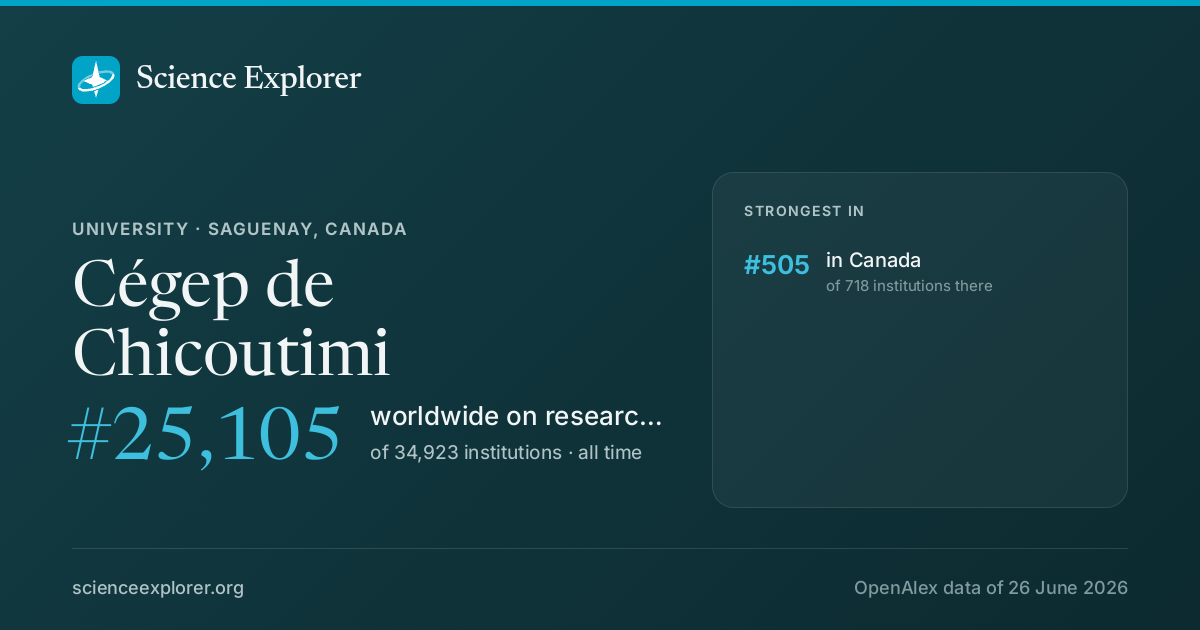
University · Saguenay · Canada

Cégep de Chicoutimi

World rank, all time
#25,105
of 34,923
Rank in Canada
#505
of 718
Research works
149
▲ 17% vs 2018-21
Citations
3.1k
20.9 per fractional work
Top-10% rate
9.5%
all institutions 10.0%
vs its own fields
0.99×
1.00× is exactly expected
Open access
48%
world 40%
International
24%
world 18%

Which fields of science does Cégep de Chicoutimi work in?

In 2022-now, 37% of research at Cégep de Chicoutimi is in Physical Sciences, 30% in Social Sciences. Its largest fields are Medicine (26%), Social Sciences (16%), Engineering (13%).

Physical Sciences: 12 fractional works · 37.4% of its workEngineering: 4 fractional works · 12.5% of its workIndustrial and Manufacturing Engineering: 1 fractional works · 2.8% of its workElectrical and Electronic Engineering: 1 fractional works · 2.3% of its workAerospace Engineering: 1 fractional works · 1.8% of its workMechanics of Materials: 0 fractional works · 1.1% of its workCivil and Structural Engineering: 0 fractional works · 1.0% of its workAutomotive Engineering: 0 fractional works · 0.9% of its workControl and Systems Engineering: 0 fractional works · 0.7% of its workMechanical Engineering: 0 fractional works · 0.7% of its workBiomedical Engineering: 0 fractional works · 0.5% of its workBuilding and Construction: 0 fractional works · 0.4% of its workMedia Technology: 0 fractional works · 0.4% of its workComputer Science: 4 fractional works · 11.7% of its workComputer Networks and Communications: 1 fractional works · 3.4% of its workComputer Vision and Pattern Recognition: 1 fractional works · 2.8% of its workArtificial Intelligence: 1 fractional works · 2.1% of its workHuman-Computer Interaction: 0 fractional works · 1.1% of its workInformation Systems: 0 fractional works · 1.1% of its workComputer Science Applications: 0 fractional works · 0.5% of its workSignal Processing: 0 fractional works · 0.5% of its workPhysics and Astronomy: 2 fractional works · 5.1% of its workAstronomy and Astrophysics: 1 fractional works · 3.0% of its workAtomic and Molecular Physics, and Optics: 0 fractional works · 1.1% of its workNuclear and High Energy Physics: 0 fractional works · 1.1% of its workSmaller subfields together: 0 fractional works · 0.0% of its workEnvironmental Science: 1 fractional works · 3.7% of its workIndustrial and Manufacturing Engineering: 0 fractional works · 1.3% of its workWater Science and Technology: 0 fractional works · 0.8% of its workEnvironmental Engineering: 0 fractional works · 0.5% of its workEcology: 0 fractional works · 0.4% of its workPollution: 0 fractional works · 0.4% of its workNature and Landscape Conservation: 0 fractional works · 0.3% of its workSmaller subfields together: 0 fractional works · 0.0% of its workMaterials Science: 0 fractional works · 1.5% of its workMaterials Chemistry: 0 fractional works · 1.0% of its workSurfaces, Coatings and Films: 0 fractional works · 0.5% of its workEarth and Planetary Sciences: 0 fractional works · 1.4% of its workGeophysics: 0 fractional works · 0.5% of its workPaleontology: 0 fractional works · 0.5% of its workEarth-Surface Processes: 0 fractional works · 0.4% of its workSmaller subfields together: 0 fractional works · 0.1% of its workChemical Engineering: 0 fractional works · 0.6% of its workBioengineering: 0 fractional works · 0.4% of its workFluid Flow and Transfer Processes: 0 fractional works · 0.3% of its workChemistry: 0 fractional works · 0.4% of its workAnalytical Chemistry: 0 fractional works · 0.2% of its workOrganic Chemistry: 0 fractional works · 0.2% of its workEnergy: 0 fractional works · 0.4% of its workRenewable Energy, Sustainability and the Environment: 0 fractional works · 0.4% of its workSocial Sciences: 9 fractional works · 30.2% of its workSocial Sciences: 5 fractional works · 15.6% of its workSociology and Political Science: 3 fractional works · 8.0% of its workEducation: 1 fractional works · 3.4% of its workCultural Studies: 0 fractional works · 1.6% of its workSafety Research: 0 fractional works · 0.9% of its workLinguistics and Language: 0 fractional works · 0.8% of its workGender Studies: 0 fractional works · 0.5% of its workHealth: 0 fractional works · 0.3% of its workArts and Humanities: 2 fractional works · 5.2% of its workReligious studies: 1 fractional works · 2.1% of its workPhilosophy: 1 fractional works · 1.9% of its workLanguage and Linguistics: 0 fractional works · 1.1% of its workSmaller subfields together: 0 fractional works · 0.2% of its workBusiness, Management and Accounting: 1 fractional works · 3.7% of its workMarketing: 0 fractional works · 1.3% of its workManagement Information Systems: 0 fractional works · 1.1% of its workStrategy and Management: 0 fractional works · 0.5% of its workBusiness and International Management: 0 fractional works · 0.5% of its workOrganizational Behavior and Human Resource Management: 0 fractional works · 0.3% of its workSmaller subfields together: 0 fractional works · 0.1% of its workPsychology: 1 fractional works · 2.7% of its workSocial Psychology: 0 fractional works · 1.5% of its workDevelopmental and Educational Psychology: 0 fractional works · 0.8% of its workClinical Psychology: 0 fractional works · 0.4% of its workSmaller subfields together: 0 fractional works · 0.0% of its workDecision Sciences: 1 fractional works · 2.0% of its workInformation Systems and Management: 0 fractional works · 1.3% of its workManagement Science and Operations Research: 0 fractional works · 0.7% of its workEconomics, Econometrics and Finance: 0 fractional works · 0.9% of its workEconomics and Econometrics: 0 fractional works · 0.9% of its workHealth Sciences: 8 fractional works · 27.0% of its workMedicine: 8 fractional works · 25.9% of its workSurgery: 2 fractional works · 6.6% of its workCardiology and Cardiovascular Medicine: 1 fractional works · 3.9% of its workPulmonary and Respiratory Medicine: 1 fractional works · 3.4% of its workEndocrinology, Diabetes and Metabolism: 0 fractional works · 1.6% of its workPathology and Forensic Medicine: 0 fractional works · 1.1% of its workRadiology, Nuclear Medicine and Imaging: 0 fractional works · 1.1% of its workNeurology: 0 fractional works · 0.9% of its workObstetrics and Gynecology: 0 fractional works · 0.8% of its workPublic Health, Environmental and Occupational Health: 0 fractional works · 0.8% of its workEpidemiology: 0 fractional works · 0.6% of its workPediatrics, Perinatology and Child Health: 0 fractional works · 0.6% of its workOncology: 0 fractional works · 0.6% of its workHealth Informatics: 0 fractional works · 0.5% of its workOrthopedics and Sports Medicine: 0 fractional works · 0.5% of its workCritical Care and Intensive Care Medicine: 0 fractional works · 0.4% of its workInfectious Diseases: 0 fractional works · 0.4% of its workOphthalmology: 0 fractional works · 0.4% of its workReproductive Medicine: 0 fractional works · 0.4% of its workBiochemistry: 0 fractional works · 0.3% of its workComplementary and alternative medicine: 0 fractional works · 0.3% of its workSmaller subfields together: 0 fractional works · 0.9% of its workHealth Professions: 0 fractional works · 0.9% of its workEmergency Medical Services: 0 fractional works · 0.4% of its workGeneral Health Professions: 0 fractional works · 0.4% of its workSmaller subfields together: 0 fractional works · 0.1% of its workNursing: 0 fractional works · 0.3% of its workNutrition and Dietetics: 0 fractional works · 0.3% of its workLife Sciences: 2 fractional works · 5.5% of its workAgricultural and Biological Sciences: 1 fractional works · 3.1% of its workPlant Science: 1 fractional works · 1.8% of its workInsect Science: 0 fractional works · 0.5% of its workFood Science: 0 fractional works · 0.5% of its workGeneral Agricultural and Biological Sciences: 0 fractional works · 0.4% of its workBiochemistry, Genetics and Molecular Biology: 1 fractional works · 1.6% of its workCancer Research: 0 fractional works · 0.6% of its workGenetics: 0 fractional works · 0.5% of its workCell Biology: 0 fractional works · 0.3% of its workMolecular Biology: 0 fractional works · 0.3% of its workImmunology and Microbiology: 0 fractional works · 0.4% of its workImmunology: 0 fractional works · 0.4% of its workNeuroscience: 0 fractional works · 0.3% of its workALL ITS WORKCégep deChicoutimi31fractional works, 2022-now
Life Sciences5%Physical Sciences37%Health Sciences27%Social Sciences30%

Each ring splits the one inside it: the four domains of science, their fields, their subfields. Size is fractional works in 2022-now. Every slice is a page; the interactive view zooms down to single topics and colours each by how much more of it this institution does than the world.

Its 4 domains and 22 fields, with their numbers
    1. Engineering412.5%
    2. Computer Science411.7%
    3. Physics and Astronomy25.1%
    4. Environmental Science13.7%
    5. Materials Science01.5%
    6. Earth and Planetary Sciences01.4%
    7. Chemical Engineering00.6%
    8. Chemistry00.4%
    9. Energy00.4%
    1. Social Sciences515.6%
    2. Arts and Humanities25.2%
    3. Business, Management and Accounting13.7%
    4. Psychology12.7%
    5. Decision Sciences12.0%
    6. Economics, Econometrics and Finance00.9%
    1. Medicine825.9%
    2. Health Professions00.9%
    3. Nursing00.3%
    1. Agricultural and Biological Sciences13.1%
    2. Biochemistry, Genetics and Molecular Biology11.6%
    3. Immunology and Microbiology00.4%
    4. Neuroscience00.3%
All of science, and how each field's share has moved since 1950: the Science domain explorer

Field profile

Location quotient across every field it publishes in: outside the ring is more than an institution of this size would be expected to publish, inside it is less.

Agricultural and Biological Sciences: 0.66× its world share, 1 worksAgricultural and Bio…Biochemistry, Genetics and Molecular Biology: 0.30× its world share, 0 worksBiochemistry, Geneti…Immunology and Microbiology: 0.41× its world share, 0 worksImmunology and Micro…Neuroscience: 0.18× its world share, 0 worksNeuroscienceChemical Engineering: 1.77× its world share, 0 worksChemical EngineeringChemistry: 0.27× its world share, 0 worksChemistryComputer Science: 1.51× its world share, 4 worksComputer ScienceEarth and Planetary Sciences: 0.89× its world share, 0 worksEarth and Planetary …Energy: 0.39× its world share, 0 worksEnergyEngineering: 0.84× its world share, 4 worksEngineeringEnvironmental Science: 0.75× its world share, 1 worksEnvironmental ScienceMaterials Science: 0.43× its world share, 0 worksMaterials SciencePhysics and Astronomy: 2.31× its world share, 2 worksPhysics and AstronomyHealth Professions: 0.34× its world share, 0 worksHealth ProfessionsMedicine: 1.35× its world share, 8 worksMedicineNursing: 0.54× its world share, 0 worksNursingArts and Humanities: 1.80× its world share, 2 worksArts and HumanitiesBusiness, Management and Accounting: 1.15× its world share, 1 worksBusiness, Management…Decision Sciences: 2.11× its world share, 1 worksDecision SciencesEconomics, Econometrics and Finance: 0.41× its world share, 0 worksEconomics, Econometr…Psychology: 0.88× its world share, 1 worksPsychologySocial Sciences: 1.23× its world share, 5 worksSocial Sciences1×world share
more than its size predictsabout as predictedless

Rings at 0.5×, 1× and 2×. Widest outward: Physics and Astronomy, 2.3×. Every wedge is a field page.

All 22 fields, with their numbers
  1. Physics and Astronomy2.31×2 works
  2. Decision Sciences2.11×1 works
  3. Arts and Humanities1.80×2 works
  4. Chemical Engineering1.77×0 works
  5. Computer Science1.51×4 works
  6. Medicine1.35×8 works
  7. Social Sciences1.23×5 works
  8. Business, Management and Accounting1.15×1 works
  9. Earth and Planetary Sciences0.89×0 works
  10. Psychology0.88×1 works
  11. Engineering0.84×4 works
  12. Environmental Science0.75×1 works
  13. Agricultural and Biological Sciences0.66×1 works
  14. Nursing0.54×0 works
  15. Materials Science0.43×0 works
  16. Immunology and Microbiology0.41×0 works
  17. Economics, Econometrics and Finance0.41×0 works
  18. Energy0.39×0 works
  19. Health Professions0.34×0 works
  20. Biochemistry, Genetics and Molecular Biology0.30×0 works
  21. Chemistry0.27×0 works
  22. Neuroscience0.18×0 works

Who are the top researchers at Cégep de Chicoutimi?

Ranked on the quality score, Voltaire, Karl Heinrich Marx and Friedrich Engels lead among researchers whose main affiliation is Cégep de Chicoutimi.

  1. 1 Voltaire Canada · #1,127,085 worldwide 1.9k citations · 994 works
  2. 2 Karl Heinrich Marx Canada · #1,358,204 worldwide 46k citations · 1,612 works
  3. 3 Friedrich Engels Canada · #1,402,689 worldwide 19k citations · 1,035 works
  4. 4 François Simiand Canada · #2,487,232 worldwide 253 citations · 89 works
  5. 5 Pierre Maine de Biran Canada · #2,667,096 worldwide 126 citations · 53 works
  6. 6 F.-A. Aulard Canada · #2,731,698 worldwide 54 citations · 22 works
  7. 7 Antonio Labriola Canada · #2,797,405 worldwide 250 citations · 45 works
  8. 8 Russel Bouchard Canada · #2,959,314 worldwide 13 citations · 21 works
  9. 9 Marie Andrée. Bertrand Canada · #3,111,399 worldwide 13 citations · 16 works
  10. 10 Louis Gill Canada · #3,666,237 worldwide 48 citations · 156 works
All ranked researchers at Cégep de Chicoutimi

What are the most cited papers from Cégep de Chicoutimi?

The most cited paper from Cégep de Chicoutimi is "Triglyceride-rich lipoproteins and their remnants: metabolic insights, role in atherosclerotic cardiovascular disease, and emerging therapeutic strategies—a consensus statement from the European Atherosclerosis Society" (Henry N. Ginsberg et al., 2021), with 966 citations. Next come "Genetic variation in the 5q31 cytokine gene cluster confers susceptibility to Crohn disease" (785) and "Maternal and fetal genetic effects on birth weight and their relevance to cardio-metabolic risk factors" (664).

Most cited papers
#PaperReleasedCitations
1 Triglyceride-rich lipoproteins and their remnants: metabolic insights, role in atherosclerotic cardiovascular disease, and emerging therapeutic strategies—a consensus statement from the European Atherosclerosis Society Henry N. Ginsberg et al. · European Heart Journal Open access 30 Jul 2021 966
2 Genetic variation in the 5q31 cytokine gene cluster confers susceptibility to Crohn disease John David Rioux et al. · Nature Genetics Oct 2001 785
3 Maternal and fetal genetic effects on birth weight and their relevance to cardio-metabolic risk factors Nicole M. Warrington et al. · Nature Genetics Open access208 authors May 2019 664
4 ARSACS, a spastic ataxia common in northeastern Québec, is caused by mutations in a new gene encoding an 11.5-kb ORF James C. Engert, Pierre R. Bérubé, Jocelyne Mercier et al. · Nature Genetics Feb 2000 439
5 A 10-year study of mortality in a cohort of patients with myotonic dystrophy Jean Mathieu, Per O. Allard, Lynne A. Potvin et al. · Neurology May 1999 416
All 60 most cited papers, with filters and sorting

Which research topics does Cégep de Chicoutimi publish most on?

By volume in 2022-now: Context-Aware Activity Recognition Systems, Historical and Linguistic Studies, French Urban and Social Studies and Linguistics and Discourse Analysis.

  1. 1 Context-Aware Activity Recognition Systems Computer Vision and Pattern Recognition 1 works
  2. 2 Historical and Linguistic Studies Sociology and Political Science 1 works
  3. 3 French Urban and Social Studies Sociology and Political Science 1 works
  4. 4 Linguistics and Discourse Analysis Philosophy 1 works
  5. 5 Education, sociology, and vocational training Sociology and Political Science 0 works
  6. 6 Diverse multidisciplinary academic research Cultural Studies 0 works
  7. 7 Digital Transformation in Industry Industrial and Manufacturing Engineering 0 works
  8. 8 Software System Performance and Reliability Computer Networks and Communications 0 works
  9. 9 Academic Research in Diverse Fields Education 0 works
  10. 10 Cosmology and Gravitation Theories Astronomy and Astrophysics 0 works

How open and international is its research?

Against the world's own shares: the tick on each track. Both are shares of its output, so they sit on one scale and can be read against each other as well as against the world.

openly available48.3%not open51.7%

World: 40% of research is openly available.

with international co-authors23.9%domestic only76.1%

World: 18% is written across borders.

How has Cégep de Chicoutimi's research output changed?

Output in 2022-2025 was 17% higher than in 2018-2021.

still counting1990200020102020
grewheldshrank

The same series as a ribbon: one cell per year, darker for more. The line above answers how much; this answers when.

Its share of all research

Growing output can still be a shrinking share: all of science grows. This is Cégep de Chicoutimi as a percentage of every work published that year, 0.00012% in 2024.

still counting0.00020%0.00040%0.00060%Cégep de Chicoutimi0.00014% in 202519801990200020102020

Fractional works of Cégep de Chicoutimi over all fractional works that year. How the balance of science has shifted.

Other research institutions in Saguenay

All research institutions in Saguenay

Share Cégep de Chicoutimi's ranking

Cégep de Chicoutimi on Science Explorer

A card with Cégep de Chicoutimi's standing and the fields it leads in, for a post or a slide. A link to this page previews as the same card.

Download the card

1200 × 630 PNG, sized for social posts, drawn from the latest snapshot.

Badges for a website1Each links back here and updates with every snapshot

Research measures only: rankings here say nothing about teaching, admissions or student experience. Comparable institutions and collaboration partners have tabs of their own, above.

Discussion

Ask a question or share a note about Cégep de Chicoutimi. Posts are plain text and can be reported.