Central American Technological University
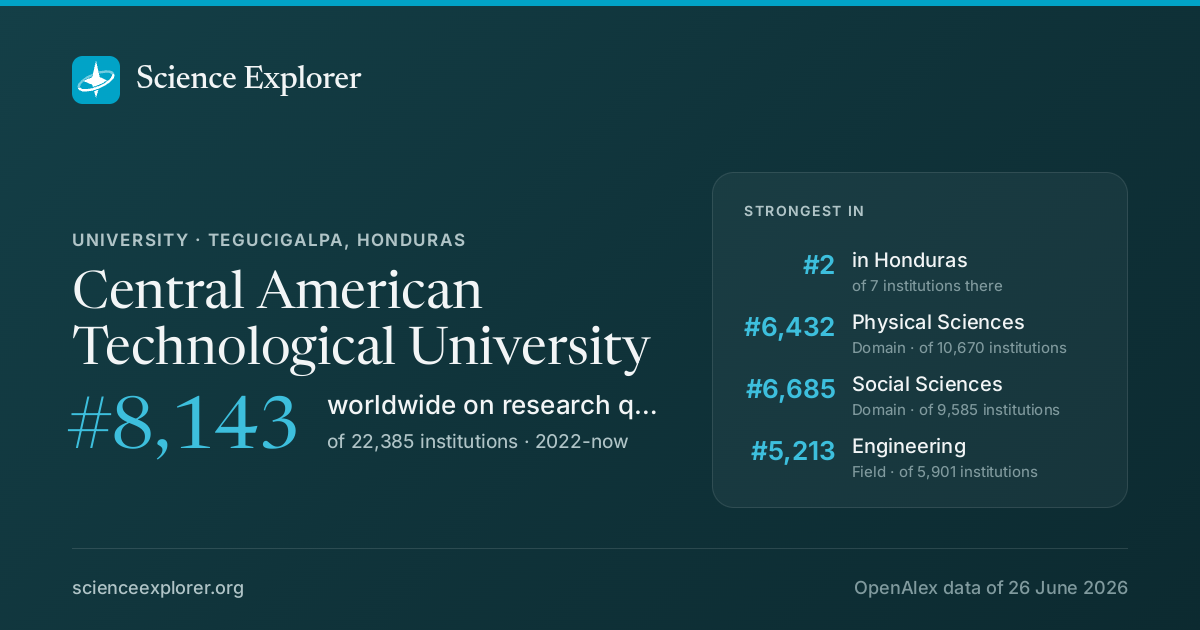
In research, Central American Technological University stands highest in Physical Sciences (#6,432 of 10,670 worldwide), Social Sciences (#6,685 of 9,585 worldwide) and Engineering (#5,213 of 5,901 worldwide), 2022-now.
- World rank, 2022-now
- #8,143 of 22,385 · #14,750 all time
- Rank in Honduras
- #2 of 7
- Research works
- 639 ▲ 73% vs 2018-21
- Citations
- 1.9k 3.0 per fractional work
- Top-10% rate
- 2.3% all institutions 10.0%
- vs its own fields
- 0.78× 1.00× is exactly expected
- Open access
- 58% world 40%
- International
- 35% world 18%
What is Central American Technological University known for in research?
The fields where it stands highest, 2022-now, ranked among every institution above the floor in each field.
| Field | World rank | Where that sits | Top-10% rate | Works | All time |
|---|---|---|---|---|---|
| Physical SciencesDomain | #6,432 of 10,670 | 1.2% | 145 | #10882 | |
| Social SciencesDomain | #6,685 of 9,585 | 3.7% | 95 | #9509 | |
| EngineeringField | #5,213 of 5,901 | 0.6% | 71 | #8057 |
Each strip is that field's whole ranked pool, with the notch where Central American Technological University sits in it, in the colour of the band that rank falls in. The track under the rate is the rate itself: it carries no average mark, because the average differs by field (from about 6% in Dentistry to 21% in Economics).
Which of those standings moved
The same fields on both windows: where it stood over the whole record, and where it stands in 2022-now. The distance is the story, and it is the one thing the two rank columns above cannot show.
- Physical Sciences#10,882 #6,432
- Social Sciences#9,509 #6,685
- Engineering#8,057 #5,213
A dot further right is a better standing. Fields it was not ranked in over the whole record are left out.
Which fields of science does Central American Technological University work in?
In 2022-now, 48% of research at Central American Technological University is in Physical Sciences, 31% in Social Sciences. Its largest fields are Engineering (23%), Social Sciences (15%), Computer Science (11%). It does 1.3× the world's share of Social Sciences.
Each ring splits the one inside it: the four domains of science, their fields, their subfields. Size is fractional works in 2022-now. Every slice is a page; the interactive view zooms down to single topics and colours each by how much more of it this institution does than the world.
Its 4 domains and 24 fields, with their numbers
- Physical Sciences15547.6%
- Engineering7523.1%
- Computer Science3510.9%
- Environmental Science278.3%
- Energy123.6%
- Earth and Planetary Sciences30.9%
- Materials Science10.3%
- Chemistry10.3%
- Mathematics00.2%
- Physics and Astronomy00.0%
- Social Sciences10131.2%
- Social Sciences5015.5%
- Economics, Econometrics and Finance195.8%
- Business, Management and Accounting175.1%
- Psychology103.0%
- Arts and Humanities51.4%
- Decision Sciences10.4%
- Health Sciences4112.5%
- Medicine309.3%
- Health Professions92.8%
- Dentistry10.2%
- Veterinary10.2%
- Life Sciences288.7%
Field profile
Location quotient across every field it publishes in: outside the ring is more than an institution of this size would be expected to publish, inside it is less.
Rings at 0.5×, 1× and 2×. Widest outward: Energy, 3.9×. Every wedge is a field page.
All 24 fields, with their numbers
- Energy3.94×12 works
- Economics, Econometrics and Finance2.72×19 works
- Environmental Science1.68×27 works
- Business, Management and Accounting1.59×17 works
- Engineering1.54×75 works
- Computer Science1.40×35 works
- Veterinary1.32×1 works
- Social Sciences1.22×50 works
- Agricultural and Biological Sciences1.09×17 works
- Health Professions1.06×9 works
- Psychology0.99×10 works
- Neuroscience0.96×5 works
- Immunology and Microbiology0.83×3 works
- Earth and Planetary Sciences0.55×3 works
- Arts and Humanities0.49×5 works
- Medicine0.48×30 works
- Dentistry0.42×1 works
- Decision Sciences0.37×1 works
- Biochemistry, Genetics and Molecular Biology0.20×4 works
- Chemistry0.18×1 works
- Mathematics0.13×0 works
- Pharmacology, Toxicology and Pharmaceutics0.11×0 works
- Materials Science0.09×1 works
- Physics and Astronomy0.02×0 works
- Energy 3.9×
- Economics, Econometrics and Finance 2.7×
- Environmental Science 1.7×
- Business, Management and Accounting 1.6×
- Engineering 1.5×
- Computer Science 1.4×
- Veterinary 1.3×
- Social Sciences 1.2×
- Agricultural and Biological Sciences 1.1×
- Health Professions 1.1×
- Psychology 1.0×
- Neuroscience 1.0×
- Immunology and Microbiology 0.8×
- Earth and Planetary Sciences 0.6×
- Arts and Humanities 0.5×
- Medicine 0.5×
- Dentistry 0.4×
- Decision Sciences 0.4×
- Biochemistry, Genetics and Molecular Biology 0.2×
- Chemistry 0.2×
- Mathematics 0.1×
- Pharmacology, Toxicology and Pharmaceutics 0.1×
- Materials Science 0.1×
- Physics and Astronomy 0.0×
Who are the top researchers at Central American Technological University?
Ranked on the quality score, Reyna M. Durón, Jared Roberto Ocampo and Céleo Ramírez lead among researchers whose main affiliation is Central American Technological University.
- 1
Reyna M. Durón
 Honduras · #2,845,308 worldwide
1.8k citations · 294 works
- 2
Jared Roberto Ocampo
Honduras · #3,323,157 worldwide
231 citations · 21 works
- 3
Céleo Ramírez
Honduras · #3,415,190 worldwide
47 citations · 16 works
- 4
Luis Gerardo Reyes Flores
Honduras · #3,491,767 worldwide
694 citations · 53 works
- 5
Heike Hesse
Honduras · #3,719,405 worldwide
165 citations · 27 works
- 6
Maria Celeste Parada-Acosta
Honduras · #4,041,118 worldwide
0 citations · 16 works
- 7
Karla Miriam Reyes Leiva
Honduras · #4,160,276 worldwide
137 citations · 23 works
- 8
Kevin Mejía Rivera
Honduras · #4,483,778 worldwide
29 citations · 20 works
- 9
Ada S. Rodríguez
Honduras · #4,649,343 worldwide
1 citations · 16 works
- 10
Olaf Jorgenson
Honduras · #4,859,349 worldwide
128 citations · 19 works
Which keywords describe research at Central American Technological University?
By fractional works in 2022-now, weighted toward what it does more of than the world: Renewable Energy, Deep Learning, Education, Sustainability, Sustainable Development, Climate Change, Digital Marketing and Innovation.
- Environmental Impact Assessment
- Competitiveness
- Community Participation
- Healthcare Access
- Tourism Management
- Inequality
- ICT
- Digital Divide
- Urban Development
- Latin America
- Small and Medium Enterprises
- Pedagogy
- Distance Learning
- Knowledge Management
- E-Learning
- COVID-19
- Public Health
- Machine Learning
- Education
- Renewable Energy
- Deep Learning
- Sustainability
- Climate Change
- Sustainable Development
- Innovation
- Globalization
- Digital Marketing
- Economic Impact
- Environmental Monitoring
- Image Processing
- Innovation Ecosystems
- Social Responsibility
- Health Promotion
- Globalization Effects
- Virtual Teaching
- Psychopharmacology Education
- Democracy
- Rural Development
- Solar Energy
- Robotic Manipulators
Size is fractional works in 2022-now in the topics tagged with each word; colour is the word's share of this institution's work against its share of the world's. The 40 words are chosen for being large and distinctive. Each links to the topic it comes from most.
All 40 words, with their numbers
- Deep Learning28▲ 2.5×36 topics
- Renewable Energy23▲ 4.9×21 topics
- Sustainability23▲ 2.9×33 topics
- Education21▲ 3.7×19 topics
- Climate Change17▲ 1.97×27 topics
- Machine Learning16▲ 1.52×32 topics
- Sustainable Development14▲ 2.8×19 topics
- Public Health12▲ 2.5×19 topics
- Innovation12▲ 3.5×15 topics
- COVID-1911▲ 2.6×9 topics
- Globalization10▲ 1.65×22 topics
- E-Learning10▲ 3.1×4 topics
- Digital Marketing9▲ 6.8×2 topics
- Knowledge Management8▲ 4.7×9 topics
- Economic Impact8▲ 4.4×4 topics
- Distance Learning8▲ 6.7×3 topics
- Environmental Monitoring7▲ 5.9×4 topics
- Pedagogy7▲ 4.5×3 topics
- Image Processing7▲ 5.2×7 topics
- Small and Medium Enterprises7▲ 12×3 topics
- Innovation Ecosystems7▲ 21×2 topics
- Latin America7▲ 11×9 topics
- Social Responsibility7▲ 9.2×2 topics
- Urban Development7▲ 5.7×3 topics
- Health Promotion6▲ 6.2×6 topics
- Digital Divide6▲ 7.4×3 topics
- Globalization Effects6▲ 28×2 topics
- ICT6▲ 14×1 topic
- Virtual Teaching6▲ 35×1 topic
- Inequality6▲ 8.2×5 topics
- Psychopharmacology Education6▲ 30×1 topic
- Tourism Management6▲ 27×1 topic
- Democracy6▲ 5.3×7 topics
- Healthcare Access6▲ 6.7×6 topics
- Rural Development6▲ 5.2×3 topics
- Community Participation6▲ 4.9×6 topics
- Solar Energy6▲ 5.6×3 topics
- Competitiveness5▲ 20×5 topics
- Robotic Manipulators5▲ 15×3 topics
- Environmental Impact Assessment5▲ 20×2 topics
Which research topics does Central American Technological University publish most on?
By volume in 2022-now: Educational Innovations and Technology, Business, Innovation, and Economy, Soft Robotics and Applications and Robot Manipulation and Learning.
Area is fractional works; colour is the subfield each topic belongs to.
- 1 Educational Innovations and Technology Information Systems 6 works
- 2 Business, Innovation, and Economy Economics and Econometrics 6 works
- 3 Soft Robotics and Applications Biomedical Engineering 4 works
- 4 Robot Manipulation and Learning Control and Systems Engineering 4 works
- 5 Smart Agriculture and AI Plant Science 4 works
- 6 Environmental and Ecological Studies Renewable Energy, Sustainability and the Environment 4 works
- 7 Entrepreneurship Studies and Influences Management of Technology and Innovation 3 works
- 8 Energy and Environment Impacts Pollution 3 works
- 9 Public Health and Environmental Issues Health, Toxicology and Mutagenesis 3 works
- 10 Modular Robots and Swarm Intelligence Mechanical Engineering 3 works
How open and international is its research?
Against the world's own shares: the tick on each track. Both are shares of its output, so they sit on one scale and can be read against each other as well as against the world.
World: 40% of research is openly available.
World: 18% is written across borders.
How has Central American Technological University's research output changed?
Output in 2022-2025 was 73% higher than in 2018-2021.
The same series as a ribbon: one cell per year, darker for more. The line above answers how much; this answers when.
Its share of all research
Growing output can still be a shrinking share: all of science grows. This is Central American Technological University as a percentage of every work published that year, 0.0013% in 2024.
Fractional works of Central American Technological University over all fractional works that year. How the balance of science has shifted.
How much of it reaches the world top 10%
Year by year, against all institutions in the same year.
Of each year's output, the share that reached the world's 10% most cited for its field and year. Peak 4.9% in 2020.
Other research institutions in Tegucigalpa
- Secretaria de Salud
- Zamorano Pan-American Agricultural School
- Universidad Metropolitana de Honduras
- Universidad Pedagógica Nacional Francisco Morazán
- Centro de Diseño, Arquitectura y Construcción
- Universidad Católica de Honduras Nuestra Señora Reina de la Paz
- Universidad José Cecilio del Valle
- Policía Nacional de Honduras
Share Central American Technological University's ranking
Badges for a website1Each links back here and updates with every snapshot

Research measures only: rankings here say nothing about teaching, admissions or student experience. Comparable institutions and collaboration partners have tabs of their own, above.
Discussion
Ask a question or share a note about Central American Technological University. Posts are plain text and can be reported.