Chienkuo Technology University
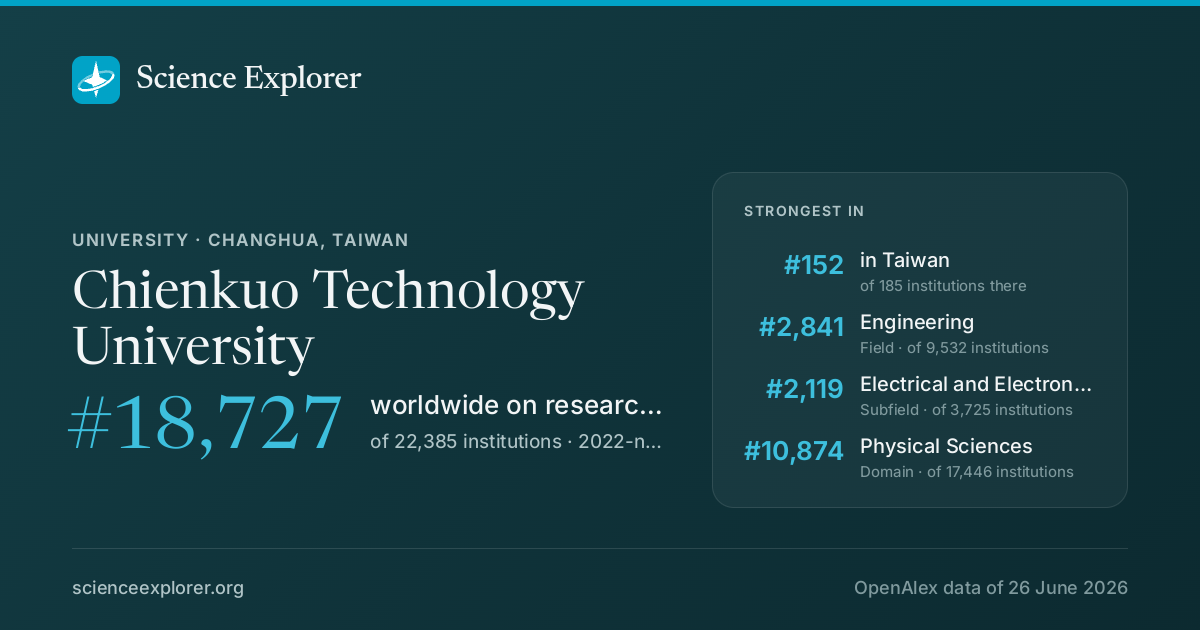
In research, Chienkuo Technology University stands highest in Engineering (#2,841 of 9,532 worldwide), Electrical and Electronic Engineering (#2,119 of 3,725 worldwide) and Physical Sciences (#10,874 of 17,446 worldwide), over all time.
- World rank, 2022-now
- #18,727 of 22,385 · #15,736 all time
- Rank in Taiwan
- #152 of 185
- Research works
- 1.4k ▼ 38% vs 2018-21
- Citations
- 15k 10.4 per fractional work
- Top-10% rate
- 7.7% all institutions 10.0%
- vs its own fields
- 0.96× 1.00× is exactly expected
- Open access
- 28% world 40%
- International
- 6% world 18%
What is Chienkuo Technology University known for in research?
The fields where it stands highest, over all time, ranked among every institution above the floor in each field.
| Field | World rank | Where that sits | Top-10% rate | Works |
|---|---|---|---|---|
| EngineeringField | #2,841 of 9,532 | 6.4% | 624 | |
| Electrical and Electronic EngineeringSubfield | #2,119 of 3,725 | 6.0% | 177 | |
| Physical SciencesDomain | #10,874 of 17,446 | 6.1% | 1,029 | |
| Computer ScienceField | #4,781 of 6,336 | 7.3% | 188 | |
| Social SciencesDomain | #13,198 of 14,833 | 5.3% | 317 |
Each strip is that field's whole ranked pool, with the notch where Chienkuo Technology University sits in it, in the colour of the band that rank falls in. The track under the rate is the rate itself: it carries no average mark, because the average differs by field (from about 6% in Dentistry to 21% in Economics).
Which fields of science does Chienkuo Technology University work in?
In 2022-now, 49% of research at Chienkuo Technology University is in Physical Sciences, 34% in Social Sciences. Its largest fields are Engineering (31%), Social Sciences (12%), Medicine (11%). It does 1.3× the world's share of Social Sciences.
Each ring splits the one inside it: the four domains of science, their fields, their subfields. Size is fractional works in 2022-now. Every slice is a page; the interactive view zooms down to single topics and colours each by how much more of it this institution does than the world.
Its 4 domains and 22 fields, with their numbers
- Physical Sciences3348.6%
- Engineering2130.8%
- Environmental Science46.0%
- Materials Science45.1%
- Computer Science34.6%
- Energy11.2%
- Earth and Planetary Sciences00.5%
- Chemical Engineering00.2%
- Chemistry00.1%
- Physics and Astronomy00.1%
- Social Sciences2333.9%
- Health Sciences913.6%
- Medicine811.2%
- Nursing11.5%
- Health Professions11.0%
- Life Sciences33.8%
Field profile
Location quotient across every field it publishes in: outside the ring is more than an institution of this size would be expected to publish, inside it is less.
Rings at 0.5×, 1× and 2×. Widest outward: Economics, Econometrics and Finance, 3.2×. Every wedge is a field page.
All 22 fields, with their numbers
- Economics, Econometrics and Finance3.19×5 works
- Nursing2.98×1 works
- Business, Management and Accounting2.54×6 works
- Engineering2.05×21 works
- Materials Science1.47×4 works
- Decision Sciences1.39×1 works
- Energy1.27×1 works
- Environmental Science1.20×4 works
- Psychology1.10×2 works
- Social Sciences0.94×8 works
- Arts and Humanities0.80×2 works
- Chemical Engineering0.70×0 works
- Neuroscience0.61×1 works
- Computer Science0.59×3 works
- Medicine0.58×8 works
- Biochemistry, Genetics and Molecular Biology0.42×2 works
- Health Professions0.36×1 works
- Immunology and Microbiology0.32×0 works
- Earth and Planetary Sciences0.31×0 works
- Chemistry0.08×0 works
- Agricultural and Biological Sciences0.05×0 works
- Physics and Astronomy0.04×0 works
- Economics, Econometrics and Finance 3.2×
- Nursing 3.0×
- Business, Management and Accounting 2.5×
- Engineering 2.0×
- Materials Science 1.5×
- Decision Sciences 1.4×
- Energy 1.3×
- Environmental Science 1.2×
- Psychology 1.1×
- Social Sciences 0.9×
- Arts and Humanities 0.8×
- Chemical Engineering 0.7×
- Neuroscience 0.6×
- Computer Science 0.6×
- Medicine 0.6×
- Biochemistry, Genetics and Molecular Biology 0.4×
- Health Professions 0.4×
- Immunology and Microbiology 0.3×
- Earth and Planetary Sciences 0.3×
- Chemistry 0.1×
- Agricultural and Biological Sciences 0.1×
- Physics and Astronomy 0.0×
Who are the top researchers at Chienkuo Technology University?
Ranked on the quality score, Hui‐Min Lai, Hongming Chen and Shou-Hsiung Cheng lead among researchers whose main affiliation is Chienkuo Technology University.
- 1
Hui‐Min Lai
 Taiwan · #354,894 worldwide
1.9k citations · 52 works
- 2
Hongming Chen
Taiwan · #1,255,249 worldwide
540 citations · 24 works
- 3
Shou-Hsiung Cheng
Taiwan · #2,118,547 worldwide
1.5k citations · 51 works
- 4
Chi‐Chang Liu
Taiwan · #2,464,563 worldwide
738 citations · 28 works
- 5
Nai‐Hua Chen
Taiwan · #2,515,713 worldwide
378 citations · 21 works
- 6
Rui Lin
Taiwan · #2,570,053 worldwide
1.1k citations · 46 works
- 7
Hak Choi
Taiwan · #2,703,203 worldwide
355 citations · 312 works
- 8
Shih-Kuen Changchien
Taiwan · #2,845,726 worldwide
987 citations · 38 works
- 9
Yi Ming Chang
Taiwan · #3,305,098 worldwide
35 citations · 17 works
- 10
Yu‐Fang Hsu
Taiwan · #3,331,709 worldwide
327 citations · 33 works
Which keywords describe research at Chienkuo Technology University?
By fractional works in 2022-now, weighted toward what it does more of than the world: Economic Growth, Mechanical Properties, Teacher Professional Development, Finite Element Analysis, Thin Films, Lifelong Learning, Coatings and Nanoindentation.
- Structural Change
- Photovoltaics
- Monetary Policy
- Two-Dimensional Materials
- Sensor Networks
- Soil Reinforcement
- Destination Image
- Spatial Variability
- Seismic
- Consumer Behavior
- Tunnel
- Liquefaction
- Smart Learning
- Online Education
- Thin Films
- Lifelong Learning
- Remote Sensing
- Finite Element Analysis
- Educational Technology
- Mechanical Properties
- Economic Growth
- Deep Learning
- Teacher Professional Development
- Nanocomposites
- Coatings
- Nanoindentation
- Analysis
- Self-Efficacy
- Tourist Satisfaction
- Service Quality
- COVID-19 Impact
- Earthquake
- Slope Stability Analysis
- Community Perceptions
- Geosynthetics
- Nanocrystals
- Texture Analysis
- Industrialization
- Nanodiamonds
- Quantum Sensing
Size is fractional works in 2022-now in the topics tagged with each word; colour is the word's share of this institution's work against its share of the world's. The 40 words are chosen for being large and distinctive. Each links to the topic it comes from most.
All 40 words, with their numbers
- Economic Growth4▲ 7.1×5 topics
- Mechanical Properties4▲ 5.2×6 topics
- Deep Learning3▲ 1.36×11 topics
- Educational Technology3▲ 3.5×3 topics
- Teacher Professional Development2▲ 23×2 topics
- Finite Element Analysis2▲ 14×3 topics
- Nanocomposites2▲ 4.1×2 topics
- Remote Sensing2▲ 2.6×3 topics
- Coatings2▲ 52×1 topic
- Lifelong Learning2▲ 15×2 topics
- Nanoindentation2▲ 54×1 topic
- Thin Films2▲ 16×2 topics
- Analysis2▲ 32×2 topics
- Online Education2▲ 15×1 topic
- Self-Efficacy2▲ 11×2 topics
- Smart Learning2▲ 97×1 topic
- Tourist Satisfaction2▲ 27×2 topics
- Liquefaction2▲ 30×2 topics
- Service Quality2▲ 10×2 topics
- Tunnel2▲ 30×2 topics
- COVID-19 Impact2▲ 14×2 topics
- Consumer Behavior2▲ 3.9×4 topics
- Earthquake2▲ 43×1 topic
- Seismic2▲ 43×1 topic
- Slope Stability Analysis2▲ 60×1 topic
- Spatial Variability2▲ 36×1 topic
- Community Perceptions2▲ 31×1 topic
- Destination Image2▲ 26×1 topic
- Geosynthetics2▲ 44×1 topic
- Soil Reinforcement2▲ 33×1 topic
- Nanocrystals1▲ 8.1×3 topics
- Sensor Networks1▲ 7.8×3 topics
- Texture Analysis1▲ 8.8×2 topics
- Two-Dimensional Materials1▲ 8.1×3 topics
- Industrialization1▲ 30×2 topics
- Monetary Policy1▲ 7.8×2 topics
- Nanodiamonds1▲ 50×1 topic
- Photovoltaics1▲ 11×2 topics
- Quantum Sensing1▲ 50×1 topic
- Structural Change1▲ 29×2 topics
Which research topics does Chienkuo Technology University publish most on?
By volume in 2022-now: Metal and Thin Film Mechanics, Education and Learning Interventions, Geotechnical Engineering and Analysis and Geotechnical Engineering and Underground Structures.
Area is fractional works; colour is the subfield each topic belongs to.
- 1 Metal and Thin Film Mechanics Mechanics of Materials 2 works
- 2 Education and Learning Interventions Information Systems 2 works
- 3 Geotechnical Engineering and Analysis Safety, Risk, Reliability and Quality 2 works
- 4 Geotechnical Engineering and Underground Structures Civil and Structural Engineering 2 works
- 5 Geotechnical Engineering and Soil Stabilization Civil and Structural Engineering 2 works
- 6 Diverse Aspects of Tourism Research Sociology and Political Science 2 works
- 7 Diamond and Carbon-based Materials Research Materials Chemistry 1 works
- 8 Consumer Behavior in Brand Consumption and Identification Marketing 1 works
- 9 Customer Service Quality and Loyalty Organizational Behavior and Human Resource Management 1 works
- 10 Industrial Vision Systems and Defect Detection Industrial and Manufacturing Engineering 1 works
How open and international is its research?
Against the world's own shares: the tick on each track. Both are shares of its output, so they sit on one scale and can be read against each other as well as against the world.
World: 40% of research is openly available.
World: 18% is written across borders.
How has Chienkuo Technology University's research output changed?
Output in 2022-2025 was 38% lower than in 2018-2021.
The same series as a ribbon: one cell per year, darker for more. The line above answers how much; this answers when.
Its share of all research
Growing output can still be a shrinking share: all of science grows. This is Chienkuo Technology University as a percentage of every work published that year, 0.00013% in 2024.
Fractional works of Chienkuo Technology University over all fractional works that year. How the balance of science has shifted.
How much of it reaches the world top 10%
Year by year, against all institutions in the same year.
Of each year's output, the share that reached the world's 10% most cited for its field and year. Peak 12.8% in 2004.
Other research institutions in Changhua
- National Changhua University of Education
- Changhua Christian Hospital
- Chang Bing Show Chwan Memorial Hospital
Share Chienkuo Technology University's ranking
Badges for a website1Each links back here and updates with every snapshot

Research measures only: rankings here say nothing about teaching, admissions or student experience. Comparable institutions and collaboration partners have tabs of their own, above.
Discussion
Ask a question or share a note about Chienkuo Technology University. Posts are plain text and can be reported.