CyberAgent (Japan)
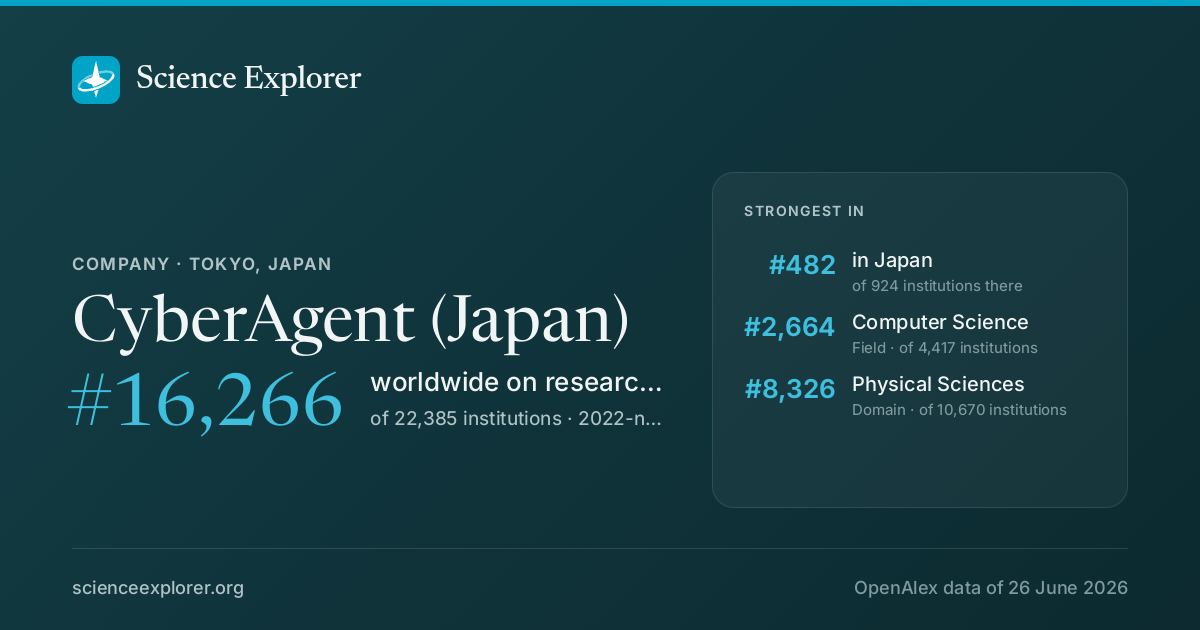
In research, CyberAgent (Japan) stands highest in Computer Science (#2,664 of 4,417 worldwide) and Physical Sciences (#8,326 of 10,670 worldwide), 2022-now. Relative to its size it is most specialised in Computer Vision and Pattern Recognition, Artificial Intelligence and Computer Science (Computer Vision and Pattern Recognition is 12.7× its share of world research).
- World rank, 2022-now
- #16,266 of 22,385 · #27,778 all time
- Rank in Japan
- #482 of 924
- Research works
- 225 ▲ 213% vs 2018-21
- Citations
- 1.3k 5.7 per fractional work
- Top-10% rate
- 5.4% all institutions 10.0%
- vs its own fields
- 0.89× 1.00× is exactly expected
- Open access
- 53% world 40%
- International
- 10% world 18%
What is CyberAgent (Japan) known for in research?
The fields where it stands highest, 2022-now, ranked among every institution above the floor in each field.
| Field | World rank | Where that sits | Top-10% rate | Works | All time |
|---|---|---|---|---|---|
| Computer ScienceField | #2,664 of 4,417 | 4.9% | 76 | - | |
| Physical SciencesDomain | #8,326 of 10,670 | 4.7% | 98 | #13973 |
Each strip is that field's whole ranked pool, with the notch where CyberAgent (Japan) sits in it, in the colour of the band that rank falls in. The track under the rate is the rate itself: it carries no average mark, because the average differs by field (from about 6% in Dentistry to 21% in Economics).
Which fields of science does CyberAgent (Japan) work in?
In 2022-now, 71% of research at CyberAgent (Japan) is in Physical Sciences, 25% in Social Sciences. Its largest fields are Computer Science (56%), Engineering (10%), Psychology (9%). It does 1.8× the world's share of Physical Sciences.
Each ring splits the one inside it: the four domains of science, their fields, their subfields. Size is fractional works in 2022-now. Every slice is a page; the interactive view zooms down to single topics and colours each by how much more of it this institution does than the world.
Its 4 domains and 18 fields, with their numbers
- Physical Sciences11571.2%
- Computer Science9055.8%
- Engineering1610.1%
- Physics and Astronomy42.7%
- Mathematics32.0%
- Materials Science00.3%
- Environmental Science00.2%
- Chemistry00.1%
- Social Sciences4025.0%
- Life Sciences32.1%
- Health Sciences31.7%
- Medicine21.4%
- Health Professions10.3%
What does CyberAgent (Japan) specialise in?
Where its research is concentrated relative to its size: Computer Vision and Pattern Recognition takes 12.7× the share of its output that it takes of world research.
- Computer Vision and Pattern RecognitionSubfield · 26.0 works13×
- Artificial IntelligenceSubfield · 31.2 works8.0×
- Computer ScienceField · 90.4 works7.2×
Location quotient, a volume reading rather than an impact one. It surfaces small, lopsided specialities.
Field profile
Location quotient across every field it publishes in: outside the ring is more than an institution of this size would be expected to publish, inside it is less.
Rings at 0.5×, 1× and 2×. Widest outward: Computer Science, 7.2×. Every wedge is a field page.
All 18 fields, with their numbers
- Computer Science7.18×90 works
- Decision Sciences4.39×7 works
- Psychology2.89×14 works
- Mathematics1.71×3 works
- Economics, Econometrics and Finance1.24×4 works
- Physics and Astronomy1.22×4 works
- Business, Management and Accounting0.89×5 works
- Neuroscience0.84×2 works
- Engineering0.67×16 works
- Arts and Humanities0.43×2 works
- Social Sciences0.41×8 works
- Biochemistry, Genetics and Molecular Biology0.13×1 works
- Health Professions0.13×1 works
- Chemistry0.09×0 works
- Materials Science0.09×0 works
- Medicine0.07×2 works
- Environmental Science0.03×0 works
- Agricultural and Biological Sciences0.01×0 works
- Computer Science 7.2×
- Decision Sciences 4.4×
- Psychology 2.9×
- Mathematics 1.7×
- Economics, Econometrics and Finance 1.2×
- Physics and Astronomy 1.2×
- Business, Management and Accounting 0.9×
- Neuroscience 0.8×
- Engineering 0.7×
- Arts and Humanities 0.4×
- Social Sciences 0.4×
- Biochemistry, Genetics and Molecular Biology 0.1×
- Health Professions 0.1×
- Chemistry 0.1×
- Materials Science 0.1×
- Medicine 0.1×
- Environmental Science 0.0×
- Agricultural and Biological Sciences 0.0×
Who are the top researchers at CyberAgent (Japan)?
Ranked on the quality score, Kota Yamaguchi, Mayu Otani and Sichao Song lead among researchers whose main affiliation is CyberAgent (Japan).
- 1
Kota Yamaguchi
 Japan · #600,142 worldwide
3.1k citations · 84 works
- 2
Mayu Otani
Japan · #881,590 worldwide
1.2k citations · 81 works
- 3
Sichao Song
Japan · #1,574,601 worldwide
695 citations · 32 works
- 4
Takuya Iwamoto
Japan · #2,291,478 worldwide
893 citations · 75 works
- 5
Jun Baba
Japan · #2,293,592 worldwide
646 citations · 82 works
- 6
Masanori Takano
Japan · #2,366,514 worldwide
442 citations · 90 works
- 7
Naoto Ohsaka
Japan · #2,494,030 worldwide
531 citations · 59 works
- 8
Undral Byambadalai
Japan · #2,514,765 worldwide
20 citations · 13 works
- 9
Masahiro Nomura
Japan · #2,784,859 worldwide
0 citations · 42 works
- 10
Peinan Zhang
Japan · #2,796,733 worldwide
14 citations · 20 works
Which keywords describe research at CyberAgent (Japan)?
By fractional works in 2022-now, weighted toward what it does more of than the world: Deep Learning, Neural Networks, Convolutional Neural Networks, Human-Robot Interaction, Unsupervised Learning, Approximation Algorithms, Algorithmic Applications and Deep Neural Networks.
- Pose Estimation
- Bayesian Optimization
- Hyperparameter Optimization
- Face Recognition
- Convolutional Networks
- Image Captioning
- Visualization
- Rendering
- Convex Optimization
- Acoustic Modeling
- Text Classification
- Semi-Supervised Learning
- Virtual Reality
- Information Retrieval
- Anthropomorphism
- Deep Neural Networks
- Artificial Intelligence
- Unsupervised Learning
- Machine Learning
- Neural Networks
- Deep Learning
- Convolutional Neural Networks
- Human-Robot Interaction
- Approximation Algorithms
- Algorithmic Applications
- Representation Learning
- Socially Assistive Robotics
- Service Robots
- Game Theory
- Simulation
- Topic Modeling
- Computer Graphics
- Machine Translation
- Speaker Verification
- Word Representation
- Visual Question Answering
- Customer Experience
- Generative Adversarial Networks
- Social Networks
- Meta-Learning
Size is fractional works in 2022-now in the topics tagged with each word; colour is the word's share of this institution's work against its share of the world's. The 40 words are chosen for being large and distinctive. Each links to the topic it comes from most.
All 40 words, with their numbers
- Deep Learning35▲ 6.2×39 topics
- Neural Networks24▲ 9.8×20 topics
- Convolutional Neural Networks11▲ 9.7×8 topics
- Machine Learning11▲ 2.0×25 topics
- Human-Robot Interaction10▲ 51×3 topics
- Unsupervised Learning7▲ 30×3 topics
- Approximation Algorithms7▲ 60×5 topics
- Artificial Intelligence6▲ 2.6×8 topics
- Algorithmic Applications6▲ 98×2 topics
- Deep Neural Networks6▲ 28×3 topics
- Representation Learning5▲ 21×3 topics
- Anthropomorphism5▲ 138×1 topic
- Socially Assistive Robotics5▲ 138×1 topic
- Information Retrieval5▲ 14×3 topics
- Service Robots4▲ 29×2 topics
- Virtual Reality4▲ 5.6×6 topics
- Game Theory4▲ 15×2 topics
- Semi-Supervised Learning4▲ 20×3 topics
- Simulation4▲ 9.1×4 topics
- Text Classification4▲ 14×2 topics
- Topic Modeling4▲ 15×2 topics
- Acoustic Modeling4▲ 59×1 topic
- Computer Graphics4▲ 85×1 topic
- Convex Optimization4▲ 26×4 topics
- Machine Translation4▲ 13×1 topic
- Rendering4▲ 85×1 topic
- Speaker Verification4▲ 59×1 topic
- Visualization4▲ 39×2 topics
- Word Representation4▲ 18×1 topic
- Image Captioning4▲ 39×1 topic
- Visual Question Answering4▲ 24×1 topic
- Convolutional Networks3▲ 15×3 topics
- Customer Experience3▲ 13×2 topics
- Face Recognition3▲ 18×2 topics
- Generative Adversarial Networks3▲ 24×2 topics
- Hyperparameter Optimization3▲ 49×2 topics
- Social Networks3▲ 7.8×4 topics
- Bayesian Optimization3▲ 24×2 topics
- Meta-Learning3▲ 23×2 topics
- Pose Estimation3▲ 17×2 topics
Which research topics does CyberAgent (Japan) publish most on?
By volume in 2022-now: Social Robot Interaction and HRI, Speech Recognition and Synthesis, Computer Graphics and Visualization Techniques and Topic Modeling.
Area is fractional works; colour is the subfield each topic belongs to.
- 1 Social Robot Interaction and HRI Social Psychology 5 works
- 2 Speech Recognition and Synthesis Artificial Intelligence 4 works
- 3 Computer Graphics and Visualization Techniques Computer Graphics and Computer-Aided Design 4 works
- 4 Topic Modeling Artificial Intelligence 4 works
- 5 Multimodal Machine Learning Applications Computer Vision and Pattern Recognition 4 works
- 6 Advanced Graph Theory Research Computational Theory and Mathematics 3 works
- 7 AI in Service Interactions Artificial Intelligence 3 works
- 8 Natural Language Processing Techniques Artificial Intelligence 3 works
- 9 Speech and Audio Processing Signal Processing 3 works
- 10 Generative Adversarial Networks and Image Synthesis Computer Vision and Pattern Recognition 3 works
How open and international is its research?
Against the world's own shares: the tick on each track. Both are shares of its output, so they sit on one scale and can be read against each other as well as against the world.
World: 40% of research is openly available.
World: 18% is written across borders.
How has CyberAgent (Japan)'s research output changed?
Output in 2022-2025 was 213% higher than in 2018-2021.
The same series as a ribbon: one cell per year, darker for more. The line above answers how much; this answers when.
Its share of all research
Growing output can still be a shrinking share: all of science grows. This is CyberAgent (Japan) as a percentage of every work published that year, 0.00058% in 2024.
Fractional works of CyberAgent (Japan) over all fractional works that year. How the balance of science has shifted.
Other research institutions in Tokyo
- The University of Tokyo
- Tokyo Institute of Technology
- Keio University
- Waseda University
- Tokyo University of Science
- Nihon University
- Hitachi (Japan)
- NTT (Japan)


Share CyberAgent (Japan)'s ranking
Badges for a website1Each links back here and updates with every snapshot

Research measures only: rankings here say nothing about teaching, admissions or student experience. Comparable institutions and collaboration partners have tabs of their own, above.
Discussion
Ask a question or share a note about CyberAgent (Japan). Posts are plain text and can be reported.