Science Explorer Back to mapMap
Discussion
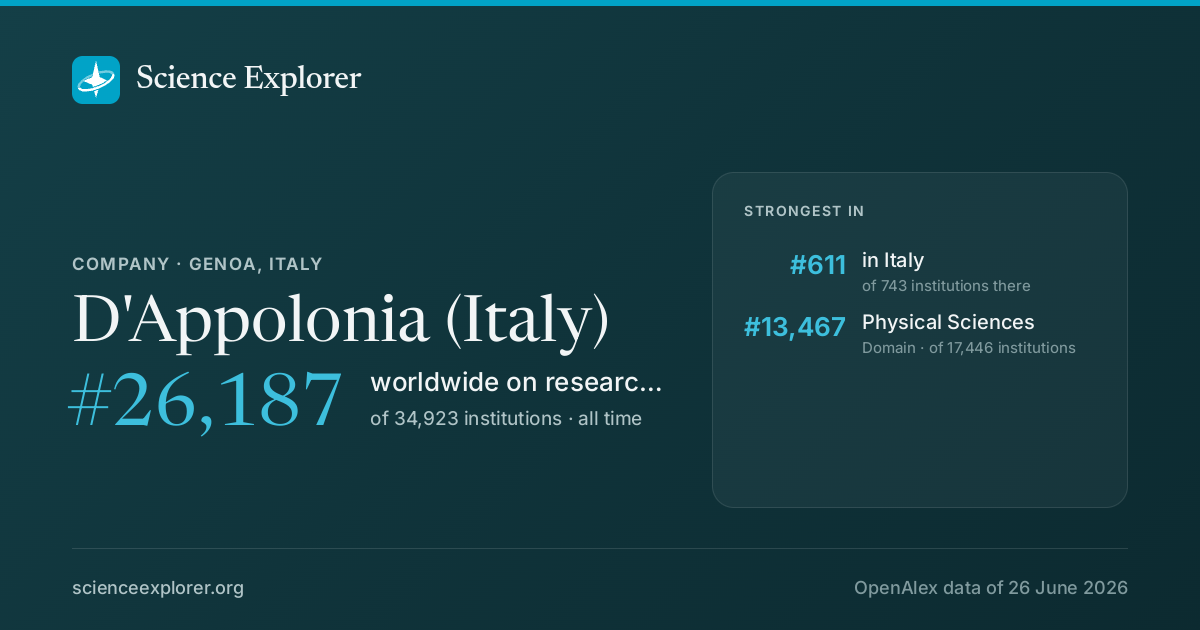
Company · Genoa · Italy

D'Appolonia (Italy)

In research, D'Appolonia (Italy) stands highest in Physical Sciences (#13,467 of 17,446 worldwide), over all time.

World rank, all time
#26,187
of 34,923
Rank in Italy
#611
of 743
Research works
192
▼ 31% vs 2018-21
Citations
3.3k
17.4 per fractional work
Top-10% rate
8.4%
all institutions 10.0%
vs its own fields
1.01×
1.00× is exactly expected
Open access
18%
world 40%
International
33%
world 18%

What is D'Appolonia (Italy) known for in research?

The fields where it stands highest, over all time, ranked among every institution above the floor in each field.

FieldWorld rankWhere that sitsTop-10% rateWorks
Physical SciencesDomain #13,467 of 17,446 7.2%154

Each strip is that field's whole ranked pool, with the notch where D'Appolonia (Italy) sits in it, in the colour of the band that rank falls in. The track under the rate is the rate itself: it carries no average mark, because the average differs by field (from about 6% in Dentistry to 21% in Economics).

Which fields of science does D'Appolonia (Italy) work in?

In all years, 80% of research at D'Appolonia (Italy) is in Physical Sciences, 10% in Social Sciences. Its largest fields are Engineering (55%), Earth and Planetary Sciences (9%), Environmental Science (6%). It does 1.9× the world's share of Physical Sciences.

Physical Sciences: 154 fractional works · 80.1% of its workEngineering: 106 fractional works · 55.3% of its workCivil and Structural Engineering: 40 fractional works · 21.0% of its workOcean Engineering: 14 fractional works · 7.5% of its workMechanical Engineering: 13 fractional works · 6.5% of its workMechanics of Materials: 7 fractional works · 3.4% of its workElectrical and Electronic Engineering: 6 fractional works · 2.9% of its workAerospace Engineering: 5 fractional works · 2.7% of its workSafety, Risk, Reliability and Quality: 5 fractional works · 2.6% of its workBuilding and Construction: 4 fractional works · 2.2% of its workComputational Mechanics: 3 fractional works · 1.4% of its workIndustrial and Manufacturing Engineering: 3 fractional works · 1.3% of its workBiomedical Engineering: 3 fractional works · 1.3% of its workControl and Systems Engineering: 2 fractional works · 1.3% of its workAutomotive Engineering: 1 fractional works · 0.7% of its workMedia Technology: 1 fractional works · 0.3% of its workEarth and Planetary Sciences: 17 fractional works · 8.7% of its workGeophysics: 8 fractional works · 4.0% of its workEarth-Surface Processes: 3 fractional works · 1.6% of its workOceanography: 2 fractional works · 1.1% of its workGeochemistry and Petrology: 2 fractional works · 0.8% of its workAtmospheric Science: 2 fractional works · 0.8% of its workGeology: 1 fractional works · 0.4% of its workEnvironmental Science: 12 fractional works · 6.3% of its workEnvironmental Engineering: 3 fractional works · 1.8% of its workManagement, Monitoring, Policy and Law: 2 fractional works · 1.1% of its workPollution: 2 fractional works · 0.8% of its workEnvironmental Chemistry: 1 fractional works · 0.6% of its workIndustrial and Manufacturing Engineering: 1 fractional works · 0.6% of its workEcology: 1 fractional works · 0.6% of its workGlobal and Planetary Change: 1 fractional works · 0.5% of its workWater Science and Technology: 1 fractional works · 0.4% of its workSmaller subfields together: 0 fractional works · 0.1% of its workComputer Science: 8 fractional works · 4.3% of its workArtificial Intelligence: 4 fractional works · 1.9% of its workComputer Networks and Communications: 2 fractional works · 1.1% of its workInformation Systems: 1 fractional works · 0.6% of its workComputer Vision and Pattern Recognition: 1 fractional works · 0.4% of its workSmaller subfields together: 1 fractional works · 0.3% of its workMaterials Science: 4 fractional works · 1.9% of its workMaterials Chemistry: 3 fractional works · 1.4% of its workPolymers and Plastics: 0 fractional works · 0.2% of its workElectronic, Optical and Magnetic Materials: 0 fractional works · 0.2% of its workChemistry: 2 fractional works · 1.1% of its workSpectroscopy: 1 fractional works · 0.5% of its workOrganic Chemistry: 1 fractional works · 0.4% of its workSmaller subfields together: 0 fractional works · 0.2% of its workPhysics and Astronomy: 2 fractional works · 0.9% of its workAstronomy and Astrophysics: 1 fractional works · 0.6% of its workAtomic and Molecular Physics, and Optics: 0 fractional works · 0.2% of its workSmaller subfields together: 0 fractional works · 0.1% of its workEnergy: 1 fractional works · 0.7% of its workRenewable Energy, Sustainability and the Environment: 1 fractional works · 0.5% of its workSmaller subfields together: 0 fractional works · 0.2% of its workChemical Engineering: 1 fractional works · 0.4% of its workMathematics: 1 fractional works · 0.3% of its workStatistics and Probability: 1 fractional works · 0.3% of its workSocial Sciences: 19 fractional works · 9.9% of its workBusiness, Management and Accounting: 5 fractional works · 2.7% of its workManagement of Technology and Innovation: 1 fractional works · 0.6% of its workAccounting: 1 fractional works · 0.5% of its workOrganizational Behavior and Human Resource Management: 1 fractional works · 0.5% of its workStrategy and Management: 1 fractional works · 0.5% of its workManagement Information Systems: 1 fractional works · 0.4% of its workMarketing: 0 fractional works · 0.2% of its workSocial Sciences: 4 fractional works · 2.2% of its workTransportation: 1 fractional works · 0.7% of its workEducation: 1 fractional works · 0.6% of its workSociology and Political Science: 1 fractional works · 0.4% of its workSafety Research: 1 fractional works · 0.3% of its workSmaller subfields together: 0 fractional works · 0.1% of its workDecision Sciences: 4 fractional works · 2.1% of its workStatistics, Probability and Uncertainty: 3 fractional works · 1.6% of its workManagement Science and Operations Research: 1 fractional works · 0.4% of its workSmaller subfields together: 0 fractional works · 0.2% of its workArts and Humanities: 4 fractional works · 1.8% of its workArcheology: 2 fractional works · 1.0% of its workReligious studies: 1 fractional works · 0.3% of its workSmaller subfields together: 1 fractional works · 0.4% of its workEconomics, Econometrics and Finance: 1 fractional works · 0.6% of its workEconomics and Econometrics: 1 fractional works · 0.4% of its workFinance: 0 fractional works · 0.2% of its workPsychology: 1 fractional works · 0.6% of its workClinical Psychology: 1 fractional works · 0.4% of its workSmaller subfields together: 0 fractional works · 0.2% of its workHealth Sciences: 11 fractional works · 5.7% of its workMedicine: 7 fractional works · 3.5% of its workPharmacology: 1 fractional works · 0.7% of its workPublic Health, Environmental and Occupational Health: 1 fractional works · 0.7% of its workSurgery: 1 fractional works · 0.4% of its workOncology: 1 fractional works · 0.3% of its workCardiology and Cardiovascular Medicine: 1 fractional works · 0.3% of its workRheumatology: 0 fractional works · 0.2% of its workSmaller subfields together: 2 fractional works · 0.9% of its workHealth Professions: 2 fractional works · 1.2% of its workRadiological and Ultrasound Technology: 1 fractional works · 0.5% of its workGeneral Health Professions: 1 fractional works · 0.5% of its workSmaller subfields together: 0 fractional works · 0.3% of its workDentistry: 2 fractional works · 0.9% of its workPeriodontics: 1 fractional works · 0.3% of its workOral Surgery: 0 fractional works · 0.3% of its workOrthodontics: 0 fractional works · 0.2% of its workSmaller subfields together: 0 fractional works · 0.0% of its workVeterinary: 0 fractional works · 0.1% of its workNursing: 0 fractional works · 0.1% of its workLife Sciences: 8 fractional works · 4.2% of its workBiochemistry, Genetics and Molecular Biology: 4 fractional works · 2.1% of its workMolecular Biology: 3 fractional works · 1.5% of its workCancer Research: 1 fractional works · 0.4% of its workSmaller subfields together: 1 fractional works · 0.3% of its workAgricultural and Biological Sciences: 2 fractional works · 1.1% of its workSoil Science: 1 fractional works · 0.6% of its workPlant Science: 1 fractional works · 0.3% of its workSmaller subfields together: 0 fractional works · 0.2% of its workNeuroscience: 2 fractional works · 0.9% of its workCognitive Neuroscience: 1 fractional works · 0.6% of its workSmaller subfields together: 1 fractional works · 0.3% of its workImmunology and Microbiology: 0 fractional works · 0.1% of its workALL ITS WORKD'Appolonia(Italy)192fractional works, all years
Life Sciences4%Physical Sciences80%Health Sciences6%Social Sciences10%

Each ring splits the one inside it: the four domains of science, their fields, their subfields. Size is fractional works in all years. Every slice is a page; the interactive view zooms down to single topics and colours each by how much more of it this institution does than the world.

Its 4 domains and 25 fields, with their numbers
    1. Engineering10655.3%
    2. Earth and Planetary Sciences178.7%
    3. Environmental Science126.3%
    4. Computer Science84.3%
    5. Materials Science41.9%
    6. Chemistry21.1%
    7. Physics and Astronomy20.9%
    8. Energy10.7%
    9. Chemical Engineering10.4%
    10. Mathematics10.3%
    1. Business, Management and Accounting52.7%
    2. Social Sciences42.2%
    3. Decision Sciences42.1%
    4. Arts and Humanities41.8%
    5. Economics, Econometrics and Finance10.6%
    6. Psychology10.6%
    1. Medicine73.5%
    2. Health Professions21.2%
    3. Dentistry20.9%
    4. Veterinary00.1%
    5. Nursing00.1%
    1. Biochemistry, Genetics and Molecular Biology42.1%
    2. Agricultural and Biological Sciences21.1%
    3. Neuroscience20.9%
    4. Immunology and Microbiology00.1%
All of science, and how each field's share has moved since 1950: the Science domain explorer

Field profile

Location quotient across every field it publishes in: outside the ring is more than an institution of this size would be expected to publish, inside it is less.

Agricultural and Biological Sciences: 1.17× its world share, 0 worksAgricultural and Bio…Biochemistry, Genetics and Molecular Biology: 0.46× its world share, 0 worksBiochemistry, Geneti…Chemistry: 4.71× its world share, 0 worksChemistryComputer Science: 1.11× its world share, 0 worksComputer ScienceEarth and Planetary Sciences: 4.71× its world share, 0 worksEarth and Planetary …Engineering: 2.48× its world share, 2 worksEngineeringEnvironmental Science: 0.25× its world share, 0 worksEnvironmental SciencePhysics and Astronomy: 2.49× its world share, 0 worksPhysics and AstronomyDentistry: 12.70× its world share, 0 worksDentistryHealth Professions: 1.64× its world share, 0 worksHealth ProfessionsMedicine: 0.32× its world share, 0 worksMedicineBusiness, Management and Accounting: 0.76× its world share, 0 worksBusiness, Management…Economics, Econometrics and Finance: 0.86× its world share, 0 worksEconomics, Econometr…Social Sciences: 0.29× its world share, 0 worksSocial Sciences1×world share
more than its size predictsabout as predictedless

Rings at 0.5×, 1× and 2×. Widest outward: Dentistry, 12.7×. Every wedge is a field page.

All 14 fields, with their numbers
  1. Dentistry12.70×0 works
  2. Chemistry4.71×0 works
  3. Earth and Planetary Sciences4.71×0 works
  4. Physics and Astronomy2.49×0 works
  5. Engineering2.48×2 works
  6. Health Professions1.64×0 works
  7. Agricultural and Biological Sciences1.17×0 works
  8. Computer Science1.11×0 works
  9. Economics, Econometrics and Finance0.86×0 works
  10. Business, Management and Accounting0.76×0 works
  11. Biochemistry, Genetics and Molecular Biology0.46×0 works
  12. Medicine0.32×0 works
  13. Social Sciences0.29×0 works
  14. Environmental Science0.25×0 works

Who are the top researchers at D'Appolonia (Italy)?

Ranked on the quality score, Alessandro Guffanti, E. D’Appolonia and Omar Zanoli lead among researchers whose main affiliation is D'Appolonia (Italy).

  1. 1 Alessandro Guffanti Italy · #797,645 worldwide 4.3k citations · 66 works
  2. 2 E. D’Appolonia Italy · #2,691,681 worldwide 521 citations · 49 works
  3. 3 Omar Zanoli Italy · #3,222,600 worldwide 103 citations · 16 works
  4. 4 Stefano Carosio Italy · #3,901,406 worldwide 129 citations · 17 works
  5. 5 Chiara Maria Traverso Italy · #4,232,079 worldwide 42 citations · 15 works
  6. 6 Robert A. Gladstone Italy · #4,407,676 worldwide 83 citations · 21 works
  7. 7 David Palmieri Italy · #4,551,748 worldwide 85 citations · 15 works
  8. 8 James L. Withiam Italy · #4,697,510 worldwide 190 citations · 55 works
  9. 9 Eric J. Parker Italy · #4,757,162 worldwide 121 citations · 34 works
  10. 10 Paul C. Rizzo Italy · #4,921,519 worldwide 114 citations · 44 works
All ranked researchers at D'Appolonia (Italy)

What are the most cited papers from D'Appolonia (Italy)?

The most cited paper from D'Appolonia (Italy) is "Genome-wide analysis of histone marks identifying an epigenetic signature of promoters and enhancers underlying cardiac hypertrophy" (Roberto Papait, Paola Cattaneo, Paolo Kunderfranco et al., 2013), with 237 citations. Next come "Sulfur Isotopes in Magmatic-Hydrothermal Systems, Melts, and Magmas" (225) and "Distribution and Plant Availability of Soil Zinc Fractions" (186).

Most cited papers
#PaperReleasedCitations
1 Genome-wide analysis of histone marks identifying an epigenetic signature of promoters and enhancers underlying cardiac hypertrophy Roberto Papait, Paola Cattaneo, Paolo Kunderfranco et al. · Proceedings of the National Academy of Sciences Open access 27 Nov 2013 237
2 Sulfur Isotopes in Magmatic-Hydrothermal Systems, Melts, and Magmas Lorenzo Marini, ROBERTO HERMÍNIO MORETTI, Marina Accornero · Reviews in Mineralogy and Geochemistry 2011 225
3 Distribution and Plant Availability of Soil Zinc Fractions S. S. Iyengar, D. C. Martens, W. P. Miller · Soil Science Society of America Journal Jul 1981 186
4 Long Non-Coding RNA and Alternative Splicing Modulations in Parkinson's Leukocytes Identified by RNA Sequencing Lilach Soreq, Alessandro Guffanti, Nathan Salomonis et al. · PLoS Computational Biology Open access 20 Mar 2014 168
5 Transient Exposure to Low Levels of Insecticide Affects Metabolic Networks of Honeybee Larvae Kamila Derecka, Martin Blythe, Sunir Malla et al. · PLoS ONE Open access 2 Jul 2013 151
All 60 most cited papers, with filters and sorting

Which keywords describe research at D'Appolonia (Italy)?

By fractional works in all years, weighted toward what it does more of than the world: Pipeline, Liquefaction, Tunnel, Analysis, Earthquake, Seismic, Finite Element Analysis and Liquefaction Resistance.

▲ more of its work than of the world's◆ about the world's share▼ less than the world's

Size is fractional works in all years in the topics tagged with each word; colour is the word's share of this institution's work against its share of the world's. The 40 words are chosen for being large and distinctive. Each links to the topic it comes from most.

All 40 words, with their numbers
  1. Pipeline11▲ 62×2 topics
  2. Liquefaction10▲ 66×2 topics
  3. Tunnel10▲ 66×2 topics
  4. Analysis8▲ 39×2 topics
  5. Earthquake8▲ 79×1 topic
  6. Seismic8▲ 79×1 topic
  7. Finite Element Analysis8▲ 17×6 topics
  8. Liquefaction Resistance7▲ 172×1 topic
  9. Particle Shape Effects7▲ 172×1 topic
  10. Environmental Impact7▲ 2.8×13 topics
  11. Soil Reinforcement7▲ 67×2 topics
  12. Fiber Reinforcement7▲ 71×2 topics
  13. Geosynthetics6▲ 83×1 topic
  14. Stone Columns6▲ 100×1 topic
  15. Machine Learning6▲ 1.54×17 topics
  16. Remote Sensing6▲ 2.9×15 topics
  17. Renewable Energy5▲ 2.7×9 topics
  18. Vibration Analysis5▲ 8.2×6 topics
  19. Energy Efficiency5▲ 3.1×11 topics
  20. Risk Assessment4▲ 3.8×5 topics
  21. Soil Properties4▲ 14×4 topics
  22. Corrosion4▲ 17×3 topics
  23. Wave Propagation4▲ 15×3 topics
  24. Technology4▲ 4.3×2 topics
  25. Nonlinear Dynamics4▲ 7.4×3 topics
  26. Oil and Gas3▲ 54×1 topic
  27. Subsea3▲ 135×1 topic
  28. Reliability Analysis3▲ 17×2 topics
  29. Natural Gas3▲ 18×2 topics
  30. Steel Structures3▲ 44×2 topics
  31. Marine Pollution3▲ 76×2 topics
  32. Risk Analysis3▲ 28×2 topics
  33. Pitting Corrosion3▲ 30×1 topic
  34. Reliability Assessment3▲ 46×1 topic
  35. Rock Mechanics3▲ 14×1 topic
  36. Seismicity3▲ 40×1 topic
  37. Economic Analysis3▲ 12×2 topics
  38. CO2 Sequestration3▲ 10×3 topics
  39. GIS-based Modeling3▲ 18×2 topics
  40. Blast Loading3▲ 30×2 topics

Which research topics does D'Appolonia (Italy) publish most on?

By volume in 2022-now: Materials Engineering and Processing, Coal Combustion and Slurry Processing, Underwater Acoustics Research and Phytochemistry Medicinal Plant Applications.

  1. 1 Materials Engineering and Processing Mechanical Engineering 0 works
  2. 2 Coal Combustion and Slurry Processing Mechanical Engineering 0 works
  3. 3 Underwater Acoustics Research Oceanography 0 works
  4. 4 Phytochemistry Medicinal Plant Applications Plant Science 0 works
  5. 5 Geotechnical Engineering and Underground Structures Civil and Structural Engineering 0 works
  6. 6 Analytical Methods in Pharmaceuticals Analytical Chemistry 0 works
  7. 7 Inorganic and Organometallic Chemistry Organic Chemistry 0 works
  8. 8 Geotechnical Engineering and Analysis Safety, Risk, Reliability and Quality 0 works
  9. 9 Cholinesterase and Neurodegenerative Diseases Pharmacology 0 works
  10. 10 Orthodontics and Dentofacial Orthopedics Orthodontics 0 works

How open and international is its research?

Against the world's own shares: the tick on each track. Both are shares of its output, so they sit on one scale and can be read against each other as well as against the world.

openly available18.3%not open81.7%

World: 40% of research is openly available.

with international co-authors32.9%domestic only67.1%

World: 18% is written across borders.

How has D'Appolonia (Italy)'s research output changed?

Output in 2022-2025 was 31% lower than in 2018-2021.

still counting1990200020102020
grewheldshrank

The same series as a ribbon: one cell per year, darker for more. The line above answers how much; this answers when.

Its share of all research

Growing output can still be a shrinking share: all of science grows. This is D'Appolonia (Italy) as a percentage of every work published that year, 0.000014% in 2024.

still counting0.0010%0.0020%D'Appolonia (Italy)0.000027% in 202519801990200020102020

Fractional works of D'Appolonia (Italy) over all fractional works that year. How the balance of science has shifted.

Other research institutions in Genoa

All research institutions in Genoa

Share D'Appolonia (Italy)'s ranking

D'Appolonia (Italy) on Science Explorer

A card with D'Appolonia (Italy)'s standing and the fields it leads in, for a post or a slide. A link to this page previews as the same card.

Download the card

1200 × 630 PNG, sized for social posts, drawn from the latest snapshot.

Badges for a website1Each links back here and updates with every snapshot

Research measures only: rankings here say nothing about teaching, admissions or student experience. Comparable institutions and collaboration partners have tabs of their own, above.

Discussion

Ask a question or share a note about D'Appolonia (Italy). Posts are plain text and can be reported.