Science Explorer Back to mapMap
Discussion
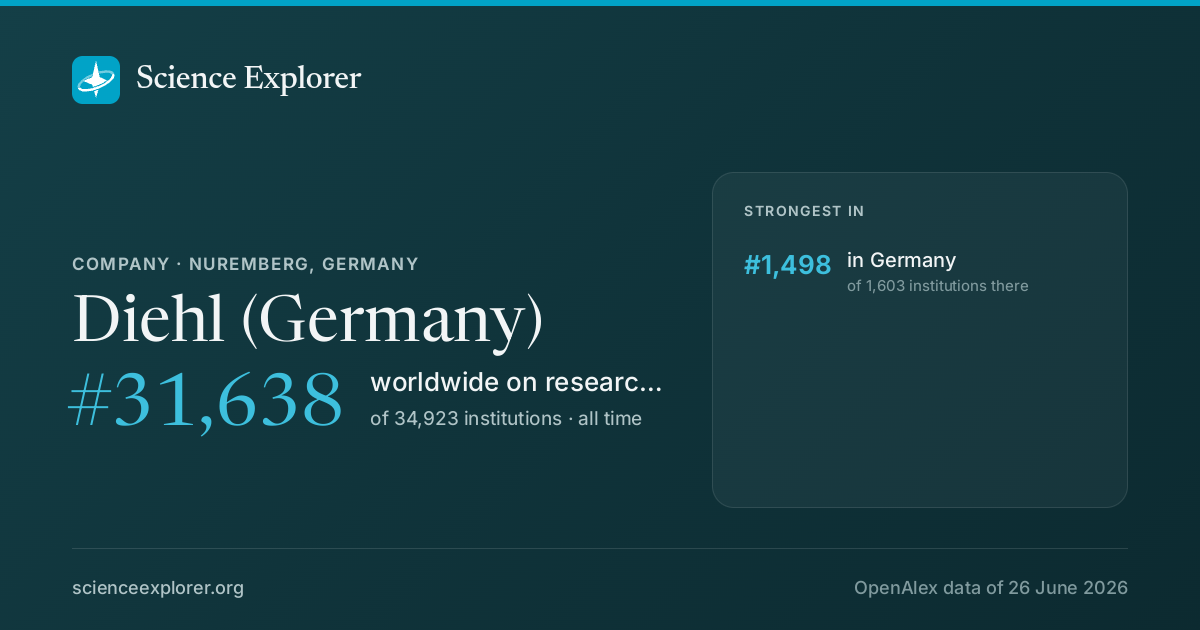
Company · Nuremberg · Germany

Diehl (Germany)

World rank, all time
#31,638
of 34,923
Rank in Germany
#1,498
of 1,603
Research works
134
▲ 28% vs 2018-21
Citations
1.7k
12.9 per fractional work
Top-10% rate
2.8%
all institutions 10.0%
vs its own fields
1.01×
1.00× is exactly expected
Open access
13%
world 40%
International
23%
world 18%

Which fields of science does Diehl (Germany) work in?

In all years, 89% of research at Diehl (Germany) is in Physical Sciences, 6% in Social Sciences. Its largest fields are Engineering (64%), Computer Science (7%), Materials Science (6%). It does 2.1× the world's share of Physical Sciences.

Physical Sciences: 119 fractional works · 88.5% of its workEngineering: 86 fractional works · 64.3% of its workElectrical and Electronic Engineering: 26 fractional works · 19.5% of its workAerospace Engineering: 20 fractional works · 15.0% of its workControl and Systems Engineering: 9 fractional works · 7.1% of its workMechanics of Materials: 9 fractional works · 6.7% of its workBiomedical Engineering: 5 fractional works · 3.8% of its workMechanical Engineering: 5 fractional works · 3.7% of its workIndustrial and Manufacturing Engineering: 3 fractional works · 2.2% of its workCivil and Structural Engineering: 2 fractional works · 1.6% of its workComputational Mechanics: 2 fractional works · 1.4% of its workAutomotive Engineering: 1 fractional works · 1.1% of its workSafety, Risk, Reliability and Quality: 1 fractional works · 0.6% of its workOcean Engineering: 1 fractional works · 0.6% of its workMedia Technology: 1 fractional works · 0.5% of its workBuilding and Construction: 0 fractional works · 0.4% of its workComputer Science: 9 fractional works · 6.8% of its workComputer Vision and Pattern Recognition: 2 fractional works · 1.6% of its workComputer Networks and Communications: 2 fractional works · 1.6% of its workHardware and Architecture: 2 fractional works · 1.2% of its workArtificial Intelligence: 1 fractional works · 1.1% of its workSoftware: 1 fractional works · 0.8% of its workComputational Theory and Mathematics: 0 fractional works · 0.4% of its workSmaller subfields together: 0 fractional works · 0.1% of its workMaterials Science: 7 fractional works · 5.6% of its workMaterials Chemistry: 6 fractional works · 4.2% of its workElectronic, Optical and Magnetic Materials: 1 fractional works · 0.5% of its workGeneral Materials Science: 0 fractional works · 0.3% of its workPolymers and Plastics: 0 fractional works · 0.2% of its workCeramics and Composites: 0 fractional works · 0.2% of its workChemistry: 6 fractional works · 4.4% of its workSpectroscopy: 4 fractional works · 3.1% of its workOrganic Chemistry: 2 fractional works · 1.2% of its workSmaller subfields together: 0 fractional works · 0.1% of its workPhysics and Astronomy: 5 fractional works · 3.7% of its workAtomic and Molecular Physics, and Optics: 2 fractional works · 1.5% of its workInstrumentation: 2 fractional works · 1.4% of its workAstronomy and Astrophysics: 0 fractional works · 0.4% of its workStatistical and Nonlinear Physics: 0 fractional works · 0.3% of its workAcoustics and Ultrasonics: 0 fractional works · 0.2% of its workEarth and Planetary Sciences: 1 fractional works · 1.0% of its workAtmospheric Science: 1 fractional works · 0.8% of its workSmaller subfields together: 0 fractional works · 0.2% of its workEnvironmental Science: 1 fractional works · 0.9% of its workGlobal and Planetary Change: 1 fractional works · 0.5% of its workEnvironmental Engineering: 0 fractional works · 0.2% of its workSmaller subfields together: 0 fractional works · 0.1% of its workMathematics: 1 fractional works · 0.8% of its workApplied Mathematics: 1 fractional works · 0.4% of its workModeling and Simulation: 0 fractional works · 0.2% of its workSmaller subfields together: 0 fractional works · 0.1% of its workChemical Engineering: 1 fractional works · 0.8% of its workBioengineering: 1 fractional works · 0.5% of its workSmaller subfields together: 0 fractional works · 0.3% of its workEnergy: 0 fractional works · 0.2% of its workRenewable Energy, Sustainability and the Environment: 0 fractional works · 0.2% of its workSocial Sciences: 7 fractional works · 5.5% of its workBusiness, Management and Accounting: 3 fractional works · 2.4% of its workStrategy and Management: 2 fractional works · 1.4% of its workOrganizational Behavior and Human Resource Management: 1 fractional works · 0.6% of its workManagement of Technology and Innovation: 0 fractional works · 0.3% of its workEconomics, Econometrics and Finance: 2 fractional works · 1.2% of its workEconomics and Econometrics: 2 fractional works · 1.2% of its workPsychology: 1 fractional works · 0.9% of its workSocial Psychology: 1 fractional works · 0.5% of its workDevelopmental and Educational Psychology: 0 fractional works · 0.3% of its workSmaller subfields together: 0 fractional works · 0.1% of its workDecision Sciences: 1 fractional works · 0.7% of its workStatistics, Probability and Uncertainty: 1 fractional works · 0.4% of its workManagement Science and Operations Research: 0 fractional works · 0.3% of its workSocial Sciences: 0 fractional works · 0.3% of its workPolitical Science and International Relations: 0 fractional works · 0.2% of its workSmaller subfields together: 0 fractional works · 0.1% of its workHealth Sciences: 5 fractional works · 4.0% of its workMedicine: 5 fractional works · 3.5% of its workNeurology: 1 fractional works · 0.5% of its workPulmonary and Respiratory Medicine: 1 fractional works · 0.5% of its workRadiology, Nuclear Medicine and Imaging: 0 fractional works · 0.4% of its workSurgery: 0 fractional works · 0.3% of its workEmergency Medicine: 0 fractional works · 0.3% of its workBiochemistry: 0 fractional works · 0.3% of its workOphthalmology: 0 fractional works · 0.3% of its workCardiology and Cardiovascular Medicine: 0 fractional works · 0.3% of its workSmaller subfields together: 1 fractional works · 0.5% of its workHealth Professions: 1 fractional works · 0.6% of its workGeneral Health Professions: 0 fractional works · 0.2% of its workMedical Laboratory Technology: 0 fractional works · 0.2% of its workSmaller subfields together: 0 fractional works · 0.1% of its workLife Sciences: 3 fractional works · 1.9% of its workBiochemistry, Genetics and Molecular Biology: 2 fractional works · 1.2% of its workBiophysics: 1 fractional works · 0.5% of its workMolecular Biology: 1 fractional works · 0.4% of its workSmaller subfields together: 0 fractional works · 0.4% of its workImmunology and Microbiology: 1 fractional works · 0.4% of its workImmunology: 0 fractional works · 0.3% of its workSmaller subfields together: 0 fractional works · 0.1% of its workNeuroscience: 0 fractional works · 0.2% of its workAgricultural and Biological Sciences: 0 fractional works · 0.1% of its workALL ITS WORKDiehl (Germany)134fractional works, all years
Life Sciences2%Physical Sciences89%Health Sciences4%Social Sciences6%

Each ring splits the one inside it: the four domains of science, their fields, their subfields. Size is fractional works in all years. Every slice is a page; the interactive view zooms down to single topics and colours each by how much more of it this institution does than the world.

Its 4 domains and 21 fields, with their numbers
    1. Engineering8664.3%
    2. Computer Science96.8%
    3. Materials Science75.6%
    4. Chemistry64.4%
    5. Physics and Astronomy53.7%
    6. Earth and Planetary Sciences11.0%
    7. Environmental Science10.9%
    8. Mathematics10.8%
    9. Chemical Engineering10.8%
    10. Energy00.2%
    1. Business, Management and Accounting32.4%
    2. Economics, Econometrics and Finance21.2%
    3. Psychology10.9%
    4. Decision Sciences10.7%
    5. Social Sciences00.3%
    1. Medicine53.5%
    2. Health Professions10.6%
    1. Biochemistry, Genetics and Molecular Biology21.2%
    2. Immunology and Microbiology10.4%
    3. Neuroscience00.2%
    4. Agricultural and Biological Sciences00.1%
All of science, and how each field's share has moved since 1950: the Science domain explorer

Field profile

Location quotient across every field it publishes in: outside the ring is more than an institution of this size would be expected to publish, inside it is less.

Chemical Engineering: 5.58× its world share, 0 worksChemical EngineeringChemistry: 2.28× its world share, 1 worksChemistryComputer Science: 0.80× its world share, 1 worksComputer ScienceEarth and Planetary Sciences: 0.62× its world share, 0 worksEarth and Planetary …Engineering: 4.83× its world share, 12 worksEngineeringEnvironmental Science: 0.39× its world share, 0 worksEnvironmental ScienceMaterials Science: 0.28× its world share, 0 worksMaterials SciencePhysics and Astronomy: 0.44× its world share, 0 worksPhysics and AstronomyBusiness, Management and Accounting: 1.82× its world share, 1 worksBusiness, Management…Decision Sciences: 1.35× its world share, 0 worksDecision SciencesEconomics, Econometrics and Finance: 0.39× its world share, 0 worksEconomics, Econometr…Psychology: 0.16× its world share, 0 worksPsychologySocial Sciences: 0.19× its world share, 0 worksSocial Sciences1×world share
more than its size predictsabout as predictedless

Rings at 0.5×, 1× and 2×. Widest outward: Chemical Engineering, 5.6×. Every wedge is a field page.

All 13 fields, with their numbers
  1. Chemical Engineering5.58×0 works
  2. Engineering4.83×12 works
  3. Chemistry2.28×1 works
  4. Business, Management and Accounting1.82×1 works
  5. Decision Sciences1.35×0 works
  6. Computer Science0.80×1 works
  7. Earth and Planetary Sciences0.62×0 works
  8. Physics and Astronomy0.44×0 works
  9. Environmental Science0.39×0 works
  10. Economics, Econometrics and Finance0.39×0 works
  11. Materials Science0.28×0 works
  12. Social Sciences0.19×0 works
  13. Psychology0.16×0 works

Who are the top researchers at Diehl (Germany)?

Ranked on the quality score, Ernst‐Christian Koch, Dominik Clément and Arno Hahma lead among researchers whose main affiliation is Diehl (Germany).

  1. 1 Ernst‐Christian Koch Germany · #1,501,954 worldwide 1.6k citations · 92 works
  2. 2 Dominik Clément Germany · #2,817,513 worldwide 371 citations · 18 works
  3. 3 Arno Hahma Germany · #3,516,322 worldwide 236 citations · 16 works
  4. 4 Hans Dieter Tholl Germany · #6,116,256 worldwide 348 citations · 61 works
All ranked researchers at Diehl (Germany)

What are the most cited papers from Diehl (Germany)?

The most cited paper from Diehl (Germany) is "Antimicrobial therapy of unexplained fever in neutropenic patients" (Hartmut Link, A. B�hme, Oliver A. Cornely et al., 2003), with 251 citations. Next come "Hemodynamic effects of fluid loading in acute massive pulmonary embolism" (246) and "An EKF-Based Nonlinear Observer with a Prescribed Degree of Stability" (211).

Most cited papers
#PaperReleasedCitations
1 Antimicrobial therapy of unexplained fever in neutropenic patients Hartmut Link, A. B�hme, Oliver A. Cornely et al. · Annals of Hematology Oct 2003 251
2 Hemodynamic effects of fluid loading in acute massive pulmonary embolism Alain Mercat, Jean-Luc Diehl, Guy Meyer et al. · Critical Care Medicine Mar 1999 246
3 An EKF-Based Nonlinear Observer with a Prescribed Degree of Stability Конрад Рейф, F. Sonnemann, Rolf Unbehauen · Automatica Sep 1998 211
4 Cerebral autoregulation testing after aneurysmal subarachnoid hemorrhage: The phase relationship between arterial blood pressure and cerebral blood flow velocity Erhard W. Lang, Rolf R. Diehl, Hubertus Maximilian Mehdorn · Critical Care Medicine 2001 184
5 Mechanism of competitive grain growth in directional solidification of a nickel-base superalloy Yuxin Zhou, Andreas Volek, Nicholas Green · Acta Materialia 19 Mar 2008 175
All 61 most cited papers, with filters and sorting

Which keywords describe research at Diehl (Germany)?

By fractional works in all years, weighted toward what it does more of than the world: Power Electronics, Thermal Decomposition, Metal Nanoparticles, Ionic Liquids, Energetic Salts, ReaxFF, Detection and Breath Analysis.

▲ more of its work than of the world's◆ about the world's share▼ less than the world's

Size is fractional works in all years in the topics tagged with each word; colour is the word's share of this institution's work against its share of the world's. The 40 words are chosen for being large and distinctive. Each links to the topic it comes from most.

All 40 words, with their numbers
  1. Power Electronics8▲ 20×7 topics
  2. Thermal Decomposition7▲ 84×2 topics
  3. Metal Nanoparticles6▲ 31×3 topics
  4. Ionic Liquids6▲ 14×2 topics
  5. Energetic Salts6▲ 162×1 topic
  6. ReaxFF6▲ 162×1 topic
  7. Detection4▲ 11×4 topics
  8. Breath Analysis4▲ 22×2 topics
  9. Frequency Conversion4▲ 30×3 topics
  10. Renewable Energy Integration4▲ 12×3 topics
  11. Gas Sensing4▲ 35×2 topics
  12. Spectroscopic Databases4▲ 46×1 topic
  13. Terahertz Quantum-Cascade Lasers4▲ 46×1 topic
  14. Mechanical Properties4▲ 2.8×9 topics
  15. Electric Discharge3▲ 72×1 topic
  16. Laser Oscillation3▲ 72×1 topic
  17. Parameter Estimation3▲ 19×4 topics
  18. Pulsed Power3▲ 92×2 topics
  19. Adaptive Control3▲ 16×4 topics
  20. Induction Motors3▲ 40×2 topics
  21. Signal Processing3▲ 18×4 topics
  22. Combustion Instabilities3▲ 27×2 topics
  23. Hybrid Rocket Propulsion2▲ 68×1 topic
  24. Regression Rate Behavior2▲ 68×1 topic
  25. Thermal Analysis2▲ 13×2 topics
  26. Fault Tolerance2▲ 9.0×3 topics
  27. Model Predictive Control2▲ 8.0×3 topics
  28. Feedback Control2▲ 8.1×4 topics
  29. Infrared2▲ 58×1 topic
  30. Optical Interconnects2▲ 22×1 topic
  31. Semiconductor Lasers2▲ 18×1 topic
  32. Small Target2▲ 58×1 topic
  33. Lithium-ion Batteries2▲ 6.3×3 topics
  34. Photovoltaic Systems2▲ 25×2 topics
  35. Electric Motor Drives2▲ 38×1 topic
  36. Permanent Magnet Machines2▲ 38×1 topic
  37. Raman Lasers2▲ 9.1×2 topics
  38. Multilevel Converters2▲ 33×1 topic
  39. Voltage Source Inverters2▲ 33×1 topic
  40. Autonomous Vehicles2▲ 10×3 topics

Which research topics does Diehl (Germany) publish most on?

By volume in 2022-now: Inertial Sensor and Navigation, Robotics and Sensor-Based Localization, Guidance and Control Systems and Real-time simulation and control systems.

  1. 1 Inertial Sensor and Navigation Aerospace Engineering 1 works
  2. 2 Robotics and Sensor-Based Localization Aerospace Engineering 1 works
  3. 3 Guidance and Control Systems Aerospace Engineering 1 works
  4. 4 Real-time simulation and control systems Control and Systems Engineering 1 works
  5. 5 Advanced Battery Technologies Research Automotive Engineering 0 works
  6. 6 Advancements in Battery Materials Electrical and Electronic Engineering 0 works
  7. 7 Energetic Materials and Combustion Mechanics of Materials 0 works
  8. 8 Rocket and propulsion systems research Aerospace Engineering 0 works
  9. 9 Heat Transfer and Boiling Studies Mechanical Engineering 0 works
  10. 10 Safety Systems Engineering in Autonomy Safety, Risk, Reliability and Quality 0 works

How open and international is its research?

Against the world's own shares: the tick on each track. Both are shares of its output, so they sit on one scale and can be read against each other as well as against the world.

openly available13.4%not open86.6%

World: 40% of research is openly available.

with international co-authors23.2%domestic only76.8%

World: 18% is written across borders.

How has Diehl (Germany)'s research output changed?

Output in 2022-2025 was 28% higher than in 2018-2021.

still counting1990200020102020
grewheldshrank

The same series as a ribbon: one cell per year, darker for more. The line above answers how much; this answers when.

Its share of all research

Growing output can still be a shrinking share: all of science grows. This is Diehl (Germany) as a percentage of every work published that year, 0.000082% in 2024.

still counting0.00025%0.00050%0.00075%Diehl (Germany)0.000062% in 202519801990200020102020

Fractional works of Diehl (Germany) over all fractional works that year. How the balance of science has shifted.

Other research institutions in Nuremberg

All research institutions in Nuremberg

Share Diehl (Germany)'s ranking

Diehl (Germany) on Science Explorer

A card with Diehl (Germany)'s standing and the fields it leads in, for a post or a slide. A link to this page previews as the same card.

Download the card

1200 × 630 PNG, sized for social posts, drawn from the latest snapshot.

Badges for a website1Each links back here and updates with every snapshot

Research measures only: rankings here say nothing about teaching, admissions or student experience. Comparable institutions and collaboration partners have tabs of their own, above.

Discussion

Ask a question or share a note about Diehl (Germany). Posts are plain text and can be reported.