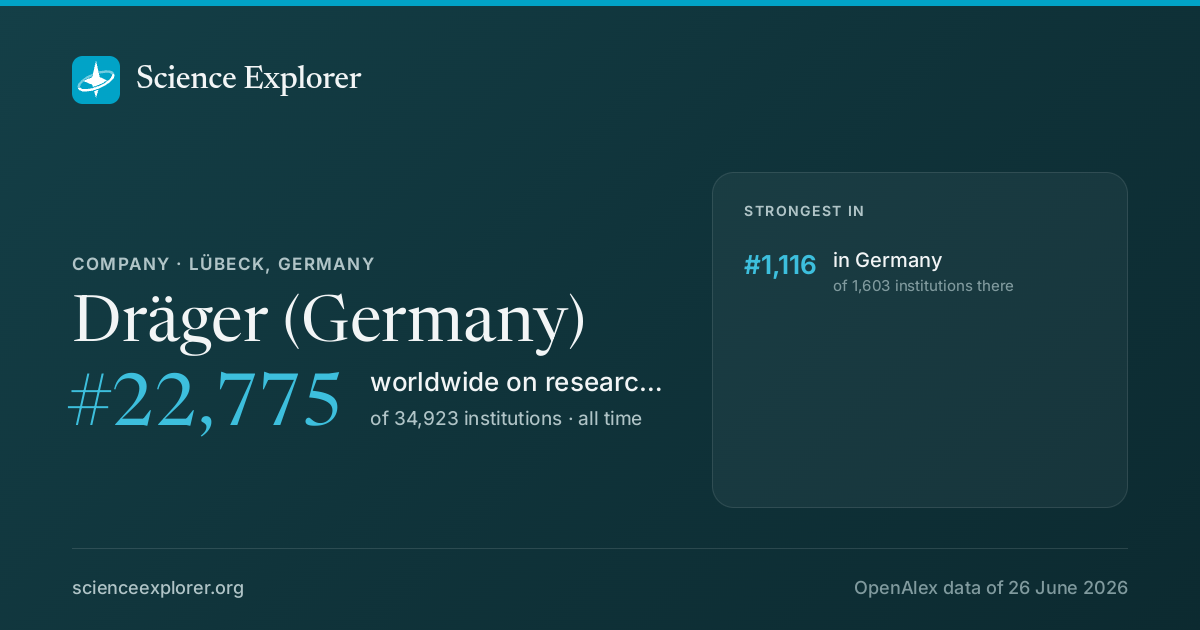
- World rank, all time
- #22,775 of 34,923
- Rank in Germany
- #1,116 of 1,603
- Research works
- 203 ▼ 33% vs 2018-21
- Citations
- 1.9k 9.5 per fractional work
- Top-10% rate
- 2.8% all institutions 10.0%
- vs its own fields
- 0.95× 1.00× is exactly expected
- Open access
- 20% world 40%
- International
- 16% world 18%
Which fields of science does Dräger (Germany) work in?
In all years, 44% of research at Dräger (Germany) is in Physical Sciences, 40% in Health Sciences. Its largest fields are Medicine (35%), Engineering (23%), Chemistry (6%). It does 1.7× the world's share of Health Sciences.
Each ring splits the one inside it: the four domains of science, their fields, their subfields. Size is fractional works in all years. Every slice is a page; the interactive view zooms down to single topics and colours each by how much more of it this institution does than the world.
Its 4 domains and 24 fields, with their numbers
- Physical Sciences9044.2%
- Engineering4622.5%
- Chemistry136.2%
- Computer Science115.4%
- Environmental Science63.1%
- Chemical Engineering62.8%
- Physics and Astronomy41.8%
- Materials Science31.6%
- Earth and Planetary Sciences20.7%
- Health Sciences8039.5%
- Medicine7034.6%
- Health Professions84.2%
- Nursing10.4%
- Veterinary10.3%
- Dentistry00.1%
- Social Sciences2210.8%
- Life Sciences115.5%
Field profile
Location quotient across every field it publishes in: outside the ring is more than an institution of this size would be expected to publish, inside it is less.
Rings at 0.5×, 1× and 2×. Widest outward: Business, Management and Accounting, 3.2×. Every wedge is a field page.
All 15 fields, with their numbers
- Business, Management and Accounting3.21×2 works
- Health Professions2.82×1 works
- Nursing2.05×0 works
- Dentistry1.78×0 works
- Neuroscience1.77×1 works
- Medicine1.57×6 works
- Engineering1.32×4 works
- Computer Science1.04×2 works
- Social Sciences1.02×2 works
- Biochemistry, Genetics and Molecular Biology0.44×0 works
- Environmental Science0.44×0 works
- Materials Science0.25×0 works
- Chemistry0.22×0 works
- Psychology0.19×0 works
- Immunology and Microbiology0.13×0 works
- Business, Management and Accounting 3.2×
- Health Professions 2.8×
- Nursing 2.0×
- Dentistry 1.8×
- Neuroscience 1.8×
- Medicine 1.6×
- Engineering 1.3×
- Computer Science 1.0×
- Social Sciences 1.0×
- Biochemistry, Genetics and Molecular Biology 0.4×
- Environmental Science 0.4×
- Materials Science 0.2×
- Chemistry 0.2×
- Psychology 0.2×
- Immunology and Microbiology 0.1×
Who are the top researchers at Dräger (Germany)?
Ranked on the quality score, Stefan Steinmeyer, Jochim Koch and J Koch lead among researchers whose main affiliation is Dräger (Germany).
- 1
Stefan Steinmeyer
 Germany · #1,643,811 worldwide
746 citations · 21 works
- 2
Jochim Koch
Germany · #2,404,687 worldwide
365 citations · 18 works
- 3
J Koch
Germany · #2,474,857 worldwide
261 citations · 19 works
- 4
D. Weismann
Germany · #3,123,922 worldwide
436 citations · 17 works
- 5
Uwe Becker
Germany · #4,286,859 worldwide
21 citations · 16 works
- 6
JEFFREY A. MAHN
Germany · #4,488,984 worldwide
20 citations · 17 works
- 7
Rainer Polzius
Germany · #4,534,650 worldwide
310 citations · 16 works
- 8
Volkmar Hellfritzsch
Germany · #5,279,960 worldwide
19 citations · 34 works
Which keywords describe research at Dräger (Germany)?
By fractional works in all years, weighted toward what it does more of than the world: Intensive Care Unit, Volatile Organic Compounds, Breath Analysis, Physiological Monitoring, Lung Cancer, Disease Diagnosis, Electronic Nose and Alarm Fatigue.
- Remote Monitoring
- Ionization
- Perioperative Care
- Mass Spectrometry
- Ion-Selective Electrodes
- Bispectral Index Monitoring
- Pharmacokinetics
- Metal Oxide
- Chemical Sensors
- Wearable Sensors
- Nanostructures
- Sedation
- Medical Gases
- Thermodynamics
- Acute Lung Injury
- Mechanical Ventilation
- Alarm Fatigue
- Disease Diagnosis
- Lung Cancer
- Volatile Organic Compounds
- Intensive Care Unit
- Breath Analysis
- Physiological Monitoring
- Electronic Nose
- Clinical Alarms
- Machine Learning
- Acute Respiratory Distress Syndrome
- Anaesthesia
- Nanomaterials
- Anesthesia
- Thermoregulation
- Biosensors
- Gas Sensors
- Field-Effect Transistors
- Heart Rate Variability
- Dexmedetomidine
- Optical Sensors
- Medication Errors
- Electrospray
- Electronic Health Records
Size is fractional works in all years in the topics tagged with each word; colour is the word's share of this institution's work against its share of the world's. The 40 words are chosen for being large and distinctive. Each links to the topic it comes from most.
All 40 words, with their numbers
- Intensive Care Unit11▲ 52×3 topics
- Volatile Organic Compounds10▲ 44×3 topics
- Breath Analysis10▲ 35×2 topics
- Lung Cancer9▲ 28×2 topics
- Physiological Monitoring9▲ 105×2 topics
- Disease Diagnosis9▲ 54×1 topic
- Electronic Nose9▲ 54×1 topic
- Alarm Fatigue9▲ 319×1 topic
- Clinical Alarms9▲ 319×1 topic
- Mechanical Ventilation8▲ 29×2 topics
- Machine Learning7▲ 1.69×10 topics
- Acute Lung Injury7▲ 56×1 topic
- Acute Respiratory Distress Syndrome7▲ 56×1 topic
- Thermodynamics7▲ 36×3 topics
- Anaesthesia6▲ 141×1 topic
- Medical Gases6▲ 141×1 topic
- Nanomaterials6▲ 3.4×5 topics
- Sedation6▲ 33×2 topics
- Anesthesia5▲ 22×4 topics
- Nanostructures5▲ 5.0×2 topics
- Thermoregulation5▲ 22×3 topics
- Wearable Sensors5▲ 26×3 topics
- Biosensors4▲ 3.9×3 topics
- Chemical Sensors4▲ 12×2 topics
- Gas Sensors4▲ 27×1 topic
- Metal Oxide4▲ 27×1 topic
- Field-Effect Transistors4▲ 10.0×2 topics
- Pharmacokinetics4▲ 6.8×2 topics
- Heart Rate Variability4▲ 16×2 topics
- Bispectral Index Monitoring4▲ 40×1 topic
- Dexmedetomidine4▲ 40×1 topic
- Ion-Selective Electrodes4▲ 18×1 topic
- Optical Sensors4▲ 13×1 topic
- Mass Spectrometry3▲ 7.9×3 topics
- Medication Errors3▲ 34×2 topics
- Perioperative Care3▲ 14×3 topics
- Electrospray3▲ 20×1 topic
- Ionization3▲ 20×1 topic
- Electronic Health Records3▲ 23×2 topics
- Remote Monitoring3▲ 13×2 topics
Which research topics does Dräger (Germany) publish most on?
By volume in 2022-now: Public Administration and Political Analysis, Flexible and Reconfigurable Manufacturing Systems, Healthcare Technology and Patient Monitoring and Respiratory Support and Mechanisms.
Area is fractional works; colour is the subfield each topic belongs to.
- 1 Public Administration and Political Analysis Political Science and International Relations 1 works
- 2 Flexible and Reconfigurable Manufacturing Systems Industrial and Manufacturing Engineering 1 works
- 3 Healthcare Technology and Patient Monitoring Surgery 1 works
- 4 Respiratory Support and Mechanisms Pulmonary and Respiratory Medicine 1 works
- 5 Neonatal Respiratory Health Research Pulmonary and Respiratory Medicine 0 works
- 6 Corporate Social Responsibility and Sustainability Organizational Behavior and Human Resource Management 0 works
- 7 Advanced Battery Technologies Research Automotive Engineering 0 works
- 8 Corporate Management and Leadership Organizational Behavior and Human Resource Management 0 works
- 9 Occupational and environmental lung diseases Pulmonary and Respiratory Medicine 0 works
- 10 Occupational exposure and asthma Public Health, Environmental and Occupational Health 0 works
How open and international is its research?
Against the world's own shares: the tick on each track. Both are shares of its output, so they sit on one scale and can be read against each other as well as against the world.
World: 40% of research is openly available.
World: 18% is written across borders.
How has Dräger (Germany)'s research output changed?
Output in 2022-2025 was 33% lower than in 2018-2021.
The same series as a ribbon: one cell per year, darker for more. The line above answers how much; this answers when.
Its share of all research
Growing output can still be a shrinking share: all of science grows. This is Dräger (Germany) as a percentage of every work published that year, 0.00014% in 2024.
Fractional works of Dräger (Germany) over all fractional works that year. How the balance of science has shifted.
Other research institutions in Lübeck
- University of Lübeck
- Universitäres Kinderwunschzentrum Lübeck
- Euroimmun Medizinische Labordiagnostika (Germany)
- Technical University of Applied Sciences Lübeck
- Medizinisches Laserzentrum Lübeck (Germany)
- Institute for Integrative and Experimental Genomics
- Lübeck Academy of Music
- Baader Food Processing Machinery (Germany)

Share Dräger (Germany)'s ranking
Badges for a website1Each links back here and updates with every snapshot

Research measures only: rankings here say nothing about teaching, admissions or student experience. Comparable institutions and collaboration partners have tabs of their own, above.
Discussion
Ask a question or share a note about Dräger (Germany). Keep it to the research: no personal attacks, advertising or links. Any reader can report a post, which collapses it for everyone until it is opened.