Drury University
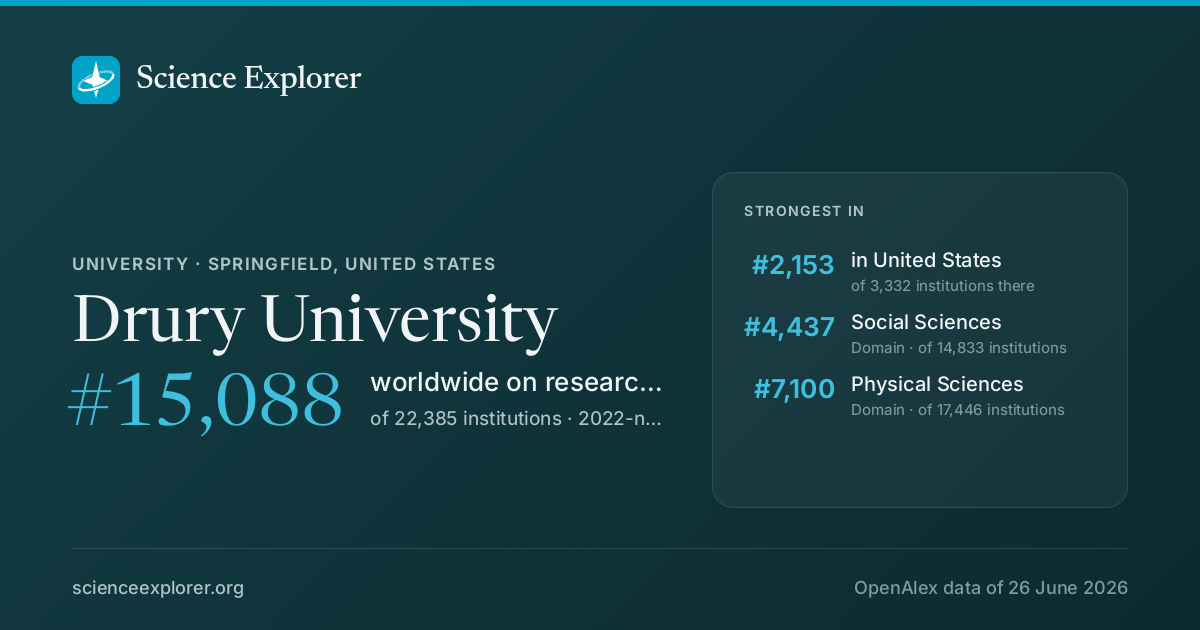
In research, Drury University stands highest in Social Sciences (#4,437 of 14,833 worldwide), Social Sciences (#2,988 of 9,330 worldwide) and Physical Sciences (#7,100 of 17,446 worldwide), over all time.
- World rank, 2022-now
- #15,088 of 22,385 · #6,292 all time
- Rank in United States
- #2,153 of 3,332
- Research works
- 741 ▲ 2% vs 2018-21
- Citations
- 14k 18.4 per fractional work
- Top-10% rate
- 5.6% all institutions 10.0%
- vs its own fields
- 0.91× 1.00× is exactly expected
- Open access
- 24% world 40%
- International
- 16% world 18%
What is Drury University known for in research?
The fields where it stands highest, over all time, ranked among every institution above the floor in each field.
| Field | World rank | Where that sits | Top-10% rate | Works |
|---|---|---|---|---|
| Social SciencesDomain | #4,437 of 14,833 | 6.9% | 361 | |
| Social SciencesField | #2,988 of 9,330 | 6.4% | 174 | |
| Physical SciencesDomain | #7,100 of 17,446 | 7.1% | 202 |
Each strip is that field's whole ranked pool, with the notch where Drury University sits in it, in the colour of the band that rank falls in. The track under the rate is the rate itself: it carries no average mark, because the average differs by field (from about 6% in Dentistry to 21% in Economics).
Which fields of science does Drury University work in?
In 2022-now, 56% of research at Drury University is in Social Sciences, 23% in Physical Sciences. Its largest fields are Social Sciences (26%), Psychology (11%), Arts and Humanities (9%). It does 2.1× the world's share of Social Sciences.
Each ring splits the one inside it: the four domains of science, their fields, their subfields. Size is fractional works in 2022-now. Every slice is a page; the interactive view zooms down to single topics and colours each by how much more of it this institution does than the world.
Its 4 domains and 23 fields, with their numbers
- Social Sciences4955.8%
- Social Sciences2225.5%
- Psychology1011.4%
- Arts and Humanities89.4%
- Economics, Econometrics and Finance55.3%
- Business, Management and Accounting33.9%
- Decision Sciences00.3%
- Physical Sciences2022.8%
- Chemistry55.7%
- Engineering55.6%
- Computer Science33.7%
- Environmental Science33.4%
- Chemical Engineering22.6%
- Earth and Planetary Sciences00.5%
- Energy00.4%
- Materials Science00.4%
- Mathematics00.3%
- Physics and Astronomy00.2%
- Health Sciences1314.5%
- Medicine89.0%
- Health Professions44.7%
- Nursing10.8%
- Life Sciences66.9%
Field profile
Location quotient across every field it publishes in: outside the ring is more than an institution of this size would be expected to publish, inside it is less.
Rings at 0.5×, 1× and 2×. Widest outward: Chemical Engineering, 7.5×. Every wedge is a field page.
All 23 fields, with their numbers
- Chemical Engineering7.49×2 works
- Psychology3.73×10 works
- Chemistry3.66×5 works
- Arts and Humanities3.25×8 works
- Economics, Econometrics and Finance2.48×5 works
- Neuroscience2.27×3 works
- Social Sciences2.02×22 works
- Health Professions1.78×4 works
- Nursing1.56×1 works
- Business, Management and Accounting1.21×3 works
- Environmental Science0.68×3 works
- Computer Science0.48×3 works
- Medicine0.47×8 works
- Biochemistry, Genetics and Molecular Biology0.43×2 works
- Energy0.42×0 works
- Engineering0.37×5 works
- Earth and Planetary Sciences0.33×0 works
- Decision Sciences0.33×0 works
- Immunology and Microbiology0.26×0 works
- Mathematics0.24×0 works
- Agricultural and Biological Sciences0.15×1 works
- Materials Science0.11×0 works
- Physics and Astronomy0.08×0 works
- Chemical Engineering 7.5×
- Psychology 3.7×
- Chemistry 3.7×
- Arts and Humanities 3.2×
- Economics, Econometrics and Finance 2.5×
- Neuroscience 2.3×
- Social Sciences 2.0×
- Health Professions 1.8×
- Nursing 1.6×
- Business, Management and Accounting 1.2×
- Environmental Science 0.7×
- Computer Science 0.5×
- Medicine 0.5×
- Biochemistry, Genetics and Molecular Biology 0.4×
- Energy 0.4×
- Engineering 0.4×
- Earth and Planetary Sciences 0.3×
- Decision Sciences 0.3×
- Immunology and Microbiology 0.3×
- Mathematics 0.2×
- Agricultural and Biological Sciences 0.1×
- Materials Science 0.1×
- Physics and Astronomy 0.1×
Who are the top researchers at Drury University?
Ranked on the quality score, James J. Gibbons, Wendy B. Anderson and Cüneyt Orman lead among researchers whose main affiliation is Drury University.
- 1
James J. Gibbons
 United States · #864,927 worldwide
4.7k citations · 134 works
- 2
Wendy B. Anderson
United States · #921,436 worldwide
3.6k citations · 25 works
- 3
Cüneyt Orman
United States · #1,765,482 worldwide
245 citations · 32 works
- 4
B. F. Finkel
United States · #1,826,521 worldwide
94 citations · 75 works
- 5
Gary R. Holmes
United States · #2,315,597 worldwide
1.4k citations · 17 works
- 6
William D. Vernon
United States · #2,518,421 worldwide
489 citations · 31 works
- 7
Gregory W. Ojakangas
United States · #2,539,358 worldwide
770 citations · 30 works
- 8
James A. Riley
United States · #2,625,592 worldwide
162 citations · 26 works
- 9
Teresa J. Hornsby
United States · #2,689,900 worldwide
262 citations · 27 works
- 10
Peter Drury
United States · #2,780,809 worldwide
253 citations · 19 works
Which keywords describe research at Drury University?
By fractional works in 2022-now, weighted toward what it does more of than the world: Mental Health, Identity, Social Media, Literature, History, Emotion Regulation, Developmental Trajectories and Leadership.
- Motor Imagery
- Italian Renaissance
- Expert Performance
- Cooperative Learning
- Aqueous Two-Phase Systems
- Sport
- Psychopathology
- Game Theory
- Attachment
- School Choice
- Emotional Responses
- Neural Plasticity
- Well-being
- Student Engagement
- Catalysis
- Gender
- Emotion Regulation
- Literature
- Globalization
- Identity
- Mental Health
- Social Media
- History
- Leadership
- Social Support
- Nationalism
- Developmental Trajectories
- Extraction
- Masculinity
- Digital Technology
- Professional Skills
- Adsorption
- Coordination Chemistry
- Fan Culture
- Social Identity
- Accounting Education
- Capital Flows
- Educational Inequality
- Financial Integration
- Matching Theory
Size is fractional works in 2022-now in the topics tagged with each word; colour is the word's share of this institution's work against its share of the world's. The 40 words are chosen for being large and distinctive. Each links to the topic it comes from most.
All 40 words, with their numbers
- Mental Health5▲ 3.9×16 topics
- Identity4▲ 6.1×11 topics
- Social Media4▲ 2.9×7 topics
- Globalization3▲ 1.86×10 topics
- History3▲ 4.4×9 topics
- Literature2▲ 5.3×5 topics
- Leadership2▲ 5.0×9 topics
- Emotion Regulation2▲ 7.2×6 topics
- Social Support2▲ 4.3×7 topics
- Gender2▲ 4.0×3 topics
- Nationalism2▲ 4.9×6 topics
- Catalysis2▲ 3.1×7 topics
- Developmental Trajectories2▲ 17×3 topics
- Student Engagement2▲ 5.0×5 topics
- Extraction2▲ 14×2 topics
- Well-being2▲ 4.6×4 topics
- Masculinity1▲ 19×2 topics
- Neural Plasticity1▲ 8.5×3 topics
- Digital Technology1▲ 15×2 topics
- Emotional Responses1▲ 13×3 topics
- Professional Skills1▲ 48×2 topics
- School Choice1▲ 64×2 topics
- Adsorption1▲ 6.8×2 topics
- Attachment1▲ 15×4 topics
- Coordination Chemistry1▲ 21×4 topics
- Game Theory1▲ 7.9×2 topics
- Fan Culture1▲ 45×1 topic
- Psychopathology1▲ 7.5×2 topics
- Social Identity1▲ 13×3 topics
- Sport1▲ 31×1 topic
- Accounting Education1▲ 154×1 topic
- Aqueous Two-Phase Systems1▲ 106×1 topic
- Capital Flows1▲ 33×1 topic
- Cooperative Learning1▲ 22×2 topics
- Educational Inequality1▲ 19×2 topics
- Expert Performance1▲ 41×1 topic
- Financial Integration1▲ 39×1 topic
- Italian Renaissance1▲ 122×1 topic
- Matching Theory1▲ 111×1 topic
- Motor Imagery1▲ 9.6×1 topic
Which research topics does Drury University publish most on?
By volume in 2022-now: Sports, Gender, and Society, Global Financial Crisis and Policies, Renaissance and Early Modern Studies and Game Theory and Voting Systems.
Area is fractional works; colour is the subfield each topic belongs to.
- 1 Sports, Gender, and Society Gender Studies 1 works
- 2 Global Financial Crisis and Policies Finance 1 works
- 3 Renaissance and Early Modern Studies History 1 works
- 4 Game Theory and Voting Systems Economics and Econometrics 1 works
- 5 Accounting Education and Careers Accounting 1 works
- 6 Chemical and Physical Properties in Aqueous Solutions Filtration and Separation 1 works
- 7 Sport Psychology and Performance Developmental and Educational Psychology 1 works
- 8 Child and Adolescent Psychosocial and Emotional Development Clinical Psychology 1 works
- 9 Impact of Technology on Adolescents Sociology and Political Science 1 works
- 10 Renal function and acid-base balance Nephrology 1 works
How open and international is its research?
Against the world's own shares: the tick on each track. Both are shares of its output, so they sit on one scale and can be read against each other as well as against the world.
World: 40% of research is openly available.
World: 18% is written across borders.
How has Drury University's research output changed?
Output in 2022-2025 was 2% higher than in 2018-2021.
The same series as a ribbon: one cell per year, darker for more. The line above answers how much; this answers when.
Its share of all research
Growing output can still be a shrinking share: all of science grows. This is Drury University as a percentage of every work published that year, 0.00036% in 2024.
Fractional works of Drury University over all fractional works that year. How the balance of science has shifted.
How much of it reaches the world top 10%
Year by year, against all institutions in the same year.
Of each year's output, the share that reached the world's 10% most cited for its field and year. Peak 14.1% in 2012.
Other research institutions in Springfield
- Missouri State University
- Forest Institute
- Evangel University
- Mercy Research
- Alternative Opportunities
- Headache Care Center
- Mercy Hospital Springfield
- Mercy Clinic Neurology
Share Drury University's ranking
Badges for a website1Each links back here and updates with every snapshot

Research measures only: rankings here say nothing about teaching, admissions or student experience. Comparable institutions and collaboration partners have tabs of their own, above.
Discussion
Ask a question or share a note about Drury University. Keep it to the research: no personal attacks, advertising or links. Any reader can report a post, which collapses it for everyone until it is opened.