Science Explorer Back to mapMap
University · Dudley · United Kingdom

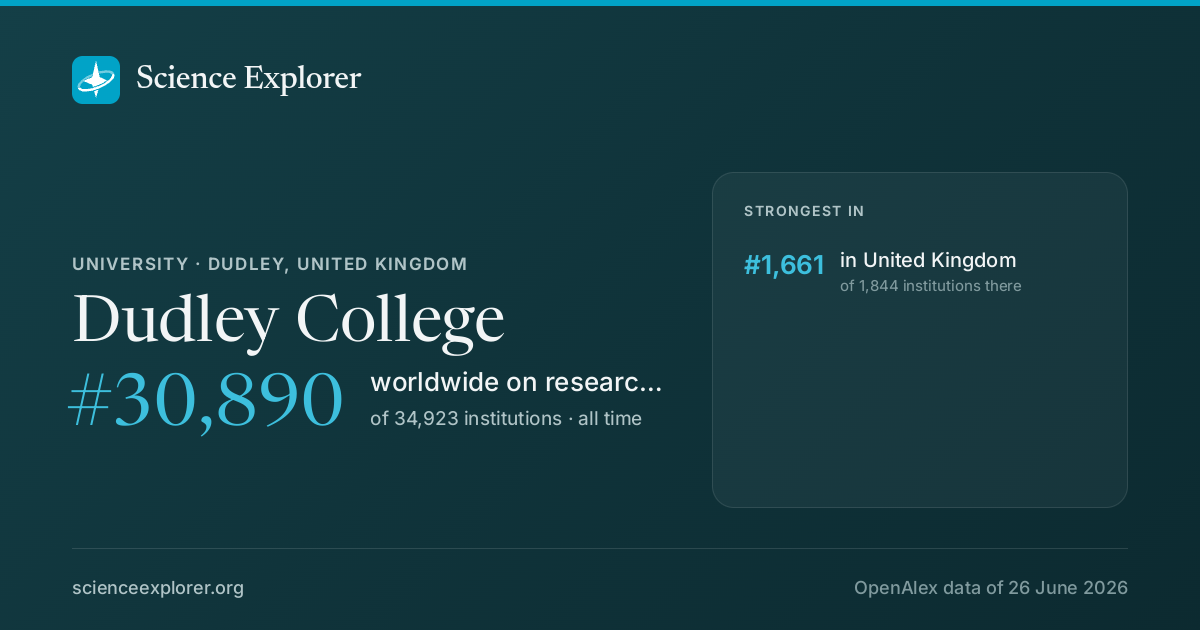
Dudley College

World rank, all time
#30,890
of 34,923
Rank in United Kingdom
#1,661
of 1,844
Research works
125
▲ 47% vs 2018-21
Citations
901
7.2 per fractional work
Top-10% rate
4.2%
all institutions 10.0%
vs its own fields
0.93×
1.00× is exactly expected
Open access
15%
world 40%
International
13%
world 18%

Which fields of science does Dudley College work in?

In all years, 51% of research at Dudley College is in Social Sciences, 25% in Health Sciences. Its largest fields are Social Sciences (24%), Medicine (15%), Arts and Humanities (14%). It does 2.3× the world's share of Social Sciences.

Social Sciences: 64 fractional works · 51.1% of its workSocial Sciences: 30 fractional works · 23.7% of its workEducation: 11 fractional works · 8.6% of its workSociology and Political Science: 7 fractional works · 5.6% of its workDemography: 3 fractional works · 2.4% of its workPolitical Science and International Relations: 2 fractional works · 1.6% of its workCultural Studies: 1 fractional works · 0.9% of its workHealth: 1 fractional works · 0.9% of its workGeography, Planning and Development: 1 fractional works · 0.8% of its workGender Studies: 1 fractional works · 0.8% of its workAnthropology: 1 fractional works · 0.7% of its workSafety Research: 1 fractional works · 0.6% of its workLibrary and Information Sciences: 0 fractional works · 0.4% of its workDevelopment: 0 fractional works · 0.3% of its workLaw: 0 fractional works · 0.3% of its workArts and Humanities: 17 fractional works · 13.6% of its workPhilosophy: 5 fractional works · 3.7% of its workLiterature and Literary Theory: 3 fractional works · 2.1% of its workHistory: 2 fractional works · 1.7% of its workReligious studies: 2 fractional works · 1.7% of its workArcheology: 2 fractional works · 1.3% of its workMusic: 1 fractional works · 1.1% of its workMuseology: 1 fractional works · 0.8% of its workClassics: 1 fractional works · 0.5% of its workHistory and Philosophy of Science: 1 fractional works · 0.5% of its workPsychology: 12 fractional works · 9.8% of its workClinical Psychology: 4 fractional works · 3.4% of its workSocial Psychology: 3 fractional works · 2.8% of its workExperimental and Cognitive Psychology: 2 fractional works · 1.5% of its workDevelopmental and Educational Psychology: 2 fractional works · 1.2% of its workNeuropsychology and Physiological Psychology: 1 fractional works · 0.8% of its workEconomics, Econometrics and Finance: 3 fractional works · 2.1% of its workEconomics and Econometrics: 3 fractional works · 2.1% of its workDecision Sciences: 1 fractional works · 1.1% of its workManagement Science and Operations Research: 1 fractional works · 0.9% of its workInformation Systems and Management: 0 fractional works · 0.2% of its workBusiness, Management and Accounting: 1 fractional works · 0.8% of its workOrganizational Behavior and Human Resource Management: 1 fractional works · 0.7% of its workSmaller subfields together: 0 fractional works · 0.1% of its workHealth Sciences: 31 fractional works · 24.7% of its workMedicine: 19 fractional works · 15.3% of its workSurgery: 2 fractional works · 1.9% of its workOrthopedics and Sports Medicine: 2 fractional works · 1.7% of its workCardiology and Cardiovascular Medicine: 1 fractional works · 1.1% of its workRadiology, Nuclear Medicine and Imaging: 1 fractional works · 1.0% of its workPsychiatry and Mental health: 1 fractional works · 0.9% of its workPhysiology: 1 fractional works · 0.9% of its workPulmonary and Respiratory Medicine: 1 fractional works · 0.8% of its workComplementary and alternative medicine: 1 fractional works · 0.8% of its workOncology: 1 fractional works · 0.7% of its workReproductive Medicine: 1 fractional works · 0.7% of its workEpidemiology: 1 fractional works · 0.5% of its workRheumatology: 1 fractional works · 0.5% of its workPublic Health, Environmental and Occupational Health: 0 fractional works · 0.4% of its workRehabilitation: 0 fractional works · 0.4% of its workGeriatrics and Gerontology: 0 fractional works · 0.3% of its workOtorhinolaryngology: 0 fractional works · 0.3% of its workAnesthesiology and Pain Medicine: 0 fractional works · 0.3% of its workHepatology: 0 fractional works · 0.3% of its workPediatrics, Perinatology and Child Health: 0 fractional works · 0.3% of its workPharmacology: 0 fractional works · 0.3% of its workCritical Care and Intensive Care Medicine: 0 fractional works · 0.2% of its workSmaller subfields together: 1 fractional works · 1.1% of its workHealth Professions: 10 fractional works · 8.0% of its workGeneral Health Professions: 7 fractional works · 5.8% of its workPharmacy: 1 fractional works · 0.8% of its workEmergency Medical Services: 1 fractional works · 0.7% of its workPhysical Therapy, Sports Therapy and Rehabilitation: 1 fractional works · 0.5% of its workSmaller subfields together: 0 fractional works · 0.2% of its workNursing: 1 fractional works · 0.9% of its workNutrition and Dietetics: 1 fractional works · 0.5% of its workIssues, ethics and legal aspects: 0 fractional works · 0.4% of its workVeterinary: 0 fractional works · 0.3% of its workSmall Animals: 0 fractional works · 0.3% of its workDentistry: 0 fractional works · 0.1% of its workPhysical Sciences: 24 fractional works · 18.8% of its workEngineering: 8 fractional works · 6.5% of its workMechanical Engineering: 2 fractional works · 1.7% of its workBiomedical Engineering: 2 fractional works · 1.6% of its workMedia Technology: 2 fractional works · 1.2% of its workCivil and Structural Engineering: 1 fractional works · 0.5% of its workControl and Systems Engineering: 1 fractional works · 0.5% of its workComputational Mechanics: 0 fractional works · 0.3% of its workElectrical and Electronic Engineering: 0 fractional works · 0.3% of its workMechanics of Materials: 0 fractional works · 0.3% of its workSmaller subfields together: 0 fractional works · 0.1% of its workComputer Science: 5 fractional works · 4.2% of its workArtificial Intelligence: 4 fractional works · 3.2% of its workHardware and Architecture: 0 fractional works · 0.4% of its workComputational Theory and Mathematics: 0 fractional works · 0.3% of its workComputer Networks and Communications: 0 fractional works · 0.3% of its workSmaller subfields together: 0 fractional works · 0.1% of its workEnvironmental Science: 4 fractional works · 3.1% of its workManagement, Monitoring, Policy and Law: 1 fractional works · 1.1% of its workEcology: 1 fractional works · 0.9% of its workNature and Landscape Conservation: 1 fractional works · 0.8% of its workHealth, Toxicology and Mutagenesis: 0 fractional works · 0.3% of its workSmaller subfields together: 0 fractional works · 0.1% of its workEarth and Planetary Sciences: 3 fractional works · 2.3% of its workAtmospheric Science: 1 fractional works · 0.6% of its workGeology: 1 fractional works · 0.5% of its workGeophysics: 0 fractional works · 0.4% of its workEarth-Surface Processes: 0 fractional works · 0.3% of its workSpace and Planetary Science: 0 fractional works · 0.3% of its workOceanography: 0 fractional works · 0.2% of its workSmaller subfields together: 0 fractional works · 0.1% of its workPhysics and Astronomy: 1 fractional works · 1.1% of its workAstronomy and Astrophysics: 1 fractional works · 0.8% of its workInstrumentation: 0 fractional works · 0.3% of its workSmaller subfields together: 0 fractional works · 0.1% of its workChemistry: 1 fractional works · 0.8% of its workOrganic Chemistry: 1 fractional works · 0.8% of its workMathematics: 1 fractional works · 0.7% of its workTheoretical Computer Science: 0 fractional works · 0.4% of its workNumerical Analysis: 0 fractional works · 0.3% of its workMaterials Science: 0 fractional works · 0.1% of its workLife Sciences: 7 fractional works · 5.4% of its workAgricultural and Biological Sciences: 3 fractional works · 2.8% of its workPlant Science: 2 fractional works · 1.6% of its workForestry: 1 fractional works · 0.5% of its workEcology, Evolution, Behavior and Systematics: 0 fractional works · 0.3% of its workInsect Science: 0 fractional works · 0.3% of its workSmaller subfields together: 0 fractional works · 0.1% of its workBiochemistry, Genetics and Molecular Biology: 2 fractional works · 1.2% of its workGenetics: 1 fractional works · 0.7% of its workMolecular Biology: 0 fractional works · 0.3% of its workCell Biology: 0 fractional works · 0.3% of its workImmunology and Microbiology: 1 fractional works · 1.2% of its workParasitology: 1 fractional works · 0.8% of its workMicrobiology: 0 fractional works · 0.4% of its workNeuroscience: 0 fractional works · 0.2% of its workALL ITS WORKDudley College125fractional works, all years
Life Sciences5%Physical Sciences19%Health Sciences25%Social Sciences51%

Each ring splits the one inside it: the four domains of science, their fields, their subfields. Size is fractional works in all years. Every slice is a page; the interactive view zooms down to single topics and colours each by how much more of it this institution does than the world.

Its 4 domains and 23 fields, with their numbers
    1. Social Sciences3023.7%
    2. Arts and Humanities1713.6%
    3. Psychology129.8%
    4. Economics, Econometrics and Finance32.1%
    5. Decision Sciences11.1%
    6. Business, Management and Accounting10.8%
    1. Medicine1915.3%
    2. Health Professions108.0%
    3. Nursing10.9%
    4. Veterinary00.3%
    5. Dentistry00.1%
    1. Engineering86.5%
    2. Computer Science54.2%
    3. Environmental Science43.1%
    4. Earth and Planetary Sciences32.3%
    5. Physics and Astronomy11.1%
    6. Chemistry10.8%
    7. Mathematics10.7%
    8. Materials Science00.1%
    1. Agricultural and Biological Sciences32.8%
    2. Biochemistry, Genetics and Molecular Biology21.2%
    3. Immunology and Microbiology11.2%
    4. Neuroscience00.2%
All of science, and how each field's share has moved since 1950: the Science domain explorer

Field profile

Location quotient across every field it publishes in: outside the ring is more than an institution of this size would be expected to publish, inside it is less.

Biochemistry, Genetics and Molecular Biology: 0.07× its world share, 0 worksBiochemistry, Geneti…Engineering: 0.34× its world share, 1 worksEngineeringHealth Professions: 1.83× its world share, 1 worksHealth ProfessionsMedicine: 0.21× its world share, 0 worksMedicineVeterinary: 2.89× its world share, 0 worksVeterinaryArts and Humanities: 12.36× its world share, 4 worksArts and HumanitiesBusiness, Management and Accounting: 0.28× its world share, 0 worksBusiness, Management…Decision Sciences: 2.13× its world share, 0 worksDecision SciencesPsychology: 9.89× its world share, 4 worksPsychologySocial Sciences: 1.32× its world share, 2 worksSocial Sciences1×world share
more than its size predictsabout as predictedless

Rings at 0.5×, 1× and 2×. Widest outward: Arts and Humanities, 12.4×. Every wedge is a field page.

All 10 fields, with their numbers
  1. Arts and Humanities12.36×4 works
  2. Psychology9.89×4 works
  3. Veterinary2.89×0 works
  4. Decision Sciences2.13×0 works
  5. Health Professions1.83×1 works
  6. Social Sciences1.32×2 works
  7. Engineering0.34×1 works
  8. Business, Management and Accounting0.28×0 works
  9. Medicine0.21×0 works
  10. Biochemistry, Genetics and Molecular Biology0.07×0 works

Who are the top researchers at Dudley College?

Ranked on the quality score, W. E. Ballard, F. H. Drinkwater and Steve Moore lead among researchers whose main affiliation is Dudley College.

  1. 1 W. E. Ballard United Kingdom · #3,381,703 worldwide 55 citations · 16 works
  2. 2 F. H. Drinkwater United Kingdom · #3,751,686 worldwide 2 citations · 28 works
  3. 3 Steve Moore United Kingdom · #5,802,361 worldwide 233 citations · 54 works
All ranked researchers at Dudley College

What are the most cited papers from Dudley College?

The most cited paper from Dudley College is "Implant-Based Breast Reconstruction with Allograft" (Richard J. Zienowicz, Ercan Karacaoğlu, 2007), with 282 citations. Next come "Evolutionary and Physical Properties of Meteoroids" (147) and "Bias in Butterfly Distribution Maps: The Effects of Sampling Effort" (144).

Most cited papers
#PaperReleasedCitations
1 Implant-Based Breast Reconstruction with Allograft Richard J. Zienowicz, Ercan Karacaoğlu · Plastic & Reconstructive Surgery 11 Jul 2007 282
2 Evolutionary and Physical Properties of Meteoroids Curtis L. Hemenway, Peter M. Millman, Allan F. Cook · NASA Technical Reports Server (NASA) 1973 147
3 Bias in Butterfly Distribution Maps: The Effects of Sampling Effort Roger L. H. Dennis, Tim H. Sparks, Peter B. Hardy · Journal of Insect Conservation Mar 1999 144
4 The Genetic Counseling Video Project (GCVP): Models of practice DEBRA L. ROTER, Lee Ellington, Lori Hamby Erby et al. · American Journal of Medical Genetics Part C Seminars in Medical Genetics Open access 29 Aug 2006 130
5 U-Pb (zircon) age constraints on the timing and duration of Wenlock (Silurian) paleocommunity collapse and recovery during the "Big Crisis" Bradley D. Cramer, Daniel J. Condon, Ulf Söderlund et al. · Geological Society of America Bulletin 2 Oct 2012 94
All 61 most cited papers, with filters and sorting

Which keywords describe research at Dudley College?

By fractional works in all years, weighted toward what it does more of than the world: Religion, Secularism, Globalization, Politics, Nationalism, Democracy, Atheism and Public Sphere.

▲ more of its work than of the world's◆ about the world's share▼ less than the world's

Size is fractional works in all years in the topics tagged with each word; colour is the word's share of this institution's work against its share of the world's. The 40 words are chosen for being large and distinctive. Each links to the topic it comes from most.

All 40 words, with their numbers
  1. Globalization8▲ 3.5×8 topics
  2. Religion6▲ 8.9×9 topics
  3. Epidemiology6▲ 1.18×22 topics
  4. Secularism6▲ 43×3 topics
  5. Nationalism5▲ 7.0×3 topics
  6. Politics5▲ 14×4 topics
  7. Democracy4▲ 9.0×2 topics
  8. Identity4▲ 4.2×7 topics
  9. Risk Factors4▲ 2.8×6 topics
  10. Mental Health4▲ 2.6×10 topics
  11. Literature4▲ 5.7×8 topics
  12. Atheism3▲ 75×1 topic
  13. Public Sphere3▲ 40×1 topic
  14. Primary Care3▲ 5.8×5 topics
  15. Ethics3▲ 5.2×6 topics
  16. History3▲ 3.0×7 topics
  17. Biodiversity3▲ 2.9×10 topics
  18. Healthcare3▲ 3.2×3 topics
  19. Philosophy3▲ 4.7×6 topics
  20. Curriculum Development2▲ 5.7×3 topics
  21. Pedagogy2▲ 5.8×2 topics
  22. Technology Integration2▲ 10×2 topics
  23. Psychological Impact2▲ 9.2×3 topics
  24. Motivation2▲ 6.3×2 topics
  25. Elderly Care2▲ 13×2 topics
  26. Mortality Risk2▲ 8.6×3 topics
  27. Classroom Interaction2▲ 69×1 topic
  28. Direct Payments2▲ 101×1 topic
  29. Diversity2▲ 8.8×2 topics
  30. Interactive Whiteboards2▲ 69×1 topic
  31. Language Acquisition2▲ 17×2 topics
  32. Model Checking2▲ 15×2 topics
  33. Personalisation2▲ 101×1 topic
  34. Religious Education2▲ 18×2 topics
  35. Theology2▲ 14×2 topics
  36. Health Workforce2▲ 30×2 topics
  37. High-Intensity Interval Training2▲ 13×2 topics
  38. Intervention2▲ 35×2 topics
  39. Teacher Preparation2▲ 21×3 topics
  40. Injury Prevention2▲ 13×2 topics

Which research topics does Dudley College publish most on?

By volume in 2022-now: Sound Studies and Aurality, Religion and Society Interactions, Psychoanalysis, Philosophy, and Politics and Philosophy, Ethics, and Existentialism.

  1. 1 Sound Studies and Aurality Experimental and Cognitive Psychology 2 works
  2. 2 Religion and Society Interactions Sociology and Political Science 1 works
  3. 3 Psychoanalysis, Philosophy, and Politics Clinical Psychology 1 works
  4. 4 Philosophy, Ethics, and Existentialism Philosophy 1 works
  5. 5 Medieval Literature and History Classics 1 works
  6. 6 Historical Studies of British Isles History 1 works
  7. 7 Scottish History and National Identity History 1 works
  8. 8 Gothic Literature and Media Analysis Cultural Studies 0 works
  9. 9 Samuel Beckett and Modernism Literature and Literary Theory 0 works
  10. 10 Biblical Studies and Interpretation Religious studies 0 works

How open and international is its research?

Against the world's own shares: the tick on each track. Both are shares of its output, so they sit on one scale and can be read against each other as well as against the world.

openly available15.2%not open84.8%

World: 40% of research is openly available.

with international co-authors12.7%domestic only87.3%

World: 18% is written across borders.

How has Dudley College's research output changed?

Output in 2022-2025 was 47% higher than in 2018-2021.

still counting1990200020102020
grewheldshrank

The same series as a ribbon: one cell per year, darker for more. The line above answers how much; this answers when.

Its share of all research

Growing output can still be a shrinking share: all of science grows. This is Dudley College as a percentage of every work published that year, 0.00015% in 2024.

still counting0.0010%0.0020%Dudley College0.000023% in 202519801990200020102020

Fractional works of Dudley College over all fractional works that year. How the balance of science has shifted.

Other research institutions in Dudley

All research institutions in Dudley

Share Dudley College's ranking

Dudley College on Science Explorer

A card with Dudley College's standing and the fields it leads in, for a post or a slide. A link to this page previews as the same card.

Download the card

1200 × 630 PNG, sized for social posts, drawn from the latest snapshot.

Badges for a website1Each links back here and updates with every snapshot

Research measures only: rankings here say nothing about teaching, admissions or student experience. Comparable institutions and collaboration partners have tabs of their own, above.

Discussion

Ask a question or share a note about Dudley College. Keep it to the research: no personal attacks, advertising or links. Any reader can report a post, which collapses it for everyone until it is opened.