Science Explorer Back to mapMap
Discussion
University · Quincy · United States

Eastern Nazarene College

World rank, all time
#28,308
of 34,923
Rank in United States
#5,939
of 7,310
Research works
131
▲ 44% vs 2018-21
Citations
3k
22.7 per fractional work
Top-10% rate
1.9%
all institutions 10.0%
vs its own fields
1.17×
1.00× is exactly expected
Open access
18%
world 40%
International
6%
world 18%

Which fields of science does Eastern Nazarene College work in?

In all years, 54% of research at Eastern Nazarene College is in Physical Sciences, 28% in Social Sciences. Its largest fields are Chemistry (23%), Computer Science (14%), Social Sciences (14%). It does 1.3× the world's share of Physical Sciences.

Physical Sciences: 71 fractional works · 54.3% of its workChemistry: 30 fractional works · 23.0% of its workSpectroscopy: 11 fractional works · 8.1% of its workOrganic Chemistry: 9 fractional works · 6.6% of its workPhysical and Theoretical Chemistry: 5 fractional works · 3.8% of its workElectrochemistry: 4 fractional works · 2.9% of its workAnalytical Chemistry: 2 fractional works · 1.3% of its workInorganic Chemistry: 0 fractional works · 0.4% of its workComputer Science: 19 fractional works · 14.3% of its workComputational Theory and Mathematics: 15 fractional works · 11.2% of its workArtificial Intelligence: 2 fractional works · 1.4% of its workComputer Vision and Pattern Recognition: 1 fractional works · 0.8% of its workInformation Systems: 1 fractional works · 0.5% of its workComputer Science Applications: 0 fractional works · 0.3% of its workSmaller subfields together: 0 fractional works · 0.2% of its workEngineering: 6 fractional works · 4.7% of its workBiomedical Engineering: 3 fractional works · 2.0% of its workElectrical and Electronic Engineering: 1 fractional works · 1.1% of its workAerospace Engineering: 1 fractional works · 0.5% of its workMedia Technology: 1 fractional works · 0.5% of its workAutomotive Engineering: 0 fractional works · 0.3% of its workSmaller subfields together: 0 fractional works · 0.3% of its workEnvironmental Science: 4 fractional works · 3.4% of its workManagement, Monitoring, Policy and Law: 1 fractional works · 0.8% of its workHealth, Toxicology and Mutagenesis: 1 fractional works · 0.7% of its workEcology: 1 fractional works · 0.5% of its workEnvironmental Chemistry: 1 fractional works · 0.5% of its workPollution: 1 fractional works · 0.4% of its workGlobal and Planetary Change: 0 fractional works · 0.3% of its workSmaller subfields together: 0 fractional works · 0.2% of its workMathematics: 4 fractional works · 3.4% of its workGeometry and Topology: 2 fractional works · 1.5% of its workAlgebra and Number Theory: 1 fractional works · 0.5% of its workMathematical Physics: 1 fractional works · 0.4% of its workStatistics and Probability: 1 fractional works · 0.4% of its workDiscrete Mathematics and Combinatorics: 0 fractional works · 0.3% of its workSmaller subfields together: 0 fractional works · 0.3% of its workPhysics and Astronomy: 3 fractional works · 2.0% of its workAtomic and Molecular Physics, and Optics: 2 fractional works · 1.5% of its workAstronomy and Astrophysics: 0 fractional works · 0.3% of its workSmaller subfields together: 0 fractional works · 0.2% of its workEarth and Planetary Sciences: 2 fractional works · 1.6% of its workGeophysics: 1 fractional works · 1.1% of its workAtmospheric Science: 1 fractional works · 0.5% of its workSmaller subfields together: 0 fractional works · 0.1% of its workMaterials Science: 2 fractional works · 1.6% of its workMaterials Chemistry: 2 fractional works · 1.4% of its workSmaller subfields together: 0 fractional works · 0.2% of its workChemical Engineering: 0 fractional works · 0.3% of its workChemical Health and Safety: 0 fractional works · 0.3% of its workSocial Sciences: 36 fractional works · 27.7% of its workSocial Sciences: 18 fractional works · 13.7% of its workSociology and Political Science: 5 fractional works · 4.2% of its workEducation: 5 fractional works · 3.6% of its workPolitical Science and International Relations: 4 fractional works · 2.9% of its workAnthropology: 1 fractional works · 0.8% of its workHealth: 1 fractional works · 0.6% of its workLibrary and Information Sciences: 1 fractional works · 0.5% of its workGeneral Social Sciences: 0 fractional works · 0.4% of its workLaw: 0 fractional works · 0.4% of its workCultural Studies: 0 fractional works · 0.3% of its workSmaller subfields together: 0 fractional works · 0.1% of its workArts and Humanities: 15 fractional works · 11.6% of its workLiterature and Literary Theory: 4 fractional works · 2.7% of its workHistory: 3 fractional works · 2.4% of its workReligious studies: 3 fractional works · 2.4% of its workPhilosophy: 2 fractional works · 1.8% of its workHistory and Philosophy of Science: 2 fractional works · 1.1% of its workClassics: 1 fractional works · 1.0% of its workPsychology: 3 fractional works · 2.2% of its workSocial Psychology: 1 fractional works · 1.0% of its workClinical Psychology: 1 fractional works · 0.5% of its workDevelopmental and Educational Psychology: 0 fractional works · 0.3% of its workGeneral Psychology: 0 fractional works · 0.3% of its workSmaller subfields together: 0 fractional works · 0.2% of its workBusiness, Management and Accounting: 0 fractional works · 0.2% of its workLife Sciences: 16 fractional works · 12.3% of its workBiochemistry, Genetics and Molecular Biology: 8 fractional works · 6.0% of its workMolecular Biology: 7 fractional works · 5.0% of its workGenetics: 0 fractional works · 0.3% of its workDevelopmental Biology: 0 fractional works · 0.3% of its workSmaller subfields together: 0 fractional works · 0.3% of its workNeuroscience: 5 fractional works · 4.1% of its workCognitive Neuroscience: 2 fractional works · 1.7% of its workDevelopmental Neuroscience: 1 fractional works · 0.9% of its workCellular and Molecular Neuroscience: 1 fractional works · 0.8% of its workNeurology: 1 fractional works · 0.6% of its workSmaller subfields together: 0 fractional works · 0.1% of its workAgricultural and Biological Sciences: 2 fractional works · 1.8% of its workPlant Science: 1 fractional works · 0.7% of its workEcology, Evolution, Behavior and Systematics: 0 fractional works · 0.3% of its workFood Science: 0 fractional works · 0.3% of its workInsect Science: 0 fractional works · 0.3% of its workSmaller subfields together: 0 fractional works · 0.3% of its workImmunology and Microbiology: 0 fractional works · 0.3% of its workVirology: 0 fractional works · 0.3% of its workPharmacology, Toxicology and Pharmaceutics: 0 fractional works · 0.2% of its workHealth Sciences: 7 fractional works · 5.7% of its workMedicine: 7 fractional works · 5.0% of its workPediatrics, Perinatology and Child Health: 1 fractional works · 0.8% of its workInfectious Diseases: 1 fractional works · 0.7% of its workOncology: 1 fractional works · 0.6% of its workRadiology, Nuclear Medicine and Imaging: 1 fractional works · 0.5% of its workPharmacology: 1 fractional works · 0.4% of its workNeurology: 1 fractional works · 0.4% of its workSurgery: 0 fractional works · 0.4% of its workGenetics: 0 fractional works · 0.3% of its workHepatology: 0 fractional works · 0.3% of its workReproductive Medicine: 0 fractional works · 0.3% of its workSmaller subfields together: 1 fractional works · 0.5% of its workNursing: 1 fractional works · 0.5% of its workNutrition and Dietetics: 1 fractional works · 0.5% of its workHealth Professions: 0 fractional works · 0.1% of its workALL ITS WORKEastern NazareneCollege131fractional works, all years
Life Sciences12%Physical Sciences54%Health Sciences6%Social Sciences28%

Each ring splits the one inside it: the four domains of science, their fields, their subfields. Size is fractional works in all years. Every slice is a page; the interactive view zooms down to single topics and colours each by how much more of it this institution does than the world.

Its 4 domains and 21 fields, with their numbers
    1. Chemistry3023.0%
    2. Computer Science1914.3%
    3. Engineering64.7%
    4. Environmental Science43.4%
    5. Mathematics43.4%
    6. Physics and Astronomy32.0%
    7. Earth and Planetary Sciences21.6%
    8. Materials Science21.6%
    9. Chemical Engineering00.3%
    1. Social Sciences1813.7%
    2. Arts and Humanities1511.6%
    3. Psychology32.2%
    4. Business, Management and Accounting00.2%
    1. Biochemistry, Genetics and Molecular Biology86.0%
    2. Neuroscience54.1%
    3. Agricultural and Biological Sciences21.8%
    4. Immunology and Microbiology00.3%
    5. Pharmacology, Toxicology and Pharmaceutics00.2%
    1. Medicine75.0%
    2. Nursing10.5%
    3. Health Professions00.1%
All of science, and how each field's share has moved since 1950: the Science domain explorer

Field profile

Location quotient across every field it publishes in: outside the ring is more than an institution of this size would be expected to publish, inside it is less.

Agricultural and Biological Sciences: 1.58× its world share, 1 worksAgricultural and Bio…Biochemistry, Genetics and Molecular Biology: 2.77× its world share, 1 worksBiochemistry, Geneti…Neuroscience: 3.98× its world share, 1 worksNeuroscienceComputer Science: 1.42× its world share, 1 worksComputer ScienceEarth and Planetary Sciences: 2.14× its world share, 0 worksEarth and Planetary …Engineering: 0.04× its world share, 0 worksEngineeringEnvironmental Science: 3.37× its world share, 2 worksEnvironmental ScienceMaterials Science: 0.26× its world share, 0 worksMaterials ScienceMathematics: 3.14× its world share, 0 worksMathematicsMedicine: 1.15× its world share, 2 worksMedicineArts and Humanities: 2.55× its world share, 1 worksArts and HumanitiesDecision Sciences: 0.04× its world share, 0 worksDecision SciencesPsychology: 0.52× its world share, 0 worksPsychologySocial Sciences: 0.30× its world share, 0 worksSocial Sciences1×world share
more than its size predictsabout as predictedless

Rings at 0.5×, 1× and 2×. Widest outward: Neuroscience, 4.0×. Every wedge is a field page.

All 14 fields, with their numbers
  1. Neuroscience3.98×1 works
  2. Environmental Science3.37×2 works
  3. Mathematics3.14×0 works
  4. Biochemistry, Genetics and Molecular Biology2.77×1 works
  5. Arts and Humanities2.55×1 works
  6. Earth and Planetary Sciences2.14×0 works
  7. Agricultural and Biological Sciences1.58×1 works
  8. Computer Science1.42×1 works
  9. Medicine1.15×2 works
  10. Psychology0.52×0 works
  11. Social Sciences0.30×0 works
  12. Materials Science0.26×0 works
  13. Engineering0.04×0 works
  14. Decision Sciences0.04×0 works

Who are the top researchers at Eastern Nazarene College?

Ranked on the quality score, Lowell H. Hall, L. Mark Hall and Noël Riley Fitch lead among researchers whose main affiliation is Eastern Nazarene College.

  1. 1 Lowell H. Hall United States · #602,569 worldwide 8.9k citations · 155 works
  2. 2 L. Mark Hall United States · #1,543,895 worldwide 664 citations · 21 works
  3. 3 Noël Riley Fitch United States · #1,606,376 worldwide 366 citations · 22 works
  4. 4 Ruth A. Cameron United States · #5,063,194 worldwide 1 citations · 23 works
  5. 5 Donald A. Yerxa United States · #7,197,679 worldwide 67 citations · 110 works
All ranked researchers at Eastern Nazarene College

What are the most cited papers from Eastern Nazarene College?

The most cited paper from Eastern Nazarene College is "An Electrotopological-State Index for Atoms in Molecules" (Lemont B. Kier, Lowell H. Hall, 1990), with 379 citations. Next come "The genomic landscape of balanced cytogenetic abnormalities associated with human congenital anomalies" (363) and "An analytical framework for whole-genome sequence association studies and its implications for autism spectrum disorder" (354).

Most cited papers
#PaperReleasedCitations
1 An Electrotopological-State Index for Atoms in Molecules Lemont B. Kier, Lowell H. Hall · Pharmaceutical Research Aug 1990 379
2 The genomic landscape of balanced cytogenetic abnormalities associated with human congenital anomalies Claire E. Redin et al. · Nature Genetics Open access149 authors 14 Nov 2016 363
3 An analytical framework for whole-genome sequence association studies and its implications for autism spectrum disorder Donna M. Werling et al. · Nature Genetics Open access 25 Apr 2018 354
4 Molecular Connectivity I: Relationship to Nonspecific Local Anesthesia Lemont B. Kier, Lowell H. Hall, Wallace J. Murray et al. · Journal of Pharmaceutical Sciences Dec 1975 299
5 Molecular Connectivity VII: Specific Treatment of Heteroatoms Lemont B. Kier, Lowell H. Hall · Journal of Pharmaceutical Sciences Dec 1976 235
All 61 most cited papers, with filters and sorting

Which keywords describe research at Eastern Nazarene College?

By fractional works in all years, weighted toward what it does more of than the world: Medicinal Chemistry, Molecular Docking, Pharmacokinetics, Drug Target Identification, Virtual Screening, Machine Learning, Religion and Nationalism.

▲ more of its work than of the world's◆ about the world's share▼ less than the world's

Size is fractional works in all years in the topics tagged with each word; colour is the word's share of this institution's work against its share of the world's. The 40 words are chosen for being large and distinctive. Each links to the topic it comes from most.

All 40 words, with their numbers
  1. Machine Learning16▲ 5.7×7 topics
  2. Medicinal Chemistry15▲ 31×4 topics
  3. Molecular Docking15▲ 80×2 topics
  4. Pharmacokinetics14▲ 40×2 topics
  5. Drug Target Identification14▲ 155×1 topic
  6. Virtual Screening14▲ 155×1 topic
  7. Religion9▲ 12×10 topics
  8. Nationalism5▲ 7.1×4 topics
  9. Oxidative Stress5▲ 2.1×5 topics
  10. Social Justice5▲ 7.6×5 topics
  11. Chiral Separation5▲ 29×1 topic
  12. Liquid Chromatography5▲ 24×1 topic
  13. Ethics4▲ 7.4×4 topics
  14. Density Functional Theory4▲ 13×4 topics
  15. Antioxidant4▲ 4.8×1 topic
  16. History4▲ 4.2×5 topics
  17. Identity4▲ 4.3×5 topics
  18. Phenolic Compounds4▲ 20×1 topic
  19. Education4▲ 2.4×7 topics
  20. Detection4▲ 10×1 topic
  21. Electrochemical4▲ 29×1 topic
  22. Colonialism4▲ 5.4×4 topics
  23. Gender4▲ 4.7×5 topics
  24. Natural Products4▲ 15×2 topics
  25. Absolute Configuration3▲ 62×1 topic
  26. Chiroptical Spectroscopy3▲ 62×1 topic
  27. Hydrogen Bonding3▲ 9.4×3 topics
  28. American founding3▲ 30×1 topic
  29. Constitutional government3▲ 30×1 topic
  30. Feminism3▲ 7.7×4 topics
  31. Molecular Dynamics3▲ 8.2×4 topics
  32. Supramolecular Chemistry3▲ 17×2 topics
  33. Pharmacology2▲ 5.8×3 topics
  34. Social Impact2▲ 6.7×3 topics
  35. Vatican II2▲ 197×2 topics
  36. Breath Analysis2▲ 12×1 topic
  37. Electronic Nose2▲ 20×1 topic
  38. Molecular Structure2▲ 14×3 topics
  39. Public Sphere2▲ 26×2 topics
  40. Thermodynamics2▲ 17×2 topics

Which research topics does Eastern Nazarene College publish most on?

By volume in 2022-now: Medical research and treatments, Robotic Path Planning Algorithms, Neurogenetic and Muscular Disorders Research and Historical and Linguistic Studies.

  1. 1 Medical research and treatments Surgery 0 works
  2. 2 Robotic Path Planning Algorithms Computer Vision and Pattern Recognition 0 works
  3. 3 Neurogenetic and Muscular Disorders Research Genetics 0 works
  4. 4 Historical and Linguistic Studies Sociology and Political Science 0 works
  5. 5 Neurological diseases and metabolism Neurology 0 works
  6. 6 Artificial Intelligence in Games Artificial Intelligence 0 works
  7. 7 Amphibian and Reptile Biology Global and Planetary Change 0 works
  8. 8 Animal Vocal Communication and Behavior Developmental Biology 0 works
  9. 9 Augmented Reality Applications Computer Vision and Pattern Recognition 0 works
  10. 10 Biblical Studies and Interpretation Religious studies 0 works

How open and international is its research?

Against the world's own shares: the tick on each track. Both are shares of its output, so they sit on one scale and can be read against each other as well as against the world.

openly available17.5%not open82.5%

World: 40% of research is openly available.

with international co-authors6.3%domestic only93.7%

World: 18% is written across borders.

How has Eastern Nazarene College's research output changed?

Output in 2022-2025 was 44% higher than in 2018-2021.

still counting1990200020102020
grewheldshrank

The same series as a ribbon: one cell per year, darker for more. The line above answers how much; this answers when.

Its share of all research

Growing output can still be a shrinking share: all of science grows. This is Eastern Nazarene College as a percentage of every work published that year, 0.000023% in 2024.

still counting0.00050%0.0010%Eastern Nazarene College0.000016% in 202519801990200020102020

Fractional works of Eastern Nazarene College over all fractional works that year. How the balance of science has shifted.

Other research institutions in Quincy

All research institutions in Quincy

Share Eastern Nazarene College's ranking
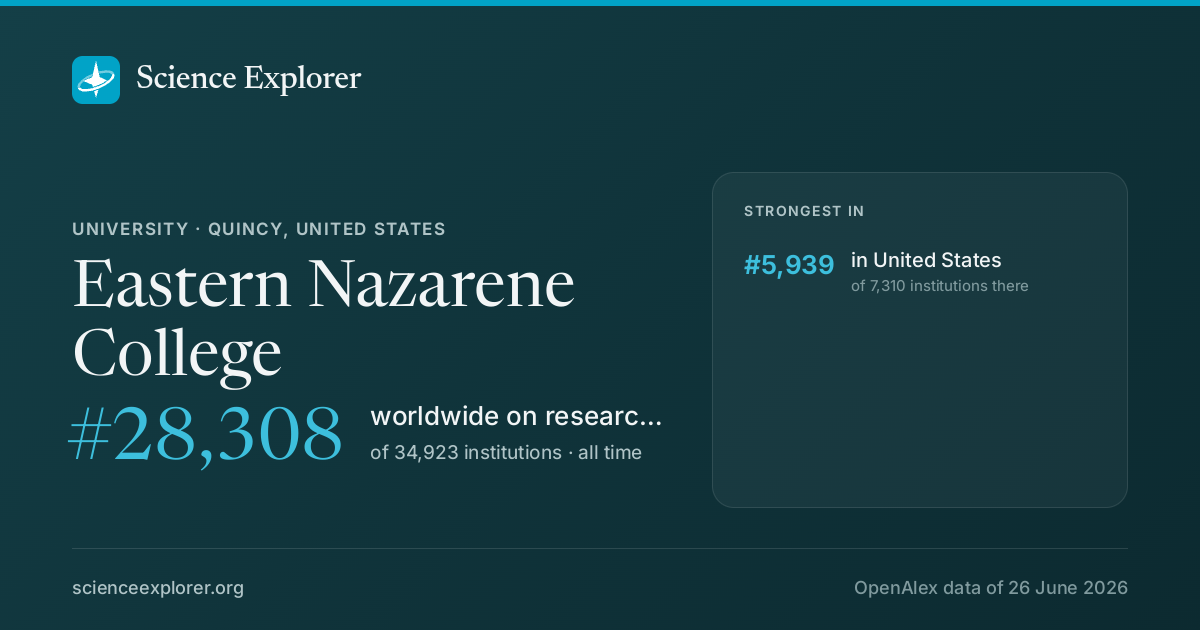
Eastern Nazarene College on Science Explorer

A card with Eastern Nazarene College's standing and the fields it leads in, for a post or a slide. A link to this page previews as the same card.

Download the card

1200 × 630 PNG, sized for social posts, drawn from the latest snapshot.

Badges for a website1Each links back here and updates with every snapshot

Research measures only: rankings here say nothing about teaching, admissions or student experience. Comparable institutions and collaboration partners have tabs of their own, above.

Discussion

Ask a question or share a note about Eastern Nazarene College. Keep it to the research: no personal attacks, advertising or links. Any reader can report a post, which collapses it for everyone until it is opened.
