Edith Cowan University
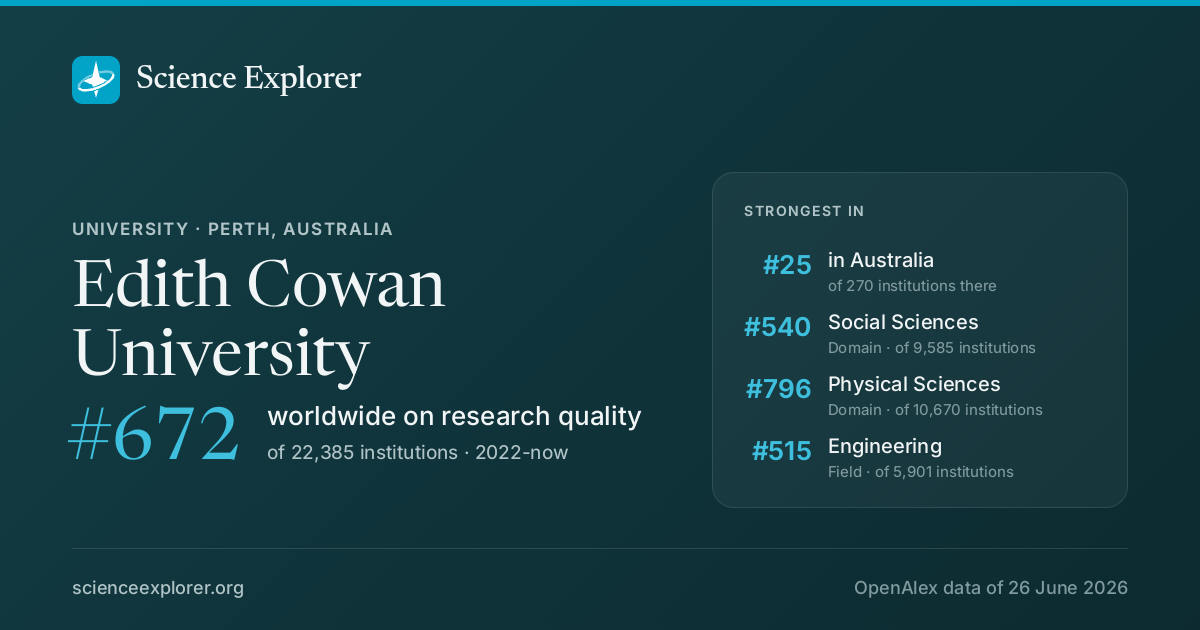
In research, Edith Cowan University stands highest in Social Sciences (#540 of 9,585 worldwide), Physical Sciences (#796 of 10,670 worldwide) and Engineering (#515 of 5,901 worldwide), 2022-now. Relative to its size it is most specialised in Orthopedics and Sports Medicine and Visual Arts and Performing Arts (Orthopedics and Sports Medicine is 9.8× its share of world research).
- World rank, 2022-now
- #672 of 22,385 · #913 all time
- Rank in Australia
- #25 of 270
- Research works
- 13k ◆ 2% vs 2018-21
- Citations
- 312k 23.7 per fractional work
- Top-10% rate
- 20.7% all institutions 10.0%
- vs its own fields
- 1.48× 1.00× is exactly expected
- Open access
- 62% world 40%
- International
- 28% world 18%
What is Edith Cowan University known for in research?
The fields where it stands highest, 2022-now, ranked among every institution above the floor in each field.
| Field | World rank | Where that sits | Top-10% rate | Works | All time |
|---|---|---|---|---|---|
| Social SciencesDomain | #540 of 9,585 | 22.4% | 1,025 | #571 | |
| Physical SciencesDomain | #796 of 10,670 | 23.5% | 900 | #1048 | |
| EngineeringField | #515 of 5,901 | 25.7% | 401 | #763 | |
| Health SciencesDomain | #875 of 9,902 | 17.9% | 706 | #1183 | |
| Social SciencesField | #548 of 5,988 | 22.4% | 526 | #521 | |
| MedicineField | #971 of 8,541 | 18.0% | 528 | #1351 | |
| Environmental ScienceField | #483 of 3,334 | 20.8% | 171 | #771 | |
| Computer ScienceField | #670 of 4,417 | 21.4% | 188 | #934 | |
| Business, Management and AccountingField | #422 of 2,581 | 28.3% | 153 | #427 | |
| Health ProfessionsField | #323 of 1,895 | 17.9% | 150 | #543 |
Each strip is that field's whole ranked pool, with the notch where Edith Cowan University sits in it, in the colour of the band that rank falls in. The track under the rate is the rate itself: it carries no average mark, because the average differs by field (from about 6% in Dentistry to 21% in Economics).
Which of those standings moved
The same fields on both windows: where it stood over the whole record, and where it stands in 2022-now. The distance is the story, and it is the one thing the two rank columns above cannot show.
- Social Sciences#571 #540
- Physical Sciences#1,048 #796
- Engineering#763 #515
- Health Sciences#1,183 #875
- Social Sciences#521 #548
- Medicine#1,351 #971
- Environmental Science#771 #483
- Computer Science#934 #670
- Business, Management and Accounting#427 #422
- Health Professions#543 #323
A dot further right is a better standing. Fields it was not ranked in over the whole record are left out.
Which fields of science does Edith Cowan University work in?
In 2022-now, 36% of research at Edith Cowan University is in Social Sciences, 32% in Physical Sciences. Its largest fields are Medicine (19%), Social Sciences (19%), Engineering (14%). It does 1.5× the world's share of Social Sciences.
Each ring splits the one inside it: the four domains of science, their fields, their subfields. Size is fractional works in 2022-now. Every slice is a page; the interactive view zooms down to single topics and colours each by how much more of it this institution does than the world.
Its 4 domains and 26 fields, with their numbers
- Social Sciences1,16536.4%
- Social Sciences60018.7%
- Psychology2247.0%
- Business, Management and Accounting1695.3%
- Arts and Humanities832.6%
- Economics, Econometrics and Finance511.6%
- Decision Sciences381.2%
- Physical Sciences1,02432.0%
- Engineering45214.1%
- Computer Science2166.8%
- Environmental Science1986.2%
- Energy461.4%
- Materials Science401.2%
- Earth and Planetary Sciences321.0%
- Chemistry170.5%
- Physics and Astronomy100.3%
- Chemical Engineering70.2%
- Mathematics70.2%
- Health Sciences80525.2%
- Medicine60218.8%
- Health Professions1725.4%
- Nursing270.8%
- Dentistry20.1%
- Veterinary20.1%
- Life Sciences2066.4%
What does Edith Cowan University specialise in?
Where its research is concentrated relative to its size: Orthopedics and Sports Medicine takes 9.8× the share of its output that it takes of world research.
- Orthopedics and Sports MedicineSubfield · 80.7 works9.8×
- Visual Arts and Performing ArtsSubfield · 21.7 works4.1×
Location quotient, a volume reading rather than an impact one. It surfaces small, lopsided specialities.
Field profile
Location quotient across every field it publishes in: outside the ring is more than an institution of this size would be expected to publish, inside it is less.
Rings at 0.5×, 1× and 2×. Widest outward: Psychology, 2.3×. Every wedge is a field page.
All 26 fields, with their numbers
- Psychology2.30×224 works
- Health Professions2.04×172 works
- Nursing1.72×27 works
- Business, Management and Accounting1.64×169 works
- Energy1.57×46 works
- Social Sciences1.48×600 works
- Environmental Science1.24×198 works
- Decision Sciences1.23×38 works
- Medicine0.98×602 works
- Engineering0.94×452 works
- Neuroscience0.91×47 works
- Arts and Humanities0.90×83 works
- Computer Science0.87×216 works
- Economics, Econometrics and Finance0.75×51 works
- Earth and Planetary Sciences0.63×32 works
- Chemical Engineering0.62×7 works
- Biochemistry, Genetics and Molecular Biology0.46×79 works
- Agricultural and Biological Sciences0.44×67 works
- Veterinary0.44×2 works
- Materials Science0.36×40 works
- Immunology and Microbiology0.33×11 works
- Chemistry0.33×17 works
- Mathematics0.18×7 works
- Pharmacology, Toxicology and Pharmaceutics0.17×2 works
- Dentistry0.15×2 works
- Physics and Astronomy0.13×10 works
- Psychology 2.3×
- Health Professions 2.0×
- Nursing 1.7×
- Business, Management and Accounting 1.6×
- Energy 1.6×
- Social Sciences 1.5×
- Environmental Science 1.2×
- Decision Sciences 1.2×
- Medicine 1.0×
- Engineering 0.9×
- Neuroscience 0.9×
- Arts and Humanities 0.9×
- Computer Science 0.9×
- Economics, Econometrics and Finance 0.8×
- Earth and Planetary Sciences 0.6×
- Chemical Engineering 0.6×
- Biochemistry, Genetics and Molecular Biology 0.5×
- Agricultural and Biological Sciences 0.4×
- Veterinary 0.4×
- Materials Science 0.4×
- Immunology and Microbiology 0.3×
- Chemistry 0.3×
- Mathematics 0.2×
- Pharmacology, Toxicology and Pharmaceutics 0.2×
- Dentistry 0.1×
- Physics and Astronomy 0.1×
Who are the top researchers at Edith Cowan University?
Ranked on the quality score, Stefan Iglauer, Hongqi Sun and Muhammad Ali lead among researchers whose main affiliation is Edith Cowan University.
- 1
Stefan Iglauer
 Australia · #1,996 worldwide
33k citations · 553 works
- 2
Hongqi Sun
Australia · #3,624 worldwide
49k citations · 460 works
- 3
Muhammad Ali
Australia · #5,936 worldwide
10k citations · 174 works
- 4
Alireza Keshavarz
Australia · #6,372 worldwide
13k citations · 290 works
- 5
Denise A Jackson
Australia · #12,912 worldwide
10k citations · 196 works
- 6
Lai‐Chang Zhang
Australia · #19,612 worldwide
35k citations · 531 works
- 7
Veer Bala Gupta
Australia · #24,511 worldwide
61k citations · 234 works
- 8
Óscar Serrano
Australia · #27,699 worldwide
14k citations · 207 works
- 9
Yujing Liu
Australia · #32,260 worldwide
15k citations · 224 works
- 10
Songshan Sam Huang
Australia · #32,285 worldwide
11k citations · 322 works
Which keywords describe research at Edith Cowan University?
By fractional works in 2022-now, weighted toward what it does more of than the world: High-Intensity Interval Training, Injury Prevention, Mental Health, Resistance Training, Epidemiology, Physiological Demands, Training Load and Athletic Training.
- Reactive Transport
- Tourist Satisfaction
- Destination Image
- Academic Achievement
- COVID-19 Impact
- Sports Injury
- Well-being
- Child Development
- Training Load
- Performance Analysis
- Prevention
- Physical Activity
- Social Justice
- High-Intensity Interval Training
- Environmental Impact
- Renewable Energy
- Public Health
- Climate Change
- Sustainability
- Deep Learning
- Epidemiology
- Machine Learning
- Mental Health
- Globalization
- Risk Factors
- Quality of Life
- Social Media
- Depression
- Injury Prevention
- Resistance Training
- Job Satisfaction
- Physiological Demands
- Athletic Training
- Anxiety
- Muscle Injuries
- CO2 Sequestration
- IoT Security
- Reflective Practice
- Sustainable Tourism
- Community Perceptions
Size is fractional works in 2022-now in the topics tagged with each word; colour is the word's share of this institution's work against its share of the world's. The 40 words are chosen for being large and distinctive. Each links to the topic it comes from most.
All 40 words, with their numbers
- Epidemiology132◆ 1.03×10⁵ topics
- Deep Learning113◆ 1.02×73 topics
- Machine Learning110◆ 1.03×71 topics
- Sustainability96▲ 1.23×68 topics
- Mental Health95▲ 2.1×41 topics
- Climate Change89◆ 1.02×82 topics
- Globalization79▲ 1.26×66 topics
- Public Health75▲ 1.61×49 topics
- Risk Factors67▲ 1.90×33 topics
- Renewable Energy67▲ 1.44×39 topics
- Quality of Life66▲ 1.43×50 topics
- Environmental Impact65▲ 1.18×48 topics
- Social Media61▲ 1.39×31 topics
- High-Intensity Interval Training51▲ 15×2 topics
- Depression51▲ 1.80×23 topics
- Social Justice50▲ 2.6×24 topics
- Injury Prevention49▲ 13×5 topics
- Physical Activity46▲ 2.9×12 topics
- Resistance Training45▲ 15×2 topics
- Prevention44▲ 3.3×14 topics
- Job Satisfaction42▲ 3.0×14 topics
- Performance Analysis41▲ 6.2×3 topics
- Physiological Demands39▲ 19×1 topic
- Training Load39▲ 19×1 topic
- Athletic Training38▲ 13×3 topics
- Child Development38▲ 2.9×9 topics
- Anxiety37▲ 2.5×11 topics
- Well-being37▲ 3.0×14 topics
- Muscle Injuries37▲ 18×1 topic
- Sports Injury37▲ 18×1 topic
- CO2 Sequestration35▲ 5.6×4 topics
- COVID-19 Impact35▲ 6.3×6 topics
- IoT Security32▲ 3.3×3 topics
- Academic Achievement31▲ 5.6×9 topics
- Reflective Practice27▲ 4.5×7 topics
- Destination Image26▲ 9.7×2 topics
- Sustainable Tourism25▲ 6.7×2 topics
- Tourist Satisfaction24▲ 7.4×2 topics
- Community Perceptions23▲ 10×1 topic
- Reactive Transport21▲ 12×2 topics
Which research topics does Edith Cowan University publish most on?
By volume in 2022-now: Sports Performance and Training, Sports injuries and prevention, Diverse Aspects of Tourism Research and CO2 Sequestration and Geologic Interactions.
Area is fractional works; colour is the subfield each topic belongs to.
- 1 Sports Performance and Training Orthopedics and Sports Medicine 39 works
- 2 Sports injuries and prevention Orthopedics and Sports Medicine 37 works
- 3 Diverse Aspects of Tourism Research Sociology and Political Science 23 works
- 4 CO2 Sequestration and Geologic Interactions Environmental Engineering 19 works
- 5 Enhanced Oil Recovery Techniques Ocean Engineering 17 works
- 6 Digital Marketing and Social Media Sociology and Political Science 17 works
- 7 Early Childhood Education and Development Education 14 works
- 8 Hydraulic Fracturing and Reservoir Analysis Mechanical Engineering 14 works
- 9 Hydrocarbon exploration and reservoir analysis Mechanics of Materials 14 works
- 10 Network Security and Intrusion Detection Computer Networks and Communications 13 works
How open and international is its research?
Against the world's own shares: the tick on each track. Both are shares of its output, so they sit on one scale and can be read against each other as well as against the world.
World: 40% of research is openly available.
World: 18% is written across borders.
How has Edith Cowan University's research output changed?
Output in 2022-2025 was 2% lower than in 2018-2021.
The same series as a ribbon: one cell per year, darker for more. The line above answers how much; this answers when.
Its share of all research
Growing output can still be a shrinking share: all of science grows. This is Edith Cowan University as a percentage of every work published that year, 0.014% in 2024.
Fractional works of Edith Cowan University over all fractional works that year. How the balance of science has shifted.
How much of it reaches the world top 10%
Year by year, against all institutions in the same year.
Of each year's output, the share that reached the world's 10% most cited for its field and year. Peak 23.2% in 2022.
Other research institutions in Perth
- The University of Western Australia
- Curtin University
- Murdoch University
- Government of Western Australia
- Sir Charles Gairdner Hospital
- Princess Margaret Hospital for Children
- Woodside (Australia)
- Western Australian Museum
Compare Edith Cowan University with
- vs
 Ca' Foscari University of Venice
- vs
 Korea Institute of Science and Technology
- vs
 Institut Sains dan Teknologi Terpadu Surabaya
- vs
 Chongqing Medical University
- vs
 Paul Scherrer Institute
- vs
 Indian Institute of Technology Roorkee
Share Edith Cowan University's ranking



Research measures only: rankings here say nothing about teaching, admissions or student experience. Comparable institutions and collaboration partners have tabs of their own, above.
Discussion
Ask a question or share a note about Edith Cowan University. Posts are plain text and can be reported.