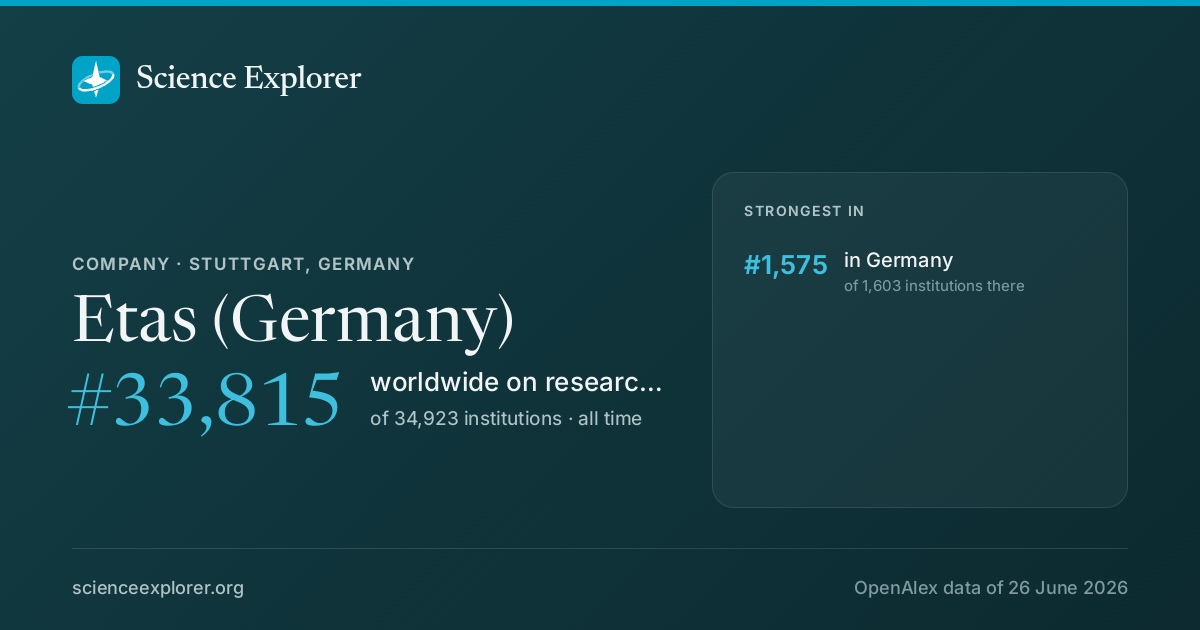
- World rank, all time
- #33,815 of 34,923
- Rank in Germany
- #1,575 of 1,603
- Research works
- 133 ▼ 61% vs 2018-21
- Citations
- 615 4.6 per fractional work
- Top-10% rate
- 0.1% all institutions 10.0%
- vs its own fields
- 0.99× 1.00× is exactly expected
- Open access
- 10% world 40%
- International
- 14% world 18%
Which fields of science does Etas (Germany) work in?
In all years, 86% of research at Etas (Germany) is in Physical Sciences, 14% in Social Sciences. Its largest fields are Engineering (51%), Computer Science (29%), Business, Management and Accounting (5%). It does 2.0× the world's share of Physical Sciences.
Each ring splits the one inside it: the four domains of science, their fields, their subfields. Size is fractional works in all years. Every slice is a page; the interactive view zooms down to single topics and colours each by how much more of it this institution does than the world.
Its 3 domains and 15 fields, with their numbers
- Physical Sciences11485.5%
- Engineering6851.1%
- Computer Science3929.1%
- Chemical Engineering21.8%
- Physics and Astronomy21.7%
- Energy11.0%
- Environmental Science10.4%
- Materials Science00.3%
- Earth and Planetary Sciences00.1%
- Social Sciences1914.2%
- Health Sciences00.2%
- Health Professions00.2%
Field profile
Location quotient across every field it publishes in: outside the ring is more than an institution of this size would be expected to publish, inside it is less.
Rings at 0.5×, 1× and 2×. Widest outward: Business, Management and Accounting, 5.5×. Every wedge is a field page.
All 7 fields, with their numbers
- Business, Management and Accounting5.46×2 works
- Decision Sciences3.72×0 works
- Computer Science3.24×4 works
- Physics and Astronomy3.24×1 works
- Engineering2.88×6 works
- Chemical Engineering2.29×0 works
- Psychology0.79×0 works
Who are the top researchers at Etas (Germany)?
Ranked on the quality score, Jürgen Häring, Darren Buttle and Ulrich Freund lead among researchers whose main affiliation is Etas (Germany).
- 1
Jürgen Häring
 Germany · #3,101,471 worldwide
151 citations · 20 works
- 2
Darren Buttle
Germany · #3,320,841 worldwide
113 citations · 17 works
- 3
Ulrich Freund
Germany · #3,655,496 worldwide
166 citations · 26 works
- 4
Jürgen Crepin
Germany · #3,840,017 worldwide
45 citations · 29 works
- 5
Thorsten Huber
Germany · #3,925,809 worldwide
73 citations · 15 works
- 6
Ulrich Lauff
Germany · #4,573,408 worldwide
34 citations · 17 works
Which keywords describe research at Etas (Germany)?
By fractional works in all years, weighted toward what it does more of than the world: Control Systems, Renewable Energy, Power Electronics, Hardware-in-the-Loop, Real-Time Simulation, Embedded Systems, Autonomous Vehicles and Hard Real-Time Systems.
- Software Development
- Modelica
- High-Level Synthesis
- Flexible Automation
- Hybrid Vehicles
- Assurance Cases
- Metamodeling
- Risk Assessment
- Real-Time Systems
- Artificial Intelligence
- Cyber-Physical Systems
- Trajectory Prediction
- Sensor Fusion
- Electric Vehicles
- Model Predictive Control
- Scheduling Algorithms
- Autonomous Vehicles
- Embedded Systems
- Hardware-in-the-Loop
- Renewable Energy
- Control Systems
- Power Electronics
- Real-Time Simulation
- Machine Learning
- Hard Real-Time Systems
- Deep Learning
- Big Data
- Collision Avoidance
- Driver Assistance Systems
- Model-Based Development
- Industrial Automation
- FPGA
- Simulation
- Internet of Things
- Statistical Analysis
- Energy Storage Systems
- Safety Assurance
- Reconfigurable Manufacturing Systems
- Reconfigurable Computing
- Object-Oriented Modeling
Size is fractional works in all years in the topics tagged with each word; colour is the word's share of this institution's work against its share of the world's. The 40 words are chosen for being large and distinctive. Each links to the topic it comes from most.
All 40 words, with their numbers
- Control Systems24▲ 70×4 topics
- Renewable Energy24▲ 18×6 topics
- Power Electronics21▲ 58×2 topics
- Hardware-in-the-Loop21▲ 549×1 topic
- Real-Time Simulation21▲ 549×1 topic
- Embedded Systems16▲ 133×4 topics
- Machine Learning12▲ 4.2×9 topics
- Autonomous Vehicles11▲ 60×4 topics
- Hard Real-Time Systems11▲ 369×1 topic
- Scheduling Algorithms11▲ 157×1 topic
- Deep Learning9▲ 3.2×6 topics
- Model Predictive Control8▲ 28×4 topics
- Big Data8▲ 11×7 topics
- Electric Vehicles8▲ 35×3 topics
- Collision Avoidance7▲ 44×2 topics
- Sensor Fusion7▲ 59×2 topics
- Driver Assistance Systems6▲ 181×1 topic
- Trajectory Prediction6▲ 181×1 topic
- Model-Based Development6▲ 118×2 topics
- Cyber-Physical Systems5▲ 31×3 topics
- Industrial Automation5▲ 59×2 topics
- Artificial Intelligence5▲ 4.7×3 topics
- FPGA5▲ 46×2 topics
- Real-Time Systems5▲ 137×2 topics
- Simulation5▲ 12×5 topics
- Risk Assessment4▲ 5.6×2 topics
- Internet of Things4▲ 5.9×6 topics
- Metamodeling4▲ 69×2 topics
- Statistical Analysis4▲ 24×2 topics
- Assurance Cases4▲ 423×1 topic
- Energy Storage Systems4▲ 34×1 topic
- Hybrid Vehicles4▲ 127×1 topic
- Safety Assurance4▲ 423×1 topic
- Flexible Automation4▲ 94×1 topic
- Reconfigurable Manufacturing Systems4▲ 94×1 topic
- High-Level Synthesis4▲ 64×1 topic
- Reconfigurable Computing4▲ 57×1 topic
- Modelica4▲ 436×1 topic
- Object-Oriented Modeling4▲ 436×1 topic
- Software Development4▲ 45×2 topics
Which research topics does Etas (Germany) publish most on?
By volume in 2022-now: Autonomous Vehicle Technology and Safety, Vehicle emissions and performance, Quantum Mechanics and Applications and Vehicle Dynamics and Control Systems.
Area is fractional works; colour is the subfield each topic belongs to.
- 1 Autonomous Vehicle Technology and Safety Automotive Engineering 1 works
- 2 Vehicle emissions and performance Automotive Engineering 1 works
- 3 Quantum Mechanics and Applications Atomic and Molecular Physics, and Optics 1 works
- 4 Vehicle Dynamics and Control Systems Automotive Engineering 1 works
- 5 Fault Detection and Control Systems Control and Systems Engineering 0 works
- 6 Business Process Modeling and Analysis Management Information Systems 0 works
- 7 Vehicular Ad Hoc Networks (VANETs) Electrical and Electronic Engineering 0 works
- 8 Real-Time Systems Scheduling Hardware and Architecture 0 works
- 9 Real-time simulation and control systems Control and Systems Engineering 0 works
- 10 Advanced Data Processing Techniques Control and Systems Engineering 0 works
How open and international is its research?
Against the world's own shares: the tick on each track. Both are shares of its output, so they sit on one scale and can be read against each other as well as against the world.
World: 40% of research is openly available.
World: 18% is written across borders.
How has Etas (Germany)'s research output changed?
Output in 2022-2025 was 61% lower than in 2018-2021.
The same series as a ribbon: one cell per year, darker for more. The line above answers how much; this answers when.
Its share of all research
Growing output can still be a shrinking share: all of science grows. This is Etas (Germany) as a percentage of every work published that year, 0.000036% in 2024.
Fractional works of Etas (Germany) over all fractional works that year. How the balance of science has shifted.
Other research institutions in Stuttgart
- University of Stuttgart
- University of Hohenheim
- Stuttgart Observatory
- Alcatel Lucent (Germany)
- Daimler (Germany)
- Robert Bosch (Germany)
- Stuttgart Technical University of Applied Sciences
- Olgahospital


Share Etas (Germany)'s ranking
Badges for a website1Each links back here and updates with every snapshot

Research measures only: rankings here say nothing about teaching, admissions or student experience. Comparable institutions and collaboration partners have tabs of their own, above.
Discussion
Ask a question or share a note about Etas (Germany). Posts are plain text and can be reported.