Science Explorer Back to mapMap
Discussion
University · Manila · Philippines

Far Eastern University

In research, Far Eastern University stands highest in Computer Science (#1,827 of 4,417 worldwide), Social Sciences (#4,112 of 9,585 worldwide) and Physical Sciences (#4,602 of 10,670 worldwide), 2022-now.

World rank, 2022-now
#5,541
of 22,385 · #10,773 all time
Rank in Philippines
#19
of 182
Research works
671
▲ 157% vs 2018-21
Citations
3.7k
5.5 per fractional work
Top-10% rate
10.2%
all institutions 10.0%
vs its own fields
0.90×
1.00× is exactly expected
Open access
47%
world 40%
International
16%
world 18%

What is Far Eastern University known for in research?

The fields where it stands highest, 2022-now, ranked among every institution above the floor in each field.

FieldWorld rankWhere that sitsTop-10% rateWorksAll time
Computer ScienceField #1,827 of 4,417 14.8%69 -
Social SciencesDomain #4,112 of 9,585 10.0%197 #8336
Physical SciencesDomain #4,602 of 10,670 10.8%138 #8483
Social SciencesField #4,494 of 5,988 11.2%106 #7288

Each strip is that field's whole ranked pool, with the notch where Far Eastern University sits in it, in the colour of the band that rank falls in. The track under the rate is the rate itself: it carries no average mark, because the average differs by field (from about 6% in Dentistry to 21% in Economics).

Which of those standings moved

The same fields on both windows: where it stood over the whole record, and where it stands in 2022-now. The distance is the story, and it is the one thing the two rank columns above cannot show.

  1. Social Sciences#8,336 #4,112
  2. Physical Sciences#8,483 #4,602
  3. Social Sciences#7,288 #4,494
all time2022-now, better2022-now, worse

A dot further right is a better standing. Fields it was not ranked in over the whole record are left out.

Which fields of science does Far Eastern University work in?

In 2022-now, 46% of research at Far Eastern University is in Social Sciences, 34% in Physical Sciences. Its largest fields are Social Sciences (25%), Computer Science (17%), Engineering (10%). It does 1.8× the world's share of Social Sciences.

Social Sciences: 215 fractional works · 46.0% of its workSocial Sciences: 116 fractional works · 24.7% of its workEducation: 48 fractional works · 10.3% of its workSociology and Political Science: 29 fractional works · 6.1% of its workSafety Research: 8 fractional works · 1.7% of its workGender Studies: 6 fractional works · 1.3% of its workAnthropology: 4 fractional works · 0.9% of its workPolitical Science and International Relations: 4 fractional works · 0.8% of its workCultural Studies: 3 fractional works · 0.6% of its workTransportation: 3 fractional works · 0.6% of its workDemography: 3 fractional works · 0.5% of its workHealth: 2 fractional works · 0.5% of its workCommunication: 1 fractional works · 0.3% of its workHuman Factors and Ergonomics: 1 fractional works · 0.3% of its workLinguistics and Language: 1 fractional works · 0.3% of its workLife-span and Life-course Studies: 1 fractional works · 0.2% of its workSmaller subfields together: 2 fractional works · 0.4% of its workPsychology: 42 fractional works · 8.9% of its workClinical Psychology: 14 fractional works · 3.0% of its workSocial Psychology: 12 fractional works · 2.6% of its workDevelopmental and Educational Psychology: 8 fractional works · 1.8% of its workExperimental and Cognitive Psychology: 4 fractional works · 0.9% of its workApplied Psychology: 3 fractional works · 0.6% of its workBusiness, Management and Accounting: 27 fractional works · 5.7% of its workMarketing: 5 fractional works · 1.1% of its workAccounting: 5 fractional works · 1.0% of its workManagement of Technology and Innovation: 5 fractional works · 1.0% of its workOrganizational Behavior and Human Resource Management: 4 fractional works · 0.9% of its workStrategy and Management: 4 fractional works · 0.8% of its workManagement Information Systems: 3 fractional works · 0.6% of its workSmaller subfields together: 1 fractional works · 0.2% of its workDecision Sciences: 14 fractional works · 2.9% of its workInformation Systems and Management: 8 fractional works · 1.7% of its workManagement Science and Operations Research: 5 fractional works · 1.1% of its workSmaller subfields together: 1 fractional works · 0.1% of its workArts and Humanities: 11 fractional works · 2.3% of its workLiterature and Literary Theory: 3 fractional works · 0.7% of its workVisual Arts and Performing Arts: 2 fractional works · 0.4% of its workLanguage and Linguistics: 2 fractional works · 0.4% of its workPhilosophy: 2 fractional works · 0.3% of its workReligious studies: 1 fractional works · 0.2% of its workSmaller subfields together: 1 fractional works · 0.3% of its workEconomics, Econometrics and Finance: 7 fractional works · 1.4% of its workEconomics and Econometrics: 4 fractional works · 0.9% of its workGeneral Economics, Econometrics and Finance: 1 fractional works · 0.3% of its workFinance: 1 fractional works · 0.3% of its workPhysical Sciences: 161 fractional works · 34.4% of its workComputer Science: 80 fractional works · 17.1% of its workInformation Systems: 25 fractional works · 5.3% of its workArtificial Intelligence: 24 fractional works · 5.1% of its workComputer Science Applications: 15 fractional works · 3.1% of its workHuman-Computer Interaction: 7 fractional works · 1.4% of its workComputer Vision and Pattern Recognition: 6 fractional works · 1.3% of its workComputer Networks and Communications: 2 fractional works · 0.5% of its workSmaller subfields together: 2 fractional works · 0.4% of its workEngineering: 46 fractional works · 9.8% of its workCivil and Structural Engineering: 9 fractional works · 1.8% of its workBuilding and Construction: 8 fractional works · 1.7% of its workElectrical and Electronic Engineering: 6 fractional works · 1.3% of its workMedia Technology: 4 fractional works · 1.0% of its workBiomedical Engineering: 4 fractional works · 0.9% of its workControl and Systems Engineering: 3 fractional works · 0.6% of its workIndustrial and Manufacturing Engineering: 2 fractional works · 0.5% of its workSafety, Risk, Reliability and Quality: 2 fractional works · 0.4% of its workMechanical Engineering: 2 fractional works · 0.4% of its workOcean Engineering: 2 fractional works · 0.4% of its workMechanics of Materials: 2 fractional works · 0.3% of its workAutomotive Engineering: 1 fractional works · 0.3% of its workSmaller subfields together: 1 fractional works · 0.2% of its workEnvironmental Science: 24 fractional works · 5.2% of its workIndustrial and Manufacturing Engineering: 4 fractional works · 0.9% of its workManagement, Monitoring, Policy and Law: 4 fractional works · 0.9% of its workEnvironmental Engineering: 3 fractional works · 0.7% of its workPollution: 3 fractional works · 0.6% of its workGlobal and Planetary Change: 2 fractional works · 0.5% of its workNature and Landscape Conservation: 2 fractional works · 0.4% of its workWater Science and Technology: 2 fractional works · 0.4% of its workHealth, Toxicology and Mutagenesis: 2 fractional works · 0.4% of its workEcology: 1 fractional works · 0.3% of its workSmaller subfields together: 0 fractional works · 0.1% of its workEarth and Planetary Sciences: 3 fractional works · 0.7% of its workOceanography: 1 fractional works · 0.3% of its workGeology: 1 fractional works · 0.2% of its workSmaller subfields together: 1 fractional works · 0.2% of its workEnergy: 3 fractional works · 0.6% of its workRenewable Energy, Sustainability and the Environment: 2 fractional works · 0.5% of its workSmaller subfields together: 1 fractional works · 0.1% of its workMaterials Science: 2 fractional works · 0.5% of its workMaterials Chemistry: 2 fractional works · 0.3% of its workSmaller subfields together: 1 fractional works · 0.1% of its workChemistry: 2 fractional works · 0.4% of its workMathematics: 1 fractional works · 0.2% of its workHealth Sciences: 61 fractional works · 13.1% of its workMedicine: 41 fractional works · 8.7% of its workPublic Health, Environmental and Occupational Health: 7 fractional works · 1.5% of its workPediatrics, Perinatology and Child Health: 5 fractional works · 1.0% of its workEpidemiology: 3 fractional works · 0.7% of its workHealth Informatics: 3 fractional works · 0.6% of its workObstetrics and Gynecology: 3 fractional works · 0.6% of its workSurgery: 2 fractional works · 0.5% of its workEndocrinology, Diabetes and Metabolism: 2 fractional works · 0.4% of its workPhysiology: 2 fractional works · 0.4% of its workPulmonary and Respiratory Medicine: 2 fractional works · 0.4% of its workInfectious Diseases: 2 fractional works · 0.3% of its workPharmacology: 1 fractional works · 0.3% of its workOncology: 1 fractional works · 0.3% of its workComplementary and alternative medicine: 1 fractional works · 0.2% of its workSmaller subfields together: 6 fractional works · 1.3% of its workHealth Professions: 16 fractional works · 3.5% of its workGeneral Health Professions: 9 fractional works · 2.0% of its workPhysical Therapy, Sports Therapy and Rehabilitation: 2 fractional works · 0.4% of its workSpeech and Hearing: 1 fractional works · 0.3% of its workHealth Information Management: 1 fractional works · 0.3% of its workOccupational Therapy: 1 fractional works · 0.3% of its workSmaller subfields together: 1 fractional works · 0.2% of its workNursing: 2 fractional works · 0.5% of its workDentistry: 1 fractional works · 0.2% of its workVeterinary: 0 fractional works · 0.1% of its workLife Sciences: 31 fractional works · 6.6% of its workAgricultural and Biological Sciences: 13 fractional works · 2.7% of its workPlant Science: 5 fractional works · 1.1% of its workFood Science: 3 fractional works · 0.7% of its workAnimal Science and Zoology: 1 fractional works · 0.2% of its workSmaller subfields together: 3 fractional works · 0.7% of its workBiochemistry, Genetics and Molecular Biology: 10 fractional works · 2.2% of its workMolecular Biology: 6 fractional works · 1.3% of its workEndocrinology: 2 fractional works · 0.4% of its workSmaller subfields together: 3 fractional works · 0.6% of its workImmunology and Microbiology: 3 fractional works · 0.7% of its workImmunology: 2 fractional works · 0.3% of its workSmaller subfields together: 2 fractional works · 0.4% of its workNeuroscience: 3 fractional works · 0.6% of its workCognitive Neuroscience: 2 fractional works · 0.5% of its workSmaller subfields together: 1 fractional works · 0.1% of its workPharmacology, Toxicology and Pharmaceutics: 2 fractional works · 0.3% of its workPharmacology: 2 fractional works · 0.3% of its workALL ITS WORKFar EasternUniversity468fractional works, 2022-now
Life Sciences7%Physical Sciences34%Health Sciences13%Social Sciences46%

Each ring splits the one inside it: the four domains of science, their fields, their subfields. Size is fractional works in 2022-now. Every slice is a page; the interactive view zooms down to single topics and colours each by how much more of it this institution does than the world.

Its 4 domains and 24 fields, with their numbers
    1. Social Sciences11624.7%
    2. Psychology428.9%
    3. Business, Management and Accounting275.7%
    4. Decision Sciences142.9%
    5. Arts and Humanities112.3%
    6. Economics, Econometrics and Finance71.4%
    1. Computer Science8017.1%
    2. Engineering469.8%
    3. Environmental Science245.2%
    4. Earth and Planetary Sciences30.7%
    5. Energy30.6%
    6. Materials Science20.5%
    7. Chemistry20.4%
    8. Mathematics10.2%
    1. Medicine418.7%
    2. Health Professions163.5%
    3. Nursing20.5%
    4. Dentistry10.2%
    5. Veterinary00.1%
    1. Agricultural and Biological Sciences132.7%
    2. Biochemistry, Genetics and Molecular Biology102.2%
    3. Immunology and Microbiology30.7%
    4. Neuroscience30.6%
    5. Pharmacology, Toxicology and Pharmaceutics20.3%
All of science, and how each field's share has moved since 1950: the Science domain explorer

Field profile

Location quotient across every field it publishes in: outside the ring is more than an institution of this size would be expected to publish, inside it is less.

Agricultural and Biological Sciences: 0.57× its world share, 13 worksAgricultural and Bio…Biochemistry, Genetics and Molecular Biology: 0.42× its world share, 10 worksBiochemistry, Geneti…Immunology and Microbiology: 0.69× its world share, 3 worksImmunology and Micro…Neuroscience: 0.40× its world share, 3 worksNeurosciencePharmacology, Toxicology and Pharmaceutics: 0.93× its world share, 2 worksPharmacology, Toxico…Chemistry: 0.23× its world share, 2 worksChemistryComputer Science: 2.20× its world share, 80 worksComputer ScienceEarth and Planetary Sciences: 0.46× its world share, 3 worksEarth and Planetary …Energy: 0.67× its world share, 3 worksEnergyEngineering: 0.65× its world share, 46 worksEngineeringEnvironmental Science: 1.04× its world share, 24 worksEnvironmental ScienceMaterials Science: 0.14× its world share, 2 worksMaterials ScienceMathematics: 0.16× its world share, 1 worksMathematicsDentistry: 0.46× its world share, 1 worksDentistryHealth Professions: 1.34× its world share, 16 worksHealth ProfessionsMedicine: 0.45× its world share, 41 worksMedicineNursing: 1.08× its world share, 2 worksNursingVeterinary: 0.79× its world share, 0 worksVeterinaryArts and Humanities: 0.79× its world share, 11 worksArts and HumanitiesBusiness, Management and Accounting: 1.77× its world share, 27 worksBusiness, Management…Decision Sciences: 3.02× its world share, 14 worksDecision SciencesEconomics, Econometrics and Finance: 0.66× its world share, 7 worksEconomics, Econometr…Psychology: 2.93× its world share, 42 worksPsychologySocial Sciences: 1.95× its world share, 116 worksSocial Sciences1×world share
more than its size predictsabout as predictedless

Rings at 0.5×, 1× and 2×. Widest outward: Decision Sciences, 3.0×. Every wedge is a field page.

All 24 fields, with their numbers
  1. Decision Sciences3.02×14 works
  2. Psychology2.93×42 works
  3. Computer Science2.20×80 works
  4. Social Sciences1.95×116 works
  5. Business, Management and Accounting1.77×27 works
  6. Health Professions1.34×16 works
  7. Nursing1.08×2 works
  8. Environmental Science1.04×24 works
  9. Pharmacology, Toxicology and Pharmaceutics0.93×2 works
  10. Veterinary0.79×0 works
  11. Arts and Humanities0.79×11 works
  12. Immunology and Microbiology0.69×3 works
  13. Energy0.67×3 works
  14. Economics, Econometrics and Finance0.66×7 works
  15. Engineering0.65×46 works
  16. Agricultural and Biological Sciences0.57×13 works
  17. Earth and Planetary Sciences0.46×3 works
  18. Dentistry0.46×1 works
  19. Medicine0.45×41 works
  20. Biochemistry, Genetics and Molecular Biology0.42×10 works
  21. Neuroscience0.40×3 works
  22. Chemistry0.23×2 works
  23. Mathematics0.16×1 works
  24. Materials Science0.14×2 works

Who are the top researchers at Far Eastern University?

Ranked on the quality score, Manuel B. Garcia, Ian Bartican Benitez and Leovigildo Lito D. Mallillin lead among researchers whose main affiliation is Far Eastern University.

  1. 1 Manuel B. Garcia Philippines · #88,544 worldwide 3.2k citations · 161 works
  2. 2 Ian Bartican Benitez Philippines · #897,223 worldwide 517 citations · 53 works
  3. 3 Leovigildo Lito D. Mallillin Philippines · #1,273,553 worldwide 403 citations · 67 works
  4. 4 Teodoro Feria Revano Jr. Philippines · #1,277,789 worldwide 346 citations · 21 works
  5. 5 Ronel F. Ramos Philippines · #1,484,174 worldwide 121 citations · 31 works
  6. 6 Giovanni De Jesus Milanez Philippines · #1,611,003 worldwide 1.2k citations · 62 works
  7. 7 Abel V. Alvarez Philippines · #1,625,850 worldwide 1.9k citations · 23 works
  8. 8 Maria Rona L. Perez Philippines · #1,750,080 worldwide 192 citations · 17 works
  9. 9 John Heland Jasper C. Ortega Philippines · #1,848,732 worldwide 218 citations · 41 works
  10. 10 Nolan C. Concha Philippines · #1,891,277 worldwide 259 citations · 25 works
All ranked researchers at Far Eastern University

What are the most cited papers from Far Eastern University?

The most cited paper from Far Eastern University is "Burden of 375 diseases and injuries, risk-attributable burden of 88 risk factors, and healthy life expectancy in 204 countries and territories, including 660 subnational locations, 1990–2023: a systematic analysis for the Global Burden of Disease Study 2023" (Simon I Hay et al., 2025), with 762 citations. Next come "Global importance of large‐diameter trees" (590) and "Global burden of 292 causes of death in 204 countries and territories and 660 subnational locations, 1990–2023: a systematic analysis for the Global Burden of Disease Study 2023" (500).

Most cited papers
#PaperReleasedCitations
1 Burden of 375 diseases and injuries, risk-attributable burden of 88 risk factors, and healthy life expectancy in 204 countries and territories, including 660 subnational locations, 1990–2023: a systematic analysis for the Global Burden of Disease Study 2023 Simon I Hay et al. · The Lancet Open access2,780 authors Oct 2025 762
2 Global importance of large‐diameter trees James A. Lutz et al. · Global Ecology and Biogeography 8 May 2018 590
3 Global burden of 292 causes of death in 204 countries and territories and 660 subnational locations, 1990–2023: a systematic analysis for the Global Burden of Disease Study 2023 Mohsen Naghavi et al. · The Lancet Open access2,463 authors Oct 2025 500
4 Plant diversity increases with the strength of negative density dependence at the global scale Joseph A. LaManna et al. · Science 30 Jun 2017 345
5 Phylogenetic classification of the world’s tropical forests Ferry J.W. Slik et al. · Proceedings of the National Academy of Sciences Open access187 authors 5 Feb 2018 199
All 60 most cited papers, with filters and sorting

Which keywords describe research at Far Eastern University?

By fractional works in 2022-now, weighted toward what it does more of than the world: Educational Technology, E-Learning, Online Learning, Machine Learning, Student Engagement, Technology Integration, Education and Learning Analytics.

▲ more of its work than of the world's◆ about the world's share▼ less than the world's

Size is fractional works in 2022-now in the topics tagged with each word; colour is the word's share of this institution's work against its share of the world's. The 40 words are chosen for being large and distinctive. Each links to the topic it comes from most.

All 40 words, with their numbers
  1. Machine Learning35▲ 2.3×44 topics
  2. Educational Technology29▲ 5.2×22 topics
  3. E-Learning26▲ 5.7×16 topics
  4. Education26▲ 3.2×36 topics
  5. Online Learning24▲ 6.1×11 topics
  6. Mental Health20▲ 2.9×26 topics
  7. Artificial Intelligence19▲ 2.9×28 topics
  8. Sustainability18▲ 1.61×40 topics
  9. Student Engagement18▲ 9.7×9 topics
  10. Technology Integration18▲ 12×7 topics
  11. Globalization16▲ 1.78×26 topics
  12. Social Media16▲ 2.4×16 topics
  13. Learning Analytics13▲ 24×2 topics
  14. Depression12▲ 3.0×11 topics
  15. Big Data12▲ 2.8×14 topics
  16. MOOCs11▲ 26×2 topics
  17. Higher Education11▲ 4.4×15 topics
  18. Well-being11▲ 6.1×10 topics
  19. E-commerce11▲ 4.1×7 topics
  20. Digital Transformation11▲ 4.2×13 topics
  21. Online Education11▲ 12×5 topics
  22. Educational Data Mining11▲ 27×1 topic
  23. Massive Open Online Courses11▲ 27×1 topic
  24. Student Satisfaction10▲ 12×2 topics
  25. Mobile Learning10▲ 6.5×3 topics
  26. Health Education10▲ 4.8×6 topics
  27. Technology Acceptance Model10▲ 13×2 topics
  28. Lifelong Learning10▲ 9.8×8 topics
  29. User Satisfaction9▲ 10×4 topics
  30. Social Interaction9▲ 4.9×6 topics
  31. Information Systems8▲ 11×4 topics
  32. Structural Equation Modeling8▲ 9.2×3 topics
  33. Google Classroom8▲ 17×1 topic
  34. Teacher Perception8▲ 16×1 topic
  35. Professional Development8▲ 8.1×7 topics
  36. Online Shopping8▲ 9.4×1 topic
  37. Partial Least Squares8▲ 18×1 topic
  38. Customer Experience7▲ 9.2×4 topics
  39. Teacher Professional Development7▲ 9.2×5 topics
  40. Intelligent Tutoring Systems7▲ 29×2 topics

Which research topics does Far Eastern University publish most on?

By volume in 2022-now: Online Learning and Analytics, Technology-Enhanced Education Studies, Technology Adoption and User Behaviour and AI in Service Interactions.

  1. 1 Online Learning and Analytics Computer Science Applications 11 works
  2. 2 Technology-Enhanced Education Studies Education 8 works
  3. 3 Technology Adoption and User Behaviour Information Systems and Management 8 works
  4. 4 AI in Service Interactions Artificial Intelligence 5 works
  5. 5 Digital Marketing and Social Media Sociology and Political Science 5 works
  6. 6 E-Learning and COVID-19 Education 5 works
  7. 7 Intelligent Tutoring Systems and Adaptive Learning Artificial Intelligence 5 works
  8. 8 Impact of Technology on Adolescents Sociology and Political Science 5 works
  9. 9 COVID-19 and Mental Health Clinical Psychology 4 works
  10. 10 Philippine History and Culture Anthropology 4 works

How open and international is its research?

Against the world's own shares: the tick on each track. Both are shares of its output, so they sit on one scale and can be read against each other as well as against the world.

openly available47.0%not open53.0%

World: 40% of research is openly available.

with international co-authors15.5%domestic only84.5%

World: 18% is written across borders.

How has Far Eastern University's research output changed?

Output in 2022-2025 was 157% higher than in 2018-2021.

still counting1990200020102020
grewheldshrank

The same series as a ribbon: one cell per year, darker for more. The line above answers how much; this answers when.

Its share of all research

Growing output can still be a shrinking share: all of science grows. This is Far Eastern University as a percentage of every work published that year, 0.0020% in 2024.

still counting0.0010%0.0020%0.0030%Far Eastern University0.0020% in 202519801990200020102020

Fractional works of Far Eastern University over all fractional works that year. How the balance of science has shifted.

How much of it reaches the world top 10%

Year by year, against all institutions in the same year.

still counting10%20%all institutions10.0% in 2025Far Eastern University9.5% in 20252020

Of each year's output, the share that reached the world's 10% most cited for its field and year. Peak 16.2% in 2020.

Other research institutions in Manila

All research institutions in Manila

Share Far Eastern University's ranking
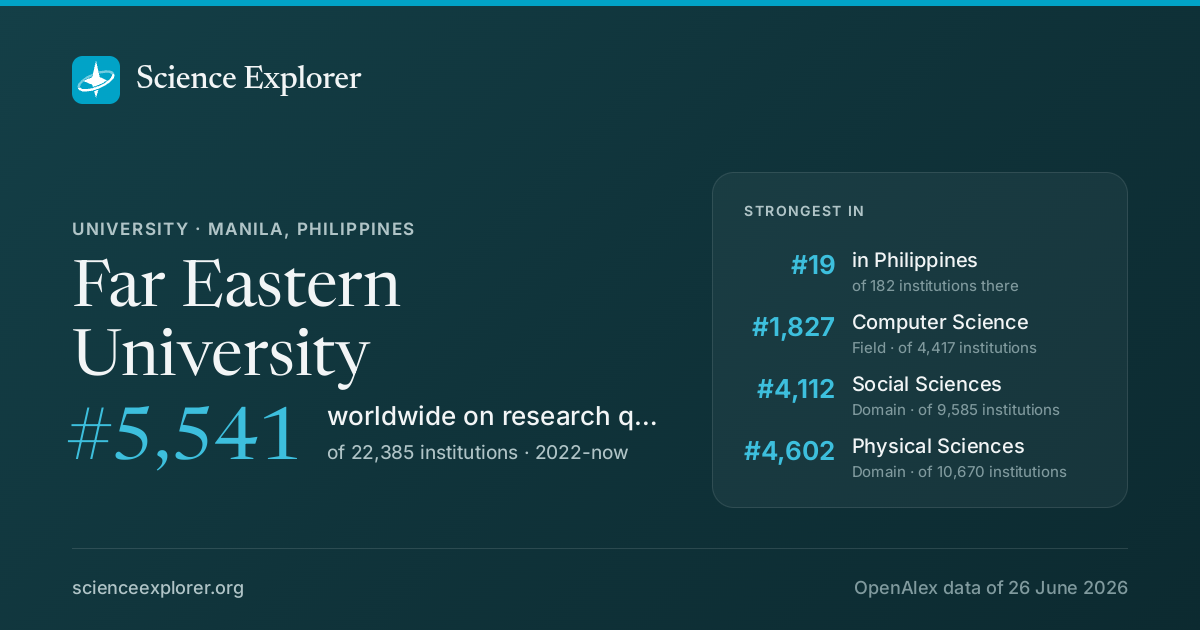
Far Eastern University on Science Explorer

A card with Far Eastern University's standing and the fields it leads in, for a post or a slide. A link to this page previews as the same card.

Download the card

1200 × 630 PNG, sized for social posts, drawn from the latest snapshot.

Badges for a website1Each links back here and updates with every snapshot

Research measures only: rankings here say nothing about teaching, admissions or student experience. Comparable institutions and collaboration partners have tabs of their own, above.

Discussion

Ask a question or share a note about Far Eastern University. Posts are plain text and can be reported.