Science Explorer Back to mapMap
Discussion
Government institution · Bern · Switzerland

Federal Roads Office

World rank, 2022-now
#14,573
of 22,385 · #10,135 all time
Rank in Switzerland
#115
of 186
Research works
287
▲ 18% vs 2018-21
Citations
2.9k
10.1 per fractional work
Top-10% rate
15.4%
all institutions 10.0%
vs its own fields
1.09×
1.00× is exactly expected
Open access
49%
world 40%
International
51%
world 18%

Which fields of science does Federal Roads Office work in?

In 2022-now, 48% of research at Federal Roads Office is in Health Sciences, 26% in Physical Sciences. Its largest fields are Medicine (44%), Engineering (13%), Social Sciences (11%). It does 1.9× the world's share of Health Sciences.

Health Sciences: 40 fractional works · 48.5% of its workMedicine: 37 fractional works · 44.3% of its workSurgery: 22 fractional works · 27.1% of its workOrthopedics and Sports Medicine: 4 fractional works · 5.2% of its workEpidemiology: 2 fractional works · 2.6% of its workRheumatology: 2 fractional works · 1.9% of its workPulmonary and Respiratory Medicine: 1 fractional works · 1.3% of its workRehabilitation: 1 fractional works · 1.1% of its workCardiology and Cardiovascular Medicine: 1 fractional works · 0.8% of its workPathology and Forensic Medicine: 0 fractional works · 0.6% of its workRadiology, Nuclear Medicine and Imaging: 0 fractional works · 0.5% of its workNephrology: 0 fractional works · 0.5% of its workOncology: 0 fractional works · 0.5% of its workPharmacology: 0 fractional works · 0.4% of its workEndocrinology, Diabetes and Metabolism: 0 fractional works · 0.4% of its workPsychiatry and Mental health: 0 fractional works · 0.3% of its workDermatology: 0 fractional works · 0.2% of its workPediatrics, Perinatology and Child Health: 0 fractional works · 0.2% of its workSmaller subfields together: 0 fractional works · 0.6% of its workHealth Professions: 3 fractional works · 3.4% of its workGeneral Health Professions: 2 fractional works · 2.1% of its workOccupational Therapy: 1 fractional works · 0.7% of its workPhysical Therapy, Sports Therapy and Rehabilitation: 0 fractional works · 0.3% of its workSmaller subfields together: 0 fractional works · 0.3% of its workVeterinary: 0 fractional works · 0.5% of its workSmall Animals: 0 fractional works · 0.5% of its workDentistry: 0 fractional works · 0.3% of its workOral Surgery: 0 fractional works · 0.2% of its workSmaller subfields together: 0 fractional works · 0.1% of its workPhysical Sciences: 21 fractional works · 25.6% of its workEngineering: 11 fractional works · 13.5% of its workBiomedical Engineering: 3 fractional works · 3.8% of its workAerospace Engineering: 1 fractional works · 1.5% of its workBuilding and Construction: 1 fractional works · 1.5% of its workElectrical and Electronic Engineering: 1 fractional works · 1.5% of its workCivil and Structural Engineering: 1 fractional works · 1.4% of its workControl and Systems Engineering: 1 fractional works · 1.0% of its workMechanical Engineering: 1 fractional works · 0.7% of its workAutomotive Engineering: 1 fractional works · 0.7% of its workIndustrial and Manufacturing Engineering: 0 fractional works · 0.4% of its workSafety, Risk, Reliability and Quality: 0 fractional works · 0.3% of its workComputational Mechanics: 0 fractional works · 0.2% of its workOcean Engineering: 0 fractional works · 0.2% of its workSmaller subfields together: 0 fractional works · 0.2% of its workComputer Science: 3 fractional works · 3.3% of its workInformation Systems: 1 fractional works · 1.5% of its workArtificial Intelligence: 1 fractional works · 0.7% of its workComputer Networks and Communications: 1 fractional works · 0.7% of its workComputer Science Applications: 0 fractional works · 0.3% of its workSmaller subfields together: 0 fractional works · 0.0% of its workEnvironmental Science: 3 fractional works · 3.1% of its workGlobal and Planetary Change: 1 fractional works · 1.3% of its workNature and Landscape Conservation: 1 fractional works · 0.7% of its workEcology: 0 fractional works · 0.3% of its workHealth, Toxicology and Mutagenesis: 0 fractional works · 0.3% of its workPollution: 0 fractional works · 0.2% of its workSmaller subfields together: 0 fractional works · 0.3% of its workPhysics and Astronomy: 2 fractional works · 2.2% of its workAstronomy and Astrophysics: 1 fractional works · 1.5% of its workStatistical and Nonlinear Physics: 0 fractional works · 0.2% of its workAtomic and Molecular Physics, and Optics: 0 fractional works · 0.2% of its workSmaller subfields together: 0 fractional works · 0.2% of its workEarth and Planetary Sciences: 2 fractional works · 1.9% of its workGeology: 1 fractional works · 0.8% of its workGeochemistry and Petrology: 1 fractional works · 0.8% of its workSmaller subfields together: 0 fractional works · 0.3% of its workMaterials Science: 0 fractional works · 0.5% of its workGeneral Materials Science: 0 fractional works · 0.2% of its workPolymers and Plastics: 0 fractional works · 0.2% of its workSmaller subfields together: 0 fractional works · 0.1% of its workMathematics: 0 fractional works · 0.4% of its workChemical Engineering: 0 fractional works · 0.3% of its workChemical Health and Safety: 0 fractional works · 0.3% of its workChemistry: 0 fractional works · 0.2% of its workPhysical and Theoretical Chemistry: 0 fractional works · 0.2% of its workEnergy: 0 fractional works · 0.2% of its workRenewable Energy, Sustainability and the Environment: 0 fractional works · 0.2% of its workSocial Sciences: 18 fractional works · 21.2% of its workSocial Sciences: 9 fractional works · 10.7% of its workSociology and Political Science: 3 fractional works · 3.2% of its workPolitical Science and International Relations: 3 fractional works · 3.1% of its workLaw: 2 fractional works · 1.9% of its workTransportation: 1 fractional works · 0.8% of its workEducation: 1 fractional works · 0.8% of its workDemography: 0 fractional works · 0.4% of its workSmaller subfields together: 0 fractional works · 0.4% of its workArts and Humanities: 2 fractional works · 2.8% of its workHistory: 1 fractional works · 1.2% of its workPhilosophy: 1 fractional works · 1.0% of its workMuseology: 0 fractional works · 0.6% of its workPsychology: 2 fractional works · 2.7% of its workClinical Psychology: 1 fractional works · 1.1% of its workSocial Psychology: 1 fractional works · 1.1% of its workExperimental and Cognitive Psychology: 0 fractional works · 0.5% of its workSmaller subfields together: 0 fractional works · 0.0% of its workBusiness, Management and Accounting: 2 fractional works · 2.6% of its workStrategy and Management: 2 fractional works · 2.0% of its workManagement Information Systems: 0 fractional works · 0.3% of its workManagement of Technology and Innovation: 0 fractional works · 0.3% of its workEconomics, Econometrics and Finance: 2 fractional works · 2.0% of its workEconomics and Econometrics: 2 fractional works · 2.0% of its workDecision Sciences: 0 fractional works · 0.3% of its workStatistics, Probability and Uncertainty: 0 fractional works · 0.3% of its workSmaller subfields together: 0 fractional works · 0.1% of its workLife Sciences: 4 fractional works · 4.7% of its workAgricultural and Biological Sciences: 2 fractional works · 2.9% of its workAnimal Science and Zoology: 2 fractional works · 1.9% of its workInsect Science: 0 fractional works · 0.3% of its workForestry: 0 fractional works · 0.2% of its workSmaller subfields together: 0 fractional works · 0.5% of its workBiochemistry, Genetics and Molecular Biology: 1 fractional works · 1.8% of its workMolecular Biology: 1 fractional works · 0.8% of its workBiochemistry: 0 fractional works · 0.4% of its workDevelopmental Biology: 0 fractional works · 0.4% of its workSmaller subfields together: 0 fractional works · 0.2% of its workImmunology and Microbiology: 0 fractional works · 0.0% of its workALL ITS WORKFederal RoadsOffice83fractional works, 2022-now
Life Sciences5%Physical Sciences26%Health Sciences48%Social Sciences21%

Each ring splits the one inside it: the four domains of science, their fields, their subfields. Size is fractional works in 2022-now. Every slice is a page; the interactive view zooms down to single topics and colours each by how much more of it this institution does than the world.

Its 4 domains and 23 fields, with their numbers
    1. Medicine3744.3%
    2. Health Professions33.4%
    3. Veterinary00.5%
    4. Dentistry00.3%
    1. Engineering1113.5%
    2. Computer Science33.3%
    3. Environmental Science33.1%
    4. Physics and Astronomy22.2%
    5. Earth and Planetary Sciences21.9%
    6. Materials Science00.5%
    7. Mathematics00.4%
    8. Chemical Engineering00.3%
    9. Chemistry00.2%
    10. Energy00.2%
    1. Social Sciences910.7%
    2. Arts and Humanities22.8%
    3. Psychology22.7%
    4. Business, Management and Accounting22.6%
    5. Economics, Econometrics and Finance22.0%
    6. Decision Sciences00.3%
    1. Agricultural and Biological Sciences22.9%
    2. Biochemistry, Genetics and Molecular Biology11.8%
    3. Immunology and Microbiology00.0%
All of science, and how each field's share has moved since 1950: the Science domain explorer

What does Federal Roads Office specialise in?

Where its research is concentrated relative to its size: Surgery takes 11.6× the share of its output that it takes of world research.

  1. SurgerySubfield · 22.4 works12×
← less than its size predicts1×more →

Location quotient, a volume reading rather than an impact one. It surfaces small, lopsided specialities.

Field profile

Location quotient across every field it publishes in: outside the ring is more than an institution of this size would be expected to publish, inside it is less.

Agricultural and Biological Sciences: 0.61× its world share, 2 worksAgricultural and Bio…Biochemistry, Genetics and Molecular Biology: 0.33× its world share, 2 worksBiochemistry, Geneti…Immunology and Microbiology: 0.05× its world share, 0 worksImmunology and Micro…Chemical Engineering: 0.87× its world share, 0 worksChemical EngineeringChemistry: 0.13× its world share, 0 worksChemistryComputer Science: 0.42× its world share, 3 worksComputer ScienceEarth and Planetary Sciences: 1.24× its world share, 2 worksEarth and Planetary …Energy: 0.22× its world share, 0 worksEnergyEngineering: 0.90× its world share, 11 worksEngineeringEnvironmental Science: 0.62× its world share, 2 worksEnvironmental ScienceMaterials Science: 0.14× its world share, 0 worksMaterials ScienceMathematics: 0.37× its world share, 0 worksMathematicsPhysics and Astronomy: 0.98× its world share, 2 worksPhysics and AstronomyDentistry: 0.58× its world share, 0 worksDentistryHealth Professions: 1.30× its world share, 3 worksHealth ProfessionsMedicine: 2.30× its world share, 37 worksMedicineVeterinary: 3.81× its world share, 0 worksVeterinaryArts and Humanities: 0.98× its world share, 2 worksArts and HumanitiesBusiness, Management and Accounting: 0.81× its world share, 2 worksBusiness, Management…Decision Sciences: 0.35× its world share, 0 worksDecision SciencesEconomics, Econometrics and Finance: 0.94× its world share, 2 worksEconomics, Econometr…Psychology: 0.90× its world share, 2 worksPsychologySocial Sciences: 0.85× its world share, 9 worksSocial Sciences1×world share
more than its size predictsabout as predictedless

Rings at 0.5×, 1× and 2×. Widest outward: Veterinary, 3.8×. Every wedge is a field page.

All 23 fields, with their numbers
  1. Veterinary3.81×0 works
  2. Medicine2.30×37 works
  3. Health Professions1.30×3 works
  4. Earth and Planetary Sciences1.24×2 works
  5. Physics and Astronomy0.98×2 works
  6. Arts and Humanities0.98×2 works
  7. Economics, Econometrics and Finance0.94×2 works
  8. Engineering0.90×11 works
  9. Psychology0.90×2 works
  10. Chemical Engineering0.87×0 works
  11. Social Sciences0.85×9 works
  12. Business, Management and Accounting0.81×2 works
  13. Environmental Science0.62×2 works
  14. Agricultural and Biological Sciences0.61×2 works
  15. Dentistry0.58×0 works
  16. Computer Science0.42×3 works
  17. Mathematics0.37×0 works
  18. Decision Sciences0.35×0 works
  19. Biochemistry, Genetics and Molecular Biology0.33×2 works
  20. Energy0.22×0 works
  21. Materials Science0.14×0 works
  22. Chemistry0.13×0 works
  23. Immunology and Microbiology0.05×0 works

Who are the top researchers at Federal Roads Office?

Ranked on the quality score, Luca Nover, Mo Saffarini and Patrick Stirling lead among researchers whose main affiliation is Federal Roads Office.

  1. 1 Luca Nover Switzerland · #509,369 worldwide 848 citations · 46 works
  2. 2 Mo Saffarini Switzerland · #543,542 worldwide 4.3k citations · 224 works
  3. 3 Patrick Stirling Switzerland · #1,008,643 worldwide 440 citations · 19 works
  4. 4 Floris van Rooij Switzerland · #1,098,270 worldwide 658 citations · 77 works
  5. 5 Jacobus Hendrik Müller Switzerland · #1,474,731 worldwide 1.2k citations · 103 works
  6. 6 Sonia Ramos‐Pascual Switzerland · #2,200,464 worldwide 376 citations · 64 works
  7. 7 Aude Michelet Switzerland · #2,781,059 worldwide 365 citations · 37 works
  8. 8 Chinyelum Agu Switzerland · #2,878,465 worldwide 30 citations · 20 works
  9. 9 Alain Machenaud Switzerland · #3,216,515 worldwide 214 citations · 33 works
  10. 10 Laurent Geais Switzerland · #3,344,111 worldwide 205 citations · 18 works
All ranked researchers at Federal Roads Office

What are the most cited papers from Federal Roads Office?

The most cited paper from Federal Roads Office is "Broad targeting of resistance to apoptosis in cancer" (Ramzi M. Mohammad et al., 2015), with 869 citations. Next come "Long-term effect of inhaled budesonide in mild and moderate chronic obstructive pulmonary disease: a randomised controlled trial" (818) and "Tissue invasion and metastasis: Molecular, biological and clinical perspectives" (532).

Most cited papers
#PaperReleasedCitations
1 Broad targeting of resistance to apoptosis in cancer Ramzi M. Mohammad et al. · Seminars in Cancer Biology Open access 28 Apr 2015 869
2 Long-term effect of inhaled budesonide in mild and moderate chronic obstructive pulmonary disease: a randomised controlled trial Jørgen Vestbo, Torben Søorensen, Peter Lange et al. · The Lancet May 1999 818
3 Tissue invasion and metastasis: Molecular, biological and clinical perspectives Wen G. Jiang et al. · Seminars in Cancer Biology Open access 11 Apr 2015 532
4 Broad targeting of angiogenesis for cancer prevention and therapy Zongwei Wang et al. · Seminars in Cancer Biology Open access 16 Jan 2015 462
5 Genomic instability in human cancer: Molecular insights and opportunities for therapeutic attack and prevention through diet and nutrition Lynnette Robyn Ferguson et al. · Seminars in Cancer Biology Open access 11 Apr 2015 342
All 62 most cited papers, with filters and sorting

Which keywords describe research at Federal Roads Office?

By fractional works in 2022-now, weighted toward what it does more of than the world: Revision Surgery, Total Hip Replacement, Complications, Rehabilitation, Arthroplasty, Epidemiology, Health-related Quality of Life and Patient Satisfaction.

▲ more of its work than of the world's◆ about the world's share▼ less than the world's

Size is fractional works in 2022-now in the topics tagged with each word; colour is the word's share of this institution's work against its share of the world's. The 40 words are chosen for being large and distinctive. Each links to the topic it comes from most.

All 40 words, with their numbers
  1. Epidemiology10▲ 3.1×15 topics
  2. Revision Surgery8▲ 80×2 topics
  3. Total Hip Replacement8▲ 80×2 topics
  4. Complications8▲ 20×6 topics
  5. Rehabilitation7▲ 21×5 topics
  6. Arthroplasty7▲ 84×2 topics
  7. Health-related Quality of Life5▲ 27×2 topics
  8. Outcomes5▲ 73×1 topic
  9. Patient Satisfaction5▲ 20×2 topics
  10. Total Knee Replacement5▲ 88×1 topic
  11. Shoulder Function4▲ 63×2 topics
  12. Biomechanics4▲ 14×5 topics
  13. Rotator Cuff Tears4▲ 67×1 topic
  14. Shoulder Pathology4▲ 67×1 topic
  15. Hip Arthroplasty3▲ 70×1 topic
  16. Wear Particles3▲ 70×1 topic
  17. Sustainable Development3▲ 2.3×9 topics
  18. Gait Analysis3▲ 33×3 topics
  19. Leadership2▲ 6.2×3 topics
  20. Osteoarthritis2▲ 23×4 topics
  21. Foot Strike Patterns2▲ 74×1 topic
  22. Running Injuries2▲ 74×1 topic
  23. History2▲ 3.6×6 topics
  24. Risk Assessment2▲ 3.6×5 topics
  25. Ankle Injuries2▲ 75×1 topic
  26. Femoroacetabular Impingement2▲ 93×1 topic
  27. Hip Arthroscopy2▲ 93×1 topic
  28. Sprains2▲ 75×1 topic
  29. Surgical Management2▲ 5.8×2 topics
  30. Anterior Cruciate Ligament2▲ 53×1 topic
  31. Injury Risk2▲ 53×1 topic
  32. Acromioclavicular Joint2▲ 83×1 topic
  33. Clavicle Fractures2▲ 83×1 topic
  34. Criminal Justice2▲ 8.5×4 topics
  35. Participation2▲ 19×2 topics
  36. Public Administration2▲ 23×2 topics
  37. Complex Systems1▲ 16×2 topics
  38. Crisis Management1▲ 34×2 topics
  39. Digitalization1▲ 8.4×2 topics
  40. Hip Fracture1▲ 45×1 topic

Which research topics does Federal Roads Office publish most on?

By volume in 2022-now: Total Knee Arthroplasty Outcomes, Shoulder Injury and Treatment, Orthopaedic implants and arthroplasty and Lower Extremity Biomechanics and Pathologies.

  1. 1 Total Knee Arthroplasty Outcomes Surgery 5 works
  2. 2 Shoulder Injury and Treatment Surgery 4 works
  3. 3 Orthopaedic implants and arthroplasty Surgery 3 works
  4. 4 Lower Extremity Biomechanics and Pathologies Biomedical Engineering 2 works
  5. 5 Foot and Ankle Surgery Orthopedics and Sports Medicine 2 works
  6. 6 Hip disorders and treatments Surgery 2 works
  7. 7 Knee injuries and reconstruction techniques Surgery 2 works
  8. 8 Shoulder and Clavicle Injuries Epidemiology 2 works
  9. 9 Hip and Femur Fractures Surgery 1 works
  10. 10 Public Administration and Political Analysis Political Science and International Relations 1 works

How open and international is its research?

Against the world's own shares: the tick on each track. Both are shares of its output, so they sit on one scale and can be read against each other as well as against the world.

openly available49.1%not open50.9%

World: 40% of research is openly available.

with international co-authors50.9%domestic only49.1%

World: 18% is written across borders.

How has Federal Roads Office's research output changed?

Output in 2022-2025 was 18% higher than in 2018-2021.

still counting1990200020102020
grewheldshrank

The same series as a ribbon: one cell per year, darker for more. The line above answers how much; this answers when.

Its share of all research

Growing output can still be a shrinking share: all of science grows. This is Federal Roads Office as a percentage of every work published that year, 0.00036% in 2024.

still counting0.00050%0.0010%0.0015%Federal Roads Office0.00034% in 202519801990200020102020

Fractional works of Federal Roads Office over all fractional works that year. How the balance of science has shifted.

Other research institutions in Bern

All research institutions in Bern

Share Federal Roads Office's ranking
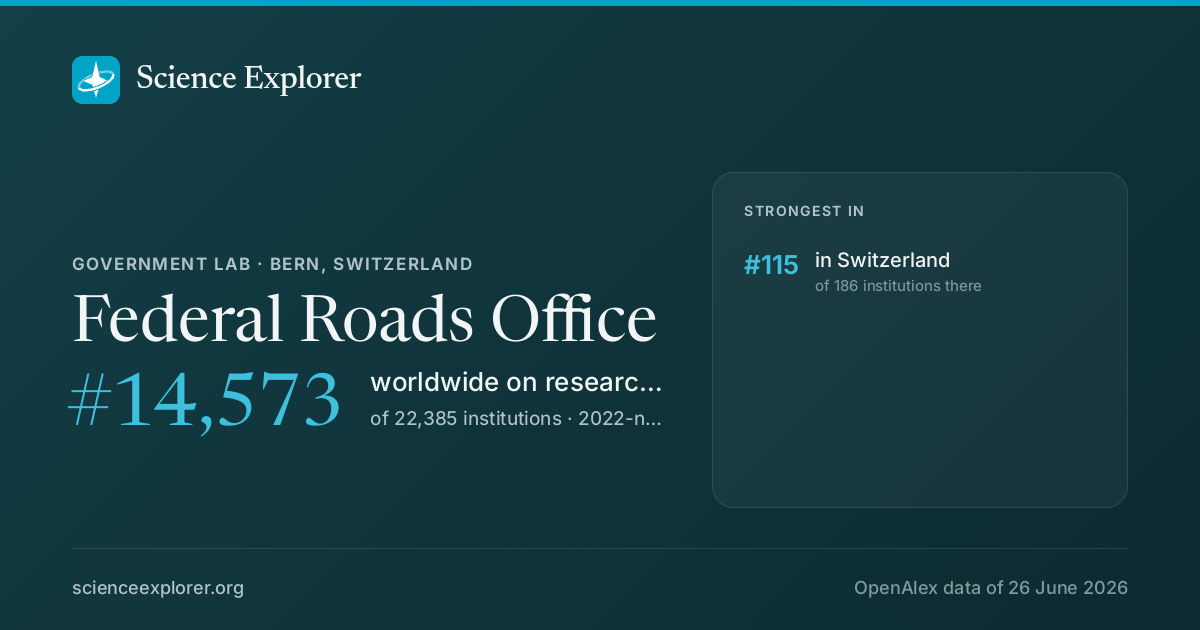
Federal Roads Office on Science Explorer

A card with Federal Roads Office's standing and the fields it leads in, for a post or a slide. A link to this page previews as the same card.

Download the card

1200 × 630 PNG, sized for social posts, drawn from the latest snapshot.

Badges for a website1Each links back here and updates with every snapshot

Research measures only: rankings here say nothing about teaching, admissions or student experience. Comparable institutions and collaboration partners have tabs of their own, above.

Discussion

Ask a question or share a note about Federal Roads Office. Posts are plain text and can be reported.