Science Explorer Back to mapMap
Discussion
University · Ballarat · Australia

Federation University

In research, Federation University stands highest in Physical Sciences (#1,797 of 10,670 worldwide), Social Sciences (#1,706 of 9,585 worldwide) and Engineering (#1,126 of 5,901 worldwide), 2022-now.

World rank, 2022-now
#1,667
of 22,385 · #1,825 all time
Rank in Australia
#49
of 270
Research works
5.8k
◆ 1% vs 2018-21
Citations
115k
19.7 per fractional work
Top-10% rate
14.4%
all institutions 10.0%
vs its own fields
1.13×
1.00× is exactly expected
Open access
42%
world 40%
International
24%
world 18%

What is Federation University known for in research?

The fields where it stands highest, 2022-now, ranked among every institution above the floor in each field.

FieldWorld rankWhere that sitsTop-10% rateWorksAll time
Physical SciencesDomain #1,797 of 10,670 15.4%486 #2261
Social SciencesDomain #1,706 of 9,585 14.9%458 #1211
EngineeringField #1,126 of 5,901 16.8%219 #1786
Health SciencesDomain #2,313 of 9,902 12.9%252 #2274
Computer ScienceField #1,144 of 4,417 18.3%135 #1082
MedicineField #2,672 of 8,541 12.2%161 #2739
PsychologyField #730 of 2,121 17.5%126 #705
Social SciencesField #2,121 of 5,988 15.3%238 #1278
Life SciencesDomain #2,451 of 6,403 9.5%109 #3103
Health ProfessionsField #757 of 1,895 13.1%73 #846

Each strip is that field's whole ranked pool, with the notch where Federation University sits in it, in the colour of the band that rank falls in. The track under the rate is the rate itself: it carries no average mark, because the average differs by field (from about 6% in Dentistry to 21% in Economics).

Which of those standings moved

The same fields on both windows: where it stood over the whole record, and where it stands in 2022-now. The distance is the story, and it is the one thing the two rank columns above cannot show.

  1. Physical Sciences#2,261 #1,797
  2. Social Sciences#1,211 #1,706
  3. Engineering#1,786 #1,126
  4. Health Sciences#2,274 #2,313
  5. Computer Science#1,082 #1,144
  6. Medicine#2,739 #2,672
  7. Psychology#705 #730
  8. Social Sciences#1,278 #2,121
  9. Life Sciences#3,103 #2,451
  10. Health Professions#846 #757
all time2022-now, better2022-now, worse

A dot further right is a better standing. Fields it was not ranked in over the whole record are left out.

Which fields of science does Federation University work in?

In 2022-now, 37% of research at Federation University is in Physical Sciences, 35% in Social Sciences. Its largest fields are Social Sciences (18%), Engineering (17%), Medicine (12%). It does 1.4× the world's share of Social Sciences.

Physical Sciences: 524 fractional works · 37.0% of its workEngineering: 236 fractional works · 16.6% of its workElectrical and Electronic Engineering: 51 fractional works · 3.6% of its workCivil and Structural Engineering: 29 fractional works · 2.1% of its workMechanical Engineering: 29 fractional works · 2.0% of its workControl and Systems Engineering: 28 fractional works · 2.0% of its workMechanics of Materials: 17 fractional works · 1.2% of its workBiomedical Engineering: 15 fractional works · 1.1% of its workSafety, Risk, Reliability and Quality: 13 fractional works · 0.9% of its workBuilding and Construction: 11 fractional works · 0.8% of its workAerospace Engineering: 9 fractional works · 0.7% of its workAutomotive Engineering: 8 fractional works · 0.6% of its workIndustrial and Manufacturing Engineering: 6 fractional works · 0.4% of its workMedia Technology: 6 fractional works · 0.4% of its workOcean Engineering: 6 fractional works · 0.4% of its workComputational Mechanics: 6 fractional works · 0.4% of its workComputer Science: 143 fractional works · 10.1% of its workArtificial Intelligence: 48 fractional works · 3.4% of its workInformation Systems: 27 fractional works · 1.9% of its workComputer Networks and Communications: 19 fractional works · 1.4% of its workComputer Vision and Pattern Recognition: 19 fractional works · 1.3% of its workComputational Theory and Mathematics: 11 fractional works · 0.8% of its workSignal Processing: 8 fractional works · 0.5% of its workComputer Science Applications: 5 fractional works · 0.3% of its workHuman-Computer Interaction: 3 fractional works · 0.2% of its workSmaller subfields together: 3 fractional works · 0.2% of its workEnvironmental Science: 82 fractional works · 5.8% of its workEcology: 18 fractional works · 1.2% of its workGlobal and Planetary Change: 13 fractional works · 0.9% of its workEnvironmental Engineering: 11 fractional works · 0.7% of its workManagement, Monitoring, Policy and Law: 10 fractional works · 0.7% of its workNature and Landscape Conservation: 8 fractional works · 0.6% of its workWater Science and Technology: 6 fractional works · 0.4% of its workEnvironmental Chemistry: 4 fractional works · 0.3% of its workIndustrial and Manufacturing Engineering: 4 fractional works · 0.3% of its workPollution: 4 fractional works · 0.3% of its workHealth, Toxicology and Mutagenesis: 3 fractional works · 0.2% of its workSmaller subfields together: 2 fractional works · 0.1% of its workMathematics: 18 fractional works · 1.3% of its workGeometry and Topology: 4 fractional works · 0.3% of its workSmaller subfields together: 14 fractional works · 1.0% of its workEarth and Planetary Sciences: 15 fractional works · 1.0% of its workAtmospheric Science: 7 fractional works · 0.5% of its workOceanography: 3 fractional works · 0.2% of its workSmaller subfields together: 4 fractional works · 0.3% of its workMaterials Science: 11 fractional works · 0.8% of its workMaterials Chemistry: 6 fractional works · 0.4% of its workBiomaterials: 3 fractional works · 0.2% of its workSmaller subfields together: 3 fractional works · 0.2% of its workPhysics and Astronomy: 8 fractional works · 0.5% of its workStatistical and Nonlinear Physics: 4 fractional works · 0.3% of its workSmaller subfields together: 3 fractional works · 0.2% of its workEnergy: 7 fractional works · 0.5% of its workRenewable Energy, Sustainability and the Environment: 4 fractional works · 0.3% of its workSmaller subfields together: 3 fractional works · 0.2% of its workChemistry: 3 fractional works · 0.2% of its workChemical Engineering: 1 fractional works · 0.1% of its workSocial Sciences: 502 fractional works · 35.4% of its workSocial Sciences: 261 fractional works · 18.4% of its workSociology and Political Science: 86 fractional works · 6.0% of its workEducation: 69 fractional works · 4.9% of its workHealth: 15 fractional works · 1.0% of its workPolitical Science and International Relations: 14 fractional works · 1.0% of its workGender Studies: 14 fractional works · 1.0% of its workDemography: 11 fractional works · 0.8% of its workSafety Research: 10 fractional works · 0.7% of its workGeography, Planning and Development: 6 fractional works · 0.4% of its workCultural Studies: 6 fractional works · 0.4% of its workPublic Administration: 5 fractional works · 0.4% of its workLaw: 4 fractional works · 0.3% of its workAnthropology: 4 fractional works · 0.3% of its workTransportation: 4 fractional works · 0.3% of its workUrban Studies: 4 fractional works · 0.3% of its workCommunication: 4 fractional works · 0.3% of its workHuman Factors and Ergonomics: 3 fractional works · 0.2% of its workSmaller subfields together: 2 fractional works · 0.2% of its workPsychology: 137 fractional works · 9.6% of its workClinical Psychology: 53 fractional works · 3.8% of its workSocial Psychology: 40 fractional works · 2.8% of its workDevelopmental and Educational Psychology: 18 fractional works · 1.3% of its workExperimental and Cognitive Psychology: 15 fractional works · 1.1% of its workApplied Psychology: 9 fractional works · 0.6% of its workSmaller subfields together: 2 fractional works · 0.1% of its workBusiness, Management and Accounting: 40 fractional works · 2.8% of its workManagement Information Systems: 9 fractional works · 0.7% of its workStrategy and Management: 8 fractional works · 0.6% of its workMarketing: 5 fractional works · 0.4% of its workOrganizational Behavior and Human Resource Management: 5 fractional works · 0.4% of its workAccounting: 5 fractional works · 0.3% of its workManagement of Technology and Innovation: 4 fractional works · 0.3% of its workSmaller subfields together: 3 fractional works · 0.2% of its workArts and Humanities: 25 fractional works · 1.7% of its workLiterature and Literary Theory: 6 fractional works · 0.4% of its workVisual Arts and Performing Arts: 4 fractional works · 0.3% of its workHistory: 3 fractional works · 0.2% of its workSmaller subfields together: 12 fractional works · 0.8% of its workEconomics, Econometrics and Finance: 23 fractional works · 1.6% of its workEconomics and Econometrics: 16 fractional works · 1.1% of its workFinance: 5 fractional works · 0.3% of its workSmaller subfields together: 2 fractional works · 0.1% of its workDecision Sciences: 17 fractional works · 1.2% of its workManagement Science and Operations Research: 9 fractional works · 0.6% of its workStatistics, Probability and Uncertainty: 4 fractional works · 0.3% of its workInformation Systems and Management: 4 fractional works · 0.3% of its workHealth Sciences: 275 fractional works · 19.4% of its workMedicine: 173 fractional works · 12.2% of its workPublic Health, Environmental and Occupational Health: 23 fractional works · 1.7% of its workPhysiology: 19 fractional works · 1.4% of its workEpidemiology: 16 fractional works · 1.1% of its workOrthopedics and Sports Medicine: 14 fractional works · 1.0% of its workInfectious Diseases: 9 fractional works · 0.7% of its workPsychiatry and Mental health: 9 fractional works · 0.6% of its workSurgery: 8 fractional works · 0.6% of its workCardiology and Cardiovascular Medicine: 8 fractional works · 0.6% of its workPulmonary and Respiratory Medicine: 7 fractional works · 0.5% of its workPediatrics, Perinatology and Child Health: 7 fractional works · 0.5% of its workEndocrinology, Diabetes and Metabolism: 7 fractional works · 0.5% of its workOncology: 6 fractional works · 0.4% of its workEmergency Medicine: 3 fractional works · 0.2% of its workComplementary and alternative medicine: 3 fractional works · 0.2% of its workGeriatrics and Gerontology: 3 fractional works · 0.2% of its workCritical Care and Intensive Care Medicine: 3 fractional works · 0.2% of its workSmaller subfields together: 28 fractional works · 2.0% of its workHealth Professions: 81 fractional works · 5.7% of its workGeneral Health Professions: 47 fractional works · 3.3% of its workEmergency Medical Services: 9 fractional works · 0.7% of its workPhysical Therapy, Sports Therapy and Rehabilitation: 7 fractional works · 0.5% of its workHealth Information Management: 4 fractional works · 0.3% of its workOccupational Therapy: 3 fractional works · 0.2% of its workSpeech and Hearing: 3 fractional works · 0.2% of its workSmaller subfields together: 7 fractional works · 0.5% of its workNursing: 17 fractional works · 1.2% of its workResearch and Theory: 12 fractional works · 0.8% of its workSmaller subfields together: 5 fractional works · 0.4% of its workVeterinary: 2 fractional works · 0.2% of its workDentistry: 2 fractional works · 0.1% of its workLife Sciences: 117 fractional works · 8.3% of its workAgricultural and Biological Sciences: 49 fractional works · 3.5% of its workPlant Science: 19 fractional works · 1.3% of its workFood Science: 7 fractional works · 0.5% of its workEcology, Evolution, Behavior and Systematics: 6 fractional works · 0.4% of its workInsect Science: 5 fractional works · 0.4% of its workSoil Science: 4 fractional works · 0.3% of its workGeneral Agricultural and Biological Sciences: 3 fractional works · 0.2% of its workSmaller subfields together: 5 fractional works · 0.3% of its workBiochemistry, Genetics and Molecular Biology: 42 fractional works · 3.0% of its workMolecular Biology: 30 fractional works · 2.1% of its workGenetics: 6 fractional works · 0.4% of its workSmaller subfields together: 7 fractional works · 0.5% of its workNeuroscience: 18 fractional works · 1.2% of its workCognitive Neuroscience: 10 fractional works · 0.7% of its workNeurology: 4 fractional works · 0.3% of its workSmaller subfields together: 3 fractional works · 0.2% of its workImmunology and Microbiology: 7 fractional works · 0.5% of its workImmunology: 4 fractional works · 0.3% of its workSmaller subfields together: 3 fractional works · 0.2% of its workPharmacology, Toxicology and Pharmaceutics: 1 fractional works · 0.1% of its workALL ITS WORKFederationUniversity1,418fractional works, 2022-now
Life Sciences8%Physical Sciences37%Health Sciences19%Social Sciences35%

Each ring splits the one inside it: the four domains of science, their fields, their subfields. Size is fractional works in 2022-now. Every slice is a page; the interactive view zooms down to single topics and colours each by how much more of it this institution does than the world.

Its 4 domains and 26 fields, with their numbers
    1. Engineering23616.6%
    2. Computer Science14310.1%
    3. Environmental Science825.8%
    4. Mathematics181.3%
    5. Earth and Planetary Sciences151.0%
    6. Materials Science110.8%
    7. Physics and Astronomy80.5%
    8. Energy70.5%
    9. Chemistry30.2%
    10. Chemical Engineering10.1%
    1. Social Sciences26118.4%
    2. Psychology1379.6%
    3. Business, Management and Accounting402.8%
    4. Arts and Humanities251.7%
    5. Economics, Econometrics and Finance231.6%
    6. Decision Sciences171.2%
    1. Medicine17312.2%
    2. Health Professions815.7%
    3. Nursing171.2%
    4. Veterinary20.2%
    5. Dentistry20.1%
    1. Agricultural and Biological Sciences493.5%
    2. Biochemistry, Genetics and Molecular Biology423.0%
    3. Neuroscience181.2%
    4. Immunology and Microbiology70.5%
    5. Pharmacology, Toxicology and Pharmaceutics10.1%
All of science, and how each field's share has moved since 1950: the Science domain explorer

Field profile

Location quotient across every field it publishes in: outside the ring is more than an institution of this size would be expected to publish, inside it is less.

Agricultural and Biological Sciences: 0.73× its world share, 49 worksAgricultural and Bio…Biochemistry, Genetics and Molecular Biology: 0.56× its world share, 42 worksBiochemistry, Geneti…Immunology and Microbiology: 0.50× its world share, 7 worksImmunology and Micro…Neuroscience: 0.77× its world share, 18 worksNeurosciencePharmacology, Toxicology and Pharmaceutics: 0.24× its world share, 1 worksPharmacology, Toxico…Chemical Engineering: 0.29× its world share, 2 worksChemical EngineeringChemistry: 0.12× its world share, 3 worksChemistryComputer Science: 1.30× its world share, 143 worksComputer ScienceEarth and Planetary Sciences: 0.66× its world share, 15 worksEarth and Planetary …Energy: 0.54× its world share, 7 worksEnergyEngineering: 1.11× its world share, 236 worksEngineeringEnvironmental Science: 1.17× its world share, 82 worksEnvironmental ScienceMaterials Science: 0.22× its world share, 11 worksMaterials ScienceMathematics: 1.08× its world share, 18 worksMathematicsPhysics and Astronomy: 0.24× its world share, 8 worksPhysics and AstronomyDentistry: 0.26× its world share, 2 worksDentistryHealth Professions: 2.16× its world share, 81 worksHealth ProfessionsMedicine: 0.64× its world share, 173 worksMedicineNursing: 2.40× its world share, 17 worksNursingVeterinary: 1.29× its world share, 2 worksVeterinaryArts and Humanities: 0.60× its world share, 25 worksArts and HumanitiesBusiness, Management and Accounting: 0.87× its world share, 40 worksBusiness, Management…Decision Sciences: 1.22× its world share, 17 worksDecision SciencesEconomics, Econometrics and Finance: 0.74× its world share, 23 worksEconomics, Econometr…Psychology: 3.16× its world share, 137 worksPsychologySocial Sciences: 1.46× its world share, 261 worksSocial Sciences1×world share
more than its size predictsabout as predictedless

Rings at 0.5×, 1× and 2×. Widest outward: Psychology, 3.2×. Every wedge is a field page.

All 26 fields, with their numbers
  1. Psychology3.16×137 works
  2. Nursing2.40×17 works
  3. Health Professions2.16×81 works
  4. Social Sciences1.46×261 works
  5. Computer Science1.30×143 works
  6. Veterinary1.29×2 works
  7. Decision Sciences1.22×17 works
  8. Environmental Science1.17×82 works
  9. Engineering1.11×236 works
  10. Mathematics1.08×18 works
  11. Business, Management and Accounting0.87×40 works
  12. Neuroscience0.77×18 works
  13. Economics, Econometrics and Finance0.74×23 works
  14. Agricultural and Biological Sciences0.73×49 works
  15. Earth and Planetary Sciences0.66×15 works
  16. Medicine0.64×173 works
  17. Arts and Humanities0.60×25 works
  18. Biochemistry, Genetics and Molecular Biology0.56×42 works
  19. Energy0.54×7 works
  20. Immunology and Microbiology0.50×7 works
  21. Chemical Engineering0.29×2 works
  22. Dentistry0.26×2 works
  23. Pharmacology, Toxicology and Pharmaceutics0.24×1 works
  24. Physics and Astronomy0.24×8 works
  25. Materials Science0.22×11 works
  26. Chemistry0.12×3 works

Who are the top researchers at Federation University?

Ranked on the quality score, Muhammad Aziz Rahman, Vasileios Stavropoulos and Jiefeng Hu lead among researchers whose main affiliation is Federation University.

  1. 1 Muhammad Aziz Rahman Australia · #14,120 worldwide 160k citations · 380 works
  2. 2 Vasileios Stavropoulos Australia · #43,796 worldwide 4.9k citations · 191 works
  3. 3 Jiefeng Hu Australia · #51,711 worldwide 7.8k citations · 184 works
  4. 4 Evita March Australia · #67,727 worldwide 2.6k citations · 103 works
  5. 5 Biswajit Banik Australia · #109,735 worldwide 8.2k citations · 42 works
  6. 6 Manoj Khandelwal Australia · #164,513 worldwide 8.8k citations · 219 works
  7. 7 Fadi Joseph Charchar Australia · #245,979 worldwide 18k citations · 307 works
  8. 8 Rochelle Eime Australia · #253,749 worldwide 9.6k citations · 221 works
  9. 9 Melanie J. Charity Australia · #295,608 worldwide 4.3k citations · 55 works
  10. 10 Adrian B. R. Shatte Australia · #366,855 worldwide 2.7k citations · 67 works
All ranked researchers at Federation University

What are the most cited papers from Federation University?

The most cited paper from Federation University is "Emerging threats and persistent conservation challenges for freshwater biodiversity" (Andrea J. Reid, Andrew K. Carlson, Irena F. Creed et al., 2018), with 3,663 citations. Next come "A systematic review of the psychological and social benefits of participation in sport for children and adolescents: informing development of a conceptual model of health through sport" (2,364) and "Cancer Incidence, Mortality, Years of Life Lost, Years Lived With Disability, and Disability-Adjusted Life Years for 29 Cancer Groups From 2010 to 2019" (2,100).

Most cited papers
#PaperReleasedCitations
1 Emerging threats and persistent conservation challenges for freshwater biodiversity Andrea J. Reid, Andrew K. Carlson, Irena F. Creed et al. · Biological reviews/Biological reviews of the Cambridge Philosophical Society ReviewOpen access 22 Nov 2018 3,663
2 A systematic review of the psychological and social benefits of participation in sport for children and adolescents: informing development of a conceptual model of health through sport Rochelle Eime, Janet A. Young, Jack T. Harvey et al. · International Journal of Behavioral Nutrition and Physical Activity ReviewOpen access 2013 2,364
3 Cancer Incidence, Mortality, Years of Life Lost, Years Lived With Disability, and Disability-Adjusted Life Years for 29 Cancer Groups From 2010 to 2019 Jonathan Kocarnik et al. · JAMA Oncology Open access601 authors 30 Dec 2021 2,100
4 Genetic variants in novel pathways influence blood pressure and cardiovascular disease risk Georg Ehret et al. · Nature Open access346 authors 9 Sep 2011 2,085
5 Survey of intrusion detection systems: techniques, datasets and challenges Ansam Khraisat, Iqbal Gondal, Peter W. Vamplew et al. · Cybersecurity Open access 17 Jul 2019 1,972
All 60 most cited papers, with filters and sorting

Which keywords describe research at Federation University?

By fractional works in 2022-now, weighted toward what it does more of than the world: Mental Health, Machine Learning, Deep Learning, Job Satisfaction, Qualitative Research, Well-being, Depression and Reflective Practice.

▲ more of its work than of the world's◆ about the world's share▼ less than the world's

Size is fractional works in 2022-now in the topics tagged with each word; colour is the word's share of this institution's work against its share of the world's. The 40 words are chosen for being large and distinctive. Each links to the topic it comes from most.

All 40 words, with their numbers
  1. Machine Learning76▲ 1.62×70 topics
  2. Deep Learning68▲ 1.39×65 topics
  3. Mental Health57▲ 2.8×30 topics
  4. Epidemiology51◆ 0.91×77 topics
  5. Climate Change43◆ 1.11×63 topics
  6. Globalization34▲ 1.22×55 topics
  7. Qualitative Research34▲ 2.8×16 topics
  8. Depression32▲ 2.6×19 topics
  9. Healthcare29▲ 1.81×17 topics
  10. Environmental Impact29▲ 1.18×39 topics
  11. Public Health28▲ 1.36×34 topics
  12. Renewable Energy28▲ 1.36×27 topics
  13. Job Satisfaction28▲ 4.4×10 topics
  14. Risk Factors26▲ 1.66×24 topics
  15. Social Justice25▲ 3.0×18 topics
  16. Well-being24▲ 4.4×12 topics
  17. Resilience23▲ 3.3×13 topics
  18. Prevalence20▲ 3.5×11 topics
  19. Renewable Energy Integration20▲ 4.4×5 topics
  20. Anxiety20▲ 2.9×11 topics
  21. Security20▲ 2.1×19 topics
  22. Power Electronics18▲ 3.9×8 topics
  23. Reflective Practice18▲ 6.6×7 topics
  24. Smart Grid17▲ 3.2×8 topics
  25. Ethical Considerations16▲ 3.2×13 topics
  26. Psychological Impact15▲ 3.4×7 topics
  27. Psychological Distress15▲ 4.2×5 topics
  28. Clinical Practice15▲ 6.8×4 topics
  29. Patient Outcomes14▲ 16×3 topics
  30. Smart Grid Applications14▲ 7.4×2 topics
  31. Professional Identity13▲ 11×3 topics
  32. Phenomenology13▲ 8.4×4 topics
  33. Healthcare Environment12▲ 27×1 topic
  34. Nursing Staffing12▲ 27×1 topic
  35. Energy Storage Systems12▲ 5.8×2 topics
  36. Employment Patterns11▲ 17×2 topics
  37. Decentralized Control11▲ 6.7×2 topics
  38. Fracture11▲ 8.0×2 topics
  39. Distributed Power Generation10▲ 7.1×1 topic
  40. Student Retention10▲ 18×2 topics

Which research topics does Federation University publish most on?

By volume in 2022-now: Nursing education and management, Microgrid Control and Optimization, Education Systems and Policy and Rock Mechanics and Modeling.

  1. 1 Nursing education and management Research and Theory 12 works
  2. 2 Microgrid Control and Optimization Control and Systems Engineering 10 works
  3. 3 Education Systems and Policy Education 9 works
  4. 4 Rock Mechanics and Modeling Mechanics of Materials 8 works
  5. 5 Smart Grid Energy Management Electrical and Electronic Engineering 8 works
  6. 6 Australian History and Society Sociology and Political Science 7 works
  7. 7 Blockchain Technology Applications and Security Information Systems 7 works
  8. 8 Network Security and Intrusion Detection Computer Networks and Communications 7 works
  9. 9 Sports Performance and Training Orthopedics and Sports Medicine 7 works
  10. 10 Sports injuries and prevention Orthopedics and Sports Medicine 7 works

How open and international is its research?

Against the world's own shares: the tick on each track. Both are shares of its output, so they sit on one scale and can be read against each other as well as against the world.

openly available42.4%not open57.6%

World: 40% of research is openly available.

with international co-authors24.2%domestic only75.8%

World: 18% is written across borders.

How has Federation University's research output changed?

Output in 2022-2025 was 1% lower than in 2018-2021.

still counting1990200020102020
grewheldshrank

The same series as a ribbon: one cell per year, darker for more. The line above answers how much; this answers when.

Its share of all research

Growing output can still be a shrinking share: all of science grows. This is Federation University as a percentage of every work published that year, 0.0062% in 2024.

still counting0.0050%0.010%Federation University0.0045% in 202519801990200020102020

Fractional works of Federation University over all fractional works that year. How the balance of science has shifted.

How much of it reaches the world top 10%

Year by year, against all institutions in the same year.

still counting10%20%Federation University15.7% in 2025all institutions10.0% in 2025200020102020

Of each year's output, the share that reached the world's 10% most cited for its field and year. Peak 18.1% in 2002.

Other research institutions in Ballarat

All research institutions in Ballarat

Share Federation University's ranking
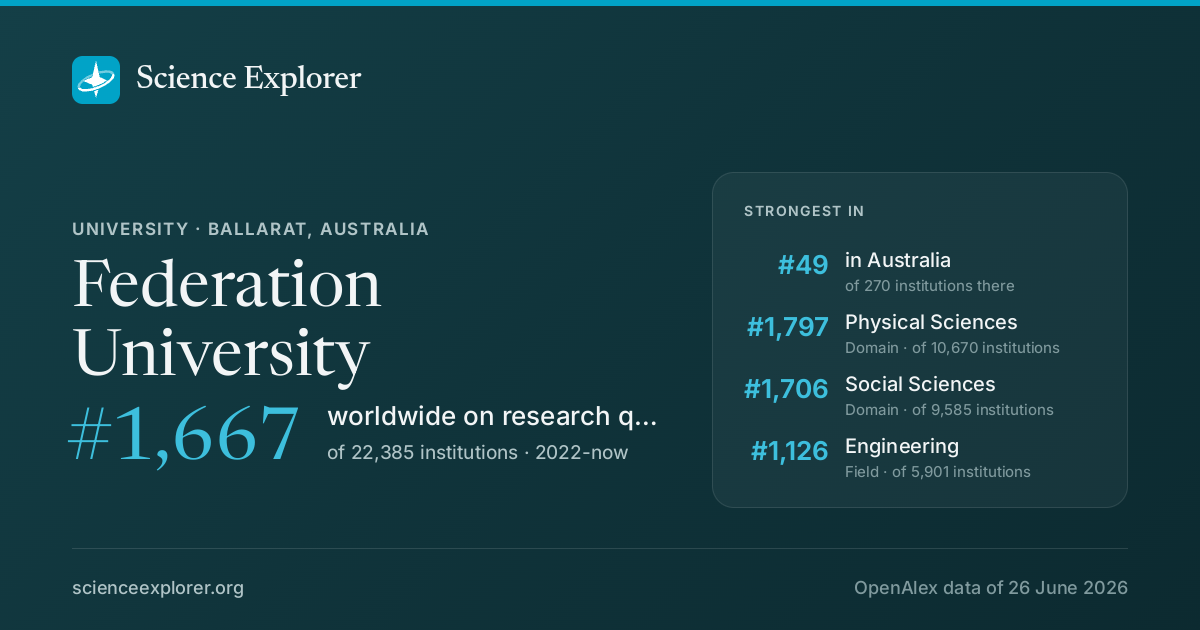
Federation University on Science Explorer

A card with Federation University's standing and the fields it leads in, for a post or a slide. A link to this page previews as the same card.

Download the card

1200 × 630 PNG, sized for social posts, drawn from the latest snapshot.

Badges for a website1Each links back here and updates with every snapshot

Research measures only: rankings here say nothing about teaching, admissions or student experience. Comparable institutions and collaboration partners have tabs of their own, above.

Discussion

Ask a question or share a note about Federation University. Posts are plain text and can be reported.