Science Explorer Back to mapMap
Discussion
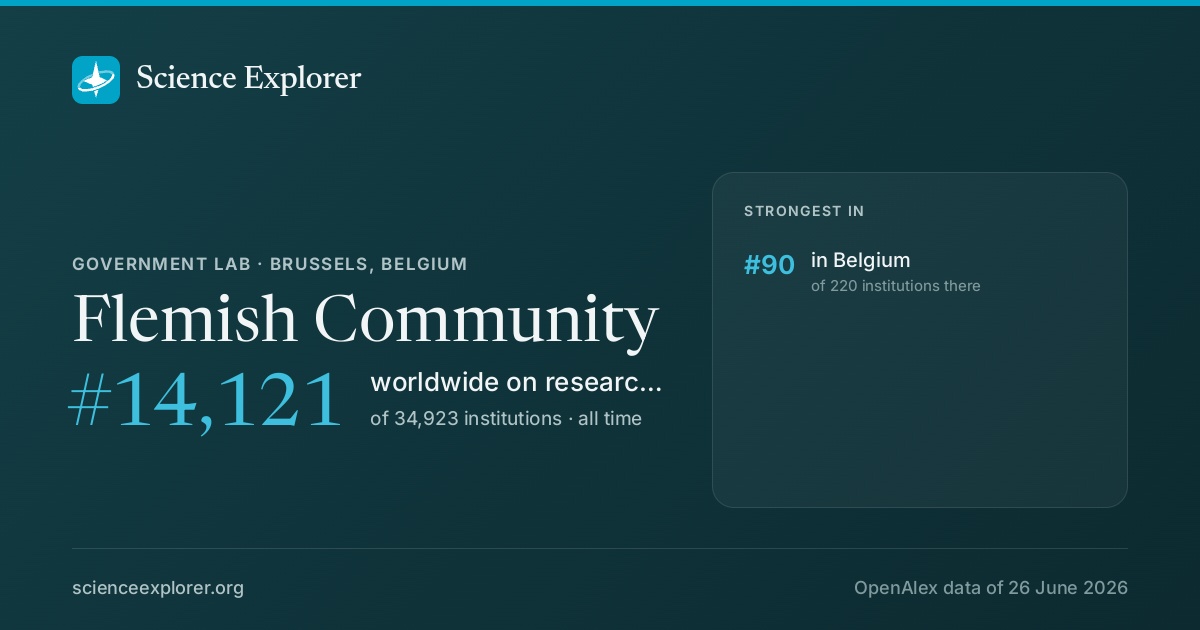
World rank, all time
#14,121
of 34,923
Rank in Belgium
#90
of 220
Research works
313
▲ 5% vs 2018-21
Citations
12k
37.5 per fractional work
Top-10% rate
11.2%
all institutions 10.0%
vs its own fields
1.09×
1.00× is exactly expected
Open access
29%
world 40%
International
24%
world 18%

Which fields of science does Flemish Community work in?

In 2022-now, 41% of research at Flemish Community is in Health Sciences, 25% in Social Sciences. Its largest fields are Medicine (21%), Health Professions (18%), Social Sciences (8%). It does 1.5× the world's share of Health Sciences.

Health Sciences: 11 fractional works · 40.8% of its workMedicine: 5 fractional works · 21.0% of its workPublic Health, Environmental and Occupational Health: 1 fractional works · 4.9% of its workEpidemiology: 1 fractional works · 3.6% of its workInfectious Diseases: 1 fractional works · 2.6% of its workCardiology and Cardiovascular Medicine: 1 fractional works · 2.0% of its workOrthopedics and Sports Medicine: 0 fractional works · 1.2% of its workEmergency Medicine: 0 fractional works · 0.9% of its workRadiology, Nuclear Medicine and Imaging: 0 fractional works · 0.9% of its workNeurology: 0 fractional works · 0.8% of its workSurgery: 0 fractional works · 0.8% of its workPsychiatry and Mental health: 0 fractional works · 0.7% of its workHepatology: 0 fractional works · 0.7% of its workGeriatrics and Gerontology: 0 fractional works · 0.4% of its workPulmonary and Respiratory Medicine: 0 fractional works · 0.4% of its workOncology: 0 fractional works · 0.3% of its workComplementary and alternative medicine: 0 fractional works · 0.3% of its workOphthalmology: 0 fractional works · 0.2% of its workSmaller subfields together: 0 fractional works · 0.1% of its workHealth Professions: 5 fractional works · 18.2% of its workGeneral Health Professions: 3 fractional works · 11.6% of its workHealth Information Management: 1 fractional works · 4.3% of its workSpeech and Hearing: 0 fractional works · 1.2% of its workEmergency Medical Services: 0 fractional works · 0.4% of its workPharmacy: 0 fractional works · 0.4% of its workOccupational Therapy: 0 fractional works · 0.3% of its workDentistry: 0 fractional works · 1.5% of its workPeriodontics: 0 fractional works · 1.5% of its workVeterinary: 0 fractional works · 0.2% of its workSocial Sciences: 6 fractional works · 24.9% of its workSocial Sciences: 2 fractional works · 8.4% of its workEducation: 1 fractional works · 5.5% of its workSociology and Political Science: 0 fractional works · 1.8% of its workHealth: 0 fractional works · 1.0% of its workArts and Humanities: 2 fractional works · 7.8% of its workLanguage and Linguistics: 1 fractional works · 3.9% of its workLiterature and Literary Theory: 1 fractional works · 2.6% of its workArcheology: 0 fractional works · 0.7% of its workVisual Arts and Performing Arts: 0 fractional works · 0.7% of its workEconomics, Econometrics and Finance: 1 fractional works · 4.0% of its workEconomics and Econometrics: 1 fractional works · 4.0% of its workPsychology: 1 fractional works · 3.3% of its workClinical Psychology: 1 fractional works · 2.6% of its workExperimental and Cognitive Psychology: 0 fractional works · 0.5% of its workSmaller subfields together: 0 fractional works · 0.1% of its workDecision Sciences: 0 fractional works · 0.7% of its workInformation Systems and Management: 0 fractional works · 0.4% of its workStatistics, Probability and Uncertainty: 0 fractional works · 0.3% of its workBusiness, Management and Accounting: 0 fractional works · 0.7% of its workManagement of Technology and Innovation: 0 fractional works · 0.7% of its workPhysical Sciences: 6 fractional works · 23.8% of its workComputer Science: 2 fractional works · 6.4% of its workComputer Vision and Pattern Recognition: 1 fractional works · 2.9% of its workInformation Systems: 1 fractional works · 2.5% of its workArtificial Intelligence: 0 fractional works · 0.7% of its workHuman-Computer Interaction: 0 fractional works · 0.3% of its workEngineering: 1 fractional works · 5.5% of its workElectrical and Electronic Engineering: 0 fractional works · 1.3% of its workMedia Technology: 0 fractional works · 0.7% of its workControl and Systems Engineering: 0 fractional works · 0.6% of its workBuilding and Construction: 0 fractional works · 0.4% of its workMechanics of Materials: 0 fractional works · 0.4% of its workBiomedical Engineering: 0 fractional works · 0.3% of its workCivil and Structural Engineering: 0 fractional works · 0.3% of its workIndustrial and Manufacturing Engineering: 0 fractional works · 0.3% of its workAutomotive Engineering: 0 fractional works · 0.3% of its workComputational Mechanics: 0 fractional works · 0.3% of its workOcean Engineering: 0 fractional works · 0.3% of its workSafety, Risk, Reliability and Quality: 0 fractional works · 0.3% of its workSmaller subfields together: 0 fractional works · 0.1% of its workEnvironmental Science: 1 fractional works · 5.2% of its workEcology: 0 fractional works · 1.4% of its workGlobal and Planetary Change: 0 fractional works · 0.9% of its workEcological Modeling: 0 fractional works · 0.7% of its workHealth, Toxicology and Mutagenesis: 0 fractional works · 0.5% of its workEnvironmental Engineering: 0 fractional works · 0.4% of its workIndustrial and Manufacturing Engineering: 0 fractional works · 0.4% of its workNature and Landscape Conservation: 0 fractional works · 0.4% of its workPollution: 0 fractional works · 0.4% of its workSmaller subfields together: 0 fractional works · 0.0% of its workEarth and Planetary Sciences: 1 fractional works · 4.4% of its workGeology: 1 fractional works · 2.6% of its workPaleontology: 0 fractional works · 1.2% of its workEarth-Surface Processes: 0 fractional works · 0.7% of its workMathematics: 1 fractional works · 2.4% of its workModeling and Simulation: 1 fractional works · 2.4% of its workLife Sciences: 3 fractional works · 10.5% of its workAgricultural and Biological Sciences: 1 fractional works · 5.4% of its workPlant Science: 1 fractional works · 2.8% of its workAnimal Science and Zoology: 0 fractional works · 1.0% of its workGeneral Agricultural and Biological Sciences: 0 fractional works · 0.5% of its workInsect Science: 0 fractional works · 0.4% of its workEcology, Evolution, Behavior and Systematics: 0 fractional works · 0.3% of its workFood Science: 0 fractional works · 0.3% of its workSmaller subfields together: 0 fractional works · 0.0% of its workBiochemistry, Genetics and Molecular Biology: 1 fractional works · 3.6% of its workMolecular Biology: 1 fractional works · 2.8% of its workBiotechnology: 0 fractional works · 0.4% of its workEndocrinology: 0 fractional works · 0.3% of its workSmaller subfields together: 0 fractional works · 0.0% of its workImmunology and Microbiology: 0 fractional works · 1.2% of its workImmunology: 0 fractional works · 1.0% of its workSmaller subfields together: 0 fractional works · 0.2% of its workNeuroscience: 0 fractional works · 0.3% of its workCognitive Neuroscience: 0 fractional works · 0.3% of its workALL ITS WORKFlemish Community26fractional works, 2022-now
Life Sciences11%Physical Sciences24%Health Sciences41%Social Sciences25%

Each ring splits the one inside it: the four domains of science, their fields, their subfields. Size is fractional works in 2022-now. Every slice is a page; the interactive view zooms down to single topics and colours each by how much more of it this institution does than the world.

Its 4 domains and 19 fields, with their numbers
    1. Medicine521.0%
    2. Health Professions518.2%
    3. Dentistry01.5%
    4. Veterinary00.2%
    1. Social Sciences28.4%
    2. Arts and Humanities27.8%
    3. Economics, Econometrics and Finance14.0%
    4. Psychology13.3%
    5. Decision Sciences00.7%
    6. Business, Management and Accounting00.7%
    1. Computer Science26.4%
    2. Engineering15.5%
    3. Environmental Science15.2%
    4. Earth and Planetary Sciences14.4%
    5. Mathematics12.4%
    1. Agricultural and Biological Sciences15.4%
    2. Biochemistry, Genetics and Molecular Biology13.6%
    3. Immunology and Microbiology01.2%
    4. Neuroscience00.3%
All of science, and how each field's share has moved since 1950: the Science domain explorer

Field profile

Location quotient across every field it publishes in: outside the ring is more than an institution of this size would be expected to publish, inside it is less.

Agricultural and Biological Sciences: 1.13× its world share, 1 worksAgricultural and Bio…Biochemistry, Genetics and Molecular Biology: 0.67× its world share, 1 worksBiochemistry, Geneti…Immunology and Microbiology: 1.23× its world share, 0 worksImmunology and Micro…Neuroscience: 0.20× its world share, 0 worksNeuroscienceComputer Science: 0.82× its world share, 2 worksComputer ScienceEarth and Planetary Sciences: 2.82× its world share, 1 worksEarth and Planetary …Engineering: 0.37× its world share, 1 worksEngineeringEnvironmental Science: 1.03× its world share, 1 worksEnvironmental ScienceMathematics: 2.02× its world share, 1 worksMathematicsDentistry: 3.06× its world share, 0 worksDentistryHealth Professions: 6.92× its world share, 5 worksHealth ProfessionsMedicine: 1.09× its world share, 5 worksMedicineVeterinary: 1.00× its world share, 0 worksVeterinaryArts and Humanities: 2.71× its world share, 2 worksArts and HumanitiesBusiness, Management and Accounting: 0.20× its world share, 0 worksBusiness, Management…Decision Sciences: 0.78× its world share, 0 worksDecision SciencesEconomics, Econometrics and Finance: 1.86× its world share, 1 worksEconomics, Econometr…Psychology: 1.07× its world share, 1 worksPsychologySocial Sciences: 0.66× its world share, 2 worksSocial Sciences1×world share
more than its size predictsabout as predictedless

Rings at 0.5×, 1× and 2×. Widest outward: Health Professions, 6.9×. Every wedge is a field page.

All 19 fields, with their numbers
  1. Health Professions6.92×5 works
  2. Dentistry3.06×0 works
  3. Earth and Planetary Sciences2.82×1 works
  4. Arts and Humanities2.71×2 works
  5. Mathematics2.02×1 works
  6. Economics, Econometrics and Finance1.86×1 works
  7. Immunology and Microbiology1.23×0 works
  8. Agricultural and Biological Sciences1.13×1 works
  9. Medicine1.09×5 works
  10. Psychology1.07×1 works
  11. Environmental Science1.03×1 works
  12. Veterinary1.00×0 works
  13. Computer Science0.82×2 works
  14. Decision Sciences0.78×0 works
  15. Biochemistry, Genetics and Molecular Biology0.67×1 works
  16. Social Sciences0.66×2 works
  17. Engineering0.37×1 works
  18. Neuroscience0.20×0 works
  19. Business, Management and Accounting0.20×0 works

Who are the top researchers at Flemish Community?

Ranked on the quality score, Leen Mortier, Herman De Ridder and Hendrik De Ruyck lead among researchers whose main affiliation is Flemish Community.

  1. 1 Leen Mortier Belgium · #3,294,631 worldwide 1.2k citations · 29 works
  2. 2 Herman De Ridder Belgium · #3,366,165 worldwide 403 citations · 15 works
  3. 3 Hendrik De Ruyck Belgium · #3,534,534 worldwide 813 citations · 31 works
  4. 4 Maarten De Waele Belgium · #4,618,586 worldwide 33 citations · 31 works
  5. 5 J.M. Vanacker Belgium · #5,075,255 worldwide 1.3k citations · 64 works
  6. 6 Jos Van Slycken Belgium · #5,286,208 worldwide 1.2k citations · 72 works
  7. 7 Frank Seberechts Belgium · #5,651,273 worldwide 3 citations · 45 works
All ranked researchers at Flemish Community

What are the most cited papers from Flemish Community?

The most cited paper from Flemish Community is "Trends in quality in the analytical laboratory. II. Analytical method validation and quality assurance" (Isabel Taverniers, Marc De Loose, Erik Van Bockstaele, 2004), with 945 citations. Next come "An update on alternatives to antimicrobial growth promoters for broilers" (789) and "Clostridium perfringensin poultry: an emerging threat for animal and public health" (665).

Most cited papers
#PaperReleasedCitations
1 Trends in quality in the analytical laboratory. II. Analytical method validation and quality assurance Isabel Taverniers, Marc De Loose, Erik Van Bockstaele · TrAC Trends in Analytical Chemistry Sep 2004 945
2 An update on alternatives to antimicrobial growth promoters for broilers G. Huyghebaert, Richard Ducatelle, Filip Van Immerseel · The Veterinary Journal Open access 10 Apr 2010 789
3 Clostridium perfringensin poultry: an emerging threat for animal and public health Filip Van Immerseel, Jeroen De Buck, Frank Pasmans et al. · Avian Pathology Open access Dec 2004 665
4 Ecological diversification in the Bacillus cereus Group Marie‐Hélène Guinebretière, Fabiano Lopes Thompson, Alexeï Sorokin et al. · Environmental Microbiology 2 Dec 2007 489
5 Fatal Family Outbreak of Bacillus cereus -Associated Food Poisoning Katelijne Dierick, Els Van Coillie, Izabela Święcicka et al. · Journal of Clinical Microbiology Open access Aug 2005 466
All 59 most cited papers, with filters and sorting

Which keywords describe research at Flemish Community?

By fractional works in 2022-now, weighted toward what it does more of than the world: Epidemiology, Primary Care, Quality of Life, Infectious Diseases, Cultural Heritage, Evidence-Based Practice, Text Mining and Healthcare.

▲ more of its work than of the world's◆ about the world's share▼ less than the world's

Size is fractional works in 2022-now in the topics tagged with each word; colour is the word's share of this institution's work against its share of the world's. The 17 words are chosen for being large and distinctive. Each links to the topic it comes from most.

All 17 words, with their numbers
  1. Epidemiology3▲ 3.0×23 topics
  2. Quality of Life2▲ 5.0×6 topics
  3. Primary Care2▲ 19×7 topics
  4. Healthcare1▲ 4.7×4 topics
  5. Infectious Diseases1▲ 16×5 topics
  6. Machine Learning1▲ 1.58×4 topics
  7. Cultural Heritage1▲ 9.7×2 topics
  8. COVID-191▲ 3.5×5 topics
  9. Climate Change1▲ 1.68×11 topics
  10. Evidence-Based Practice1▲ 34×4 topics
  11. Text Mining1▲ 34×2 topics
  12. Big Data Analytics1▲ 18×1 topic
  13. Implementation Science1▲ 108×1 topic
  14. Medical Diagnosis1▲ 42×1 topic
  15. Qualitative Research1▲ 4.6×1 topic
  16. Student Veterans1▲ 673×1 topic
  17. Transition1▲ 44×1 topic

Which research topics does Flemish Community publish most on?

By volume in 2022-now: Health Policy Implementation Science, Education and Military Integration, Artificial Intelligence in Healthcare and Health Systems, Economic Evaluations, Quality of Life.

  1. 1 Health Policy Implementation Science General Health Professions 1 works
  2. 2 Education and Military Integration Education 1 works
  3. 3 Artificial Intelligence in Healthcare Health Information Management 1 works
  4. 4 Health Systems, Economic Evaluations, Quality of Life Economics and Econometrics 1 works
  5. 5 Interprofessional Education and Collaboration General Health Professions 1 works
  6. 6 Digital Humanities and Scholarship Literature and Literary Theory 1 works
  7. 7 Image Processing and 3D Reconstruction Computer Vision and Pattern Recognition 1 works
  8. 8 3D Surveying and Cultural Heritage Geology 1 works
  9. 9 COVID-19 epidemiological studies Modeling and Simulation 1 works
  10. 10 Cardiac pacing and defibrillation studies Cardiology and Cardiovascular Medicine 0 works

How open and international is its research?

Against the world's own shares: the tick on each track. Both are shares of its output, so they sit on one scale and can be read against each other as well as against the world.

openly available29.1%not open70.9%

World: 40% of research is openly available.

with international co-authors24.0%domestic only76.0%

World: 18% is written across borders.

How has Flemish Community's research output changed?

Output in 2022-2025 was 5% higher than in 2018-2021.

still counting1990200020102020
grewheldshrank

The same series as a ribbon: one cell per year, darker for more. The line above answers how much; this answers when.

Its share of all research

Growing output can still be a shrinking share: all of science grows. This is Flemish Community as a percentage of every work published that year, 0.000092% in 2024.

still counting0.0010%0.0020%Flemish Community0.00013% in 202519801990200020102020

Fractional works of Flemish Community over all fractional works that year. How the balance of science has shifted.

Other research institutions in Brussels

All research institutions in Brussels

Share Flemish Community's ranking

Flemish Community on Science Explorer

A card with Flemish Community's standing and the fields it leads in, for a post or a slide. A link to this page previews as the same card.

Download the card

1200 × 630 PNG, sized for social posts, drawn from the latest snapshot.

Badges for a website1Each links back here and updates with every snapshot

Research measures only: rankings here say nothing about teaching, admissions or student experience. Comparable institutions and collaboration partners have tabs of their own, above.

Discussion

Ask a question or share a note about Flemish Community. Keep it to the research: no personal attacks, advertising or links. Any reader can report a post, which collapses it for everyone until it is opened.