Science Explorer Back to mapMap
Discussion
Company · Rijswijk · Netherlands

Florence (Netherlands)

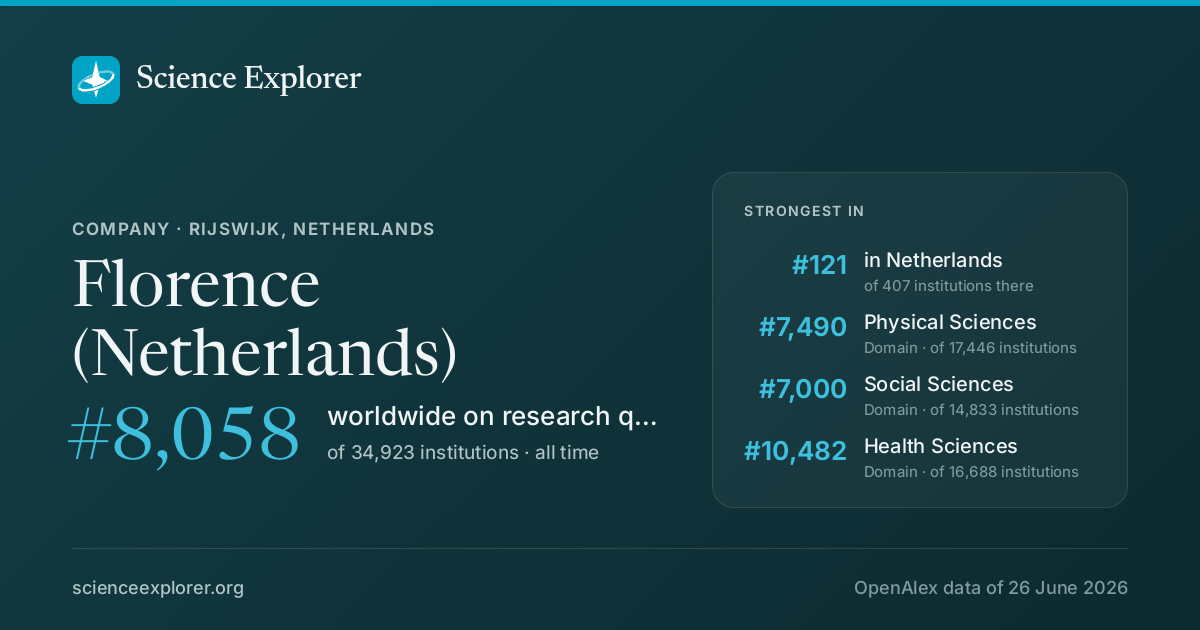
In research, Florence (Netherlands) stands highest in Physical Sciences (#7,490 of 17,446 worldwide), Social Sciences (#7,000 of 14,833 worldwide) and Health Sciences (#10,482 of 16,688 worldwide), over all time.

World rank, all time
#8,058
of 34,923
Rank in Netherlands
#121
of 407
Research works
1.1k
▼ 79% vs 2018-21
Citations
7.6k
7.2 per fractional work
Top-10% rate
11.4%
all institutions 10.0%
vs its own fields
0.64×
1.00× is exactly expected
Open access
38%
world 40%
International
41%
world 18%

What is Florence (Netherlands) known for in research?

The fields where it stands highest, over all time, ranked among every institution above the floor in each field.

FieldWorld rankWhere that sitsTop-10% rateWorks
Physical SciencesDomain #7,490 of 17,446 2.6%261
Social SciencesDomain #7,000 of 14,833 5.5%417
Health SciencesDomain #10,482 of 16,688 5.3%267
MedicineField #9,294 of 14,558 5.3%226
Arts and HumanitiesField #2,410 of 3,511 6.0%124
Social SciencesField #6,890 of 9,330 6.4%157

Each strip is that field's whole ranked pool, with the notch where Florence (Netherlands) sits in it, in the colour of the band that rank falls in. The track under the rate is the rate itself: it carries no average mark, because the average differs by field (from about 6% in Dentistry to 21% in Economics).

Which fields of science does Florence (Netherlands) work in?

In 2022-now, 51% of research at Florence (Netherlands) is in Social Sciences, 26% in Health Sciences. Its largest fields are Medicine (22%), Arts and Humanities (20%), Social Sciences (15%). It does 1.8× the world's share of Social Sciences.

Social Sciences: 19 fractional works · 51.5% of its workArts and Humanities: 7 fractional works · 19.6% of its workHistory: 3 fractional works · 8.5% of its workClassics: 2 fractional works · 5.2% of its workArcheology: 1 fractional works · 2.9% of its workGeneral Arts and Humanities: 0 fractional works · 0.9% of its workLiterature and Literary Theory: 0 fractional works · 0.9% of its workConservation: 0 fractional works · 0.5% of its workMuseology: 0 fractional works · 0.5% of its workVisual Arts and Performing Arts: 0 fractional works · 0.3% of its workSocial Sciences: 5 fractional works · 14.8% of its workSociology and Political Science: 3 fractional works · 6.8% of its workPolitical Science and International Relations: 1 fractional works · 1.8% of its workLaw: 1 fractional works · 1.7% of its workAnthropology: 0 fractional works · 0.9% of its workEducation: 0 fractional works · 0.9% of its workGeography, Planning and Development: 0 fractional works · 0.9% of its workUrban Studies: 0 fractional works · 0.9% of its workDemography: 0 fractional works · 0.6% of its workHealth: 0 fractional works · 0.3% of its workBusiness, Management and Accounting: 2 fractional works · 5.7% of its workManagement Information Systems: 1 fractional works · 2.7% of its workStrategy and Management: 1 fractional works · 1.6% of its workManagement of Technology and Innovation: 0 fractional works · 1.2% of its workIndustrial relations: 0 fractional works · 0.2% of its workPsychology: 2 fractional works · 5.3% of its workSocial Psychology: 1 fractional works · 1.9% of its workExperimental and Cognitive Psychology: 1 fractional works · 1.5% of its workClinical Psychology: 0 fractional works · 1.2% of its workNeuropsychology and Physiological Psychology: 0 fractional works · 0.5% of its workSmaller subfields together: 0 fractional works · 0.2% of its workEconomics, Econometrics and Finance: 1 fractional works · 3.8% of its workEconomics and Econometrics: 1 fractional works · 2.9% of its workGeneral Economics, Econometrics and Finance: 0 fractional works · 0.9% of its workDecision Sciences: 1 fractional works · 2.3% of its workInformation Systems and Management: 1 fractional works · 1.6% of its workManagement Science and Operations Research: 0 fractional works · 0.7% of its workHealth Sciences: 10 fractional works · 25.8% of its workMedicine: 8 fractional works · 22.2% of its workEpidemiology: 2 fractional works · 4.3% of its workSurgery: 1 fractional works · 2.6% of its workCardiology and Cardiovascular Medicine: 1 fractional works · 2.1% of its workPublic Health, Environmental and Occupational Health: 1 fractional works · 2.1% of its workRheumatology: 1 fractional works · 1.4% of its workPediatrics, Perinatology and Child Health: 1 fractional works · 1.4% of its workRadiology, Nuclear Medicine and Imaging: 0 fractional works · 1.1% of its workUrology: 0 fractional works · 0.9% of its workPulmonary and Respiratory Medicine: 0 fractional works · 0.8% of its workHepatology: 0 fractional works · 0.6% of its workGeriatrics and Gerontology: 0 fractional works · 0.5% of its workAnesthesiology and Pain Medicine: 0 fractional works · 0.5% of its workPharmacology: 0 fractional works · 0.5% of its workNeurology: 0 fractional works · 0.4% of its workPsychiatry and Mental health: 0 fractional works · 0.4% of its workComplementary and alternative medicine: 0 fractional works · 0.3% of its workEmergency Medicine: 0 fractional works · 0.3% of its workHematology: 0 fractional works · 0.2% of its workOncology: 0 fractional works · 0.2% of its workCritical Care and Intensive Care Medicine: 0 fractional works · 0.2% of its workObstetrics and Gynecology: 0 fractional works · 0.2% of its workPhysiology: 0 fractional works · 0.2% of its workSmaller subfields together: 0 fractional works · 1.0% of its workHealth Professions: 1 fractional works · 2.3% of its workGeneral Health Professions: 0 fractional works · 1.1% of its workHealth Information Management: 0 fractional works · 0.5% of its workEmergency Medical Services: 0 fractional works · 0.2% of its workRadiological and Ultrasound Technology: 0 fractional works · 0.2% of its workSmaller subfields together: 0 fractional works · 0.2% of its workDentistry: 0 fractional works · 1.3% of its workPeriodontics: 0 fractional works · 0.9% of its workOral Surgery: 0 fractional works · 0.5% of its workPhysical Sciences: 6 fractional works · 17.3% of its workComputer Science: 2 fractional works · 5.6% of its workArtificial Intelligence: 1 fractional works · 2.1% of its workInformation Systems: 1 fractional works · 1.5% of its workComputer Networks and Communications: 0 fractional works · 1.3% of its workComputational Theory and Mathematics: 0 fractional works · 0.6% of its workEngineering: 1 fractional works · 3.6% of its workAutomotive Engineering: 1 fractional works · 1.8% of its workControl and Systems Engineering: 0 fractional works · 0.9% of its workBiomedical Engineering: 0 fractional works · 0.5% of its workElectrical and Electronic Engineering: 0 fractional works · 0.5% of its workPhysics and Astronomy: 1 fractional works · 3.3% of its workNuclear and High Energy Physics: 1 fractional works · 2.2% of its workAtomic and Molecular Physics, and Optics: 0 fractional works · 1.1% of its workSmaller subfields together: 0 fractional works · 0.0% of its workEarth and Planetary Sciences: 1 fractional works · 1.4% of its workGeophysics: 0 fractional works · 0.7% of its workGeology: 0 fractional works · 0.5% of its workEarth-Surface Processes: 0 fractional works · 0.2% of its workSmaller subfields together: 0 fractional works · 0.0% of its workEnvironmental Science: 1 fractional works · 1.4% of its workNature and Landscape Conservation: 0 fractional works · 0.9% of its workGlobal and Planetary Change: 0 fractional works · 0.4% of its workSmaller subfields together: 0 fractional works · 0.1% of its workChemistry: 0 fractional works · 0.8% of its workSpectroscopy: 0 fractional works · 0.4% of its workAnalytical Chemistry: 0 fractional works · 0.3% of its workSmaller subfields together: 0 fractional works · 0.2% of its workEnergy: 0 fractional works · 0.8% of its workGeneral Energy: 0 fractional works · 0.5% of its workRenewable Energy, Sustainability and the Environment: 0 fractional works · 0.4% of its workMathematics: 0 fractional works · 0.3% of its workComputational Mathematics: 0 fractional works · 0.3% of its workLife Sciences: 2 fractional works · 5.4% of its workBiochemistry, Genetics and Molecular Biology: 1 fractional works · 2.5% of its workGenetics: 0 fractional works · 0.9% of its workMolecular Biology: 0 fractional works · 0.7% of its workBiophysics: 0 fractional works · 0.4% of its workCancer Research: 0 fractional works · 0.3% of its workSmaller subfields together: 0 fractional works · 0.3% of its workAgricultural and Biological Sciences: 1 fractional works · 2.3% of its workEcology, Evolution, Behavior and Systematics: 0 fractional works · 1.3% of its workInsect Science: 0 fractional works · 0.8% of its workSmaller subfields together: 0 fractional works · 0.2% of its workNeuroscience: 0 fractional works · 0.5% of its workCellular and Molecular Neuroscience: 0 fractional works · 0.3% of its workSmaller subfields together: 0 fractional works · 0.2% of its workImmunology and Microbiology: 0 fractional works · 0.1% of its workALL ITS WORKFlorence(Netherlands)37fractional works, 2022-now
Life Sciences5%Physical Sciences17%Health Sciences26%Social Sciences51%

Each ring splits the one inside it: the four domains of science, their fields, their subfields. Size is fractional works in 2022-now. Every slice is a page; the interactive view zooms down to single topics and colours each by how much more of it this institution does than the world.

Its 4 domains and 21 fields, with their numbers
    1. Arts and Humanities719.6%
    2. Social Sciences514.8%
    3. Business, Management and Accounting25.7%
    4. Psychology25.3%
    5. Economics, Econometrics and Finance13.8%
    6. Decision Sciences12.3%
    1. Medicine822.2%
    2. Health Professions12.3%
    3. Dentistry01.3%
    1. Computer Science25.6%
    2. Engineering13.6%
    3. Physics and Astronomy13.3%
    4. Earth and Planetary Sciences11.4%
    5. Environmental Science11.4%
    6. Chemistry00.8%
    7. Energy00.8%
    8. Mathematics00.3%
    1. Biochemistry, Genetics and Molecular Biology12.5%
    2. Agricultural and Biological Sciences12.3%
    3. Neuroscience00.5%
    4. Immunology and Microbiology00.1%
All of science, and how each field's share has moved since 1950: the Science domain explorer

Field profile

Location quotient across every field it publishes in: outside the ring is more than an institution of this size would be expected to publish, inside it is less.

Agricultural and Biological Sciences: 0.48× its world share, 1 worksAgricultural and Bio…Biochemistry, Genetics and Molecular Biology: 0.47× its world share, 1 worksBiochemistry, Geneti…Immunology and Microbiology: 0.11× its world share, 0 worksImmunology and Micro…Neuroscience: 0.29× its world share, 0 worksNeuroscienceChemistry: 0.53× its world share, 0 worksChemistryComputer Science: 0.72× its world share, 2 worksComputer ScienceEarth and Planetary Sciences: 0.91× its world share, 0 worksEarth and Planetary …Energy: 0.88× its world share, 0 worksEnergyEngineering: 0.24× its world share, 1 worksEngineeringEnvironmental Science: 0.27× its world share, 0 worksEnvironmental ScienceMathematics: 0.25× its world share, 0 worksMathematicsPhysics and Astronomy: 1.51× its world share, 1 worksPhysics and AstronomyDentistry: 2.78× its world share, 0 worksDentistryHealth Professions: 0.87× its world share, 1 worksHealth ProfessionsMedicine: 1.15× its world share, 8 worksMedicineArts and Humanities: 6.80× its world share, 7 worksArts and HumanitiesBusiness, Management and Accounting: 1.76× its world share, 2 worksBusiness, Management…Decision Sciences: 2.40× its world share, 1 worksDecision SciencesEconomics, Econometrics and Finance: 1.78× its world share, 1 worksEconomics, Econometr…Psychology: 1.73× its world share, 2 worksPsychologySocial Sciences: 1.17× its world share, 6 worksSocial Sciences1×world share
more than its size predictsabout as predictedless

Rings at 0.5×, 1× and 2×. Widest outward: Arts and Humanities, 6.8×. Every wedge is a field page.

All 21 fields, with their numbers
  1. Arts and Humanities6.80×7 works
  2. Dentistry2.78×0 works
  3. Decision Sciences2.40×1 works
  4. Economics, Econometrics and Finance1.78×1 works
  5. Business, Management and Accounting1.76×2 works
  6. Psychology1.73×2 works
  7. Physics and Astronomy1.51×1 works
  8. Social Sciences1.17×6 works
  9. Medicine1.15×8 works
  10. Earth and Planetary Sciences0.91×0 works
  11. Energy0.88×0 works
  12. Health Professions0.87×1 works
  13. Computer Science0.72×2 works
  14. Chemistry0.53×0 works
  15. Agricultural and Biological Sciences0.48×1 works
  16. Biochemistry, Genetics and Molecular Biology0.47×1 works
  17. Neuroscience0.29×0 works
  18. Environmental Science0.27×0 works
  19. Mathematics0.25×0 works
  20. Engineering0.24×1 works
  21. Immunology and Microbiology0.11×0 works

Who are the top researchers at Florence (Netherlands)?

Ranked on the quality score, James Henry Dixon, Henry Ince Anderton and Henry Hillyer Giglioli lead among researchers whose main affiliation is Florence (Netherlands).

  1. 1 James Henry Dixon Netherlands · #1,866,071 worldwide 21 citations · 145 works
  2. 2 Henry Ince Anderton Netherlands · #2,384,500 worldwide 0 citations · 36 works
  3. 3 Henry Hillyer Giglioli Netherlands · #2,397,767 worldwide 64 citations · 35 works
  4. 4 G. B. Donati Netherlands · #2,422,873 worldwide 50 citations · 62 works
  5. 5 Eve Borsook Netherlands · #2,501,107 worldwide 151 citations · 22 works
  6. 6 Charles Godfrey Leland Netherlands · #2,818,645 worldwide 182 citations · 108 works
  7. 7 J. A. Spranger Netherlands · #3,012,017 worldwide 31 citations · 19 works
  8. 8 Lorenz Böninger Netherlands · #3,061,659 worldwide 67 citations · 42 works
  9. 9 J F Acar Netherlands · #3,312,781 worldwide 153 citations · 22 works
  10. 10 Giorgio La Pira Netherlands · #3,567,086 worldwide 43 citations · 29 works
All ranked researchers at Florence (Netherlands)

What are the most cited papers from Florence (Netherlands)?

The most cited paper from Florence (Netherlands) is "The Determinants of Quality of Life of Nursing Home Residents with Young-Onset Dementia and the Differences between Dementia Subtypes" (Britt Appelhof, Christian Bakker, Jeannette C.L. van Duinen‐van den IJssel et al., 2017), with 2,776 citations. Next come "Revisions to the staging and classification of mycosis fungoides and Sézary syndrome: a proposal of the International Society for Cutaneous Lymphomas (ISCL) and the cutaneous lymphoma task force of the European Organization of Research and Treatment of Cancer (EORTC)" (1,437) and "American College of Rheumatology/European League Against Rheumatism provisional definition of remission in rheumatoid arthritis for clinical trials" (1,029).

Most cited papers
#PaperReleasedCitations
1 The Determinants of Quality of Life of Nursing Home Residents with Young-Onset Dementia and the Differences between Dementia Subtypes Britt Appelhof, Christian Bakker, Jeannette C.L. van Duinen‐van den IJssel et al. · Dementia and Geriatric Cognitive Disorders Open access 2017 2,776
2 Revisions to the staging and classification of mycosis fungoides and Sézary syndrome: a proposal of the International Society for Cutaneous Lymphomas (ISCL) and the cutaneous lymphoma task force of the European Organization of Research and Treatment of Cancer (EORTC) Elise A. Olsen et al. · Blood 31 May 2007 1,437
3 American College of Rheumatology/European League Against Rheumatism provisional definition of remission in rheumatoid arthritis for clinical trials David T. Felson et al. · Arthritis & Rheumatism Open access 3 Feb 2011 1,029
4 Epidemiology and One-Year Outcomes in Patients With Chronic Heart Failure and Preserved, Mid-Range and Reduced Ejection Fraction: An Analysis of The ESC Heart Failure Long-Term Registry Ovidiu Chioncel, Mitja Lainščak, Petar M Seferovic et al. · European Journal of Heart Failure Open access 6 Apr 2017 927
5 EUR Observational Research Programme: regional differences and 1-year follow-up results of the Heart Failure Pilot Survey (ESC-HF Pilot) Aldo Pietro Maggioni, Ulf Dahlström, Gerasimos S Filippatos et al. · European Journal of Heart Failure Open access 28 Mar 2013 812
All 60 most cited papers, with filters and sorting

Which keywords describe research at Florence (Netherlands)?

By fractional works in 2022-now, weighted toward what it does more of than the world: Literature, Religion, Italian Renaissance, Renaissance Florence, History, Philosophy, Culture and Society.

▲ more of its work than of the world's◆ about the world's share▼ less than the world's

Size is fractional works in 2022-now in the topics tagged with each word; colour is the word's share of this institution's work against its share of the world's. The 21 words are chosen for being large and distinctive. Each links to the topic it comes from most.

All 21 words, with their numbers
  1. Literature5▲ 24×6 topics
  2. Religion2▲ 14×4 topics
  3. History2▲ 8.7×4 topics
  4. Italian Renaissance2▲ 669×1 topic
  5. Renaissance Florence2▲ 669×1 topic
  6. Philosophy2▲ 13×3 topics
  7. Culture2▲ 9.9×2 topics
  8. Society2▲ 27×2 topics
  9. Epidemiology2▲ 1.24×12 topics
  10. Gender2▲ 7.9×5 topics
  11. Climate Change1▲ 1.34×9 topics
  12. Healthcare1▲ 3.0×5 topics
  13. Identity1▲ 5.0×4 topics
  14. Social Capital1▲ 6.9×2 topics
  15. Manuscripts1▲ 147×1 topic
  16. Medieval1▲ 89×1 topic
  17. Internet of Things1▲ 3.4×3 topics
  18. Treatment1▲ 2.4×9 topics
  19. Crowdfunding1▲ 38×1 topic
  20. Emotion1▲ 13×3 topics
  21. Fintech1▲ 35×1 topic

Which research topics does Florence (Netherlands) publish most on?

By volume in 2022-now: Renaissance and Early Modern Studies, Medieval Literature and History, FinTech, Crowdfunding, Digital Finance and Renaissance Literature and Culture.

  1. 1 Renaissance and Early Modern Studies History 2 works
  2. 2 Medieval Literature and History Classics 1 works
  3. 3 FinTech, Crowdfunding, Digital Finance Management Information Systems 1 works
  4. 4 Renaissance Literature and Culture Classics 1 works
  5. 5 Archaeological and Historical Studies Archeology 1 works
  6. 6 Sociopolitical Dynamics in Russia Sociology and Political Science 0 works
  7. 7 Blockchain Technology Applications and Security Information Systems 0 works
  8. 8 Transport and Economic Policies Strategy and Management 0 works
  9. 9 Color perception and design Social Psychology 0 works
  10. 10 IoT and Edge/Fog Computing Computer Networks and Communications 0 works

How open and international is its research?

Against the world's own shares: the tick on each track. Both are shares of its output, so they sit on one scale and can be read against each other as well as against the world.

openly available38.1%not open61.9%

World: 40% of research is openly available.

with international co-authors40.7%domestic only59.3%

World: 18% is written across borders.

How has Florence (Netherlands)'s research output changed?

Output in 2022-2025 was 79% lower than in 2018-2021.

still counting1990200020102020
grewheldshrank

The same series as a ribbon: one cell per year, darker for more. The line above answers how much; this answers when.

Its share of all research

Growing output can still be a shrinking share: all of science grows. This is Florence (Netherlands) as a percentage of every work published that year, 0.00013% in 2024.

still counting0.0010%0.0020%0.0030%Florence (Netherlands)0.00012% in 202519801990200020102020

Fractional works of Florence (Netherlands) over all fractional works that year. How the balance of science has shifted.

How much of it reaches the world top 10%

Year by year, against all institutions in the same year.

5%10%15%all institutions10.0% in 2021Florence (Netherlands)6.2% in 2021200020102020

Of each year's output, the share that reached the world's 10% most cited for its field and year. Peak 8.8% in 2006.

Other research institutions in Rijswijk

All research institutions in Rijswijk

Share Florence (Netherlands)'s ranking

Florence (Netherlands) on Science Explorer

A card with Florence (Netherlands)'s standing and the fields it leads in, for a post or a slide. A link to this page previews as the same card.

Download the card

1200 × 630 PNG, sized for social posts, drawn from the latest snapshot.

Badges for a website1Each links back here and updates with every snapshot

Research measures only: rankings here say nothing about teaching, admissions or student experience. Comparable institutions and collaboration partners have tabs of their own, above.

Discussion

Ask a question or share a note about Florence (Netherlands). Keep it to the research: no personal attacks, advertising or links. Any reader can report a post, which collapses it for everyone until it is opened.

