Science Explorer Back to mapMap
Discussion
University · Fukushima · Japan

Fukushima College

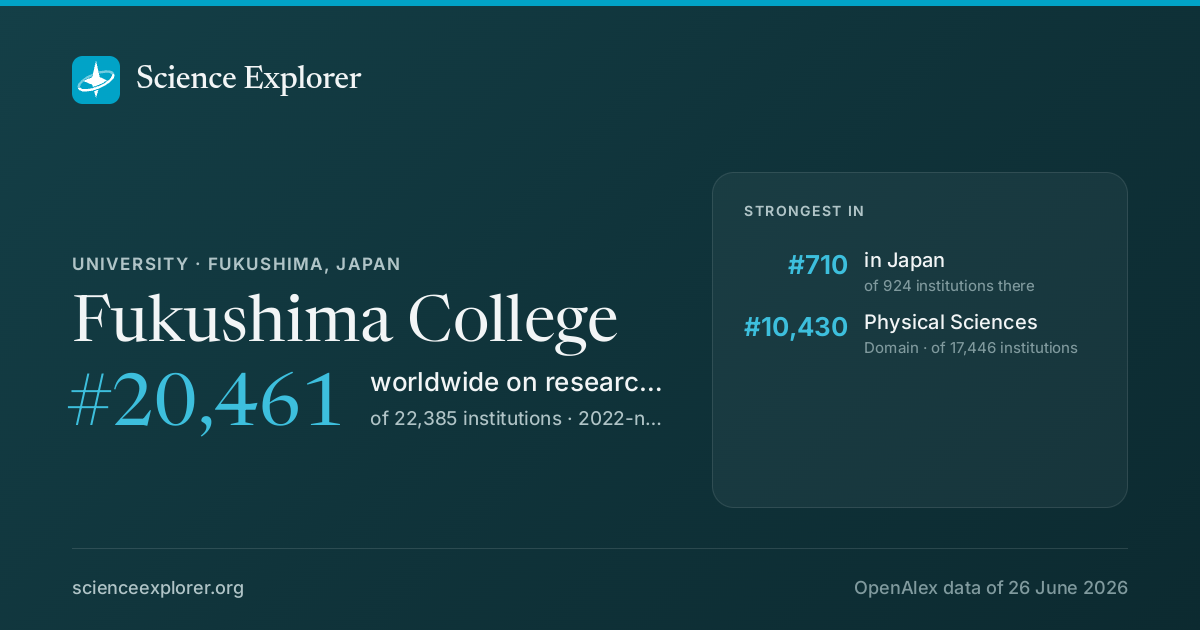
In research, Fukushima College stands highest in Physical Sciences (#10,430 of 17,446 worldwide), over all time.

World rank, 2022-now
#20,461
of 22,385 · #18,699 all time
Rank in Japan
#710
of 924
Research works
330
▼ 13% vs 2018-21
Citations
2.1k
6.5 per fractional work
Top-10% rate
7.4%
all institutions 10.0%
vs its own fields
0.93×
1.00× is exactly expected
Open access
56%
world 40%
International
10%
world 18%

What is Fukushima College known for in research?

The fields where it stands highest, over all time, ranked among every institution above the floor in each field.

FieldWorld rankWhere that sitsTop-10% rateWorks
Physical SciencesDomain #10,430 of 17,446 5.0%181

Each strip is that field's whole ranked pool, with the notch where Fukushima College sits in it, in the colour of the band that rank falls in. The track under the rate is the rate itself: it carries no average mark, because the average differs by field (from about 6% in Dentistry to 21% in Economics).

Which fields of science does Fukushima College work in?

In 2022-now, 68% of research at Fukushima College is in Physical Sciences, 12% in Health Sciences. Its largest fields are Engineering (28%), Environmental Science (11%), Medicine (9%). It does 1.7× the world's share of Physical Sciences.

Physical Sciences: 46 fractional works · 67.9% of its workEngineering: 19 fractional works · 27.7% of its workBiomedical Engineering: 3 fractional works · 4.8% of its workCivil and Structural Engineering: 3 fractional works · 4.3% of its workControl and Systems Engineering: 3 fractional works · 4.1% of its workMechanical Engineering: 3 fractional works · 3.8% of its workElectrical and Electronic Engineering: 2 fractional works · 3.5% of its workAutomotive Engineering: 2 fractional works · 2.3% of its workMechanics of Materials: 1 fractional works · 1.4% of its workSafety, Risk, Reliability and Quality: 0 fractional works · 0.7% of its workOcean Engineering: 0 fractional works · 0.7% of its workBuilding and Construction: 0 fractional works · 0.5% of its workAerospace Engineering: 0 fractional works · 0.5% of its workIndustrial and Manufacturing Engineering: 0 fractional works · 0.5% of its workMedia Technology: 0 fractional works · 0.3% of its workComputational Mechanics: 0 fractional works · 0.3% of its workEnvironmental Science: 8 fractional works · 11.1% of its workGlobal and Planetary Change: 2 fractional works · 3.4% of its workWater Science and Technology: 2 fractional works · 3.3% of its workEcology: 1 fractional works · 1.8% of its workIndustrial and Manufacturing Engineering: 1 fractional works · 0.8% of its workNature and Landscape Conservation: 0 fractional works · 0.6% of its workHealth, Toxicology and Mutagenesis: 0 fractional works · 0.5% of its workEnvironmental Chemistry: 0 fractional works · 0.5% of its workSmaller subfields together: 0 fractional works · 0.3% of its workPhysics and Astronomy: 6 fractional works · 8.4% of its workNuclear and High Energy Physics: 2 fractional works · 2.5% of its workAtomic and Molecular Physics, and Optics: 1 fractional works · 2.1% of its workAstronomy and Astrophysics: 1 fractional works · 2.0% of its workRadiation: 1 fractional works · 0.9% of its workCondensed Matter Physics: 1 fractional works · 0.8% of its workSmaller subfields together: 0 fractional works · 0.2% of its workMaterials Science: 4 fractional works · 5.4% of its workElectronic, Optical and Magnetic Materials: 2 fractional works · 2.6% of its workMaterials Chemistry: 1 fractional works · 1.7% of its workBiomaterials: 1 fractional works · 0.8% of its workCeramics and Composites: 0 fractional works · 0.3% of its workSmaller subfields together: 0 fractional works · 0.1% of its workComputer Science: 3 fractional works · 3.9% of its workHuman-Computer Interaction: 1 fractional works · 1.0% of its workInformation Systems: 1 fractional works · 0.8% of its workArtificial Intelligence: 1 fractional works · 0.8% of its workComputer Networks and Communications: 0 fractional works · 0.5% of its workComputer Vision and Pattern Recognition: 0 fractional works · 0.5% of its workSmaller subfields together: 0 fractional works · 0.3% of its workChemistry: 2 fractional works · 3.3% of its workOrganic Chemistry: 1 fractional works · 2.1% of its workInorganic Chemistry: 0 fractional works · 0.7% of its workAnalytical Chemistry: 0 fractional works · 0.3% of its workPhysical and Theoretical Chemistry: 0 fractional works · 0.3% of its workMathematics: 2 fractional works · 3.2% of its workApplied Mathematics: 2 fractional works · 2.2% of its workMathematical Physics: 0 fractional works · 0.7% of its workStatistics and Probability: 0 fractional works · 0.3% of its workChemical Engineering: 2 fractional works · 2.5% of its workFluid Flow and Transfer Processes: 1 fractional works · 1.0% of its workFiltration and Separation: 0 fractional works · 0.5% of its workProcess Chemistry and Technology: 0 fractional works · 0.5% of its workBioengineering: 0 fractional works · 0.3% of its workCatalysis: 0 fractional works · 0.3% of its workEarth and Planetary Sciences: 1 fractional works · 1.7% of its workAtmospheric Science: 0 fractional works · 0.5% of its workOceanography: 0 fractional works · 0.5% of its workGeophysics: 0 fractional works · 0.3% of its workPaleontology: 0 fractional works · 0.2% of its workSmaller subfields together: 0 fractional works · 0.1% of its workEnergy: 1 fractional works · 0.8% of its workRenewable Energy, Sustainability and the Environment: 0 fractional works · 0.7% of its workSmaller subfields together: 0 fractional works · 0.1% of its workHealth Sciences: 8 fractional works · 11.7% of its workMedicine: 6 fractional works · 8.9% of its workPsychiatry and Mental health: 1 fractional works · 1.8% of its workSurgery: 1 fractional works · 1.7% of its workEpidemiology: 1 fractional works · 0.9% of its workRadiology, Nuclear Medicine and Imaging: 0 fractional works · 0.7% of its workPulmonary and Respiratory Medicine: 0 fractional works · 0.6% of its workPathology and Forensic Medicine: 0 fractional works · 0.6% of its workGastroenterology: 0 fractional works · 0.5% of its workHematology: 0 fractional works · 0.5% of its workNephrology: 0 fractional works · 0.3% of its workOncology: 0 fractional works · 0.2% of its workSmaller subfields together: 1 fractional works · 1.2% of its workHealth Professions: 2 fractional works · 2.4% of its workRadiological and Ultrasound Technology: 1 fractional works · 1.1% of its workGeneral Health Professions: 1 fractional works · 1.1% of its workEmergency Medical Services: 0 fractional works · 0.2% of its workNursing: 0 fractional works · 0.3% of its workNutrition and Dietetics: 0 fractional works · 0.3% of its workDentistry: 0 fractional works · 0.1% of its workSocial Sciences: 7 fractional works · 10.7% of its workPsychology: 3 fractional works · 4.3% of its workClinical Psychology: 2 fractional works · 2.7% of its workSocial Psychology: 1 fractional works · 0.9% of its workDevelopmental and Educational Psychology: 0 fractional works · 0.5% of its workSmaller subfields together: 0 fractional works · 0.2% of its workSocial Sciences: 2 fractional works · 3.7% of its workSociology and Political Science: 1 fractional works · 1.4% of its workTransportation: 1 fractional works · 0.9% of its workPolitical Science and International Relations: 0 fractional works · 0.6% of its workEducation: 0 fractional works · 0.6% of its workSmaller subfields together: 0 fractional works · 0.2% of its workArts and Humanities: 1 fractional works · 2.0% of its workHistory and Philosophy of Science: 1 fractional works · 1.5% of its workLiterature and Literary Theory: 0 fractional works · 0.5% of its workBusiness, Management and Accounting: 1 fractional works · 0.8% of its workOrganizational Behavior and Human Resource Management: 0 fractional works · 0.7% of its workSmaller subfields together: 0 fractional works · 0.0% of its workEconomics, Econometrics and Finance: 0 fractional works · 0.0% of its workLife Sciences: 7 fractional works · 9.7% of its workBiochemistry, Genetics and Molecular Biology: 3 fractional works · 4.6% of its workMolecular Biology: 2 fractional works · 2.5% of its workPhysiology: 0 fractional works · 0.6% of its workMolecular Medicine: 0 fractional works · 0.4% of its workCell Biology: 0 fractional works · 0.4% of its workBiotechnology: 0 fractional works · 0.2% of its workSmaller subfields together: 0 fractional works · 0.4% of its workAgricultural and Biological Sciences: 2 fractional works · 3.7% of its workPlant Science: 1 fractional works · 1.1% of its workFood Science: 1 fractional works · 0.9% of its workEcology, Evolution, Behavior and Systematics: 1 fractional works · 0.9% of its workAquatic Science: 0 fractional works · 0.3% of its workAnimal Science and Zoology: 0 fractional works · 0.3% of its workSmaller subfields together: 0 fractional works · 0.3% of its workImmunology and Microbiology: 0 fractional works · 0.7% of its workImmunology: 0 fractional works · 0.6% of its workSmaller subfields together: 0 fractional works · 0.1% of its workNeuroscience: 0 fractional works · 0.4% of its workCognitive Neuroscience: 0 fractional works · 0.3% of its workSmaller subfields together: 0 fractional works · 0.2% of its workPharmacology, Toxicology and Pharmaceutics: 0 fractional works · 0.3% of its workPharmaceutical Science: 0 fractional works · 0.3% of its workSmaller subfields together: 0 fractional works · 0.1% of its workALL ITS WORKFukushima College68fractional works, 2022-now
Life Sciences10%Physical Sciences68%Health Sciences12%Social Sciences11%

Each ring splits the one inside it: the four domains of science, their fields, their subfields. Size is fractional works in 2022-now. Every slice is a page; the interactive view zooms down to single topics and colours each by how much more of it this institution does than the world.

Its 4 domains and 24 fields, with their numbers
    1. Engineering1927.7%
    2. Environmental Science811.1%
    3. Physics and Astronomy68.4%
    4. Materials Science45.4%
    5. Computer Science33.9%
    6. Chemistry23.3%
    7. Mathematics23.2%
    8. Chemical Engineering22.5%
    9. Earth and Planetary Sciences11.7%
    10. Energy10.8%
    1. Medicine68.9%
    2. Health Professions22.4%
    3. Nursing00.3%
    4. Dentistry00.1%
    1. Psychology34.3%
    2. Social Sciences23.7%
    3. Arts and Humanities12.0%
    4. Business, Management and Accounting10.8%
    5. Economics, Econometrics and Finance00.0%
    1. Biochemistry, Genetics and Molecular Biology34.6%
    2. Agricultural and Biological Sciences23.7%
    3. Immunology and Microbiology00.7%
    4. Neuroscience00.4%
    5. Pharmacology, Toxicology and Pharmaceutics00.3%
All of science, and how each field's share has moved since 1950: the Science domain explorer

Field profile

Location quotient across every field it publishes in: outside the ring is more than an institution of this size would be expected to publish, inside it is less.

Agricultural and Biological Sciences: 0.77× its world share, 2 worksAgricultural and Bio…Biochemistry, Genetics and Molecular Biology: 0.85× its world share, 3 worksBiochemistry, Geneti…Immunology and Microbiology: 0.71× its world share, 0 worksImmunology and Micro…Neuroscience: 0.26× its world share, 0 worksNeurosciencePharmacology, Toxicology and Pharmaceutics: 0.87× its world share, 0 worksPharmacology, Toxico…Chemical Engineering: 7.03× its world share, 2 worksChemical EngineeringChemistry: 2.11× its world share, 2 worksChemistryComputer Science: 0.51× its world share, 3 worksComputer ScienceEarth and Planetary Sciences: 1.06× its world share, 1 worksEarth and Planetary …Energy: 0.82× its world share, 0 worksEnergyEngineering: 1.85× its world share, 19 worksEngineeringEnvironmental Science: 2.23× its world share, 8 worksEnvironmental ScienceMaterials Science: 1.55× its world share, 4 worksMaterials ScienceMathematics: 2.72× its world share, 2 worksMathematicsPhysics and Astronomy: 3.79× its world share, 6 worksPhysics and AstronomyDentistry: 0.17× its world share, 0 worksDentistryHealth Professions: 0.91× its world share, 2 worksHealth ProfessionsMedicine: 0.46× its world share, 6 worksMedicineNursing: 0.50× its world share, 0 worksNursingArts and Humanities: 0.68× its world share, 1 worksArts and HumanitiesBusiness, Management and Accounting: 0.24× its world share, 0 worksBusiness, Management…Economics, Econometrics and Finance: 0.01× its world share, 0 worksEconomics, Econometr…Psychology: 1.41× its world share, 3 worksPsychologySocial Sciences: 0.29× its world share, 2 worksSocial Sciences1×world share
more than its size predictsabout as predictedless

Rings at 0.5×, 1× and 2×. Widest outward: Chemical Engineering, 7.0×. Every wedge is a field page.

All 24 fields, with their numbers
  1. Chemical Engineering7.03×2 works
  2. Physics and Astronomy3.79×6 works
  3. Mathematics2.72×2 works
  4. Environmental Science2.23×8 works
  5. Chemistry2.11×2 works
  6. Engineering1.85×19 works
  7. Materials Science1.55×4 works
  8. Psychology1.41×3 works
  9. Earth and Planetary Sciences1.06×1 works
  10. Health Professions0.91×2 works
  11. Pharmacology, Toxicology and Pharmaceutics0.87×0 works
  12. Biochemistry, Genetics and Molecular Biology0.85×3 works
  13. Energy0.82×0 works
  14. Agricultural and Biological Sciences0.77×2 works
  15. Immunology and Microbiology0.71×0 works
  16. Arts and Humanities0.68×1 works
  17. Computer Science0.51×3 works
  18. Nursing0.50×0 works
  19. Medicine0.46×6 works
  20. Social Sciences0.29×2 works
  21. Neuroscience0.26×0 works
  22. Business, Management and Accounting0.24×0 works
  23. Dentistry0.17×0 works
  24. Economics, Econometrics and Finance0.01×0 works

Who are the top researchers at Fukushima College?

Ranked on the quality score, Tetsuo Naito, Takeshi Iida and Yoichiro Sogame lead among researchers whose main affiliation is Fukushima College.

  1. 1 Tetsuo Naito Japan · #4,005,214 worldwide 6 citations · 25 works
  2. 2 Takeshi Iida Japan · #4,009,028 worldwide 227 citations · 27 works
  3. 3 Yoichiro Sogame Japan · #4,393,472 worldwide 597 citations · 56 works
  4. 4 Masahide Hagiri Japan · #4,555,969 worldwide 276 citations · 32 works
  5. 5 Koji Nishiura Japan · #4,737,766 worldwide 32 citations · 19 works
  6. 6 Haruhiko Suzuki Japan · #4,853,549 worldwide 496 citations · 34 works
  7. 7 Makoto Kaneta Japan · #5,087,382 worldwide 197 citations · 27 works
  8. 8 Hisashi Manabe Japan · #5,440,043 worldwide 142 citations · 35 works
  9. 9 Shigekazu Suzuki Japan · #6,235,440 worldwide 45 citations · 48 works
  10. 10 Satsuya NODA Japan · #6,275,193 worldwide 18 citations · 53 works
All ranked researchers at Fukushima College

What are the most cited papers from Fukushima College?

The most cited paper from Fukushima College is "A global synthesis reveals biodiversity-mediated benefits for crop production" (Matteo Dainese et al., 2019), with 1,007 citations. Next come "Combined Mode Fracture Toughness Measurement by the Disk Test" (384) and "Periodontal tissue activation by vibration: Intermittent stimulation by resonance vibration accelerates experimental tooth movement in rats" (269).

Most cited papers
#PaperReleasedCitations
1 A global synthesis reveals biodiversity-mediated benefits for crop production Matteo Dainese et al. · Science Advances Open access101 authors 11 Oct 2019 1,007
2 Combined Mode Fracture Toughness Measurement by the Disk Test Hideo Awaji, Sennosuke SATO · Journal of Engineering Materials and Technology Apr 1978 384
3 Periodontal tissue activation by vibration: Intermittent stimulation by resonance vibration accelerates experimental tooth movement in rats Makoto Nishimura, Mirei Chiba, Toshiro OHASHI et al. · American Journal of Orthodontics and Dentofacial Orthopedics Apr 2008 269
4 Atmospheric‐pressure nonthermal plasma synthesis of ammonia over ruthenium catalysts Hyun‐Ha Kim, Yoshiyuki Teramoto, Atsushi Ogata et al. · Plasma Processes and Polymers 28 Oct 2016 195
5 Assessing environmental impacts and change in Myanmar's mangrove ecosystem service value due to deforestation (2000–2014) Ronald C. Estoque, Soe Win Myint, Chuyuan Wang et al. · Global Change Biology 27 Jul 2018 125
All 61 most cited papers, with filters and sorting

Which keywords describe research at Fukushima College?

By fractional works in 2022-now, weighted toward what it does more of than the world: Nanoparticles, Radionuclides, Health Effects, Aquaculture, Biomedical Applications, Fukushima Daiichi, nuclear accident and Spintronics.

▲ more of its work than of the world's◆ about the world's share▼ less than the world's

Size is fractional works in 2022-now in the topics tagged with each word; colour is the word's share of this institution's work against its share of the world's. The 40 words are chosen for being large and distinctive. Each links to the topic it comes from most.

All 40 words, with their numbers
  1. Nanoparticles3▲ 3.4×12 topics
  2. Biomedical Applications2▲ 3.1×13 topics
  3. Health Effects2▲ 5.1×3 topics
  4. Environmental Impact2▲ 1.76×8 topics
  5. Deep Learning2▼ 0.80×10 topics
  6. Radionuclides2▲ 67×2 topics
  7. Climate Change2◆ 0.93×18 topics
  8. Aquaculture2▲ 9.5×3 topics
  9. Fukushima Daiichi2▲ 144×1 topic
  10. Spintronics2▲ 18×4 topics
  11. nuclear accident2▲ 144×1 topic
  12. Environmental Monitoring2▲ 5.7×5 topics
  13. Remote Sensing2▲ 1.85×7 topics
  14. Depression1▲ 2.4×5 topics
  15. Mental Health1▲ 1.44×5 topics
  16. Thermodynamic Properties1▲ 41×3 topics
  17. Computer Vision1▲ 7.1×2 topics
  18. Electric Vehicles1▲ 6.5×4 topics
  19. IoT1▲ 5.3×3 topics
  20. Renewable Energy1▲ 1.29×11 topics
  21. Microstructure1▲ 3.4×6 topics
  22. Sensor Networks1▲ 7.3×2 topics
  23. Electronic Structure1▲ 9.0×3 topics
  24. Energy Storage Systems1▲ 12×2 topics
  25. Finite Element Analysis1▲ 7.2×3 topics
  26. Fish Behavior Analysis1▲ 29×1 topic
  27. Microbial Ecology1▲ 9.1×3 topics
  28. Model Predictive Control1▲ 6.2×3 topics
  29. Nanomaterials1▲ 1.49×4 topics
  30. Optimization1▲ 3.7×4 topics
  31. Water Quality Monitoring1▲ 22×1 topic
  32. Water Treatment1▲ 13×3 topics
  33. Bioinspired Robotics1▲ 40×1 topic
  34. Children1▲ 6.6×2 topics
  35. Evolutionary Synthesis1▲ 87×1 topic
  36. Hydrogenation1▲ 8.7×4 topics
  37. Mechanistic Explanation1▲ 87×1 topic
  38. Nanocomposites1▲ 1.92×6 topics
  39. Renewable Energy Integration1▲ 4.7×5 topics
  40. Soft Robotics1▲ 19×1 topic

Which research topics does Fukushima College publish most on?

By volume in 2022-now: Radioactive contamination and transfer, Water Quality Monitoring Technologies, Soft Robotics and Applications and Philosophy and History of Science.

  1. 1 Radioactive contamination and transfer Global and Planetary Change 2 works
  2. 2 Water Quality Monitoring Technologies Water Science and Technology 1 works
  3. 3 Soft Robotics and Applications Biomedical Engineering 1 works
  4. 4 Philosophy and History of Science History and Philosophy of Science 1 works
  5. 5 Magnetic properties of thin films Atomic and Molecular Physics, and Optics 1 works
  6. 6 Advanced Harmonic Analysis Research Applied Mathematics 1 works
  7. 7 Cosmology and Gravitation Theories Astronomy and Astrophysics 1 works
  8. 8 Protist diversity and phylogeny Molecular Biology 1 works
  9. 9 Child and Adolescent Psychosocial and Emotional Development Clinical Psychology 1 works
  10. 10 Thermodynamic properties of mixtures Fluid Flow and Transfer Processes 1 works

How open and international is its research?

Against the world's own shares: the tick on each track. Both are shares of its output, so they sit on one scale and can be read against each other as well as against the world.

openly available56.4%not open43.6%

World: 40% of research is openly available.

with international co-authors10.1%domestic only89.9%

World: 18% is written across borders.

How has Fukushima College's research output changed?

Output in 2022-2025 was 13% lower than in 2018-2021.

still counting1990200020102020
grewheldshrank

The same series as a ribbon: one cell per year, darker for more. The line above answers how much; this answers when.

Its share of all research

Growing output can still be a shrinking share: all of science grows. This is Fukushima College as a percentage of every work published that year, 0.00022% in 2024.

still counting0.0010%0.0020%Fukushima College0.00034% in 202519801990200020102020

Fractional works of Fukushima College over all fractional works that year. How the balance of science has shifted.

Other research institutions in Fukushima

All research institutions in Fukushima

Share Fukushima College's ranking

Fukushima College on Science Explorer

A card with Fukushima College's standing and the fields it leads in, for a post or a slide. A link to this page previews as the same card.

Download the card

1200 × 630 PNG, sized for social posts, drawn from the latest snapshot.

Badges for a website1Each links back here and updates with every snapshot

Research measures only: rankings here say nothing about teaching, admissions or student experience. Comparable institutions and collaboration partners have tabs of their own, above.

Discussion

Ask a question or share a note about Fukushima College. Posts are plain text and can be reported.