Science Explorer Back to mapMap
Hospital / health system · Fort Wayne · United States

FWRadiology

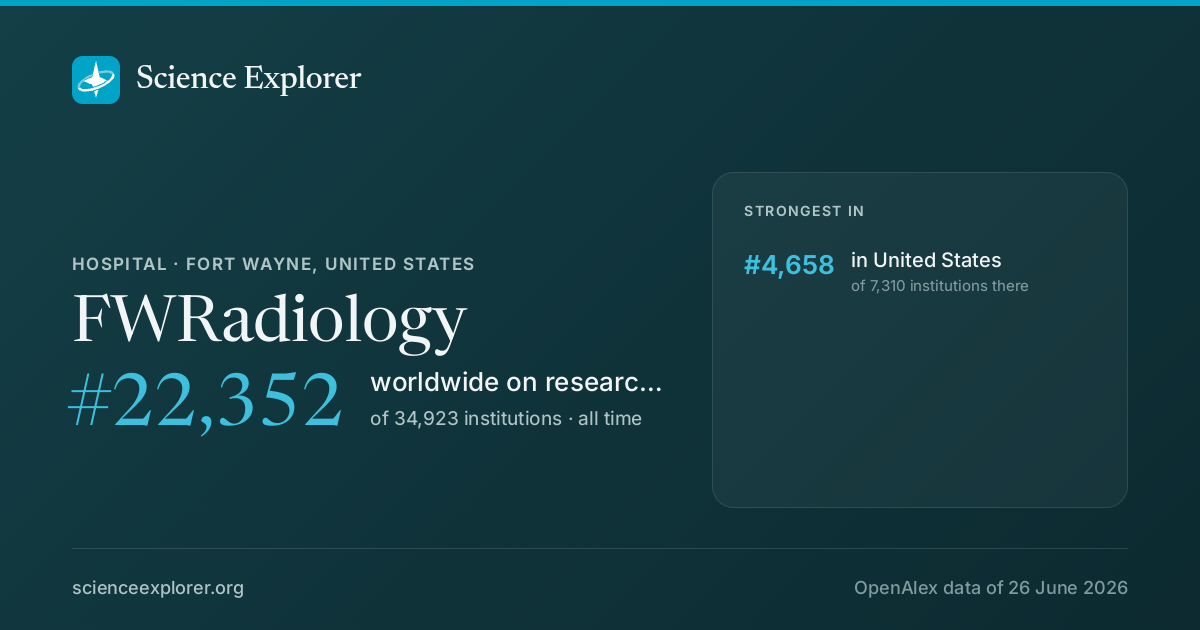
World rank, all time
#22,352
of 34,923
Rank in United States
#4,658
of 7,310
Research works
199
▼ 59% vs 2018-21
Citations
1.8k
9.2 per fractional work
Top-10% rate
8.1%
all institutions 10.0%
vs its own fields
0.95×
1.00× is exactly expected
Open access
15%
world 40%
International
6%
world 18%

Which fields of science does FWRadiology work in?

In all years, 51% of research at FWRadiology is in Health Sciences, 24% in Physical Sciences. Its largest fields are Medicine (48%), Engineering (10%), Computer Science (8%). It does 2.1× the world's share of Health Sciences.

Health Sciences: 102 fractional works · 51.0% of its workMedicine: 95 fractional works · 47.6% of its workSurgery: 28 fractional works · 13.8% of its workPulmonary and Respiratory Medicine: 9 fractional works · 4.8% of its workPathology and Forensic Medicine: 9 fractional works · 4.3% of its workEpidemiology: 6 fractional works · 2.8% of its workNeurology: 4 fractional works · 2.2% of its workRheumatology: 4 fractional works · 1.9% of its workPhysiology: 3 fractional works · 1.7% of its workCardiology and Cardiovascular Medicine: 3 fractional works · 1.6% of its workPediatrics, Perinatology and Child Health: 3 fractional works · 1.6% of its workOrthopedics and Sports Medicine: 3 fractional works · 1.5% of its workEndocrinology, Diabetes and Metabolism: 3 fractional works · 1.5% of its workPublic Health, Environmental and Occupational Health: 2 fractional works · 1.1% of its workDermatology: 2 fractional works · 1.0% of its workRehabilitation: 2 fractional works · 0.9% of its workPharmacology: 2 fractional works · 0.8% of its workGastroenterology: 2 fractional works · 0.8% of its workGenetics: 2 fractional works · 0.8% of its workOncology: 1 fractional works · 0.7% of its workRadiology, Nuclear Medicine and Imaging: 1 fractional works · 0.7% of its workUrology: 1 fractional works · 0.3% of its workInfectious Diseases: 1 fractional works · 0.3% of its workReproductive Medicine: 1 fractional works · 0.3% of its workOtorhinolaryngology: 1 fractional works · 0.3% of its workComplementary and alternative medicine: 0 fractional works · 0.3% of its workPsychiatry and Mental health: 0 fractional works · 0.2% of its workEmergency Medicine: 0 fractional works · 0.2% of its workImmunology and Allergy: 0 fractional works · 0.2% of its workSmaller subfields together: 2 fractional works · 0.9% of its workHealth Professions: 5 fractional works · 2.7% of its workMedical Laboratory Technology: 2 fractional works · 1.0% of its workGeneral Health Professions: 2 fractional works · 0.8% of its workHealth Information Management: 1 fractional works · 0.5% of its workOccupational Therapy: 0 fractional works · 0.2% of its workPhysical Therapy, Sports Therapy and Rehabilitation: 0 fractional works · 0.2% of its workSmaller subfields together: 0 fractional works · 0.0% of its workDentistry: 1 fractional works · 0.3% of its workOrthodontics: 0 fractional works · 0.2% of its workSmaller subfields together: 0 fractional works · 0.1% of its workVeterinary: 0 fractional works · 0.2% of its workSmall Animals: 0 fractional works · 0.2% of its workNursing: 0 fractional works · 0.2% of its workPhysical Sciences: 48 fractional works · 23.9% of its workEngineering: 19 fractional works · 9.5% of its workBiomedical Engineering: 4 fractional works · 2.1% of its workElectrical and Electronic Engineering: 3 fractional works · 1.6% of its workCivil and Structural Engineering: 2 fractional works · 1.2% of its workMechanical Engineering: 2 fractional works · 1.2% of its workSafety, Risk, Reliability and Quality: 2 fractional works · 1.2% of its workAerospace Engineering: 2 fractional works · 1.1% of its workArchitecture: 1 fractional works · 0.5% of its workControl and Systems Engineering: 0 fractional works · 0.3% of its workSmaller subfields together: 1 fractional works · 0.4% of its workComputer Science: 15 fractional works · 7.5% of its workSoftware: 10 fractional works · 4.9% of its workArtificial Intelligence: 2 fractional works · 0.9% of its workInformation Systems: 1 fractional works · 0.6% of its workHardware and Architecture: 1 fractional works · 0.5% of its workComputer Vision and Pattern Recognition: 1 fractional works · 0.3% of its workSmaller subfields together: 1 fractional works · 0.4% of its workMaterials Science: 6 fractional works · 2.8% of its workMaterials Chemistry: 3 fractional works · 1.6% of its workBiomaterials: 1 fractional works · 0.5% of its workElectronic, Optical and Magnetic Materials: 0 fractional works · 0.2% of its workSmaller subfields together: 1 fractional works · 0.4% of its workEnvironmental Science: 4 fractional works · 1.8% of its workGlobal and Planetary Change: 1 fractional works · 0.5% of its workWater Science and Technology: 1 fractional works · 0.5% of its workNature and Landscape Conservation: 0 fractional works · 0.2% of its workSmaller subfields together: 1 fractional works · 0.6% of its workPhysics and Astronomy: 2 fractional works · 0.9% of its workAstronomy and Astrophysics: 1 fractional works · 0.4% of its workAtomic and Molecular Physics, and Optics: 0 fractional works · 0.3% of its workSmaller subfields together: 1 fractional works · 0.3% of its workEarth and Planetary Sciences: 1 fractional works · 0.5% of its workAtmospheric Science: 1 fractional works · 0.3% of its workSmaller subfields together: 0 fractional works · 0.2% of its workMathematics: 1 fractional works · 0.5% of its workStatistics and Probability: 1 fractional works · 0.4% of its workSmaller subfields together: 0 fractional works · 0.0% of its workChemical Engineering: 0 fractional works · 0.3% of its workChemical Health and Safety: 0 fractional works · 0.3% of its workChemistry: 0 fractional works · 0.1% of its workSocial Sciences: 35 fractional works · 17.8% of its workSocial Sciences: 9 fractional works · 4.4% of its workEducation: 3 fractional works · 1.3% of its workSafety Research: 2 fractional works · 1.2% of its workSociology and Political Science: 2 fractional works · 1.2% of its workAnthropology: 0 fractional works · 0.2% of its workSmaller subfields together: 1 fractional works · 0.5% of its workArts and Humanities: 9 fractional works · 4.4% of its workMusic: 2 fractional works · 1.0% of its workLiterature and Literary Theory: 2 fractional works · 0.9% of its workPhilosophy: 2 fractional works · 0.9% of its workHistory and Philosophy of Science: 1 fractional works · 0.7% of its workHistory: 1 fractional works · 0.4% of its workClassics: 1 fractional works · 0.3% of its workSmaller subfields together: 0 fractional works · 0.2% of its workPsychology: 7 fractional works · 3.5% of its workClinical Psychology: 3 fractional works · 1.3% of its workSocial Psychology: 2 fractional works · 1.2% of its workExperimental and Cognitive Psychology: 2 fractional works · 0.8% of its workSmaller subfields together: 0 fractional works · 0.2% of its workBusiness, Management and Accounting: 6 fractional works · 2.9% of its workManagement Information Systems: 3 fractional works · 1.3% of its workOrganizational Behavior and Human Resource Management: 2 fractional works · 0.9% of its workStrategy and Management: 1 fractional works · 0.6% of its workSmaller subfields together: 0 fractional works · 0.1% of its workDecision Sciences: 3 fractional works · 1.4% of its workInformation Systems and Management: 1 fractional works · 0.7% of its workManagement Science and Operations Research: 1 fractional works · 0.7% of its workSmaller subfields together: 0 fractional works · 0.1% of its workEconomics, Econometrics and Finance: 2 fractional works · 1.1% of its workEconomics and Econometrics: 2 fractional works · 1.1% of its workSmaller subfields together: 0 fractional works · 0.0% of its workLife Sciences: 15 fractional works · 7.3% of its workBiochemistry, Genetics and Molecular Biology: 7 fractional works · 3.7% of its workMolecular Biology: 3 fractional works · 1.3% of its workGenetics: 2 fractional works · 1.1% of its workClinical Biochemistry: 1 fractional works · 0.6% of its workBiochemistry: 0 fractional works · 0.3% of its workDevelopmental Biology: 0 fractional works · 0.2% of its workSmaller subfields together: 0 fractional works · 0.2% of its workNeuroscience: 3 fractional works · 1.7% of its workCognitive Neuroscience: 2 fractional works · 1.1% of its workNeurology: 1 fractional works · 0.3% of its workCellular and Molecular Neuroscience: 1 fractional works · 0.3% of its workAgricultural and Biological Sciences: 3 fractional works · 1.4% of its workPlant Science: 2 fractional works · 0.9% of its workEcology, Evolution, Behavior and Systematics: 1 fractional works · 0.4% of its workSmaller subfields together: 0 fractional works · 0.1% of its workPharmacology, Toxicology and Pharmaceutics: 1 fractional works · 0.4% of its workPharmacology: 1 fractional works · 0.4% of its workImmunology and Microbiology: 0 fractional works · 0.1% of its workALL ITS WORKFWRadiology199fractional works, all years
Life Sciences7%Physical Sciences24%Health Sciences51%Social Sciences18%

Each ring splits the one inside it: the four domains of science, their fields, their subfields. Size is fractional works in all years. Every slice is a page; the interactive view zooms down to single topics and colours each by how much more of it this institution does than the world.

Its 4 domains and 25 fields, with their numbers
    1. Medicine9547.6%
    2. Health Professions52.7%
    3. Dentistry10.3%
    4. Veterinary00.2%
    5. Nursing00.2%
    1. Engineering199.5%
    2. Computer Science157.5%
    3. Materials Science62.8%
    4. Environmental Science41.8%
    5. Physics and Astronomy20.9%
    6. Earth and Planetary Sciences10.5%
    7. Mathematics10.5%
    8. Chemical Engineering00.3%
    9. Chemistry00.1%
    1. Social Sciences94.4%
    2. Arts and Humanities94.4%
    3. Psychology73.5%
    4. Business, Management and Accounting62.9%
    5. Decision Sciences31.4%
    6. Economics, Econometrics and Finance21.1%
    1. Biochemistry, Genetics and Molecular Biology73.7%
    2. Neuroscience31.7%
    3. Agricultural and Biological Sciences31.4%
    4. Pharmacology, Toxicology and Pharmaceutics10.4%
    5. Immunology and Microbiology00.1%
All of science, and how each field's share has moved since 1950: the Science domain explorer

Field profile

Location quotient across every field it publishes in: outside the ring is more than an institution of this size would be expected to publish, inside it is less.

Agricultural and Biological Sciences: 0.18× its world share, 0 worksAgricultural and Bio…Biochemistry, Genetics and Molecular Biology: 0.28× its world share, 0 worksBiochemistry, Geneti…Neuroscience: 2.31× its world share, 1 worksNeurosciencePharmacology, Toxicology and Pharmaceutics: 0.88× its world share, 0 worksPharmacology, Toxico…Computer Science: 0.09× its world share, 0 worksComputer ScienceEarth and Planetary Sciences: 1.19× its world share, 0 worksEarth and Planetary …Engineering: 0.84× its world share, 2 worksEngineeringEnvironmental Science: 0.66× its world share, 1 worksEnvironmental ScienceMaterials Science: 4.09× its world share, 2 worksMaterials SciencePhysics and Astronomy: 1.12× its world share, 0 worksPhysics and AstronomyHealth Professions: 2.05× its world share, 1 worksHealth ProfessionsMedicine: 2.12× its world share, 7 worksMedicineNursing: 0.64× its world share, 0 worksNursingVeterinary: 2.29× its world share, 0 worksVeterinaryArts and Humanities: 2.59× its world share, 1 worksArts and HumanitiesEconomics, Econometrics and Finance: 0.12× its world share, 0 worksEconomics, Econometr…Psychology: 0.92× its world share, 0 worksPsychologySocial Sciences: 0.07× its world share, 0 worksSocial Sciences1×world share
more than its size predictsabout as predictedless

Rings at 0.5×, 1× and 2×. Widest outward: Materials Science, 4.1×. Every wedge is a field page.

All 18 fields, with their numbers
  1. Materials Science4.09×2 works
  2. Arts and Humanities2.59×1 works
  3. Neuroscience2.31×1 works
  4. Veterinary2.29×0 works
  5. Medicine2.12×7 works
  6. Health Professions2.05×1 works
  7. Earth and Planetary Sciences1.19×0 works
  8. Physics and Astronomy1.12×0 works
  9. Psychology0.92×0 works
  10. Pharmacology, Toxicology and Pharmaceutics0.88×0 works
  11. Engineering0.84×2 works
  12. Environmental Science0.66×1 works
  13. Nursing0.64×0 works
  14. Biochemistry, Genetics and Molecular Biology0.28×0 works
  15. Agricultural and Biological Sciences0.18×0 works
  16. Economics, Econometrics and Finance0.12×0 works
  17. Computer Science0.09×0 works
  18. Social Sciences0.07×0 works

Who are the top researchers at FWRadiology?

Ranked on the quality score, David L. Slager, G. W. McCASKEY and Annette Slager lead among researchers whose main affiliation is FWRadiology.

  1. 1 David L. Slager United States · #1,717,669 worldwide 1.7k citations · 111 works
  2. 2 G. W. McCASKEY United States · #2,554,267 worldwide 40 citations · 37 works
  3. 3 Annette Slager United States · #2,576,771 worldwide 3 citations · 29 works
  4. 4 Albert E. Bulson United States · #2,742,016 worldwide 64 citations · 21 works
  5. 5 Beaumont S. Cornell United States · #2,892,354 worldwide 29 citations · 44 works
  6. 6 James E. Small United States · #3,005,369 worldwide 2 citations · 19 works
  7. 7 Bradley R. Coolman United States · #3,339,811 worldwide 412 citations · 19 works
All ranked researchers at FWRadiology

What are the most cited papers from FWRadiology?

The most cited paper from FWRadiology is "Practice Parameter: Treatment of Parkinson disease with motor fluctuations and dyskinesia (an evidence-based review): [RETIRED]" (Rajesh Pahwa, Stewart Alan Factor, Kelly E. Lyons et al., 2006), with 500 citations. Next come "Supply and demand analysis of the current and future US neurology workforce" (407) and "Alkaline Phosphatase Knock-Out Mice Recapitulate the Metabolic and Skeletal Defects of Infantile Hypophosphatasia" (406).

Most cited papers
#PaperReleasedCitations
1 Practice Parameter: Treatment of Parkinson disease with motor fluctuations and dyskinesia (an evidence-based review): [RETIRED] Rajesh Pahwa, Stewart Alan Factor, Kelly E. Lyons et al. · Neurology Open access 3 Apr 2006 500
2 Supply and demand analysis of the current and future US neurology workforce Timothy M. Dall, Michael V. Storm, Ritashree Chakrabarti et al. · Neurology Open access 17 Apr 2013 407
3 Alkaline Phosphatase Knock-Out Mice Recapitulate the Metabolic and Skeletal Defects of Infantile Hypophosphatasia Kenton N. Fedde, Libby A. Blair, Julie Martha Silverstein et al. · Journal of Bone and Mineral Research Open access Dec 1999 406
4 A cross-disorder dosage sensitivity map of the human genome Ryan L. Collins et al. · Cell Open access Aug 2022 381
5 Clinical outcomes after long-term treatment with alglucosidase alfa in infants and children with advanced Pompe disease Marc P Nicolino et al. · Genetics in Medicine Open access Mar 2009 294
All 60 most cited papers, with filters and sorting

Which keywords describe research at FWRadiology?

By fractional works in all years, weighted toward what it does more of than the world: End-User Software Engineering, Meta-design, Low Back Pain, Epidemiology, Surgical Treatment, Degenerative Disc Disease, Clinical Outcomes and Spinal Fusion.

▲ more of its work than of the world's◆ about the world's share▼ less than the world's

Size is fractional works in all years in the topics tagged with each word; colour is the word's share of this institution's work against its share of the world's. The 40 words are chosen for being large and distinctive. Each links to the topic it comes from most.

All 40 words, with their numbers
  1. Epidemiology16▲ 2.0×56 topics
  2. End-User Software Engineering9▲ 1161×1 topic
  3. Meta-design9▲ 1161×1 topic
  4. Low Back Pain8▲ 25×3 topics
  5. Surgical Treatment8▲ 19×5 topics
  6. Degenerative Disc Disease8▲ 42×2 topics
  7. Clinical Outcomes8▲ 19×3 topics
  8. Spinal Fusion7▲ 41×2 topics
  9. Intervertebral Disc6▲ 49×1 topic
  10. Lumbar Disc Degeneration6▲ 49×1 topic
  11. Spinal Surgery6▲ 43×2 topics
  12. Surgical Management6▲ 6.2×16 topics
  13. Risk Factors5▲ 2.5×13 topics
  14. Treatment5▲ 2.0×20 topics
  15. Artificial Intelligence4▲ 2.6×8 topics
  16. Clinical Trials4▲ 3.4×10 topics
  17. Complications4▲ 4.0×11 topics
  18. Diagnosis4▲ 2.0×15 topics
  19. Healthcare4▲ 2.9×6 topics
  20. Biomechanics4▲ 6.1×6 topics
  21. Management4▲ 2.5×13 topics
  22. Big Data4▲ 3.2×4 topics
  23. Prognostic Factors3▲ 3.8×10 topics
  24. Rehabilitation3▲ 4.4×5 topics
  25. Data Science3▲ 19×2 topics
  26. Shoulder Function3▲ 16×2 topics
  27. Nanotechnology3▲ 7.3×3 topics
  28. Chronic Pain2▲ 5.2×3 topics
  29. Chemical Imaging2▲ 28×1 topic
  30. Distal Radius Fractures2▲ 18×1 topic
  31. Fingermark Residue2▲ 180×1 topic
  32. Flexor Tendon Repair2▲ 18×1 topic
  33. Rotator Cuff Tears2▲ 19×1 topic
  34. Shoulder Pathology2▲ 19×1 topic
  35. Failure Analysis2▲ 7.8×4 topics
  36. Revision Surgery2▲ 8.9×2 topics
  37. Total Hip Replacement2▲ 8.9×2 topics
  38. Ethnomusicology2▲ 25×2 topics
  39. Maintenance2▲ 15×1 topic
  40. Medical Equipment2▲ 40×1 topic

Which research topics does FWRadiology publish most on?

By volume in 2022-now: Diverse Musicological Studies, Spine and Intervertebral Disc Pathology, Shape Memory Alloy Transformations and Magnesium Alloys: Properties and Applications.

  1. 1 Diverse Musicological Studies Music 1 works
  2. 2 Spine and Intervertebral Disc Pathology Pathology and Forensic Medicine 1 works
  3. 3 Shape Memory Alloy Transformations Materials Chemistry 1 works
  4. 4 Magnesium Alloys: Properties and Applications Biomaterials 0 works
  5. 5 Titanium Alloys Microstructure and Properties Materials Chemistry 0 works
  6. 6 Gastrointestinal disorders and treatments Surgery 0 works
  7. 7 Orthopaedic implants and arthroplasty Surgery 0 works
  8. 8 Aluminum Alloys Composites Properties Mechanical Engineering 0 works
  9. 9 Death Anxiety and Social Exclusion Social Psychology 0 works
  10. 10 Bone Tissue Engineering Materials Biomedical Engineering 0 works

How open and international is its research?

Against the world's own shares: the tick on each track. Both are shares of its output, so they sit on one scale and can be read against each other as well as against the world.

openly available15.2%not open84.8%

World: 40% of research is openly available.

with international co-authors5.6%domestic only94.4%

World: 18% is written across borders.

How has FWRadiology's research output changed?

Output in 2022-2025 was 59% lower than in 2018-2021.

still counting1990200020102020
grewheldshrank

The same series as a ribbon: one cell per year, darker for more. The line above answers how much; this answers when.

Its share of all research

Growing output can still be a shrinking share: all of science grows. This is FWRadiology as a percentage of every work published that year, 0.000063% in 2024.

still counting0.00050%0.0010%0.0015%FWRadiology0.000068% in 202519801990200020102020

Fractional works of FWRadiology over all fractional works that year. How the balance of science has shifted.

Other research institutions in Fort Wayne

All research institutions in Fort Wayne

Share FWRadiology's ranking

FWRadiology on Science Explorer

A card with FWRadiology's standing and the fields it leads in, for a post or a slide. A link to this page previews as the same card.

Download the card

1200 × 630 PNG, sized for social posts, drawn from the latest snapshot.

Badges for a website1Each links back here and updates with every snapshot

Research measures only: rankings here say nothing about teaching, admissions or student experience. Comparable institutions and collaboration partners have tabs of their own, above.

Discussion

Ask a question or share a note about FWRadiology. Posts are plain text and can be reported.