Science Explorer Back to mapMap
Discussion

Impulse Dynamics (United States)

World rank, all time
#27,798
of 34,923
Rank in United States
#5,822
of 7,310
Research works
137
▲ 105% vs 2018-21
Citations
1.4k
10.1 per fractional work
Top-10% rate
6.3%
all institutions 10.0%
vs its own fields
0.90×
1.00× is exactly expected
Open access
51%
world 40%
International
29%
world 18%

Which fields of science does Impulse Dynamics (United States) work in?

In 2022-now, 41% of research at Impulse Dynamics (United States) is in Social Sciences, 30% in Health Sciences. Its largest fields are Medicine (28%), Social Sciences (17%), Engineering (10%). It does 1.5× the world's share of Social Sciences.

Social Sciences: 18 fractional works · 41.4% of its workSocial Sciences: 7 fractional works · 17.4% of its workEducation: 2 fractional works · 5.1% of its workSociology and Political Science: 2 fractional works · 3.8% of its workUrban Studies: 1 fractional works · 2.5% of its workPolitical Science and International Relations: 1 fractional works · 1.6% of its workSafety Research: 0 fractional works · 0.9% of its workLaw: 0 fractional works · 0.8% of its workTransportation: 0 fractional works · 0.8% of its workArcheology: 0 fractional works · 0.4% of its workCultural Studies: 0 fractional works · 0.4% of its workGeneral Social Sciences: 0 fractional works · 0.4% of its workPublic Administration: 0 fractional works · 0.3% of its workSmaller subfields together: 0 fractional works · 0.4% of its workPsychology: 3 fractional works · 7.6% of its workClinical Psychology: 1 fractional works · 2.5% of its workDevelopmental and Educational Psychology: 1 fractional works · 2.0% of its workExperimental and Cognitive Psychology: 1 fractional works · 1.6% of its workSocial Psychology: 1 fractional works · 1.5% of its workBusiness, Management and Accounting: 3 fractional works · 6.5% of its workManagement of Technology and Innovation: 1 fractional works · 2.8% of its workAccounting: 1 fractional works · 1.6% of its workMarketing: 0 fractional works · 0.7% of its workManagement Information Systems: 0 fractional works · 0.6% of its workStrategy and Management: 0 fractional works · 0.4% of its workOrganizational Behavior and Human Resource Management: 0 fractional works · 0.4% of its workArts and Humanities: 3 fractional works · 6.1% of its workPhilosophy: 1 fractional works · 2.9% of its workMusic: 0 fractional works · 1.2% of its workArcheology: 0 fractional works · 0.5% of its workClassics: 0 fractional works · 0.4% of its workHistory: 0 fractional works · 0.4% of its workLiterature and Literary Theory: 0 fractional works · 0.4% of its workVisual Arts and Performing Arts: 0 fractional works · 0.4% of its workEconomics, Econometrics and Finance: 1 fractional works · 3.1% of its workEconomics and Econometrics: 1 fractional works · 1.6% of its workGeneral Economics, Econometrics and Finance: 1 fractional works · 1.6% of its workDecision Sciences: 0 fractional works · 0.8% of its workInformation Systems and Management: 0 fractional works · 0.8% of its workHealth Sciences: 13 fractional works · 30.3% of its workMedicine: 12 fractional works · 28.5% of its workCardiology and Cardiovascular Medicine: 5 fractional works · 12.7% of its workPublic Health, Environmental and Occupational Health: 1 fractional works · 1.9% of its workSurgery: 1 fractional works · 1.7% of its workPsychiatry and Mental health: 1 fractional works · 1.6% of its workPhysiology: 1 fractional works · 1.6% of its workEndocrinology, Diabetes and Metabolism: 1 fractional works · 1.4% of its workNeurology: 1 fractional works · 1.2% of its workEmergency Medicine: 0 fractional works · 1.0% of its workPediatrics, Perinatology and Child Health: 0 fractional works · 0.8% of its workRheumatology: 0 fractional works · 0.8% of its workEpidemiology: 0 fractional works · 0.6% of its workRadiology, Nuclear Medicine and Imaging: 0 fractional works · 0.4% of its workAnesthesiology and Pain Medicine: 0 fractional works · 0.4% of its workRehabilitation: 0 fractional works · 0.4% of its workPulmonary and Respiratory Medicine: 0 fractional works · 0.3% of its workOrthopedics and Sports Medicine: 0 fractional works · 0.3% of its workReproductive Medicine: 0 fractional works · 0.3% of its workInfectious Diseases: 0 fractional works · 0.2% of its workSmaller subfields together: 0 fractional works · 1.0% of its workVeterinary: 0 fractional works · 0.8% of its workEquine: 0 fractional works · 0.5% of its workSmall Animals: 0 fractional works · 0.3% of its workHealth Professions: 0 fractional works · 0.7% of its workPhysical Therapy, Sports Therapy and Rehabilitation: 0 fractional works · 0.7% of its workSmaller subfields together: 0 fractional works · 0.0% of its workNursing: 0 fractional works · 0.4% of its workNutrition and Dietetics: 0 fractional works · 0.4% of its workPhysical Sciences: 9 fractional works · 22.1% of its workEngineering: 4 fractional works · 10.0% of its workBiomedical Engineering: 2 fractional works · 3.9% of its workMechanical Engineering: 1 fractional works · 1.5% of its workAerospace Engineering: 1 fractional works · 1.4% of its workElectrical and Electronic Engineering: 0 fractional works · 1.0% of its workAutomotive Engineering: 0 fractional works · 0.8% of its workMechanics of Materials: 0 fractional works · 0.8% of its workControl and Systems Engineering: 0 fractional works · 0.4% of its workSmaller subfields together: 0 fractional works · 0.2% of its workEnvironmental Science: 2 fractional works · 4.6% of its workNature and Landscape Conservation: 1 fractional works · 2.5% of its workManagement, Monitoring, Policy and Law: 0 fractional works · 0.8% of its workGlobal and Planetary Change: 0 fractional works · 0.7% of its workEcology: 0 fractional works · 0.4% of its workSmaller subfields together: 0 fractional works · 0.1% of its workComputer Science: 2 fractional works · 4.6% of its workArtificial Intelligence: 1 fractional works · 1.8% of its workInformation Systems: 1 fractional works · 1.6% of its workComputer Vision and Pattern Recognition: 0 fractional works · 0.8% of its workComputer Science Applications: 0 fractional works · 0.4% of its workEarth and Planetary Sciences: 1 fractional works · 1.6% of its workGeophysics: 1 fractional works · 1.3% of its workGeology: 0 fractional works · 0.3% of its workSmaller subfields together: 0 fractional works · 0.0% of its workMaterials Science: 0 fractional works · 0.6% of its workGeneral Materials Science: 0 fractional works · 0.3% of its workSmaller subfields together: 0 fractional works · 0.3% of its workEnergy: 0 fractional works · 0.4% of its workRenewable Energy, Sustainability and the Environment: 0 fractional works · 0.4% of its workChemistry: 0 fractional works · 0.2% of its workPhysics and Astronomy: 0 fractional works · 0.2% of its workLife Sciences: 3 fractional works · 6.1% of its workBiochemistry, Genetics and Molecular Biology: 1 fractional works · 3.4% of its workBiophysics: 0 fractional works · 1.0% of its workMolecular Biology: 0 fractional works · 1.0% of its workGenetics: 0 fractional works · 0.7% of its workBiotechnology: 0 fractional works · 0.4% of its workSmaller subfields together: 0 fractional works · 0.3% of its workNeuroscience: 1 fractional works · 1.4% of its workNeurology: 0 fractional works · 1.0% of its workCognitive Neuroscience: 0 fractional works · 0.4% of its workAgricultural and Biological Sciences: 1 fractional works · 1.3% of its workPlant Science: 0 fractional works · 0.6% of its workFood Science: 0 fractional works · 0.4% of its workSoil Science: 0 fractional works · 0.3% of its workALL ITS WORKImpulse Dynamics(United States)42fractional works, 2022-now
Life Sciences6%Physical Sciences22%Health Sciences30%Social Sciences41%

Each ring splits the one inside it: the four domains of science, their fields, their subfields. Size is fractional works in 2022-now. Every slice is a page; the interactive view zooms down to single topics and colours each by how much more of it this institution does than the world.

Its 4 domains and 21 fields, with their numbers
    1. Social Sciences717.4%
    2. Psychology37.6%
    3. Business, Management and Accounting36.5%
    4. Arts and Humanities36.1%
    5. Economics, Econometrics and Finance13.1%
    6. Decision Sciences00.8%
    1. Medicine1228.5%
    2. Veterinary00.8%
    3. Health Professions00.7%
    4. Nursing00.4%
    1. Engineering410.0%
    2. Environmental Science24.6%
    3. Computer Science24.6%
    4. Earth and Planetary Sciences11.6%
    5. Materials Science00.6%
    6. Energy00.4%
    7. Chemistry00.2%
    8. Physics and Astronomy00.2%
    1. Biochemistry, Genetics and Molecular Biology13.4%
    2. Neuroscience11.4%
    3. Agricultural and Biological Sciences11.3%
All of science, and how each field's share has moved since 1950: the Science domain explorer

Field profile

Location quotient across every field it publishes in: outside the ring is more than an institution of this size would be expected to publish, inside it is less.

Agricultural and Biological Sciences: 0.27× its world share, 0 worksAgricultural and Bio…Biochemistry, Genetics and Molecular Biology: 0.64× its world share, 1 worksBiochemistry, Geneti…Neuroscience: 0.89× its world share, 1 worksNeuroscienceChemistry: 0.13× its world share, 0 worksChemistryComputer Science: 0.59× its world share, 2 worksComputer ScienceEarth and Planetary Sciences: 0.99× its world share, 1 worksEarth and Planetary …Energy: 0.43× its world share, 0 worksEnergyEngineering: 0.66× its world share, 4 worksEngineeringEnvironmental Science: 0.94× its world share, 2 worksEnvironmental ScienceMaterials Science: 0.16× its world share, 0 worksMaterials SciencePhysics and Astronomy: 0.09× its world share, 0 worksPhysics and AstronomyHealth Professions: 0.27× its world share, 0 worksHealth ProfessionsMedicine: 1.48× its world share, 12 worksMedicineNursing: 0.80× its world share, 0 worksNursingVeterinary: 5.79× its world share, 0 worksVeterinaryArts and Humanities: 2.12× its world share, 3 worksArts and HumanitiesBusiness, Management and Accounting: 2.01× its world share, 3 worksBusiness, Management…Decision Sciences: 0.77× its world share, 0 worksDecision SciencesEconomics, Econometrics and Finance: 1.47× its world share, 1 worksEconomics, Econometr…Psychology: 2.48× its world share, 3 worksPsychologySocial Sciences: 1.37× its world share, 7 worksSocial Sciences1×world share
more than its size predictsabout as predictedless

Rings at 0.5×, 1× and 2×. Widest outward: Veterinary, 5.8×. Every wedge is a field page.

All 21 fields, with their numbers
  1. Veterinary5.79×0 works
  2. Psychology2.48×3 works
  3. Arts and Humanities2.12×3 works
  4. Business, Management and Accounting2.01×3 works
  5. Medicine1.48×12 works
  6. Economics, Econometrics and Finance1.47×1 works
  7. Social Sciences1.37×7 works
  8. Earth and Planetary Sciences0.99×1 works
  9. Environmental Science0.94×2 works
  10. Neuroscience0.89×1 works
  11. Nursing0.80×0 works
  12. Decision Sciences0.77×0 works
  13. Engineering0.66×4 works
  14. Biochemistry, Genetics and Molecular Biology0.64×1 works
  15. Computer Science0.59×2 works
  16. Energy0.43×0 works
  17. Agricultural and Biological Sciences0.27×0 works
  18. Health Professions0.27×0 works
  19. Materials Science0.16×0 works
  20. Chemistry0.13×0 works
  21. Physics and Astronomy0.09×0 works

Who are the top researchers at Impulse Dynamics (United States)?

Ranked on the quality score, Benny Rousso, Yuval Mika and David Prutchi lead among researchers whose main affiliation is Impulse Dynamics (United States).

  1. 1 Benny Rousso United States · #862,613 worldwide 1.7k citations · 36 works
  2. 2 Yuval Mika United States · #2,694,181 worldwide 1.5k citations · 46 works
  3. 3 David Prutchi United States · #2,823,382 worldwide 634 citations · 33 works
  4. 4 Gerhild Deutinger United States · #2,924,362 worldwide 44 citations · 19 works
All ranked researchers at Impulse Dynamics (United States)

What are the most cited papers from Impulse Dynamics (United States)?

The most cited paper from Impulse Dynamics (United States) is "A Randomized Controlled Trial to Evaluate the Safety and Efficacy of Cardiac Contractility Modulation" (William T. Abraham et al., 2018), with 273 citations. Next come "A randomized controlled trial evaluating the safety and efficacy of cardiac contractility modulation in advanced heart failure" (231) and "LVAD-Induced Reverse Remodeling: Basic and Clinical Implications for Myocardial Recovery" (177).

Most cited papers
#PaperReleasedCitations
1 A Randomized Controlled Trial to Evaluate the Safety and Efficacy of Cardiac Contractility Modulation William T. Abraham et al. · JACC Heart Failure Open access 10 May 2018 273
2 A randomized controlled trial evaluating the safety and efficacy of cardiac contractility modulation in advanced heart failure Alan Howard Kadish, Koonlawee Nademanee, KENT J. VOLOSIN et al. · American Heart Journal Feb 2011 231
3 LVAD-Induced Reverse Remodeling: Basic and Clinical Implications for Myocardial Recovery Daniel Burkhoff, Stefan Klotz, DONNA M. MANCINI · Journal of Cardiac Failure Apr 2006 177
4 Therapy With Cardiac Contractility Modulation Electrical Signals Improves Left Ventricular Function and Remodeling in Dogs With Chronic Heart Failure Makoto Imai, Sharad Rastogi, Ramesh Chandra Gupta et al. · Journal of the American College of Cardiology Open access May 2007 154
5 The overlap between binge eating disorder and substance use disorders: Diagnosis and neurobiology Liana R. N. Schreiber, Brian L. Odlaug, Jon Edgar Grant · Journal of Behavioral Addictions Open access 16 Oct 2013 113
All 61 most cited papers, with filters and sorting

Which keywords describe research at Impulse Dynamics (United States)?

By fractional works in 2022-now, weighted toward what it does more of than the world: Sustainable Development, Virtual Reality, Arrhythmias, Teacher Training, Sudden Cardiac Death, Pedagogy, Catheter Ablation and Atherosclerosis.

▲ more of its work than of the world's◆ about the world's share▼ less than the world's

Size is fractional works in 2022-now in the topics tagged with each word; colour is the word's share of this institution's work against its share of the world's. The 34 words are chosen for being large and distinctive. Each links to the topic it comes from most.

All 34 words, with their numbers
  1. Sustainable Development3▲ 4.2×7 topics
  2. Education2▲ 3.0×7 topics
  3. Social Media2▲ 3.2×5 topics
  4. Arrhythmias2▲ 44×2 topics
  5. Artificial Intelligence2▲ 3.0×7 topics
  6. Cardiovascular Disease2▲ 3.6×7 topics
  7. Teacher Training2▲ 6.8×5 topics
  8. Virtual Reality2▲ 8.7×2 topics
  9. Inflammation2▲ 1.88×5 topics
  10. Innovation2▲ 3.8×4 topics
  11. Sudden Cardiac Death2▲ 46×2 topics
  12. Pedagogy2▲ 7.4×4 topics
  13. Big Data2▲ 3.7×5 topics
  14. Catheter Ablation2▲ 29×2 topics
  15. Machine Learning2◆ 1.07×8 topics
  16. Atherosclerosis1▲ 12×3 topics
  17. Economic Growth1▲ 3.9×2 topics
  18. Heart Failure1▲ 6.8×4 topics
  19. Vascular Function1▲ 31×2 topics
  20. Customer Experience1▲ 17×3 topics
  21. Epidemiology1▼ 0.70×7 topics
  22. Internet1▲ 35×2 topics
  23. E-commerce1▲ 4.4×2 topics
  24. Obesity1▲ 3.5×5 topics
  25. Business Models1▲ 33×1 topic
  26. Digital Religion1▲ 170×1 topic
  27. Digital Transformation1▲ 4.4×1 topic
  28. Echocardiography1▲ 8.5×2 topics
  29. Endothelial Function1▲ 26×2 topics
  30. Labor Market1▲ 8.4×2 topics
  31. Mental Health1▲ 1.65×4 topics
  32. Religious Authority1▲ 170×1 topic
  33. Shrinking Cities1▲ 124×1 topic
  34. Urban Decline1▲ 124×1 topic

Which research topics does Impulse Dynamics (United States) publish most on?

By volume in 2022-now: Digital Innovation in Industries, Urbanization and City Planning, Media, Religion, Digital Communication and Cardiac electrophysiology and arrhythmias.

  1. 1 Digital Innovation in Industries Management of Technology and Innovation 1 works
  2. 2 Urbanization and City Planning Urban Studies 1 works
  3. 3 Media, Religion, Digital Communication Philosophy 1 works
  4. 4 Cardiac electrophysiology and arrhythmias Cardiology and Cardiovascular Medicine 1 works
  5. 5 Cardiac Arrhythmias and Treatments Cardiology and Cardiovascular Medicine 1 works
  6. 6 Ecology, Conservation, and Geographical Studies Nature and Landscape Conservation 1 works
  7. 7 Educational Methods and Teacher Development Information Systems 1 works
  8. 8 Unemployment and Economic Growth Economics and Econometrics 1 works
  9. 9 Cardiovascular Disease and Adiposity Cardiology and Cardiovascular Medicine 1 works
  10. 10 Takotsubo Cardiomyopathy and Associated Phenomena Cardiology and Cardiovascular Medicine 1 works

How open and international is its research?

Against the world's own shares: the tick on each track. Both are shares of its output, so they sit on one scale and can be read against each other as well as against the world.

openly available50.9%not open49.1%

World: 40% of research is openly available.

with international co-authors29.4%domestic only70.6%

World: 18% is written across borders.

How has Impulse Dynamics (United States)'s research output changed?

Output in 2022-2025 was 105% higher than in 2018-2021.

still counting1990200020102020
grewheldshrank

The same series as a ribbon: one cell per year, darker for more. The line above answers how much; this answers when.

Its share of all research

Growing output can still be a shrinking share: all of science grows. This is Impulse Dynamics (United States) as a percentage of every work published that year, 0.00013% in 2024.

still counting0.00020%0.00040%Impulse Dynamics (United States)0.00018% in 202519801990200020102020

Fractional works of Impulse Dynamics (United States) over all fractional works that year. How the balance of science has shifted.

Other research institutions in Orangeburg

All research institutions in Orangeburg

Share Impulse Dynamics (United States)'s ranking
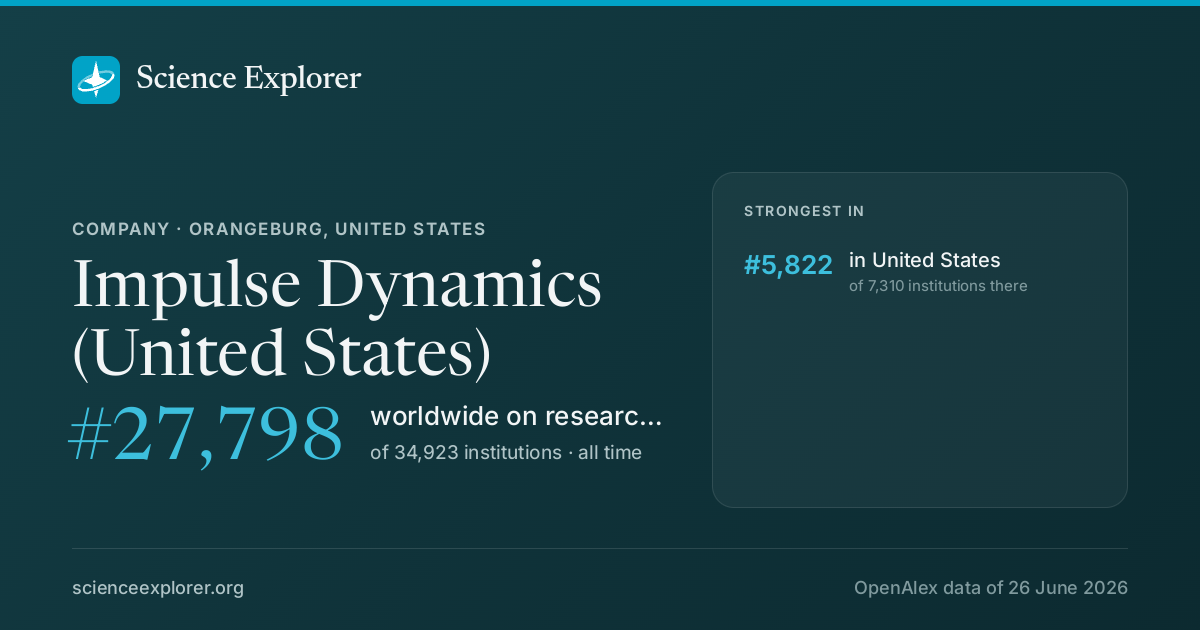
Impulse Dynamics (United States) on Science Explorer

A card with Impulse Dynamics (United States)'s standing and the fields it leads in, for a post or a slide. A link to this page previews as the same card.

Download the card

1200 × 630 PNG, sized for social posts, drawn from the latest snapshot.

Badges for a website1Each links back here and updates with every snapshot

Research measures only: rankings here say nothing about teaching, admissions or student experience. Comparable institutions and collaboration partners have tabs of their own, above.

Discussion

Ask a question or share a note about Impulse Dynamics (United States). Keep it to the research: no personal attacks, advertising or links. Any reader can report a post, which collapses it for everyone until it is opened.
