Science Explorer Back to mapMap
Discussion
Nonprofit · Udine · Italy

International Centre for Mechanical Sciences

World rank, all time
#32,125
of 34,923
Rank in Italy
#710
of 743
Research works
128
▼ 29% vs 2018-21
Citations
2.3k
17.7 per fractional work
Top-10% rate
8.1%
all institutions 10.0%
vs its own fields
1.01×
1.00× is exactly expected
Open access
18%
world 40%
International
25%
world 18%
International Centre for Mechanical Sciences

Which fields of science does International Centre for Mechanical Sciences work in?

In all years, 79% of research at International Centre for Mechanical Sciences is in Physical Sciences, 9% in Social Sciences. Its largest fields are Engineering (35%), Physics and Astronomy (15%), Computer Science (11%). It does 1.9× the world's share of Physical Sciences.

Physical Sciences: 101 fractional works · 78.9% of its workEngineering: 44 fractional works · 34.6% of its workElectrical and Electronic Engineering: 13 fractional works · 10.1% of its workComputational Mechanics: 8 fractional works · 5.9% of its workBiomedical Engineering: 5 fractional works · 4.3% of its workOcean Engineering: 4 fractional works · 3.1% of its workMechanical Engineering: 3 fractional works · 2.5% of its workAerospace Engineering: 3 fractional works · 2.4% of its workMechanics of Materials: 3 fractional works · 2.4% of its workCivil and Structural Engineering: 2 fractional works · 1.7% of its workIndustrial and Manufacturing Engineering: 1 fractional works · 1.0% of its workControl and Systems Engineering: 1 fractional works · 0.5% of its workSafety, Risk, Reliability and Quality: 0 fractional works · 0.4% of its workAutomotive Engineering: 0 fractional works · 0.2% of its workPhysics and Astronomy: 20 fractional works · 15.3% of its workAtomic and Molecular Physics, and Optics: 10 fractional works · 7.8% of its workCondensed Matter Physics: 5 fractional works · 4.0% of its workStatistical and Nonlinear Physics: 2 fractional works · 1.6% of its workRadiation: 1 fractional works · 0.9% of its workNuclear and High Energy Physics: 1 fractional works · 0.5% of its workInstrumentation: 0 fractional works · 0.3% of its workSmaller subfields together: 0 fractional works · 0.1% of its workComputer Science: 14 fractional works · 10.9% of its workArtificial Intelligence: 4 fractional works · 3.4% of its workComputer Networks and Communications: 3 fractional works · 2.4% of its workComputational Theory and Mathematics: 2 fractional works · 1.8% of its workComputer Vision and Pattern Recognition: 2 fractional works · 1.3% of its workInformation Systems: 2 fractional works · 1.2% of its workSignal Processing: 0 fractional works · 0.3% of its workSmaller subfields together: 1 fractional works · 0.5% of its workMaterials Science: 11 fractional works · 8.6% of its workMaterials Chemistry: 6 fractional works · 4.4% of its workElectronic, Optical and Magnetic Materials: 2 fractional works · 1.8% of its workCeramics and Composites: 2 fractional works · 1.3% of its workSurfaces, Coatings and Films: 1 fractional works · 1.0% of its workSmaller subfields together: 0 fractional works · 0.1% of its workEnvironmental Science: 5 fractional works · 4.0% of its workEnvironmental Engineering: 2 fractional works · 1.2% of its workManagement, Monitoring, Policy and Law: 1 fractional works · 0.5% of its workGlobal and Planetary Change: 1 fractional works · 0.5% of its workNature and Landscape Conservation: 1 fractional works · 0.5% of its workEcology: 1 fractional works · 0.4% of its workWater Science and Technology: 0 fractional works · 0.4% of its workHealth, Toxicology and Mutagenesis: 0 fractional works · 0.2% of its workSmaller subfields together: 0 fractional works · 0.2% of its workEarth and Planetary Sciences: 3 fractional works · 2.3% of its workAtmospheric Science: 1 fractional works · 1.1% of its workEarth-Surface Processes: 1 fractional works · 0.7% of its workGeochemistry and Petrology: 0 fractional works · 0.3% of its workOceanography: 0 fractional works · 0.2% of its workChemistry: 2 fractional works · 1.6% of its workOrganic Chemistry: 1 fractional works · 0.7% of its workPhysical and Theoretical Chemistry: 0 fractional works · 0.3% of its workSpectroscopy: 0 fractional works · 0.3% of its workAnalytical Chemistry: 0 fractional works · 0.2% of its workSmaller subfields together: 0 fractional works · 0.1% of its workMathematics: 1 fractional works · 0.6% of its workNumerical Analysis: 0 fractional works · 0.3% of its workSmaller subfields together: 0 fractional works · 0.3% of its workEnergy: 1 fractional works · 0.5% of its workGeneral Energy: 0 fractional works · 0.3% of its workRenewable Energy, Sustainability and the Environment: 0 fractional works · 0.3% of its workChemical Engineering: 0 fractional works · 0.4% of its workFluid Flow and Transfer Processes: 0 fractional works · 0.4% of its workSocial Sciences: 11 fractional works · 8.9% of its workEconomics, Econometrics and Finance: 3 fractional works · 2.2% of its workEconomics and Econometrics: 2 fractional works · 1.9% of its workGeneral Economics, Econometrics and Finance: 0 fractional works · 0.3% of its workSmaller subfields together: 0 fractional works · 0.1% of its workSocial Sciences: 3 fractional works · 2.1% of its workDevelopment: 1 fractional works · 0.5% of its workLinguistics and Language: 1 fractional works · 0.5% of its workGeography, Planning and Development: 0 fractional works · 0.4% of its workHealth: 0 fractional works · 0.3% of its workSmaller subfields together: 0 fractional works · 0.4% of its workArts and Humanities: 2 fractional works · 1.8% of its workArcheology: 1 fractional works · 1.1% of its workLanguage and Linguistics: 1 fractional works · 0.6% of its workSmaller subfields together: 0 fractional works · 0.1% of its workDecision Sciences: 2 fractional works · 1.4% of its workManagement Science and Operations Research: 1 fractional works · 1.0% of its workStatistics, Probability and Uncertainty: 0 fractional works · 0.4% of its workPsychology: 1 fractional works · 1.0% of its workSocial Psychology: 1 fractional works · 0.5% of its workClinical Psychology: 0 fractional works · 0.4% of its workSmaller subfields together: 0 fractional works · 0.0% of its workBusiness, Management and Accounting: 0 fractional works · 0.4% of its workHealth Sciences: 9 fractional works · 7.2% of its workMedicine: 8 fractional works · 6.4% of its workCardiology and Cardiovascular Medicine: 2 fractional works · 1.4% of its workPediatrics, Perinatology and Child Health: 1 fractional works · 0.8% of its workSurgery: 1 fractional works · 0.6% of its workPulmonary and Respiratory Medicine: 1 fractional works · 0.5% of its workEpidemiology: 1 fractional works · 0.5% of its workPhysiology: 1 fractional works · 0.4% of its workOphthalmology: 0 fractional works · 0.3% of its workNeurology: 0 fractional works · 0.3% of its workInfectious Diseases: 0 fractional works · 0.3% of its workPharmacology: 0 fractional works · 0.3% of its workSmaller subfields together: 1 fractional works · 1.0% of its workHealth Professions: 1 fractional works · 0.5% of its workRadiological and Ultrasound Technology: 0 fractional works · 0.3% of its workGeneral Health Professions: 0 fractional works · 0.2% of its workDentistry: 0 fractional works · 0.2% of its workNursing: 0 fractional works · 0.1% of its workVeterinary: 0 fractional works · 0.1% of its workLife Sciences: 6 fractional works · 5.0% of its workBiochemistry, Genetics and Molecular Biology: 3 fractional works · 2.1% of its workMolecular Biology: 2 fractional works · 1.3% of its workGenetics: 1 fractional works · 0.5% of its workSmaller subfields together: 0 fractional works · 0.3% of its workAgricultural and Biological Sciences: 2 fractional works · 1.7% of its workPlant Science: 1 fractional works · 1.0% of its workSoil Science: 0 fractional works · 0.3% of its workSmaller subfields together: 1 fractional works · 0.5% of its workNeuroscience: 1 fractional works · 0.8% of its workCognitive Neuroscience: 1 fractional works · 0.8% of its workSmaller subfields together: 0 fractional works · 0.0% of its workImmunology and Microbiology: 0 fractional works · 0.3% of its workImmunology: 0 fractional works · 0.3% of its workPharmacology, Toxicology and Pharmaceutics: 0 fractional works · 0.1% of its workALL ITS WORKInternationalCentre for…128fractional works, all years
Life Sciences5%Physical Sciences79%Health Sciences7%Social Sciences9%

Each ring splits the one inside it: the four domains of science, their fields, their subfields. Size is fractional works in all years. Every slice is a page; the interactive view zooms down to single topics and colours each by how much more of it this institution does than the world.

Its 4 domains and 26 fields, with their numbers
    1. Engineering4434.6%
    2. Physics and Astronomy2015.3%
    3. Computer Science1410.9%
    4. Materials Science118.6%
    5. Environmental Science54.0%
    6. Earth and Planetary Sciences32.3%
    7. Chemistry21.6%
    8. Mathematics10.6%
    9. Energy10.5%
    10. Chemical Engineering00.4%
    1. Economics, Econometrics and Finance32.2%
    2. Social Sciences32.1%
    3. Arts and Humanities21.8%
    4. Decision Sciences21.4%
    5. Psychology11.0%
    6. Business, Management and Accounting00.4%
    1. Medicine86.4%
    2. Health Professions10.5%
    3. Dentistry00.2%
    4. Nursing00.1%
    5. Veterinary00.1%
    1. Biochemistry, Genetics and Molecular Biology32.1%
    2. Agricultural and Biological Sciences21.7%
    3. Neuroscience10.8%
    4. Immunology and Microbiology00.3%
    5. Pharmacology, Toxicology and Pharmaceutics00.1%
All of science, and how each field's share has moved since 1950: the Science domain explorer

Field profile

Location quotient across every field it publishes in: outside the ring is more than an institution of this size would be expected to publish, inside it is less.

Biochemistry, Genetics and Molecular Biology: 0.28× its world share, 0 worksBiochemistry, Geneti…Immunology and Microbiology: 4.39× its world share, 0 worksImmunology and Micro…Neuroscience: 5.45× its world share, 1 worksNeuroscienceComputer Science: 0.57× its world share, 0 worksComputer ScienceEarth and Planetary Sciences: 0.56× its world share, 0 worksEarth and Planetary …Engineering: 1.28× its world share, 1 worksEngineeringEnvironmental Science: 2.38× its world share, 1 worksEnvironmental ScienceMaterials Science: 0.42× its world share, 0 worksMaterials ScienceDentistry: 5.47× its world share, 0 worksDentistryMedicine: 0.98× its world share, 1 worksMedicineVeterinary: 10.85× its world share, 0 worksVeterinaryBusiness, Management and Accounting: 1.37× its world share, 0 worksBusiness, Management…Decision Sciences: 4.57× its world share, 0 worksDecision SciencesEconomics, Econometrics and Finance: 3.10× its world share, 0 worksEconomics, Econometr…Psychology: 0.08× its world share, 0 worksPsychologySocial Sciences: 0.70× its world share, 1 worksSocial Sciences1×world share
more than its size predictsabout as predictedless

Rings at 0.5×, 1× and 2×. Widest outward: Veterinary, 10.8×. Every wedge is a field page.

All 16 fields, with their numbers
  1. Veterinary10.85×0 works
  2. Dentistry5.47×0 works
  3. Neuroscience5.45×1 works
  4. Decision Sciences4.57×0 works
  5. Immunology and Microbiology4.39×0 works
  6. Economics, Econometrics and Finance3.10×0 works
  7. Environmental Science2.38×1 works
  8. Business, Management and Accounting1.37×0 works
  9. Engineering1.28×1 works
  10. Medicine0.98×1 works
  11. Social Sciences0.70×1 works
  12. Computer Science0.57×0 works
  13. Earth and Planetary Sciences0.56×0 works
  14. Materials Science0.42×0 works
  15. Biochemistry, Genetics and Molecular Biology0.28×0 works
  16. Psychology0.08×0 works

Who are the top researchers at International Centre for Mechanical Sciences?

Ranked on the quality score, Giorgio Ponti, V. Ottoboni and C. Flores lead among researchers whose main affiliation is International Centre for Mechanical Sciences.

  1. 1 Giorgio Ponti Italy · #3,563,112 worldwide 7 citations · 32 works
  2. 2 V. Ottoboni Italy · #5,278,031 worldwide 155 citations · 31 works
  3. 3 C. Flores Italy · #6,662,086 worldwide 238 citations · 66 works
All ranked researchers at International Centre for Mechanical Sciences

What are the most cited papers from International Centre for Mechanical Sciences?

The most cited paper from International Centre for Mechanical Sciences is "Anomalous scaling laws in multifractal objects" (Giovanni Paladin, Angelo Vulpiani, 1987), with 990 citations. Next come "Anisotropic Particles in Turbulence" (370) and "Preparation and characterization of hexaaluminate-based materials for catalytic combustion" (169).

Most cited papers
#PaperReleasedCitations
1 Anomalous scaling laws in multifractal objects Giovanni Paladin, Angelo Vulpiani · Physics Reports Dec 1987 990
2 Anisotropic Particles in Turbulence Greg Voth, Alfredo Soldati · Annual Review of Fluid Mechanics Review 2 Aug 2016 370
3 Preparation and characterization of hexaaluminate-based materials for catalytic combustion Gianpiero Groppi, Maurizio Pietro Bellotto, C. Cristiam et al. · Applied Catalysis A General Oct 1993 169
4 Spreading of Liquid Drops over Dry Porous Layers: Complete Wetting Case Victor Mikhilovich Starov, S.R. Kostvintsev, Vladimir D. Sobolev et al. · Journal of Colloid and Interface Science Aug 2002 156
5 Spreading of liquid drops over porous substrates Victor Mikhilovich Starov, S.A. Zhdanov, Serguei R. Kosvintsev et al. · Advances in Colloid and Interface Science 24 Apr 2003 135
All 61 most cited papers, with filters and sorting

Which keywords describe research at International Centre for Mechanical Sciences?

By fractional works in all years, weighted toward what it does more of than the world: Photovoltaics, Large-Eddy Simulation, Solar Cells, Multiphase Flow, Electronic Structure Calculations, Turbulent Flows, Two-Phase Flow and Semiconductor.

▲ more of its work than of the world's◆ about the world's share▼ less than the world's

Size is fractional works in all years in the topics tagged with each word; colour is the word's share of this institution's work against its share of the world's. The 40 words are chosen for being large and distinctive. Each links to the topic it comes from most.

All 40 words, with their numbers
  1. Climate Change5▲ 1.36×18 topics
  2. Photovoltaics4▲ 13×4 topics
  3. Large-Eddy Simulation4▲ 12×3 topics
  4. Solar Cells4▲ 9.4×6 topics
  5. Nanoparticles4▲ 2.1×9 topics
  6. Multiphase Flow3▲ 27×3 topics
  7. Heat Transfer3▲ 5.1×5 topics
  8. Electronic Structure Calculations3▲ 11×2 topics
  9. Semiconductor3▲ 7.2×4 topics
  10. Turbulent Flows3▲ 18×2 topics
  11. Cuprate Superconductors3▲ 23×1 topic
  12. Efficiency3▲ 8.6×2 topics
  13. High-Temperature Superconductivity3▲ 23×1 topic
  14. Two-Phase Flow3▲ 25×4 topics
  15. Vortex Dynamics3▲ 13×2 topics
  16. Boundary Layer Transition3▲ 22×1 topic
  17. Particle Image Velocimetry3▲ 22×1 topic
  18. Critical Current Density3▲ 38×2 topics
  19. Superconductivity3▲ 6.7×5 topics
  20. Turbulence3▲ 14×2 topics
  21. Particle-Laden Flows2▲ 70×1 topic
  22. Particles2▲ 70×1 topic
  23. Fiber Lasers2▲ 13×2 topics
  24. Nb3Sn Conductor2▲ 43×1 topic
  25. Spectroscopy2▲ 5.4×5 topics
  26. Superconducting Magnets2▲ 43×1 topic
  27. Data Integration2▲ 6.8×2 topics
  28. High Efficiency2▲ 47×2 topics
  29. Pattern Formation2▲ 26×2 topics
  30. Semantic Web2▲ 11×2 topics
  31. Structural Analysis2▲ 10×3 topics
  32. Optical Properties2▲ 13×2 topics
  33. Silicon2▲ 20×2 topics
  34. Concentrator Photovoltaics2▲ 78×1 topic
  35. Knowledge Representation2▲ 10×2 topics
  36. Multijunction Solar Cells2▲ 78×1 topic
  37. Thin Films2▲ 5.4×4 topics
  38. Glass Science2▲ 27×1 topic
  39. Heterojunction2▲ 30×1 topic
  40. Passivation2▲ 30×1 topic

Which research topics does International Centre for Mechanical Sciences publish most on?

By volume in 2022-now: Landslides and related hazards, Tree Root and Stability Studies, Embodied and Extended Cognition and Vaccine Coverage and Hesitancy.

  1. 1 Landslides and related hazards Management, Monitoring, Policy and Law 1 works
  2. 2 Tree Root and Stability Studies Mechanical Engineering 0 works
  3. 3 Embodied and Extended Cognition Cognitive Neuroscience 0 works
  4. 4 Vaccine Coverage and Hesitancy Health 0 works
  5. 5 Economic, Social, and Public Health Issues in Russia and Globally Management Science and Operations Research 0 works
  6. 6 Intracranial Aneurysms: Treatment and Complications Neurology 0 works
  7. 7 Influenza Virus Research Studies Epidemiology 0 works
  8. 8 Psychiatry, Mental Health, Neuroscience Artificial Intelligence 0 works
  9. 9 Economic and Technological Developments in Russia Development 0 works
  10. 10 Economic Sanctions and International Relations Economics and Econometrics 0 works

How open and international is its research?

Against the world's own shares: the tick on each track. Both are shares of its output, so they sit on one scale and can be read against each other as well as against the world.

openly available17.7%not open82.3%

World: 40% of research is openly available.

with international co-authors24.6%domestic only75.4%

World: 18% is written across borders.

How has International Centre for Mechanical Sciences's research output changed?

Output in 2022-2025 was 29% lower than in 2018-2021.

still counting1990200020102020
grewheldshrank

The same series as a ribbon: one cell per year, darker for more. The line above answers how much; this answers when.

Its share of all research

Growing output can still be a shrinking share: all of science grows. This is International Centre for Mechanical Sciences as a percentage of every work published that year, 0.000015% in 2024.

still counting0.00050%0.0010%0.0015%International Centre for Mechanical Sciences0.000061% in 202519801990200020102020

Fractional works of International Centre for Mechanical Sciences over all fractional works that year. How the balance of science has shifted.

Other research institutions in Udine

All research institutions in Udine

Share International Centre for Mechanical Sciences's ranking
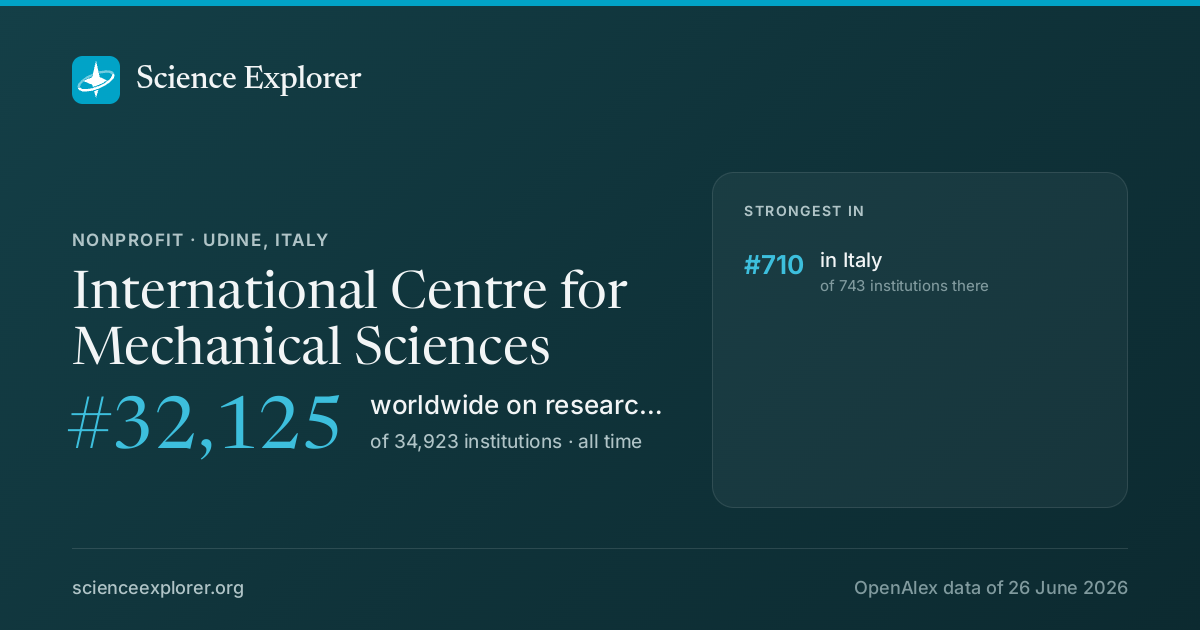
International Centre for Mechanical Sciences on Science Explorer

A card with International Centre for Mechanical Sciences's standing and the fields it leads in, for a post or a slide. A link to this page previews as the same card.

Download the card

1200 × 630 PNG, sized for social posts, drawn from the latest snapshot.

Badges for a website1Each links back here and updates with every snapshot

Research measures only: rankings here say nothing about teaching, admissions or student experience. Comparable institutions and collaboration partners have tabs of their own, above.

Discussion

Ask a question or share a note about International Centre for Mechanical Sciences. Keep it to the research: no personal attacks, advertising or links. Any reader can report a post, which collapses it for everyone until it is opened.
