Ion Beam Applications (Belgium)
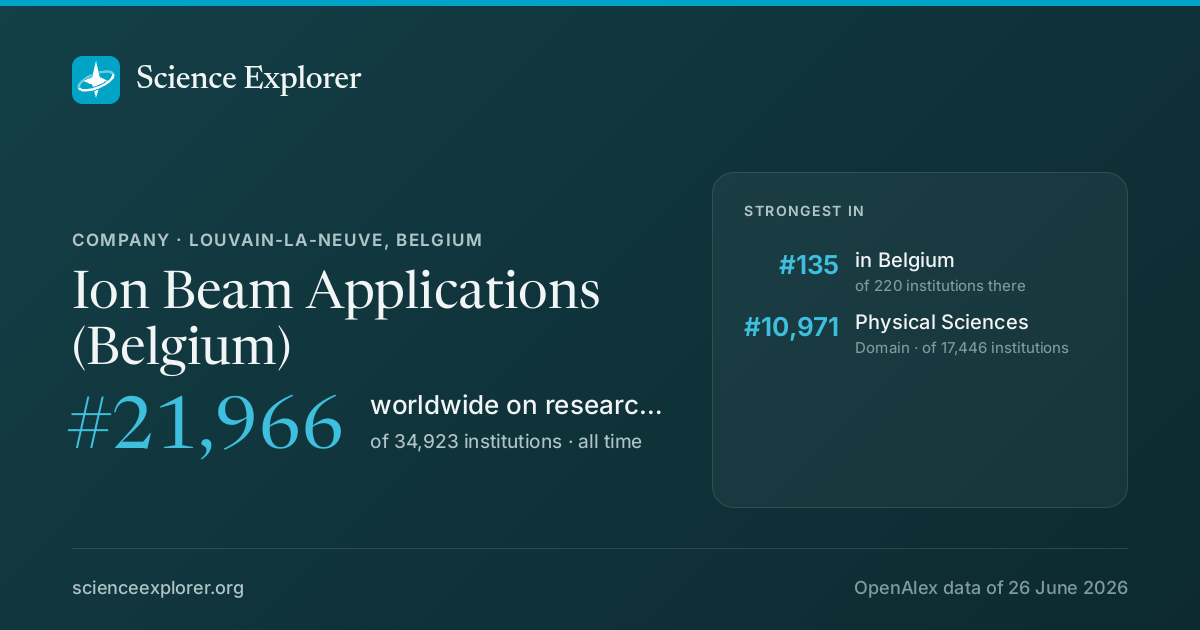
In research, Ion Beam Applications (Belgium) stands highest in Physical Sciences (#10,971 of 17,446 worldwide), over all time.
- World rank, all time
- #21,966 of 34,923
- Rank in Belgium
- #135 of 220
- Research works
- 216 ▲ 82% vs 2018-21
- Citations
- 2.9k 13.5 per fractional work
- Top-10% rate
- 14.3% all institutions 10.0%
- vs its own fields
- 1.08× 1.00× is exactly expected
- Open access
- 40% world 40%
- International
- 46% world 18%
What is Ion Beam Applications (Belgium) known for in research?
The fields where it stands highest, over all time, ranked among every institution above the floor in each field.
| Field | World rank | Where that sits | Top-10% rate | Works |
|---|---|---|---|---|
| Physical SciencesDomain | #10,971 of 17,446 | 9.9% | 141 |
Each strip is that field's whole ranked pool, with the notch where Ion Beam Applications (Belgium) sits in it, in the colour of the band that rank falls in. The track under the rate is the rate itself: it carries no average mark, because the average differs by field (from about 6% in Dentistry to 21% in Economics).
Which fields of science does Ion Beam Applications (Belgium) work in?
In 2022-now, 54% of research at Ion Beam Applications (Belgium) is in Physical Sciences, 36% in Health Sciences. Its largest fields are Medicine (34%), Physics and Astronomy (19%), Engineering (18%). It does 1.4× the world's share of Health Sciences.
Each ring splits the one inside it: the four domains of science, their fields, their subfields. Size is fractional works in 2022-now. Every slice is a page; the interactive view zooms down to single topics and colours each by how much more of it this institution does than the world.
Its 4 domains and 19 fields, with their numbers
- Physical Sciences2554.0%
- Physics and Astronomy918.9%
- Engineering818.2%
- Mathematics24.6%
- Computer Science23.6%
- Materials Science13.3%
- Chemistry12.4%
- Environmental Science12.2%
- Earth and Planetary Sciences00.6%
- Chemical Engineering00.4%
- Health Sciences1635.7%
- Medicine1634.1%
- Health Professions11.6%
- Life Sciences36.3%
- Social Sciences23.9%
Field profile
Location quotient across every field it publishes in: outside the ring is more than an institution of this size would be expected to publish, inside it is less.
Rings at 0.5×, 1× and 2×. Widest outward: Physics and Astronomy, 8.5×. Every wedge is a field page.
All 19 fields, with their numbers
- Physics and Astronomy8.50×9 works
- Mathematics3.89×2 works
- Medicine1.78×16 works
- Chemistry1.50×1 works
- Engineering1.22×8 works
- Chemical Engineering1.05×0 works
- Agricultural and Biological Sciences0.97×2 works
- Materials Science0.94×2 works
- Health Professions0.59×1 works
- Arts and Humanities0.51×1 works
- Computer Science0.46×2 works
- Environmental Science0.44×1 works
- Economics, Econometrics and Finance0.43×0 works
- Earth and Planetary Sciences0.35×0 works
- Biochemistry, Genetics and Molecular Biology0.32×1 works
- Decision Sciences0.31×0 works
- Social Sciences0.07×0 works
- Business, Management and Accounting0.06×0 works
- Psychology0.03×0 works
- Physics and Astronomy 8.5×
- Mathematics 3.9×
- Medicine 1.8×
- Chemistry 1.5×
- Engineering 1.2×
- Chemical Engineering 1.1×
- Agricultural and Biological Sciences 1.0×
- Materials Science 0.9×
- Health Professions 0.6×
- Arts and Humanities 0.5×
- Computer Science 0.5×
- Environmental Science 0.4×
- Economics, Econometrics and Finance 0.4×
- Earth and Planetary Sciences 0.3×
- Biochemistry, Genetics and Molecular Biology 0.3×
- Decision Sciences 0.3×
- Social Sciences 0.1×
- Business, Management and Accounting 0.1×
- Psychology 0.0×
Who are the top researchers at Ion Beam Applications (Belgium)?
Ranked on the quality score, Guillaume Janssens, François Vander Stappen and J. Smeets lead among researchers whose main affiliation is Ion Beam Applications (Belgium).
- 1
Guillaume Janssens
 Belgium · #1,190,492 worldwide
2.9k citations · 178 works
- 2
François Vander Stappen
Belgium · #1,233,797 worldwide
1.3k citations · 76 works
- 3
J. Smeets
Belgium · #1,282,887 worldwide
1.9k citations · 100 works
- 4
Damien Prieels
Belgium · #1,941,847 worldwide
1.4k citations · 55 works
- 5
Jarrick Nys
Belgium · #2,317,293 worldwide
17 citations · 18 works
- 6
Lucian Hotoiu
Belgium · #2,448,186 worldwide
1k citations · 36 works
- 7
El Hassane Bentefour
Belgium · #2,917,629 worldwide
980 citations · 48 works
- 8
R.F. Verbruggen
Belgium · #3,591,163 worldwide
187 citations · 15 works
- 9
Sébastien Brousmiche
Belgium · #3,642,836 worldwide
465 citations · 35 works
- 10
Rudi Labarbe
Belgium · #3,737,954 worldwide
773 citations · 57 works
Which keywords describe research at Ion Beam Applications (Belgium)?
By fractional works in 2022-now, weighted toward what it does more of than the world: Particle Therapy, Proton Therapy, Dosimetry, Monte Carlo Simulation, Quality Assurance, Image-Guided Radiotherapy, Radiotherapy Physics and Cancer Treatment.
- Small-Angle Scattering
- Neutron Imaging
- Cerebral Palsy
- Radiography
- Inorganic Scintillators
- Carboranes
- Soft Errors
- Medical Imaging
- Reliability Evaluation
- CMOS Technology
- Superconducting Cavities
- Cancer Treatment
- Quality Assurance
- Monte Carlo Simulation
- Proton Therapy
- Particle Therapy
- Dosimetry
- Image-Guided Radiotherapy
- Radiotherapy Physics
- Negative Ion Sources
- Epidemiology
- Radiotherapy
- Biological Applications
- Radiation Effects
- Boron Neutron Capture Therapy
- Data Analysis
- Scintillation Detectors
- Rehabilitation
- ICF Model
- Oxidative Stress
Size is fractional works in 2022-now in the topics tagged with each word; colour is the word's share of this institution's work against its share of the world's. The 30 words are chosen for being large and distinctive. Each links to the topic it comes from most.
All 30 words, with their numbers
- Particle Therapy7▲ 613×1 topic
- Proton Therapy7▲ 613×1 topic
- Dosimetry6▲ 176×2 topics
- Monte Carlo Simulation6▲ 60×3 topics
- Image-Guided Radiotherapy5▲ 258×1 topic
- Quality Assurance5▲ 65×2 topics
- Radiotherapy Physics5▲ 258×1 topic
- Cancer Treatment2▲ 20×4 topics
- Negative Ion Sources2▲ 218×1 topic
- Superconducting Cavities2▲ 218×1 topic
- Epidemiology2◆ 0.90×6 topics
- CMOS Technology2▲ 40×2 topics
- Radiotherapy2▲ 8.4×6 topics
- Reliability Evaluation2▲ 63×2 topics
- Biological Applications1▲ 46×2 topics
- Medical Imaging1▲ 5.7×3 topics
- Radiation Effects1▲ 75×1 topic
- Soft Errors1▲ 175×1 topic
- Boron Neutron Capture Therapy1▲ 347×1 topic
- Carboranes1▲ 347×1 topic
- Data Analysis1▲ 10.0×2 topics
- Inorganic Scintillators1▲ 82×1 topic
- Scintillation Detectors1▲ 82×1 topic
- Radiography1▲ 67×2 topics
- Rehabilitation1▲ 6.3×3 topics
- Cerebral Palsy1▲ 30×1 topic
- ICF Model1▲ 54×1 topic
- Neutron Imaging1▲ 69×1 topic
- Oxidative Stress1▲ 1.38×4 topics
- Small-Angle Scattering1▲ 44×1 topic
Which research topics does Ion Beam Applications (Belgium) publish most on?
By volume in 2022-now: Radiation Therapy and Dosimetry, Advanced Radiotherapy Techniques, Particle accelerators and beam dynamics and Radiation Effects in Electronics.
Area is fractional works; colour is the subfield each topic belongs to.
- 1 Radiation Therapy and Dosimetry Pulmonary and Respiratory Medicine 7 works
- 2 Advanced Radiotherapy Techniques Radiation 5 works
- 3 Particle accelerators and beam dynamics Aerospace Engineering 2 works
- 4 Radiation Effects in Electronics Electrical and Electronic Engineering 1 works
- 5 Boron Compounds in Chemistry Radiology, Nuclear Medicine and Imaging 1 works
- 6 Radiation Detection and Scintillator Technologies Radiation 1 works
- 7 Nuclear Physics and Applications Radiation 1 works
- 8 Cerebral Palsy and Movement Disorders Psychiatry and Mental health 1 works
- 9 Particle Accelerators and Free-Electron Lasers Electrical and Electronic Engineering 1 works
- 10 Effects of Radiation Exposure Radiology, Nuclear Medicine and Imaging 1 works
How open and international is its research?
Against the world's own shares: the tick on each track. Both are shares of its output, so they sit on one scale and can be read against each other as well as against the world.
World: 40% of research is openly available.
World: 18% is written across borders.
How has Ion Beam Applications (Belgium)'s research output changed?
Output in 2022-2025 was 82% higher than in 2018-2021.
The same series as a ribbon: one cell per year, darker for more. The line above answers how much; this answers when.
Its share of all research
Growing output can still be a shrinking share: all of science grows. This is Ion Beam Applications (Belgium) as a percentage of every work published that year, 0.00018% in 2024.
Fractional works of Ion Beam Applications (Belgium) over all fractional works that year. How the balance of science has shifted.
Other research institutions in Louvain-la-Neuve
- UCLouvain
- Asahi Glass (Belgium)
- Institut des Arts de Diffusion
- Coatings Research Institute
- Albemarle (Belgium)
- Wetlands Incubator (Belgium)
- European Inter-University Association of Society, Science and Technology
- Metamorphose VI AISBL

Share Ion Beam Applications (Belgium)'s ranking
Badges for a website1Each links back here and updates with every snapshot

Research measures only: rankings here say nothing about teaching, admissions or student experience. Comparable institutions and collaboration partners have tabs of their own, above.
Discussion
Ask a question or share a note about Ion Beam Applications (Belgium). Posts are plain text and can be reported.