Iringa Mercy Organization
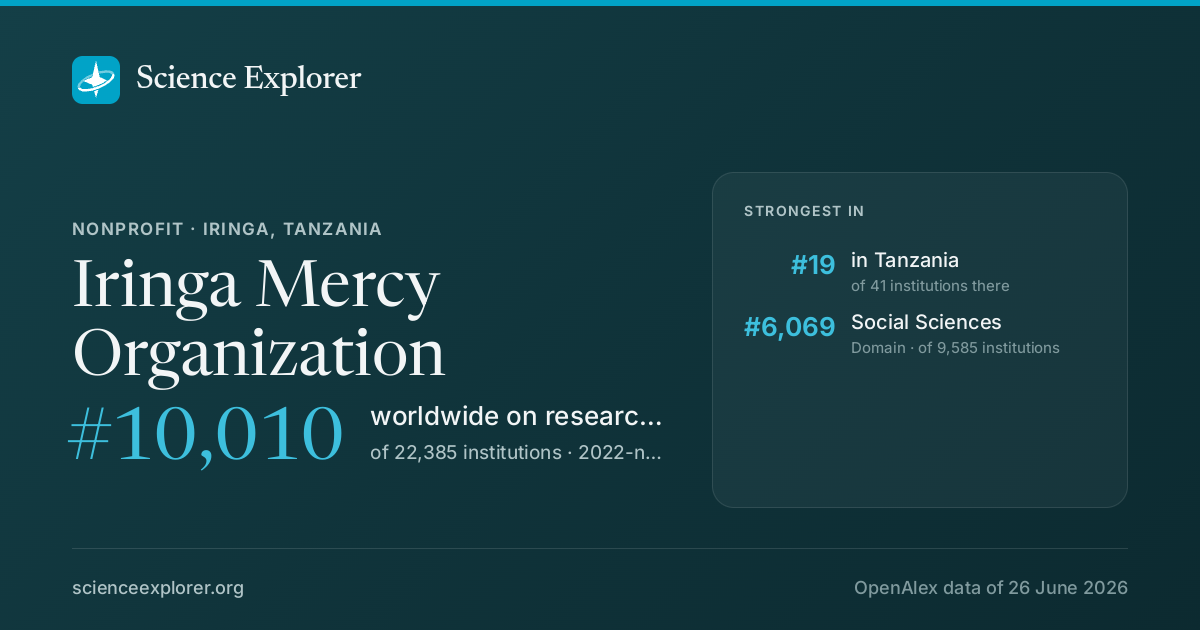
In research, Iringa Mercy Organization stands highest in Social Sciences (#6,069 of 9,585 worldwide) and Social Sciences (#4,654 of 5,988 worldwide), 2022-now. Relative to its size it is most specialised in Education (Education is 4.4× its share of world research).
- World rank, 2022-now
- #10,010 of 22,385 · #20,188 all time
- Rank in Tanzania
- #19 of 41
- Research works
- 388 ▲ 306% vs 2018-21
- Citations
- 1.4k 3.7 per fractional work
- Top-10% rate
- 4.7% all institutions 10.0%
- vs its own fields
- 0.84× 1.00× is exactly expected
- Open access
- 87% world 40%
- International
- 14% world 18%
What is Iringa Mercy Organization known for in research?
The fields where it stands highest, 2022-now, ranked among every institution above the floor in each field.
| Field | World rank | Where that sits | Top-10% rate | Works | All time |
|---|---|---|---|---|---|
| Social SciencesDomain | #6,069 of 9,585 | 3.9% | 169 | #12048 | |
| Social SciencesField | #4,654 of 5,988 | 4.6% | 103 | #7902 |
Each strip is that field's whole ranked pool, with the notch where Iringa Mercy Organization sits in it, in the colour of the band that rank falls in. The track under the rate is the rate itself: it carries no average mark, because the average differs by field (from about 6% in Dentistry to 21% in Economics).
Which fields of science does Iringa Mercy Organization work in?
In 2022-now, 65% of research at Iringa Mercy Organization is in Social Sciences, 16% in Physical Sciences. Its largest fields are Social Sciences (39%), Business, Management and Accounting (11%), Computer Science (8%). It does 2.6× the world's share of Social Sciences.
Each ring splits the one inside it: the four domains of science, their fields, their subfields. Size is fractional works in 2022-now. Every slice is a page; the interactive view zooms down to single topics and colours each by how much more of it this institution does than the world.
Its 4 domains and 22 fields, with their numbers
- Social Sciences17965.1%
- Social Sciences10739.0%
- Business, Management and Accounting3111.2%
- Economics, Econometrics and Finance186.5%
- Psychology103.5%
- Decision Sciences72.7%
- Arts and Humanities62.3%
- Physical Sciences4516.3%
- Computer Science217.6%
- Environmental Science165.7%
- Engineering41.6%
- Mathematics20.8%
- Materials Science10.3%
- Energy00.1%
- Physics and Astronomy00.1%
- Earth and Planetary Sciences00.0%
- Health Sciences3312.2%
- Medicine207.2%
- Health Professions103.5%
- Nursing41.4%
- Veterinary00.1%
- Life Sciences186.4%
What does Iringa Mercy Organization specialise in?
Where its research is concentrated relative to its size: Education takes 4.4× the share of its output that it takes of world research.
- EducationSubfield · 37.0 works4.4×
Location quotient, a volume reading rather than an impact one. It surfaces small, lopsided specialities.
Field profile
Location quotient across every field it publishes in: outside the ring is more than an institution of this size would be expected to publish, inside it is less.
Rings at 0.5×, 1× and 2×. Widest outward: Business, Management and Accounting, 3.5×. Every wedge is a field page.
All 22 fields, with their numbers
- Business, Management and Accounting3.48×31 works
- Social Sciences3.08×107 works
- Economics, Econometrics and Finance3.02×18 works
- Nursing2.85×4 works
- Decision Sciences2.78×7 works
- Health Professions1.34×10 works
- Environmental Science1.14×16 works
- Psychology1.14×10 works
- Computer Science0.98×21 works
- Agricultural and Biological Sciences0.93×12 works
- Arts and Humanities0.78×6 works
- Mathematics0.66×2 works
- Immunology and Microbiology0.47×1 works
- Veterinary0.43×0 works
- Medicine0.37×20 works
- Biochemistry, Genetics and Molecular Biology0.26×4 works
- Energy0.13×0 works
- Engineering0.11×4 works
- Materials Science0.09×1 works
- Neuroscience0.07×0 works
- Physics and Astronomy0.05×0 works
- Earth and Planetary Sciences0.01×0 works
- Business, Management and Accounting 3.5×
- Social Sciences 3.1×
- Economics, Econometrics and Finance 3.0×
- Nursing 2.9×
- Decision Sciences 2.8×
- Health Professions 1.3×
- Environmental Science 1.1×
- Psychology 1.1×
- Computer Science 1.0×
- Agricultural and Biological Sciences 0.9×
- Arts and Humanities 0.8×
- Mathematics 0.7×
- Immunology and Microbiology 0.5×
- Veterinary 0.4×
- Medicine 0.4×
- Biochemistry, Genetics and Molecular Biology 0.3×
- Energy 0.1×
- Engineering 0.1×
- Materials Science 0.1×
- Neuroscience 0.1×
- Physics and Astronomy 0.1×
- Earth and Planetary Sciences 0.0×
Who are the top researchers at Iringa Mercy Organization?
Ranked on the quality score, Japhace Poncian, Charlotte E. Searle and Saul C. Mpeshe lead among researchers whose main affiliation is Iringa Mercy Organization.
- 1
Japhace Poncian
 Tanzania · #1,598,455 worldwide
426 citations · 44 works
- 2
Charlotte E. Searle
Tanzania · #2,124,161 worldwide
290 citations · 24 works
- 3
Saul C. Mpeshe
Tanzania · #3,057,030 worldwide
404 citations · 26 works
- 4
Brown Gwambene
Tanzania · #3,461,108 worldwide
148 citations · 39 works
- 5
Neil Baker
Tanzania · #3,962,879 worldwide
541 citations · 38 works
- 6
Norman Adamson Sigalla King
Tanzania · #4,130,287 worldwide
34 citations · 16 works
- 7
Elia Mulungu
Tanzania · #4,156,966 worldwide
98 citations · 15 works
- 8
Dorothy Lubawa
Tanzania · #4,610,151 worldwide
16 citations · 16 works
- 9
Sosthenes Ruheza
Tanzania · #4,909,652 worldwide
24 citations · 20 works
- 10
Lusekelo Kibona
Tanzania · #5,606,862 worldwide
36 citations · 31 works
Which keywords describe research at Iringa Mercy Organization?
By fractional works in 2022-now, weighted toward what it does more of than the world: Gender Equality, Poverty Reduction, Development, Education, Social Capital, Human Rights, Economic Development and Sustainable Development.
- School Improvement
- Teacher Professional Development
- Conditional Cash Transfers
- Shariah Supervision
- Ethical Identity
- Technology Integration
- Nigeria
- Global Financial Crisis
- Islamic Banking
- Microfinance
- Gender Inequality
- Risk Management
- Curriculum Development
- Innovation
- Corporate Governance
- Economic Development
- Climate Change
- Human Rights
- Sustainable Development
- Sustainability
- Education
- Gender Equality
- Poverty Reduction
- Development
- Social Capital
- Artificial Intelligence
- Supply Chain Management
- Information Technology
- International Law
- Finance
- Empowerment
- Teacher Education
- Quality Assurance
- Entrepreneurship
- Security Council
- Youth Unemployment
- Global Governance
- Biodiversity Conservation
- School Subsidies
- Educational Leadership
Size is fractional works in 2022-now in the topics tagged with each word; colour is the word's share of this institution's work against its share of the world's. The 40 words are chosen for being large and distinctive. Each links to the topic it comes from most.
All 40 words, with their numbers
- Education17▲ 3.7×17 topics
- Sustainability16▲ 2.5×18 topics
- Gender Equality15▲ 19×5 topics
- Sustainable Development14▲ 3.3×17 topics
- Poverty Reduction14▲ 38×5 topics
- Human Rights13▲ 4.6×19 topics
- Development13▲ 13×8 topics
- Climate Change12▲ 1.63×24 topics
- Social Capital12▲ 8.4×6 topics
- Economic Development12▲ 5.3×8 topics
- Artificial Intelligence10▲ 2.7×8 topics
- Corporate Governance10▲ 4.8×7 topics
- Supply Chain Management10▲ 4.0×6 topics
- Innovation9▲ 3.3×8 topics
- Information Technology8▲ 6.2×5 topics
- Curriculum Development8▲ 4.3×5 topics
- International Law8▲ 9.1×10 topics
- Risk Management7▲ 5.6×3 topics
- Finance7▲ 14×2 topics
- Gender Inequality7▲ 18×4 topics
- Empowerment7▲ 26×1 topic
- Microfinance7▲ 50×1 topic
- Teacher Education7▲ 20×3 topics
- Islamic Banking7▲ 6.7×2 topics
- Quality Assurance7▲ 14×2 topics
- Global Financial Crisis6▲ 18×2 topics
- Entrepreneurship6▲ 5.8×4 topics
- Nigeria6▲ 106×1 topic
- Security Council6▲ 47×2 topics
- Technology Integration6▲ 7.3×5 topics
- Youth Unemployment6▲ 194×1 topic
- Ethical Identity6▲ 19×1 topic
- Global Governance6▲ 9.4×7 topics
- Shariah Supervision6▲ 19×1 topic
- Biodiversity Conservation6▲ 6.0×7 topics
- Conditional Cash Transfers6▲ 59×1 topic
- School Subsidies6▲ 59×1 topic
- Teacher Professional Development6▲ 13×4 topics
- Educational Leadership5▲ 15×2 topics
- School Improvement5▲ 23×2 topics
Which research topics does Iringa Mercy Organization publish most on?
By volume in 2022-now: Microfinance and Financial Inclusion, African Education and Politics, Islamic Finance and Banking Studies and Poverty, Education, and Child Welfare.
Area is fractional works; colour is the subfield each topic belongs to.
- 1 Microfinance and Financial Inclusion Economics and Econometrics 7 works
- 2 African Education and Politics Education 6 works
- 3 Islamic Finance and Banking Studies Accounting 6 works
- 4 Poverty, Education, and Child Welfare Safety Research 6 works
- 5 Public Procurement and Policy Strategy and Management 5 works
- 6 International Law and Human Rights Political Science and International Relations 4 works
- 7 Teacher Education and Leadership Studies Education 4 works
- 8 Child Nutrition and Water Access Nutrition and Dietetics 4 works
- 9 Technology Adoption and User Behaviour Information Systems and Management 3 works
- 10 Innovation and Socioeconomic Development Business and International Management 3 works
How open and international is its research?
Against the world's own shares: the tick on each track. Both are shares of its output, so they sit on one scale and can be read against each other as well as against the world.
World: 40% of research is openly available.
World: 18% is written across borders.
How has Iringa Mercy Organization's research output changed?
Output in 2022-2025 was 306% higher than in 2018-2021.
The same series as a ribbon: one cell per year, darker for more. The line above answers how much; this answers when.
Its share of all research
Growing output can still be a shrinking share: all of science grows. This is Iringa Mercy Organization as a percentage of every work published that year, 0.0010% in 2024.
Fractional works of Iringa Mercy Organization over all fractional works that year. How the balance of science has shifted.
Other research institutions in Iringa
Share Iringa Mercy Organization's ranking
Badges for a website1Each links back here and updates with every snapshot

Research measures only: rankings here say nothing about teaching, admissions or student experience. Comparable institutions and collaboration partners have tabs of their own, above.
Discussion
Ask a question or share a note about Iringa Mercy Organization. Posts are plain text and can be reported.