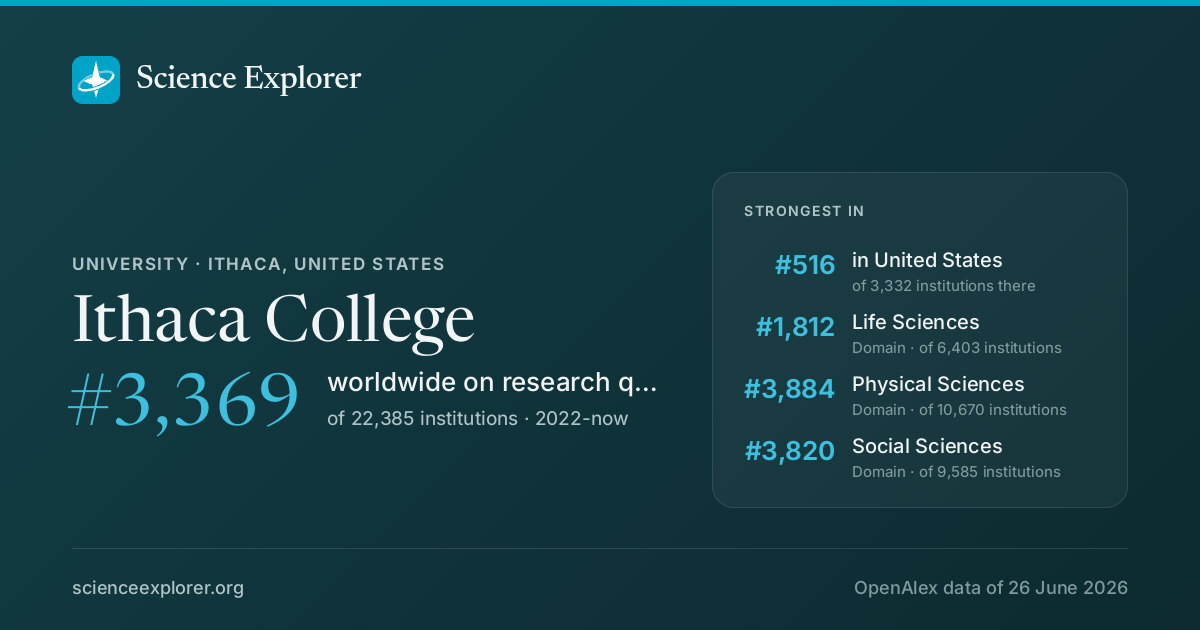
In research, Ithaca College stands highest in Life Sciences (#1,812 of 6,403 worldwide), Physical Sciences (#3,884 of 10,670 worldwide) and Social Sciences (#3,820 of 9,585 worldwide), 2022-now.
Each strip is that field's whole ranked pool, with the notch where Ithaca College sits in it, in the colour
of the band that rank falls in. The track under the rate is the rate itself: it carries no average mark, because the average
differs by field (from about 6% in Dentistry to 21% in Economics).
Which of those standings moved
The same fields on both windows: where it stood over the whole record, and where it stands in 2022-now. The distance is the story, and it is the one thing the two rank columns above cannot show.
A dot further right is a better standing. Fields it was not ranked in over the whole record are left out.
Which fields of science does Ithaca College work in?
In 2022-now, 36% of research at Ithaca College is in Social Sciences, 29% in Physical Sciences. Its largest fields are Social Sciences (14%), Medicine (14%), Engineering (9%). It does 1.4× the world's share of Social Sciences.
Life Sciences18%Physical Sciences29%Health Sciences18%Social Sciences36%
Each ring splits the one inside it: the four domains of science, their fields, their subfields. Size is fractional works in 2022-now. Every slice is a page; the interactive view zooms down to single topics and colours each by how much more of it this institution does than the world.
Location quotient across every field it publishes in: outside the ring is more than an institution of this size would be expected to publish, inside it is less.
more than its size predictsabout as predictedless
Rings at 0.5×, 1× and 2×. Widest outward: Arts and Humanities, 2.8×. Every wedge is a field page.
All 26 fields, with their numbers
Arts and Humanities2.76×49 works
Psychology2.23×42 works
Mathematics1.97×14 works
Agricultural and Biological Sciences1.69×49 works
Biochemistry, Genetics and Molecular Biology1.48×49 works
Decision Sciences1.36×8 works
Social Sciences1.14×88 works
Health Professions1.09×18 works
Veterinary1.09×1 works
Business, Management and Accounting1.06×21 works
Physics and Astronomy0.92×13 works
Environmental Science0.91×28 works
Neuroscience0.90×9 works
Earth and Planetary Sciences0.84×8 works
Economics, Econometrics and Finance0.82×11 works
Computer Science0.76×36 works
Medicine0.74×88 works
Chemistry0.70×7 works
Pharmacology, Toxicology and Pharmaceutics0.65×1 works
What are the most cited papers from Ithaca College?
The most cited paper from Ithaca College is "Methods for Dietary Fiber, Neutral Detergent Fiber, and Nonstarch Polysaccharides in Relation to Animal Nutrition" (Peter J. Van Soest, James B. Robertson, B.A. Lewis, 1991), with 28,661 citations. Next come "MATPOWER: Steady-State Operations, Planning, and Analysis Tools for Power Systems Research and Education" (6,899) and "A net carbohydrate and protein system for evaluating cattle diets: II. Carbohydrate and protein availability" (3,596).
Which keywords describe research at Ithaca College?
By fractional works in 2022-now, weighted toward what it does more of than the world: Gender, Feminism, Identity, Globalization, History, Colonialism, Neoliberalism and Nationalism.
▲ more of its work than of the world's◆ about the world's share▼ less than the world's
Size is fractional works in 2022-now in the topics tagged with each word; colour is the word's share of this institution's work against its share of the world's. The 40 words are chosen for being large and distinctive. Each links to the topic it comes from most.
All 40 words, with their numbers
Epidemiology19▼ 0.79×66 topics
Globalization17▲ 1.43×45 topics
Climate Change17◆ 1.02×54 topics
Machine Learning17▼ 0.82×44 topics
Sustainability15◆ 1.02×37 topics
Gender14▲ 4.3×21 topics
Identity13▲ 2.9×24 topics
Oxidative Stress12▲ 1.18×31 topics
Mental Health12▲ 1.33×25 topics
Education12◆ 1.09×31 topics
History12▲ 2.7×20 topics
Feminism11▲ 6.0×14 topics
Colonialism10▲ 3.4×15 topics
Literature9▲ 2.6×16 topics
Nationalism9▲ 3.2×16 topics
Gene Expression9▲ 2.2×14 topics
Neoliberalism9▲ 4.0×14 topics
Philosophy9▲ 3.2×12 topics
Biodiversity8▲ 1.80×19 topics
Culture8▲ 2.6×14 topics
Religion8▲ 2.9×16 topics
Invasive Species7▲ 2.7×19 topics
Leadership7▲ 2.2×9 topics
Modeling6▲ 4.3×5 topics
Biogeography6▲ 3.5×14 topics
Emotion5▲ 4.2×7 topics
Narrative5▲ 5.6×6 topics
Teaching Methods5▲ 5.0×5 topics
Positive Psychology5▲ 9.6×3 topics
Biological Control5▲ 4.9×9 topics
Plant Immunity4▲ 7.4×2 topics
Race4▲ 5.4×8 topics
Altruism4▲ 7.5×3 topics
Complex Systems4▲ 6.0×2 topics
Cultural Critique4▲ 18×2 topics
Small RNAs4▲ 10×2 topics
Soft Systems Methodology4▲ 23×1 topic
System Dynamics4▲ 10×1 topic
Courage3▲ 51×1 topic
Geometry3▲ 34×1 topic
Which research topics does Ithaca College publish most on?
Against the world's own shares: the tick on each track. Both are shares of its output, so they
sit on one scale and can be read against each other as well as against the world.
28%72%
openly available28.1%not open71.9%
World: 40% of research is openly available.
11%89%
with international co-authors11.3%domestic only88.7%
World: 18% is written across borders.
How has Ithaca College's research output changed?
Output in 2022-2025 was 30% lower than in 2018-2021.
grewheldshrank
The same series as a ribbon: one cell per year, darker for more. The line above answers how much; this answers when.
Its share of all research
Growing output can still be a shrinking share: all of science grows. This is Ithaca College as a percentage of every work published that year, 0.0023% in 2024.
Research measures only: rankings here say nothing about teaching, admissions or student experience. Comparable institutions and collaboration partners have tabs of their own, above.
Discussion
Ask a question or share a note about Ithaca College. Posts are plain text and can be reported.
 United States · #139,844 worldwide
6k citations · 139 works