- World rank, all time
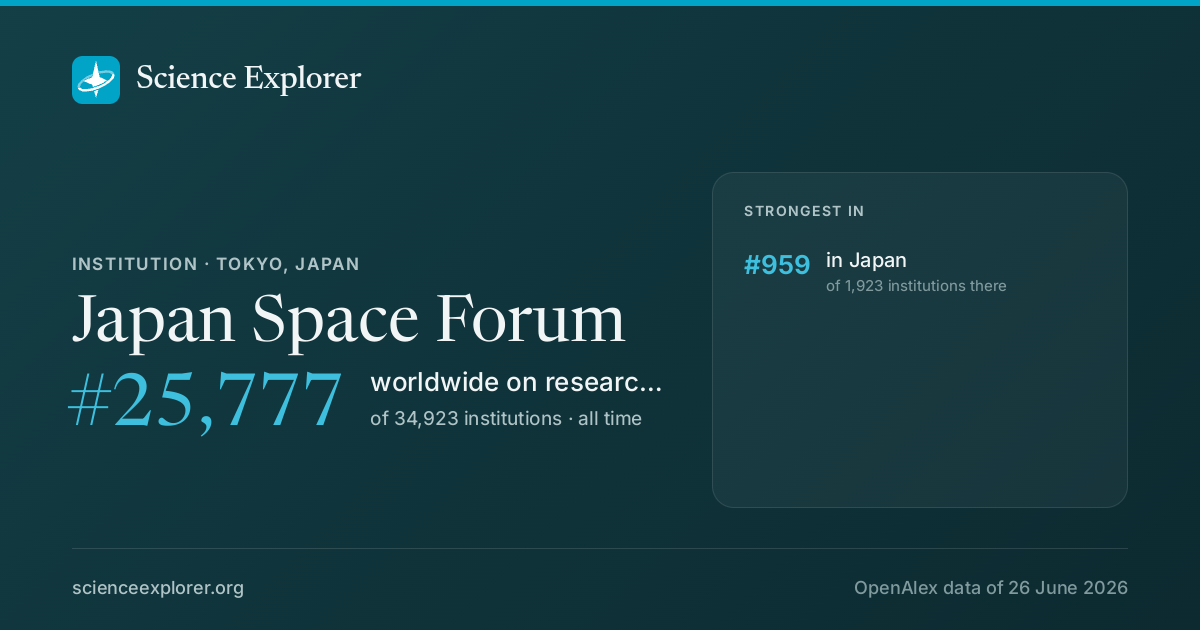
- #25,777 of 34,923
- Rank in Japan
- #959 of 1,923
- Research works
- 200 ▲ 33% vs 2018-21
- Citations
- 1.9k 9.7 per fractional work
- Top-10% rate
- 6.4% all institutions 10.0%
- vs its own fields
- 0.84× 1.00× is exactly expected
- Open access
- 44% world 40%
- International
- 21% world 18%
Which fields of science does Japan Space Forum work in?
In 2022-now, 68% of research at Japan Space Forum is in Physical Sciences, 13% in Life Sciences. Its largest fields are Engineering (34%), Medicine (11%), Environmental Science (8%). It does 1.6× the world's share of Physical Sciences.
Each ring splits the one inside it: the four domains of science, their fields, their subfields. Size is fractional works in 2022-now. Every slice is a page; the interactive view zooms down to single topics and colours each by how much more of it this institution does than the world.
Its 4 domains and 21 fields, with their numbers
- Physical Sciences2867.6%
- Engineering1433.8%
- Environmental Science38.2%
- Physics and Astronomy38.2%
- Materials Science36.9%
- Computer Science25.1%
- Earth and Planetary Sciences12.4%
- Chemistry12.4%
- Energy00.4%
- Chemical Engineering00.2%
- Life Sciences613.4%
- Health Sciences511.2%
- Medicine410.7%
- Health Professions00.5%
- Social Sciences37.7%
Field profile
Location quotient across every field it publishes in: outside the ring is more than an institution of this size would be expected to publish, inside it is less.
Rings at 0.5×, 1× and 2×. Widest outward: Physics and Astronomy, 3.7×. Every wedge is a field page.
All 21 fields, with their numbers
- Physics and Astronomy3.69×3 works
- Engineering2.26×14 works
- Materials Science1.98×3 works
- Environmental Science1.66×3 works
- Earth and Planetary Sciences1.52×1 works
- Chemistry1.51×1 works
- Biochemistry, Genetics and Molecular Biology1.29×3 works
- Agricultural and Biological Sciences1.16×2 works
- Immunology and Microbiology0.73×0 works
- Computer Science0.65×2 works
- Chemical Engineering0.57×0 works
- Medicine0.56×4 works
- Psychology0.48×1 works
- Energy0.42×0 works
- Social Sciences0.35×2 works
- Pharmacology, Toxicology and Pharmaceutics0.28×0 works
- Arts and Humanities0.28×0 works
- Business, Management and Accounting0.25×0 works
- Health Professions0.20×0 works
- Neuroscience0.14×0 works
- Economics, Econometrics and Finance0.08×0 works
- Physics and Astronomy 3.7×
- Engineering 2.3×
- Materials Science 2.0×
- Environmental Science 1.7×
- Earth and Planetary Sciences 1.5×
- Chemistry 1.5×
- Biochemistry, Genetics and Molecular Biology 1.3×
- Agricultural and Biological Sciences 1.2×
- Immunology and Microbiology 0.7×
- Computer Science 0.7×
- Chemical Engineering 0.6×
- Medicine 0.6×
- Psychology 0.5×
- Energy 0.4×
- Social Sciences 0.3×
- Pharmacology, Toxicology and Pharmaceutics 0.3×
- Arts and Humanities 0.3×
- Business, Management and Accounting 0.2×
- Health Professions 0.2×
- Neuroscience 0.1×
- Economics, Econometrics and Finance 0.1×
Who are the top researchers at Japan Space Forum?
Ranked on the quality score, Yoji Shibato, 徹 嶋津 and Sachiko Aizawa lead among researchers whose main affiliation is Japan Space Forum.
- 1
Yoji Shibato
 Japan · #4,796,139 worldwide
8 citations · 19 works
- 2
徹 嶋津
Japan · #4,830,248 worldwide
0 citations · 16 works
- 3
Sachiko Aizawa
Japan · #5,029,619 worldwide
164 citations · 20 works
- 4
Takehiko Sone
Japan · #5,219,811 worldwide
124 citations · 32 works
- 5
Keiji Fukui
Japan · #5,788,193 worldwide
575 citations · 48 works
- 6
Shigeki Kamigaichi
Japan · #5,953,629 worldwide
311 citations · 43 works
- 7
Taro Shimaoka
Japan · #6,061,107 worldwide
210 citations · 47 works
- 8
Toru Shimazu
Japan · #6,552,525 worldwide
1.9k citations · 218 works
Which keywords describe research at Japan Space Forum?
By fractional works in 2022-now, weighted toward what it does more of than the world: Remote Sensing, Immune System, Thermal Analysis, Climate Change, CubeSat, Environmental Attitudes, Pro-environmental Behavior and small satellite.
- Pro-environmental Behavior
- Environmental Attitudes
- Thermal Analysis
- Immune System
- Deep Learning
- Climate Change
- Remote Sensing
- Machine Learning
- CubeSat
- Nanocomposites
- small satellite
Size is fractional works in 2022-now in the topics tagged with each word; colour is the word's share of this institution's work against its share of the world's. The 11 words are chosen for being large and distinctive. Each links to the topic it comes from most.
All 11 words, with their numbers
- Climate Change2▲ 1.91×19 topics
- Deep Learning2▲ 1.27×11 topics
- Remote Sensing2▲ 3.4×10 topics
- Immune System1▲ 11×2 topics
- Machine Learning1▼ 0.80×12 topics
- Thermal Analysis1▲ 20×2 topics
- CubeSat1▲ 131×1 topic
- Environmental Attitudes1▲ 31×1 topic
- Nanocomposites1▲ 3.2×7 topics
- Pro-environmental Behavior1▲ 48×1 topic
- small satellite1▲ 131×1 topic
Which research topics does Japan Space Forum publish most on?
By volume in 2022-now: Environmental Education and Sustainability, Spaceflight effects on biology, Spacecraft Design and Technology and Millimeter-Wave Propagation and Modeling.
Area is fractional works; colour is the subfield each topic belongs to.
- 1 Environmental Education and Sustainability Management, Monitoring, Policy and Law 1 works
- 2 Spaceflight effects on biology Physiology 1 works
- 3 Spacecraft Design and Technology Aerospace Engineering 1 works
- 4 Millimeter-Wave Propagation and Modeling Electrical and Electronic Engineering 1 works
- 5 UAV Applications and Optimization Aerospace Engineering 1 works
- 6 Ubiquitin and proteasome pathways Molecular Biology 0 works
- 7 Bone Tissue Engineering Materials Biomedical Engineering 0 works
- 8 Space Exploration and Technology Aerospace Engineering 0 works
- 9 Radio Wave Propagation Studies Aerospace Engineering 0 works
- 10 Systems Engineering Methodologies and Applications Control and Systems Engineering 0 works
How open and international is its research?
Against the world's own shares: the tick on each track. Both are shares of its output, so they sit on one scale and can be read against each other as well as against the world.
World: 40% of research is openly available.
World: 18% is written across borders.
How has Japan Space Forum's research output changed?
Output in 2022-2025 was 33% higher than in 2018-2021.
The same series as a ribbon: one cell per year, darker for more. The line above answers how much; this answers when.
Its share of all research
Growing output can still be a shrinking share: all of science grows. This is Japan Space Forum as a percentage of every work published that year, 0.00013% in 2024.
Fractional works of Japan Space Forum over all fractional works that year. How the balance of science has shifted.
Other research institutions in Tokyo
- The University of Tokyo
- Tokyo Institute of Technology
- Keio University
- Waseda University
- Tokyo University of Science
- Nihon University
- Hitachi (Japan)
- NTT (Japan)


Share Japan Space Forum's ranking
Badges for a website1Each links back here and updates with every snapshot

Research measures only: rankings here say nothing about teaching, admissions or student experience. Comparable institutions and collaboration partners have tabs of their own, above.
Discussion
Ask a question or share a note about Japan Space Forum. Keep it to the research: no personal attacks, advertising or links. Any reader can report a post, which collapses it for everyone until it is opened.