Science Explorer Back to mapMap
Discussion
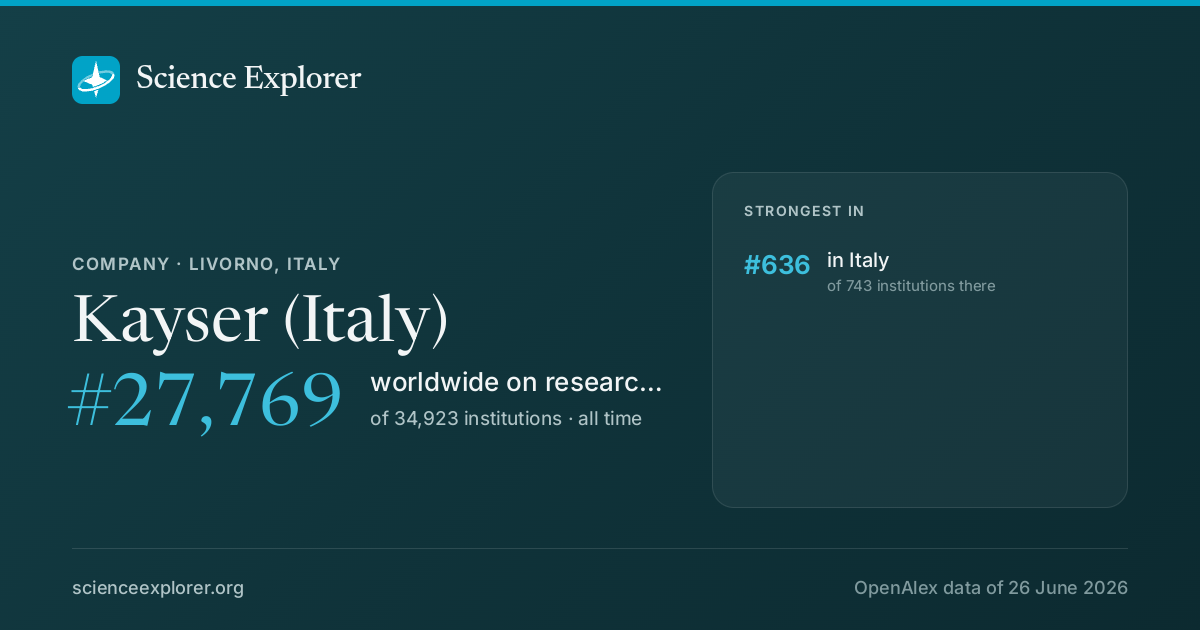
Company · Livorno · Italy

Kayser (Italy)

World rank, all time
#27,769
of 34,923
Rank in Italy
#636
of 743
Research works
171
◆ 1% vs 2018-21
Citations
1k
5.9 per fractional work
Top-10% rate
1.6%
all institutions 10.0%
vs its own fields
0.82×
1.00× is exactly expected
Open access
53%
world 40%
International
74%
world 18%

Which fields of science does Kayser (Italy) work in?

In 2022-now, 42% of research at Kayser (Italy) is in Health Sciences, 25% in Social Sciences. Its largest fields are Medicine (38%), Social Sciences (11%), Engineering (11%). It does 1.6× the world's share of Health Sciences.

Health Sciences: 19 fractional works · 42.3% of its workMedicine: 17 fractional works · 37.6% of its workPulmonary and Respiratory Medicine: 4 fractional works · 9.2% of its workPhysiology: 2 fractional works · 5.1% of its workSurgery: 2 fractional works · 3.7% of its workRadiology, Nuclear Medicine and Imaging: 1 fractional works · 2.1% of its workEndocrinology, Diabetes and Metabolism: 1 fractional works · 1.5% of its workOncology: 1 fractional works · 1.5% of its workPathology and Forensic Medicine: 1 fractional works · 1.5% of its workNeurology: 0 fractional works · 1.1% of its workPsychiatry and Mental health: 0 fractional works · 1.1% of its workCardiology and Cardiovascular Medicine: 0 fractional works · 1.0% of its workReproductive Medicine: 0 fractional works · 1.0% of its workPublic Health, Environmental and Occupational Health: 0 fractional works · 1.0% of its workInfectious Diseases: 0 fractional works · 0.9% of its workObstetrics and Gynecology: 0 fractional works · 0.8% of its workRheumatology: 0 fractional works · 0.8% of its workGastroenterology: 0 fractional works · 0.7% of its workHematology: 0 fractional works · 0.7% of its workPediatrics, Perinatology and Child Health: 0 fractional works · 0.7% of its workEpidemiology: 0 fractional works · 0.5% of its workOphthalmology: 0 fractional works · 0.4% of its workUrology: 0 fractional works · 0.4% of its workPharmacology: 0 fractional works · 0.3% of its workRehabilitation: 0 fractional works · 0.3% of its workDermatology: 0 fractional works · 0.2% of its workNephrology: 0 fractional works · 0.2% of its workOrthopedics and Sports Medicine: 0 fractional works · 0.2% of its workSmaller subfields together: 0 fractional works · 0.4% of its workHealth Professions: 1 fractional works · 3.1% of its workPharmacy: 0 fractional works · 1.0% of its workEmergency Medical Services: 0 fractional works · 0.5% of its workGeneral Health Professions: 0 fractional works · 0.5% of its workOccupational Therapy: 0 fractional works · 0.4% of its workHealth Information Management: 0 fractional works · 0.2% of its workRadiological and Ultrasound Technology: 0 fractional works · 0.2% of its workSmaller subfields together: 0 fractional works · 0.2% of its workDentistry: 0 fractional works · 1.0% of its workGeneral Dentistry: 0 fractional works · 0.4% of its workOral Surgery: 0 fractional works · 0.2% of its workOrthodontics: 0 fractional works · 0.2% of its workSmaller subfields together: 0 fractional works · 0.0% of its workNursing: 0 fractional works · 0.7% of its workNutrition and Dietetics: 0 fractional works · 0.7% of its workSocial Sciences: 11 fractional works · 25.4% of its workSocial Sciences: 5 fractional works · 11.5% of its workEducation: 2 fractional works · 4.9% of its workSociology and Political Science: 1 fractional works · 3.3% of its workPolitical Science and International Relations: 1 fractional works · 1.6% of its workGender Studies: 0 fractional works · 0.7% of its workUrban Studies: 0 fractional works · 0.7% of its workSmaller subfields together: 0 fractional works · 0.2% of its workPsychology: 3 fractional works · 6.0% of its workSocial Psychology: 1 fractional works · 2.1% of its workClinical Psychology: 1 fractional works · 2.0% of its workExperimental and Cognitive Psychology: 0 fractional works · 0.8% of its workApplied Psychology: 0 fractional works · 0.7% of its workDevelopmental and Educational Psychology: 0 fractional works · 0.4% of its workArts and Humanities: 2 fractional works · 4.5% of its workHistory: 1 fractional works · 1.5% of its workLanguage and Linguistics: 0 fractional works · 0.8% of its workLiterature and Literary Theory: 0 fractional works · 0.8% of its workMusic: 0 fractional works · 0.7% of its workPhilosophy: 0 fractional works · 0.4% of its workSmaller subfields together: 0 fractional works · 0.1% of its workEconomics, Econometrics and Finance: 1 fractional works · 2.1% of its workEconomics and Econometrics: 1 fractional works · 2.1% of its workBusiness, Management and Accounting: 0 fractional works · 1.0% of its workManagement Information Systems: 0 fractional works · 0.4% of its workStrategy and Management: 0 fractional works · 0.4% of its workSmaller subfields together: 0 fractional works · 0.2% of its workDecision Sciences: 0 fractional works · 0.4% of its workManagement Science and Operations Research: 0 fractional works · 0.4% of its workPhysical Sciences: 9 fractional works · 20.6% of its workEngineering: 5 fractional works · 11.0% of its workElectrical and Electronic Engineering: 1 fractional works · 2.6% of its workAerospace Engineering: 1 fractional works · 2.1% of its workBiomedical Engineering: 1 fractional works · 2.1% of its workIndustrial and Manufacturing Engineering: 0 fractional works · 1.0% of its workMechanical Engineering: 0 fractional works · 0.9% of its workControl and Systems Engineering: 0 fractional works · 0.6% of its workSafety, Risk, Reliability and Quality: 0 fractional works · 0.4% of its workMechanics of Materials: 0 fractional works · 0.4% of its workOcean Engineering: 0 fractional works · 0.4% of its workComputational Mechanics: 0 fractional works · 0.3% of its workSmaller subfields together: 0 fractional works · 0.2% of its workComputer Science: 2 fractional works · 4.1% of its workArtificial Intelligence: 1 fractional works · 1.5% of its workInformation Systems: 1 fractional works · 1.3% of its workComputer Networks and Communications: 0 fractional works · 1.0% of its workHardware and Architecture: 0 fractional works · 0.4% of its workPhysics and Astronomy: 1 fractional works · 2.6% of its workAstronomy and Astrophysics: 0 fractional works · 1.0% of its workNuclear and High Energy Physics: 0 fractional works · 0.4% of its workRadiation: 0 fractional works · 0.4% of its workAtomic and Molecular Physics, and Optics: 0 fractional works · 0.4% of its workInstrumentation: 0 fractional works · 0.3% of its workMaterials Science: 1 fractional works · 1.5% of its workMaterials Chemistry: 1 fractional works · 1.2% of its workCeramics and Composites: 0 fractional works · 0.4% of its workEnvironmental Science: 1 fractional works · 1.2% of its workEnvironmental Engineering: 0 fractional works · 0.7% of its workWater Science and Technology: 0 fractional works · 0.6% of its workMathematics: 0 fractional works · 0.2% of its workModeling and Simulation: 0 fractional works · 0.2% of its workLife Sciences: 5 fractional works · 11.7% of its workBiochemistry, Genetics and Molecular Biology: 3 fractional works · 5.8% of its workMolecular Biology: 1 fractional works · 3.4% of its workGenetics: 1 fractional works · 1.3% of its workCancer Research: 0 fractional works · 0.4% of its workAging: 0 fractional works · 0.3% of its workSmaller subfields together: 0 fractional works · 0.4% of its workAgricultural and Biological Sciences: 1 fractional works · 2.6% of its workPlant Science: 1 fractional works · 2.0% of its workInsect Science: 0 fractional works · 0.4% of its workEcology, Evolution, Behavior and Systematics: 0 fractional works · 0.2% of its workNeuroscience: 1 fractional works · 1.5% of its workNeurology: 0 fractional works · 0.7% of its workCellular and Molecular Neuroscience: 0 fractional works · 0.4% of its workDevelopmental Neuroscience: 0 fractional works · 0.4% of its workImmunology and Microbiology: 1 fractional works · 1.4% of its workImmunology: 0 fractional works · 0.8% of its workParasitology: 0 fractional works · 0.4% of its workSmaller subfields together: 0 fractional works · 0.2% of its workPharmacology, Toxicology and Pharmaceutics: 0 fractional works · 0.4% of its workToxicology: 0 fractional works · 0.4% of its workALL ITS WORKKayser (Italy)44fractional works, 2022-now
Life Sciences12%Physical Sciences21%Health Sciences42%Social Sciences25%

Each ring splits the one inside it: the four domains of science, their fields, their subfields. Size is fractional works in 2022-now. Every slice is a page; the interactive view zooms down to single topics and colours each by how much more of it this institution does than the world.

Its 4 domains and 21 fields, with their numbers
    1. Medicine1737.6%
    2. Health Professions13.1%
    3. Dentistry01.0%
    4. Nursing00.7%
    1. Social Sciences511.5%
    2. Psychology36.0%
    3. Arts and Humanities24.5%
    4. Economics, Econometrics and Finance12.1%
    5. Business, Management and Accounting01.0%
    6. Decision Sciences00.4%
    1. Engineering511.0%
    2. Computer Science24.1%
    3. Physics and Astronomy12.6%
    4. Materials Science11.5%
    5. Environmental Science11.2%
    6. Mathematics00.2%
    1. Biochemistry, Genetics and Molecular Biology35.8%
    2. Agricultural and Biological Sciences12.6%
    3. Neuroscience11.5%
    4. Immunology and Microbiology11.4%
    5. Pharmacology, Toxicology and Pharmaceutics00.4%
All of science, and how each field's share has moved since 1950: the Science domain explorer

Field profile

Location quotient across every field it publishes in: outside the ring is more than an institution of this size would be expected to publish, inside it is less.

Agricultural and Biological Sciences: 0.55× its world share, 1 worksAgricultural and Bio…Biochemistry, Genetics and Molecular Biology: 1.09× its world share, 3 worksBiochemistry, Geneti…Immunology and Microbiology: 1.35× its world share, 1 worksImmunology and Micro…Neuroscience: 0.93× its world share, 1 worksNeurosciencePharmacology, Toxicology and Pharmaceutics: 1.07× its world share, 0 worksPharmacology, Toxico…Computer Science: 0.52× its world share, 2 worksComputer ScienceEngineering: 0.73× its world share, 5 worksEngineeringEnvironmental Science: 0.25× its world share, 0 worksEnvironmental ScienceMaterials Science: 0.44× its world share, 1 worksMaterials ScienceMathematics: 0.21× its world share, 0 worksMathematicsPhysics and Astronomy: 1.16× its world share, 1 worksPhysics and AstronomyDentistry: 1.95× its world share, 0 worksDentistryHealth Professions: 1.18× its world share, 1 worksHealth ProfessionsMedicine: 1.95× its world share, 17 worksMedicineNursing: 1.42× its world share, 0 worksNursingArts and Humanities: 1.55× its world share, 2 worksArts and HumanitiesBusiness, Management and Accounting: 0.29× its world share, 0 worksBusiness, Management…Decision Sciences: 0.39× its world share, 0 worksDecision SciencesEconomics, Econometrics and Finance: 0.97× its world share, 1 worksEconomics, Econometr…Psychology: 1.96× its world share, 3 worksPsychologySocial Sciences: 0.91× its world share, 5 worksSocial Sciences1×world share
more than its size predictsabout as predictedless

Rings at 0.5×, 1× and 2×. Widest outward: Psychology, 2.0×. Every wedge is a field page.

All 21 fields, with their numbers
  1. Psychology1.96×3 works
  2. Dentistry1.95×0 works
  3. Medicine1.95×17 works
  4. Arts and Humanities1.55×2 works
  5. Nursing1.42×0 works
  6. Immunology and Microbiology1.35×1 works
  7. Health Professions1.18×1 works
  8. Physics and Astronomy1.16×1 works
  9. Biochemistry, Genetics and Molecular Biology1.09×3 works
  10. Pharmacology, Toxicology and Pharmaceutics1.07×0 works
  11. Economics, Econometrics and Finance0.97×1 works
  12. Neuroscience0.93×1 works
  13. Social Sciences0.91×5 works
  14. Engineering0.73×5 works
  15. Agricultural and Biological Sciences0.55×1 works
  16. Computer Science0.52×2 works
  17. Materials Science0.44×1 works
  18. Decision Sciences0.39×0 works
  19. Business, Management and Accounting0.29×0 works
  20. Environmental Science0.25×0 works
  21. Mathematics0.21×0 works

Who are the top researchers at Kayser (Italy)?

Ranked on the quality score, Michele Balsamo, Valfredo Zolesi and Gianluca Neri lead among researchers whose main affiliation is Kayser (Italy).

  1. 1 Michele Balsamo Italy · #2,038,134 worldwide 1.4k citations · 66 works
  2. 2 Valfredo Zolesi Italy · #2,365,125 worldwide 598 citations · 36 works
  3. 3 Gianluca Neri Italy · #3,735,322 worldwide 107 citations · 25 works
  4. 4 Marco Vukich Italy · #4,652,201 worldwide 158 citations · 15 works
  5. 5 Elisa Carrubba Italy · #5,584,191 worldwide 135 citations · 23 works
All ranked researchers at Kayser (Italy)

What are the most cited papers from Kayser (Italy)?

The most cited paper from Kayser (Italy) is "Space station biomining experiment demonstrates rare earth element extraction in microgravity and Mars gravity" (Charles S. Cockell et al., 2020), with 156 citations. Next come "Left Temporal Lobe Dysfunction in Schizophrenia" (99) and "Level of Anxiety, Depression, Self‐Esteem, Social Anxiety, and Quality of Life among the Women with Polycystic Ovary Syndrome" (88).

Most cited papers
#PaperReleasedCitations
1 Space station biomining experiment demonstrates rare earth element extraction in microgravity and Mars gravity Charles S. Cockell et al. · Nature Communications Open access 10 Nov 2020 156
2 Left Temporal Lobe Dysfunction in Schizophrenia Gerard E. Bruder, Jürgen Kayser, Craig E. Tenke et al. · Archives of General Psychiatry Mar 1999 99
3 Level of Anxiety, Depression, Self‐Esteem, Social Anxiety, and Quality of Life among the Women with Polycystic Ovary Syndrome Gökhan Açmaz, Evrim Albayrak, Banu Açmaz et al. · The Scientific World JOURNAL Open access 2013 88
4 Social support and symptoms of postpartum depression among new mothers in Eastern Turkey Emel Ege, Sermin Timur, Handan Zincir et al. · Journal of obstetrics and gynaecology research Aug 2008 80
5 Impulse Noise Removal From Digital Images by a Detail-Preserving Filter Based on Type-2 Fuzzy Logic M. Tülin Yıldırım, Alper Baştürk, Mehmet Emin Yüksel · IEEE Transactions on Fuzzy Systems Aug 2008 74
All 60 most cited papers, with filters and sorting

Which keywords describe research at Kayser (Italy)?

By fractional works in 2022-now, weighted toward what it does more of than the world: Diagnosis, Management, Neurological Effects, Immune System, Microgravity, Spaceflight, Global Burden and Anxiety.

▲ more of its work than of the world's◆ about the world's share▼ less than the world's

Size is fractional works in 2022-now in the topics tagged with each word; colour is the word's share of this institution's work against its share of the world's. The 25 words are chosen for being large and distinctive. Each links to the topic it comes from most.

All 25 words, with their numbers
  1. Epidemiology3▲ 1.49×20 topics
  2. Diagnosis2▲ 6.1×10 topics
  3. Management2▲ 5.6×8 topics
  4. Treatment2▲ 3.2×11 topics
  5. Depression2▲ 4.1×7 topics
  6. Global Burden2▲ 6.5×6 topics
  7. Immune System2▲ 15×2 topics
  8. Innovation2▲ 3.4×3 topics
  9. Neurological Effects2▲ 55×2 topics
  10. Microgravity2▲ 186×1 topic
  11. Spaceflight2▲ 186×1 topic
  12. Anxiety1▲ 6.5×5 topics
  13. Big Data1▲ 2.6×5 topics
  14. Educational Technology1▲ 2.1×2 topics
  15. Machine Learning1▼ 0.75×5 topics
  16. COPD1▲ 34×1 topic
  17. COVID-191▲ 1.79×5 topics
  18. E-Learning1▲ 2.4×1 topic
  19. Economic Crisis1▲ 20×1 topic
  20. Google Classroom1▲ 22×1 topic
  21. Inflammation1◆ 1.07×10 topics
  22. Obesity1▲ 3.0×6 topics
  23. Social Theory1▲ 81×1 topic
  24. Sustainability1◆ 0.93×4 topics
  25. spirometry1▲ 34×1 topic

Which research topics does Kayser (Italy) publish most on?

By volume in 2022-now: Spaceflight effects on biology, Chronic Obstructive Pulmonary Disease (COPD) Research, Technology-Enhanced Education Studies and Diverse Academic Research Analysis.

  1. 1 Spaceflight effects on biology Physiology 2 works
  2. 2 Chronic Obstructive Pulmonary Disease (COPD) Research Pulmonary and Respiratory Medicine 1 works
  3. 3 Technology-Enhanced Education Studies Education 1 works
  4. 4 Diverse Academic Research Analysis Sociology and Political Science 1 works
  5. 5 COVID-19 and Mental Health Clinical Psychology 1 works
  6. 6 Cardiac Imaging and Diagnostics Radiology, Nuclear Medicine and Imaging 0 works
  7. 7 Deception detection and forensic psychology Social Psychology 0 works
  8. 8 Neonatal Respiratory Health Research Pulmonary and Respiratory Medicine 0 works
  9. 9 Sentiment Analysis and Opinion Mining Artificial Intelligence 0 works
  10. 10 Economic and Technological Innovation Economics and Econometrics 0 works

How open and international is its research?

Against the world's own shares: the tick on each track. Both are shares of its output, so they sit on one scale and can be read against each other as well as against the world.

openly available53.3%not open46.7%

World: 40% of research is openly available.

with international co-authors73.5%domestic only26.5%

World: 18% is written across borders.

How has Kayser (Italy)'s research output changed?

Output in 2022-2025 was 1% higher than in 2018-2021.

still counting1990200020102020
grewheldshrank

The same series as a ribbon: one cell per year, darker for more. The line above answers how much; this answers when.

Its share of all research

Growing output can still be a shrinking share: all of science grows. This is Kayser (Italy) as a percentage of every work published that year, 0.00025% in 2024.

still counting0.00020%0.00040%Kayser (Italy)0.00010% in 20251990200020102020

Fractional works of Kayser (Italy) over all fractional works that year. How the balance of science has shifted.

Other research institutions in Livorno

All research institutions in Livorno

Share Kayser (Italy)'s ranking

Kayser (Italy) on Science Explorer

A card with Kayser (Italy)'s standing and the fields it leads in, for a post or a slide. A link to this page previews as the same card.

Download the card

1200 × 630 PNG, sized for social posts, drawn from the latest snapshot.

Badges for a website1Each links back here and updates with every snapshot

Research measures only: rankings here say nothing about teaching, admissions or student experience. Comparable institutions and collaboration partners have tabs of their own, above.

Discussion

Ask a question or share a note about Kayser (Italy). Keep it to the research: no personal attacks, advertising or links. Any reader can report a post, which collapses it for everyone until it is opened.