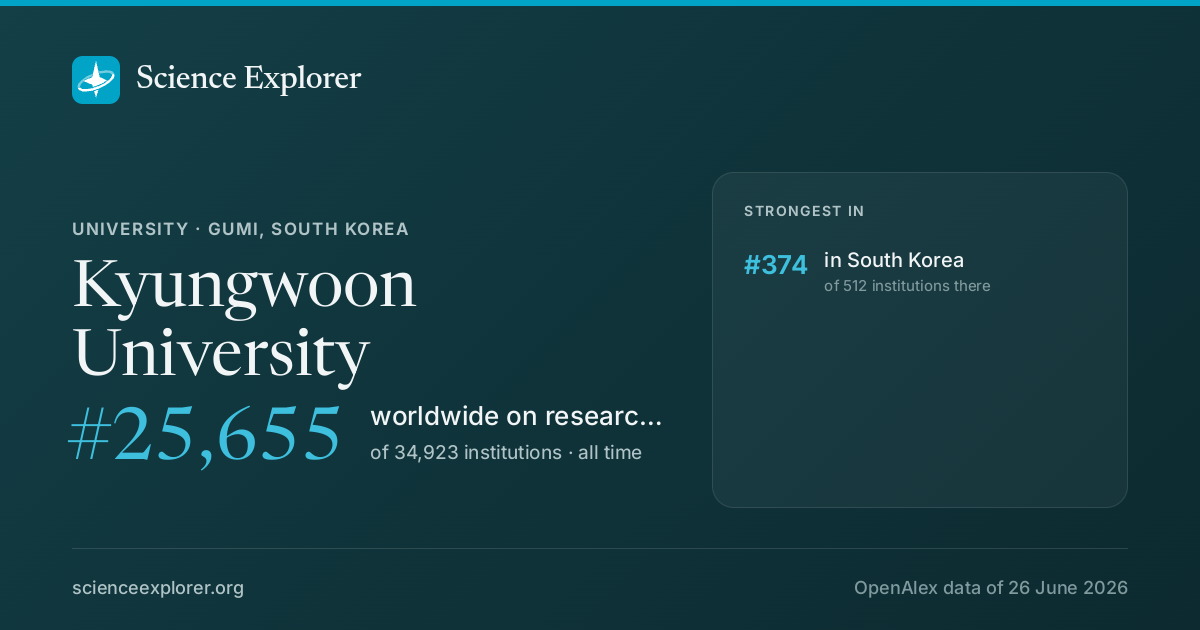
- World rank, all time
- #25,655 of 34,923
- Rank in South Korea
- #374 of 512
- Research works
- 245 ▼ 4% vs 2018-21
- Citations
- 2.1k 8.6 per fractional work
- Top-10% rate
- 6.2% all institutions 10.0%
- vs its own fields
- 0.80× 1.00× is exactly expected
- Open access
- 68% world 40%
- International
- 9% world 18%
Which fields of science does Kyungwoon University work in?
In 2022-now, 51% of research at Kyungwoon University is in Health Sciences, 22% in Physical Sciences. Its largest fields are Medicine (38%), Engineering (11%), Social Sciences (10%). It does 2.0× the world's share of Health Sciences.
Each ring splits the one inside it: the four domains of science, their fields, their subfields. Size is fractional works in 2022-now. Every slice is a page; the interactive view zooms down to single topics and colours each by how much more of it this institution does than the world.
Its 4 domains and 22 fields, with their numbers
- Health Sciences2551.4%
- Medicine1838.0%
- Health Professions47.6%
- Nursing12.8%
- Dentistry12.4%
- Veterinary00.7%
- Physical Sciences1121.9%
- Engineering510.7%
- Computer Science37.1%
- Earth and Planetary Sciences11.4%
- Environmental Science00.9%
- Materials Science00.7%
- Physics and Astronomy00.5%
- Chemical Engineering00.4%
- Chemistry00.2%
- Social Sciences919.3%
- Life Sciences47.4%
Field profile
Location quotient across every field it publishes in: outside the ring is more than an institution of this size would be expected to publish, inside it is less.
Rings at 0.5×, 1× and 2×. Widest outward: Nursing, 5.8×. Every wedge is a field page.
All 22 fields, with their numbers
- Nursing5.75×1 works
- Veterinary5.04×0 works
- Dentistry4.86×1 works
- Health Professions2.89×4 works
- Medicine1.98×18 works
- Psychology1.68×2 works
- Neuroscience1.16×1 works
- Chemical Engineering1.05×0 works
- Business, Management and Accounting0.99×2 works
- Computer Science0.92×4 works
- Earth and Planetary Sciences0.87×1 works
- Social Sciences0.79×5 works
- Biochemistry, Genetics and Molecular Biology0.78×2 works
- Engineering0.71×5 works
- Decision Sciences0.67×0 works
- Immunology and Microbiology0.34×0 works
- Agricultural and Biological Sciences0.22×0 works
- Materials Science0.21×0 works
- Physics and Astronomy0.21×0 works
- Environmental Science0.18×0 works
- Economics, Econometrics and Finance0.16×0 works
- Chemistry0.15×0 works
- Nursing 5.8×
- Veterinary 5.0×
- Dentistry 4.9×
- Health Professions 2.9×
- Medicine 2.0×
- Psychology 1.7×
- Neuroscience 1.2×
- Chemical Engineering 1.1×
- Business, Management and Accounting 1.0×
- Computer Science 0.9×
- Earth and Planetary Sciences 0.9×
- Social Sciences 0.8×
- Biochemistry, Genetics and Molecular Biology 0.8×
- Engineering 0.7×
- Decision Sciences 0.7×
- Immunology and Microbiology 0.3×
- Agricultural and Biological Sciences 0.2×
- Materials Science 0.2×
- Physics and Astronomy 0.2×
- Environmental Science 0.2×
- Economics, Econometrics and Finance 0.2×
- Chemistry 0.1×
Who are the top researchers at Kyungwoon University?
Ranked on the quality score, Min-Bong Kang, Myung-Chun Ryoo and Ho-Weon Kwak lead among researchers whose main affiliation is Kyungwoon University.
- 1
Min-Bong Kang
 South Korea · #3,941,443 worldwide
22 citations · 19 works
- 2
Myung-Chun Ryoo
South Korea · #4,945,460 worldwide
6 citations · 16 works
- 3
Ho-Weon Kwak
South Korea · #4,953,582 worldwide
17 citations · 15 works
- 4
Hee Joon Shin
South Korea · #5,128,734 worldwide
59 citations · 19 works
- 5
Cheolkyu Cho
South Korea · #5,305,111 worldwide
2 citations · 22 works
- 6
Hyung-Soo Shin
South Korea · #5,593,103 worldwide
76 citations · 25 works
- 7
Byoung-Do Seo
South Korea · #5,640,383 worldwide
300 citations · 27 works
- 8
Seon-Jeong Moon
South Korea · #5,676,465 worldwide
71 citations · 29 works
- 9
Kyunghwan Ka
South Korea · #6,304,782 worldwide
36 citations · 46 works
- 10
Jongdae Yoon
South Korea · #6,316,947 worldwide
115 citations · 44 works
Which keywords describe research at Kyungwoon University?
By fractional works in 2022-now, weighted toward what it does more of than the world: Epidemiology, Global Burden, Self-Efficacy, Job Satisfaction, Low Back Pain, Chronic Pain, Psychological Factors and Risk Factors.
- Thyroid Nodules
- Differentiated Thyroid Cancer
- Big Data
- Burnout
- Nursing Professionalism
- Injury Prevention
- Clinical Competence
- Anxiety
- Text Mining
- Measurement Properties
- Stress Management
- Prevention
- Psychological Factors
- Clinical Trials
- Low Back Pain
- Machine Learning
- Risk Factors
- Global Burden
- Epidemiology
- Self-Efficacy
- Job Satisfaction
- Quality of Life
- Chronic Pain
- Inflammation
- Depression
- Social Media
- Disability
- Social Support
- Mental Health
- Nursing Students
- Gait Analysis
- Management Guidelines
- Adherence
- Mobile Health
- Data Analysis
- Integrative Medicine
- Traditional Chinese Medicine
Size is fractional works in 2022-now in the topics tagged with each word; colour is the word's share of this institution's work against its share of the world's. The 37 words are chosen for being large and distinctive. Each links to the topic it comes from most.
All 37 words, with their numbers
- Epidemiology5▲ 2.7×15 topics
- Global Burden3▲ 10.0×4 topics
- Self-Efficacy3▲ 21×4 topics
- Risk Factors2▲ 4.3×6 topics
- Job Satisfaction2▲ 9.8×5 topics
- Machine Learning2▲ 1.30×5 topics
- Quality of Life2▲ 2.9×5 topics
- Low Back Pain2▲ 24×2 topics
- Chronic Pain2▲ 17×2 topics
- Clinical Trials2▲ 5.5×2 topics
- Inflammation2▲ 1.78×13 topics
- Psychological Factors2▲ 18×3 topics
- Depression2▲ 4.1×7 topics
- Prevention2▲ 8.4×3 topics
- Social Media2▲ 2.5×5 topics
- Stress Management2▲ 33×2 topics
- Disability2▲ 30×1 topic
- Measurement Properties2▲ 44×1 topic
- Social Support2▲ 5.9×4 topics
- Text Mining2▲ 24×3 topics
- Mental Health2▲ 2.2×8 topics
- Anxiety1▲ 5.9×4 topics
- Nursing Students1▲ 65×2 topics
- Clinical Competence1▲ 168×1 topic
- Gait Analysis1▲ 26×3 topics
- Injury Prevention1▲ 20×3 topics
- Management Guidelines1▲ 44×2 topics
- Nursing Professionalism1▲ 168×1 topic
- Adherence1▲ 18×2 topics
- Burnout1▲ 25×4 topics
- Mobile Health1▲ 16×2 topics
- Big Data1▲ 2.1×1 topic
- Data Analysis1▲ 7.9×1 topic
- Differentiated Thyroid Cancer1▲ 52×1 topic
- Integrative Medicine1▲ 36×2 topics
- Thyroid Nodules1▲ 52×1 topic
- Traditional Chinese Medicine1▲ 17×2 topics
Which research topics does Kyungwoon University publish most on?
By volume in 2022-now: Musculoskeletal pain and rehabilitation, Healthcare Education and Workforce Issues, Technology and Data Analysis and Thyroid Cancer Diagnosis and Treatment.
Area is fractional works; colour is the subfield each topic belongs to.
- 1 Musculoskeletal pain and rehabilitation Pharmacology 2 works
- 2 Healthcare Education and Workforce Issues Leadership and Management 1 works
- 3 Technology and Data Analysis Information Systems 1 works
- 4 Thyroid Cancer Diagnosis and Treatment Endocrinology, Diabetes and Metabolism 1 works
- 5 Sports injuries and prevention Orthopedics and Sports Medicine 1 works
- 6 Digital Mental Health Interventions Applied Psychology 1 works
- 7 Health and Wellbeing Research General Health Professions 1 works
- 8 Optical Imaging and Spectroscopy Techniques Radiology, Nuclear Medicine and Imaging 1 works
- 9 Dental Health and Care Utilization Periodontics 1 works
- 10 Balance, Gait, and Falls Prevention Physical Therapy, Sports Therapy and Rehabilitation 1 works
How open and international is its research?
Against the world's own shares: the tick on each track. Both are shares of its output, so they sit on one scale and can be read against each other as well as against the world.
World: 40% of research is openly available.
World: 18% is written across borders.
How has Kyungwoon University's research output changed?
Output in 2022-2025 was 4% lower than in 2018-2021.
The same series as a ribbon: one cell per year, darker for more. The line above answers how much; this answers when.
Its share of all research
Growing output can still be a shrinking share: all of science grows. This is Kyungwoon University as a percentage of every work published that year, 0.00012% in 2024.
Fractional works of Kyungwoon University over all fractional works that year. How the balance of science has shifted.
Other research institutions in Gumi
- Kumoh National Institute of Technology
- Gumi University
- Gumi Electronics & Information Technology Research Institute (South Korea)
- Jeuk (South Korea)
- U-Tel (South Korea)
- Bexel (South Korea)
- Wonbiogen (South Korea)

Share Kyungwoon University's ranking
Badges for a website1Each links back here and updates with every snapshot

Research measures only: rankings here say nothing about teaching, admissions or student experience. Comparable institutions and collaboration partners have tabs of their own, above.
Discussion
Ask a question or share a note about Kyungwoon University. Posts are plain text and can be reported.