- World rank, all time
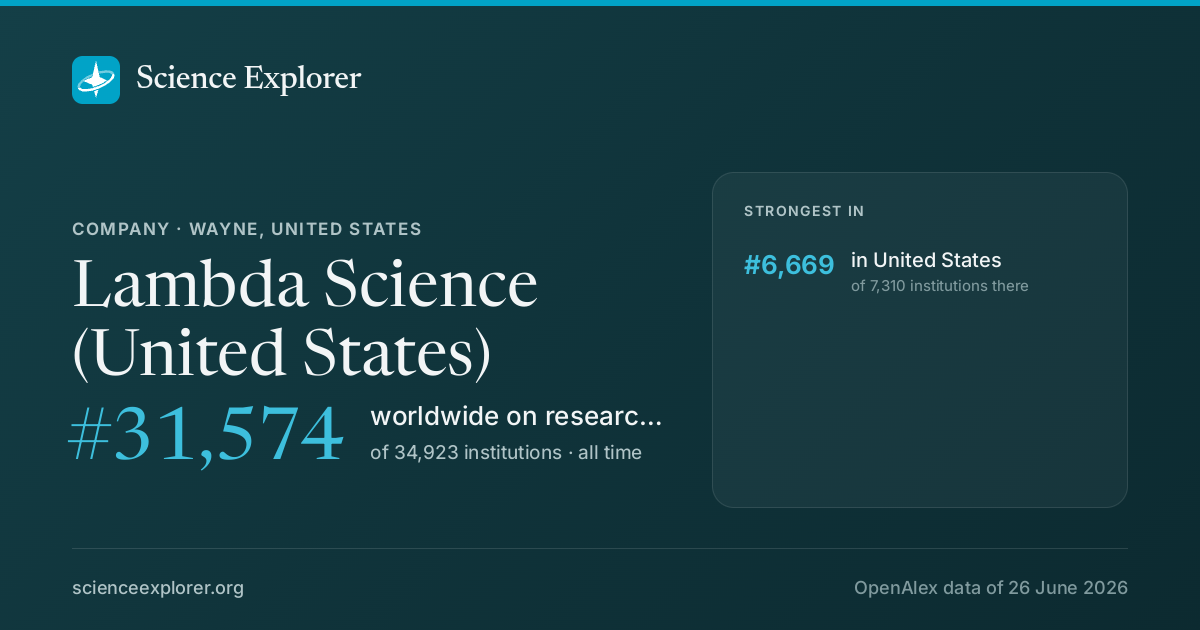
- #31,574 of 34,923
- Rank in United States
- #6,669 of 7,310
- Research works
- 154 ▲ 167% vs 2018-21
- Citations
- 2.2k 14.0 per fractional work
- Top-10% rate
- 9.7% all institutions 10.0%
- vs its own fields
- 0.85× 1.00× is exactly expected
- Open access
- 22% world 40%
- International
- 24% world 18%
Which fields of science does Lambda Science (United States) work in?
In all years, 71% of research at Lambda Science (United States) is in Physical Sciences, 17% in Social Sciences. Its largest fields are Engineering (52%), Social Sciences (8%), Medicine (7%). It does 1.7× the world's share of Physical Sciences.
Each ring splits the one inside it: the four domains of science, their fields, their subfields. Size is fractional works in all years. Every slice is a page; the interactive view zooms down to single topics and colours each by how much more of it this institution does than the world.
Its 4 domains and 25 fields, with their numbers
- Physical Sciences11071.2%
- Engineering8052.0%
- Physics and Astronomy95.6%
- Computer Science85.1%
- Chemistry53.3%
- Materials Science32.1%
- Earth and Planetary Sciences10.9%
- Environmental Science10.9%
- Energy10.5%
- Mathematics10.4%
- Chemical Engineering00.3%
- Social Sciences2617.0%
- Health Sciences159.6%
- Medicine106.8%
- Health Professions42.6%
- Nursing00.2%
- Dentistry00.1%
- Life Sciences32.2%
Field profile
Location quotient across every field it publishes in: outside the ring is more than an institution of this size would be expected to publish, inside it is less.
Rings at 0.5×, 1× and 2×. Widest outward: Physics and Astronomy, 2.9×. Every wedge is a field page.
All 14 fields, with their numbers
- Physics and Astronomy2.91×1 works
- Economics, Econometrics and Finance2.88×1 works
- Energy2.68×0 works
- Arts and Humanities2.34×1 works
- Health Professions1.87×1 works
- Computer Science1.83×2 works
- Social Sciences1.47×2 works
- Dentistry1.27×0 works
- Medicine1.01×3 works
- Engineering0.90×2 works
- Chemistry0.78×0 works
- Biochemistry, Genetics and Molecular Biology0.71×0 works
- Psychology0.57×0 works
- Materials Science0.05×0 works
- Physics and Astronomy 2.9×
- Economics, Econometrics and Finance 2.9×
- Energy 2.7×
- Arts and Humanities 2.3×
- Health Professions 1.9×
- Computer Science 1.8×
- Social Sciences 1.5×
- Dentistry 1.3×
- Medicine 1.0×
- Engineering 0.9×
- Chemistry 0.8×
- Biochemistry, Genetics and Molecular Biology 0.7×
- Psychology 0.6×
- Materials Science 0.1×
Who are the top researchers at Lambda Science (United States)?
Ranked on the quality score, Peter Lokai, J.G. Teti and Wolfgang Zschocke lead among researchers whose main affiliation is Lambda Science (United States).
- 1
Peter Lokai
 United States · #4,159,381 worldwide
134 citations · 20 works
- 2
J.G. Teti
United States · #4,618,160 worldwide
133 citations · 23 works
- 3
Wolfgang Zschocke
United States · #4,806,985 worldwide
49 citations · 20 works
- 4
Hans-Juergen Kahlert
United States · #5,098,614 worldwide
77 citations · 26 works
- 5
Frank Voss
United States · #5,194,174 worldwide
78 citations · 27 works
- 6
Sergei V. Govorkov
United States · #5,203,169 worldwide
576 citations · 59 works
- 7
Igor Bragin
United States · #5,336,598 worldwide
87 citations · 32 works
- 8
Ulrich Rebhan
United States · #5,354,152 worldwide
192 citations · 38 works
- 9
D. Basting
United States · #5,740,619 worldwide
834 citations · 120 works
- 10
Heinrich Endert
United States · #5,799,899 worldwide
205 citations · 39 works
Which keywords describe research at Lambda Science (United States)?
By fractional works in all years, weighted toward what it does more of than the world: Frequency Conversion, Electric Discharge, Laser Oscillation, Femtosecond Laser, Micromachining, Raman Lasers, Crystal Growth and Solid-State Lasers.
- Nanofabrication
- Residual Stress
- Mobile Health
- Late Antiquity
- Educational Leadership
- Silicon Photonics
- Microresonators
- Biosensors
- Knowledge Management
- Attosecond Physics
- Optical Modulators
- Psychotherapy Outcome
- Nonlinear Optics
- Spectroscopic Databases
- Gas Sensing
- Optical Interconnects
- Solid-State Lasers
- Raman Lasers
- Femtosecond Laser
- Electric Discharge
- Frequency Conversion
- Laser Oscillation
- Micromachining
- Crystal Growth
- Ytterbium
- Semiconductor Lasers
- Evidence-Based Practice
- Terahertz Quantum-Cascade Lasers
- Meta-Analysis
- Therapeutic Alliance
- Molecular Dynamics
- High-Harmonic Generation
- Primary Care
- Integrated Circuits
- Microcavities
- Dimensional Metrology
- Error Compensation
- Lithium Niobate
- Photonics
- Electron Beam Lithography
Size is fractional works in all years in the topics tagged with each word; colour is the word's share of this institution's work against its share of the world's. The 40 words are chosen for being large and distinctive. Each links to the topic it comes from most.
All 40 words, with their numbers
- Frequency Conversion35▲ 229×3 topics
- Electric Discharge25▲ 458×1 topic
- Laser Oscillation25▲ 458×1 topic
- Femtosecond Laser13▲ 125×1 topic
- Micromachining13▲ 158×1 topic
- Raman Lasers10▲ 40×2 topics
- Crystal Growth9▲ 17×2 topics
- Solid-State Lasers9▲ 191×1 topic
- Ytterbium9▲ 191×1 topic
- Optical Interconnects8▲ 62×1 topic
- Semiconductor Lasers8▲ 51×1 topic
- Gas Sensing4▲ 36×2 topics
- Evidence-Based Practice4▲ 17×4 topics
- Spectroscopic Databases4▲ 49×1 topic
- Terahertz Quantum-Cascade Lasers4▲ 49×1 topic
- Nonlinear Optics4▲ 16×4 topics
- Meta-Analysis3▲ 3.9×2 topics
- Psychotherapy Outcome3▲ 47×1 topic
- Therapeutic Alliance3▲ 47×1 topic
- Optical Modulators3▲ 8.9×2 topics
- Molecular Dynamics3▲ 6.7×3 topics
- Attosecond Physics2▲ 37×1 topic
- High-Harmonic Generation2▲ 37×1 topic
- Knowledge Management2▲ 3.3×4 topics
- Primary Care2▲ 3.4×5 topics
- Biosensors2▲ 2.4×3 topics
- Integrated Circuits2▲ 5.6×3 topics
- Microresonators2▲ 8.6×2 topics
- Microcavities2▲ 6.2×1 topic
- Silicon Photonics2▲ 6.2×1 topic
- Dimensional Metrology1▲ 27×1 topic
- Educational Leadership1▲ 10×3 topics
- Error Compensation1▲ 27×1 topic
- Late Antiquity1▲ 14×2 topics
- Lithium Niobate1▲ 26×1 topic
- Mobile Health1▲ 11×2 topics
- Photonics1▲ 17×1 topic
- Residual Stress1▲ 20×2 topics
- Electron Beam Lithography1▲ 37×1 topic
- Nanofabrication1▲ 8.5×1 topic
Which research topics does Lambda Science (United States) publish most on?
By volume in 2022-now: Intestinal and Peritoneal Adhesions, Apelin-related biomedical research, Military Technology and Strategies and Healthcare Policy and Management.
Area is fractional works; colour is the subfield each topic belongs to.
- 1 Intestinal and Peritoneal Adhesions Surgery 0 works
- 2 Apelin-related biomedical research Pharmacology 0 works
- 3 Military Technology and Strategies Aerospace Engineering 0 works
- 4 Healthcare Policy and Management Economics and Econometrics 0 works
- 5 Cardiovascular Health and Risk Factors Cardiology and Cardiovascular Medicine 0 works
- 6 EFL/ESL Teaching and Learning Language and Linguistics 0 works
- 7 Educator Training and Historical Pedagogy Sociology and Political Science 0 works
- 8 Linguistic Education and Pedagogy Language and Linguistics 0 works
- 9 Health Systems, Economic Evaluations, Quality of Life Economics and Econometrics 0 works
- 10 Bariatric Surgery and Outcomes Surgery 0 works
How open and international is its research?
Against the world's own shares: the tick on each track. Both are shares of its output, so they sit on one scale and can be read against each other as well as against the world.
World: 40% of research is openly available.
World: 18% is written across borders.
How has Lambda Science (United States)'s research output changed?
Output in 2022-2025 was 167% higher than in 2018-2021.
The same series as a ribbon: one cell per year, darker for more. The line above answers how much; this answers when.
Its share of all research
Growing output can still be a shrinking share: all of science grows. This is Lambda Science (United States) as a percentage of every work published that year, 0.000039% in 2024.
Fractional works of Lambda Science (United States) over all fractional works that year. How the balance of science has shifted.
Other research institutions in Wayne
- Teleflex (United States)
- Institute of Musculoskeletal Science & Education (United States)
- Clinical and Laboratory Standards Institute
- Materials Research & Design (United States)
- Real Time Tomography (United States)
- Valley Forge Military Academy and College
- Lightning Packs (United States)
- Polaris Health Direction
Share Lambda Science (United States)'s ranking
Badges for a website1Each links back here and updates with every snapshot

Research measures only: rankings here say nothing about teaching, admissions or student experience. Comparable institutions and collaboration partners have tabs of their own, above.
Discussion
Ask a question or share a note about Lambda Science (United States). Keep it to the research: no personal attacks, advertising or links. Any reader can report a post, which collapses it for everyone until it is opened.