Science Explorer Back to mapMap
Discussion
Research facility · Plymouth · Montserrat

Montserrat Volcano Observatory

World rank, all time
#25,717
of 34,923
Rank in Montserrat
#1
of 2
Research works
192
▼ 45% vs 2018-21
Citations
3.6k
18.7 per fractional work
Top-10% rate
5.8%
all institutions 10.0%
vs its own fields
1.02×
1.00× is exactly expected
Open access
57%
world 40%
International
59%
world 18%

Which fields of science does Montserrat Volcano Observatory work in?

In 2022-now, 47% of research at Montserrat Volcano Observatory is in Physical Sciences, 28% in Social Sciences. Its largest fields are Earth and Planetary Sciences (28%), Social Sciences (18%), Medicine (14%).

Physical Sciences: 10 fractional works · 46.7% of its workEarth and Planetary Sciences: 6 fractional works · 27.9% of its workGeophysics: 5 fractional works · 24.1% of its workAtmospheric Science: 1 fractional works · 2.7% of its workGeology: 0 fractional works · 0.8% of its workGeochemistry and Petrology: 0 fractional works · 0.3% of its workEnvironmental Science: 2 fractional works · 8.4% of its workEcology: 1 fractional works · 3.3% of its workEcological Modeling: 0 fractional works · 1.5% of its workGlobal and Planetary Change: 0 fractional works · 1.3% of its workNature and Landscape Conservation: 0 fractional works · 1.1% of its workManagement, Monitoring, Policy and Law: 0 fractional works · 1.0% of its workEnvironmental Engineering: 0 fractional works · 0.2% of its workComputer Science: 1 fractional works · 3.7% of its workInformation Systems: 0 fractional works · 1.8% of its workArtificial Intelligence: 0 fractional works · 1.6% of its workComputer Science Applications: 0 fractional works · 0.4% of its workEngineering: 1 fractional works · 2.8% of its workAerospace Engineering: 0 fractional works · 1.6% of its workBiomedical Engineering: 0 fractional works · 1.2% of its workChemistry: 0 fractional works · 1.6% of its workOrganic Chemistry: 0 fractional works · 1.6% of its workMaterials Science: 0 fractional works · 1.6% of its workPolymers and Plastics: 0 fractional works · 1.6% of its workPhysics and Astronomy: 0 fractional works · 0.8% of its workAstronomy and Astrophysics: 0 fractional works · 0.7% of its workSmaller subfields together: 0 fractional works · 0.1% of its workSocial Sciences: 6 fractional works · 27.7% of its workSocial Sciences: 4 fractional works · 18.1% of its workEducation: 2 fractional works · 7.9% of its workSociology and Political Science: 1 fractional works · 6.5% of its workGeneral Social Sciences: 0 fractional works · 1.9% of its workPolitical Science and International Relations: 0 fractional works · 1.3% of its workDemography: 0 fractional works · 0.5% of its workArts and Humanities: 1 fractional works · 4.8% of its workHistory: 0 fractional works · 1.6% of its workArcheology: 0 fractional works · 0.8% of its workConservation: 0 fractional works · 0.8% of its workHistory and Philosophy of Science: 0 fractional works · 0.8% of its workClassics: 0 fractional works · 0.3% of its workLanguage and Linguistics: 0 fractional works · 0.3% of its workPhilosophy: 0 fractional works · 0.3% of its workPsychology: 1 fractional works · 3.2% of its workExperimental and Cognitive Psychology: 0 fractional works · 1.1% of its workClinical Psychology: 0 fractional works · 0.8% of its workDevelopmental and Educational Psychology: 0 fractional works · 0.8% of its workSocial Psychology: 0 fractional works · 0.5% of its workEconomics, Econometrics and Finance: 0 fractional works · 1.6% of its workEconomics and Econometrics: 0 fractional works · 1.6% of its workHealth Sciences: 4 fractional works · 18.5% of its workMedicine: 3 fractional works · 14.3% of its workEndocrinology, Diabetes and Metabolism: 1 fractional works · 3.2% of its workPublic Health, Environmental and Occupational Health: 0 fractional works · 1.9% of its workDermatology: 0 fractional works · 1.6% of its workPhysiology: 0 fractional works · 1.6% of its workCardiology and Cardiovascular Medicine: 0 fractional works · 1.2% of its workOphthalmology: 0 fractional works · 1.2% of its workInfectious Diseases: 0 fractional works · 0.8% of its workOncology: 0 fractional works · 0.8% of its workReproductive Medicine: 0 fractional works · 0.8% of its workEpidemiology: 0 fractional works · 0.5% of its workOtorhinolaryngology: 0 fractional works · 0.5% of its workSmaller subfields together: 0 fractional works · 0.1% of its workHealth Professions: 1 fractional works · 3.3% of its workGeneral Health Professions: 1 fractional works · 3.1% of its workSmaller subfields together: 0 fractional works · 0.2% of its workDentistry: 0 fractional works · 0.6% of its workOral Surgery: 0 fractional works · 0.6% of its workNursing: 0 fractional works · 0.3% of its workNutrition and Dietetics: 0 fractional works · 0.3% of its workLife Sciences: 1 fractional works · 7.1% of its workBiochemistry, Genetics and Molecular Biology: 1 fractional works · 4.4% of its workMolecular Biology: 0 fractional works · 2.4% of its workGenetics: 0 fractional works · 1.5% of its workDevelopmental Biology: 0 fractional works · 0.5% of its workAgricultural and Biological Sciences: 0 fractional works · 1.7% of its workFood Science: 0 fractional works · 1.2% of its workPlant Science: 0 fractional works · 0.3% of its workEcology, Evolution, Behavior and Systematics: 0 fractional works · 0.2% of its workImmunology and Microbiology: 0 fractional works · 1.0% of its workMicrobiology: 0 fractional works · 0.5% of its workApplied Microbiology and Biotechnology: 0 fractional works · 0.3% of its workSmaller subfields together: 0 fractional works · 0.1% of its workALL ITS WORKMontserratVolcano…21fractional works, 2022-now
Life Sciences7%Physical Sciences47%Health Sciences18%Social Sciences28%

Each ring splits the one inside it: the four domains of science, their fields, their subfields. Size is fractional works in 2022-now. Every slice is a page; the interactive view zooms down to single topics and colours each by how much more of it this institution does than the world.

Its 4 domains and 18 fields, with their numbers
    1. Earth and Planetary Sciences627.9%
    2. Environmental Science28.4%
    3. Computer Science13.7%
    4. Engineering12.8%
    5. Chemistry01.6%
    6. Materials Science01.6%
    7. Physics and Astronomy00.8%
    1. Social Sciences418.1%
    2. Arts and Humanities14.8%
    3. Psychology13.2%
    4. Economics, Econometrics and Finance01.6%
    1. Medicine314.3%
    2. Health Professions13.3%
    3. Dentistry00.6%
    4. Nursing00.3%
    1. Biochemistry, Genetics and Molecular Biology14.4%
    2. Agricultural and Biological Sciences01.7%
    3. Immunology and Microbiology01.0%
All of science, and how each field's share has moved since 1950: the Science domain explorer

Field profile

Location quotient across every field it publishes in: outside the ring is more than an institution of this size would be expected to publish, inside it is less.

Agricultural and Biological Sciences: 0.37× its world share, 0 worksAgricultural and Bio…Biochemistry, Genetics and Molecular Biology: 0.83× its world share, 1 worksBiochemistry, Geneti…Immunology and Microbiology: 0.97× its world share, 0 worksImmunology and Micro…Chemistry: 1.02× its world share, 0 worksChemistryComputer Science: 0.48× its world share, 1 worksComputer ScienceEarth and Planetary Sciences: 17.75× its world share, 6 worksEarth and Planetary …Engineering: 0.19× its world share, 1 worksEngineeringEnvironmental Science: 1.69× its world share, 2 worksEnvironmental ScienceMaterials Science: 0.46× its world share, 0 worksMaterials SciencePhysics and Astronomy: 0.34× its world share, 0 worksPhysics and AstronomyDentistry: 1.23× its world share, 0 worksDentistryHealth Professions: 1.24× its world share, 1 worksHealth ProfessionsMedicine: 0.74× its world share, 3 worksMedicineNursing: 0.65× its world share, 0 worksNursingArts and Humanities: 1.67× its world share, 1 worksArts and HumanitiesEconomics, Econometrics and Finance: 0.75× its world share, 0 worksEconomics, Econometr…Psychology: 1.03× its world share, 1 worksPsychologySocial Sciences: 1.43× its world share, 4 worksSocial Sciences1×world share
more than its size predictsabout as predictedless

Rings at 0.5×, 1× and 2×. Widest outward: Earth and Planetary Sciences, 17.8×. Every wedge is a field page.

All 18 fields, with their numbers
  1. Earth and Planetary Sciences17.75×6 works
  2. Environmental Science1.69×2 works
  3. Arts and Humanities1.67×1 works
  4. Social Sciences1.43×4 works
  5. Health Professions1.24×1 works
  6. Dentistry1.23×0 works
  7. Psychology1.03×1 works
  8. Chemistry1.02×0 works
  9. Immunology and Microbiology0.97×0 works
  10. Biochemistry, Genetics and Molecular Biology0.83×1 works
  11. Economics, Econometrics and Finance0.75×0 works
  12. Medicine0.74×3 works
  13. Nursing0.65×0 works
  14. Computer Science0.48×1 works
  15. Materials Science0.46×0 works
  16. Agricultural and Biological Sciences0.37×0 works
  17. Physics and Astronomy0.34×0 works
  18. Engineering0.19×1 works

Who are the top researchers at Montserrat Volcano Observatory?

Ranked on the quality score, Adam J. Stinton, G. Ryan and Thomas E. Christopher lead among researchers whose main affiliation is Montserrat Volcano Observatory.

  1. 1 Adam J. Stinton Montserrat · #616,084 worldwide 1.8k citations · 73 works
  2. 2 G. Ryan Montserrat · #1,334,895 worldwide 1.8k citations · 62 works
  3. 3 Thomas E. Christopher Montserrat · #1,581,232 worldwide 1.4k citations · 59 works
  4. 4 R. C. Stewart Montserrat · #1,850,574 worldwide 1.2k citations · 35 works
  5. 5 V. Bass Montserrat · #2,321,428 worldwide 542 citations · 16 works
  6. 6 Karen Pascal Montserrat · #2,532,728 worldwide 187 citations · 42 works
  7. 7 Soledad Acosta de Samper Montserrat · #3,930,203 worldwide 58 citations · 29 works
  8. 8 Calvin Fenton Montserrat · #4,572,870 worldwide 326 citations · 26 works
  9. 9 Howard A. Fergus Montserrat · #4,887,613 worldwide 124 citations · 35 works
  10. 10 Lluís Duch Montserrat · #5,763,513 worldwide 195 citations · 111 works
All ranked researchers at Montserrat Volcano Observatory

What are the most cited papers from Montserrat Volcano Observatory?

The most cited paper from Montserrat Volcano Observatory is "A miniaturised ultraviolet spectrometer for remote sensing of SO2 fluxes: a new tool for volcano surveillance" (Bo Galle, Clive Oppenheimer, Andreas Geyer et al., 2002), with 439 citations. Next come "Magma Flow Instability and Cyclic Activity at Soufriere Hills Volcano, Montserrat, British West Indies" (296) and "Models of tremor and low-frequency earthquake swarms on Montserrat" (229).

Most cited papers
#PaperReleasedCitations
1 A miniaturised ultraviolet spectrometer for remote sensing of SO2 fluxes: a new tool for volcano surveillance Bo Galle, Clive Oppenheimer, Andreas Geyer et al. · Journal of Volcanology and Geothermal Research 2 Dec 2002 439
2 Magma Flow Instability and Cyclic Activity at Soufriere Hills Volcano, Montserrat, British West Indies B. Voight et al. · Science 19 Feb 1999 296
3 Models of tremor and low-frequency earthquake swarms on Montserrat Jürgen Neuberg, Richard Luckett, Brian J. Baptie et al. · Journal of Volcanology and Geothermal Research Aug 2000 229
4 Unprecedented pressure increase in deep magma reservoir triggered by lava‐dome collapse B. Voight, Alan Trevor Linde, I. Selwyn Sacks et al. · Geophysical Research Letters Open access Feb 2006 213
5 SO2 emissions from Soufrière Hills Volcano and their relationship to conduit permeability, hydrothermal interaction and degassing regime Marie Edmonds, Clive Oppenheimer, David M. Pyle et al. · Journal of Volcanology and Geothermal Research May 2003 212
All 60 most cited papers, with filters and sorting

Which keywords describe research at Montserrat Volcano Observatory?

By fractional works in 2022-now, weighted toward what it does more of than the world: Plate Tectonics, Subduction, Earthquakes, Plate Boundaries, Tomography, Geochronology, Zircon and Climate Change.

▲ more of its work than of the world's◆ about the world's share▼ less than the world's

Size is fractional works in 2022-now in the topics tagged with each word; colour is the word's share of this institution's work against its share of the world's. The 10 words are chosen for being large and distinctive. Each links to the topic it comes from most.

All 10 words, with their numbers
  1. Plate Tectonics2▲ 75×3 topics
  2. Subduction2▲ 118×2 topics
  3. Climate Change2▲ 2.9×13 topics
  4. Earthquakes2▲ 144×1 topic
  5. Plate Boundaries2▲ 144×1 topic
  6. Geochronology2▲ 104×1 topic
  7. Tomography2▲ 41×2 topics
  8. Zircon2▲ 104×1 topic
  9. Competencias Docentes1▲ 358×1 topic
  10. Espacio Europeo de Educación Superior1▲ 358×1 topic

Which research topics does Montserrat Volcano Observatory publish most on?

By volume in 2022-now: earthquake and tectonic studies, Geological and Geochemical Analysis, Higher Education Teaching and Evaluation and Seismic Waves and Analysis.

  1. 1 earthquake and tectonic studies Geophysics 2 works
  2. 2 Geological and Geochemical Analysis Geophysics 2 works
  3. 3 Higher Education Teaching and Evaluation Education 1 works
  4. 4 Seismic Waves and Analysis Geophysics 1 works
  5. 5 High-pressure geophysics and materials Geophysics 1 works
  6. 6 French Urban and Social Studies Sociology and Political Science 1 works
  7. 7 Mental Health and Patient Involvement General Health Professions 0 works
  8. 8 Participatory Visual Research Methods Sociology and Political Science 0 works
  9. 9 Diet, Metabolism, and Disease Endocrinology, Diabetes and Metabolism 0 works
  10. 10 Chemical Synthesis and Analysis Molecular Biology 0 works

How open and international is its research?

Against the world's own shares: the tick on each track. Both are shares of its output, so they sit on one scale and can be read against each other as well as against the world.

openly available56.9%not open43.1%

World: 40% of research is openly available.

with international co-authors59.4%domestic only40.6%

World: 18% is written across borders.

How has Montserrat Volcano Observatory's research output changed?

Output in 2022-2025 was 45% lower than in 2018-2021.

still counting1990200020102020
grewheldshrank

The same series as a ribbon: one cell per year, darker for more. The line above answers how much; this answers when.

Its share of all research

Growing output can still be a shrinking share: all of science grows. This is Montserrat Volcano Observatory as a percentage of every work published that year, 0.000089% in 2024.

still counting0.00020%0.00040%0.00060%Montserrat Volcano Observatory0.000050% in 202519801990200020102020

Fractional works of Montserrat Volcano Observatory over all fractional works that year. How the balance of science has shifted.

Share Montserrat Volcano Observatory's ranking
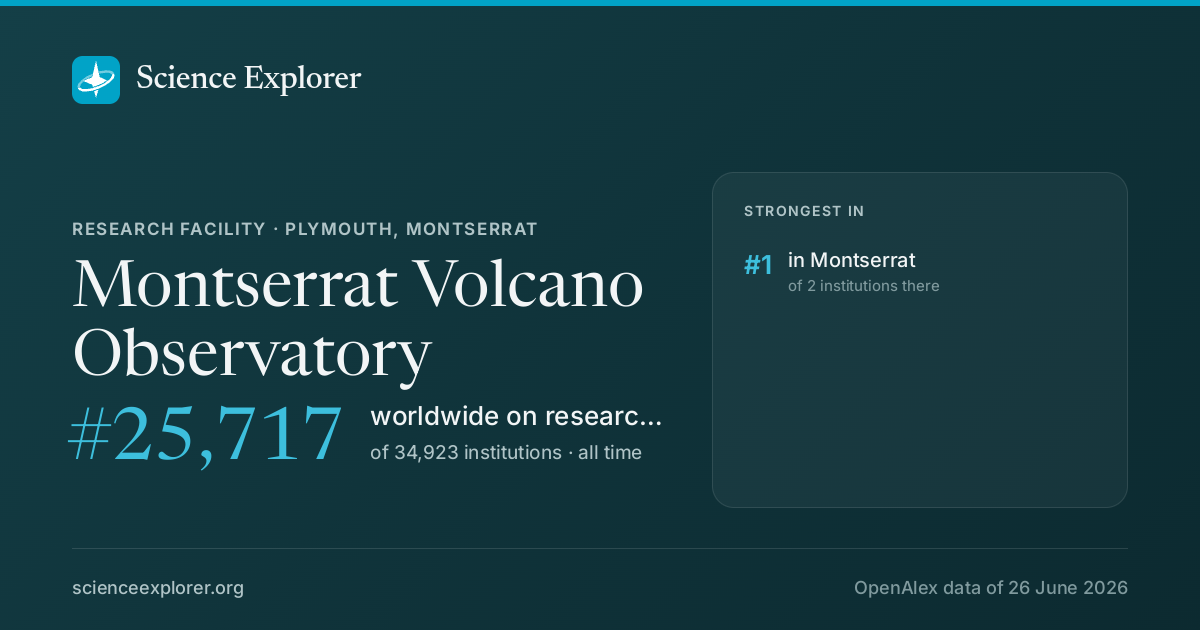
Montserrat Volcano Observatory on Science Explorer

A card with Montserrat Volcano Observatory's standing and the fields it leads in, for a post or a slide. A link to this page previews as the same card.

Download the card

1200 × 630 PNG, sized for social posts, drawn from the latest snapshot.

Badges for a website1Each links back here and updates with every snapshot

Research measures only: rankings here say nothing about teaching, admissions or student experience. Comparable institutions and collaboration partners have tabs of their own, above.

Discussion

Ask a question or share a note about Montserrat Volcano Observatory. Posts are plain text and can be reported.