Science Explorer Back to mapMap
Discussion
Company · Paramaribo · Suriname

Multi Electrical System (Suriname)

World rank, all time
#29,567
of 34,923
Rank in Suriname
#2
of 2
Research works
120
▲ 41% vs 2018-21
Citations
1.5k
12.4 per fractional work
Top-10% rate
4.9%
all institutions 10.0%
vs its own fields
0.95×
1.00× is exactly expected
Open access
64%
world 40%
International
59%
world 18%

Which fields of science does Multi Electrical System (Suriname) work in?

In 2022-now, 30% of research at Multi Electrical System (Suriname) is in Social Sciences, 29% in Physical Sciences. Its largest fields are Medicine (19%), Agricultural and Biological Sciences (14%), Environmental Science (11%).

Social Sciences: 10 fractional works · 29.6% of its workSocial Sciences: 3 fractional works · 9.9% of its workSociology and Political Science: 1 fractional works · 3.2% of its workAnthropology: 0 fractional works · 1.6% of its workEducation: 0 fractional works · 1.3% of its workPolitical Science and International Relations: 0 fractional works · 1.3% of its workSafety Research: 0 fractional works · 1.0% of its workLaw: 0 fractional works · 0.8% of its workHealth: 0 fractional works · 0.5% of its workSmaller subfields together: 0 fractional works · 0.2% of its workBusiness, Management and Accounting: 2 fractional works · 5.5% of its workManagement of Technology and Innovation: 1 fractional works · 4.0% of its workManagement Information Systems: 0 fractional works · 0.8% of its workOrganizational Behavior and Human Resource Management: 0 fractional works · 0.5% of its workBusiness and International Management: 0 fractional works · 0.2% of its workEconomics, Econometrics and Finance: 2 fractional works · 5.3% of its workGeneral Economics, Econometrics and Finance: 1 fractional works · 4.4% of its workFinance: 0 fractional works · 0.6% of its workEconomics and Econometrics: 0 fractional works · 0.2% of its workPsychology: 1 fractional works · 3.9% of its workSocial Psychology: 1 fractional works · 2.0% of its workDevelopmental and Educational Psychology: 0 fractional works · 1.4% of its workApplied Psychology: 0 fractional works · 0.2% of its workClinical Psychology: 0 fractional works · 0.2% of its workArts and Humanities: 1 fractional works · 3.8% of its workHistory: 1 fractional works · 2.1% of its workArcheology: 0 fractional works · 1.0% of its workPhilosophy: 0 fractional works · 0.3% of its workLanguage and Linguistics: 0 fractional works · 0.2% of its workSmaller subfields together: 0 fractional works · 0.2% of its workDecision Sciences: 0 fractional works · 1.2% of its workManagement Science and Operations Research: 0 fractional works · 1.0% of its workInformation Systems and Management: 0 fractional works · 0.2% of its workPhysical Sciences: 9 fractional works · 28.6% of its workEnvironmental Science: 4 fractional works · 11.1% of its workEcology: 1 fractional works · 3.0% of its workManagement, Monitoring, Policy and Law: 1 fractional works · 1.6% of its workWater Science and Technology: 0 fractional works · 1.6% of its workHealth, Toxicology and Mutagenesis: 0 fractional works · 1.5% of its workGlobal and Planetary Change: 0 fractional works · 1.3% of its workNature and Landscape Conservation: 0 fractional works · 1.0% of its workEnvironmental Engineering: 0 fractional works · 0.7% of its workEcological Modeling: 0 fractional works · 0.4% of its workEngineering: 3 fractional works · 9.1% of its workOcean Engineering: 1 fractional works · 3.7% of its workMechanical Engineering: 1 fractional works · 2.2% of its workMechanics of Materials: 0 fractional works · 1.6% of its workBuilding and Construction: 0 fractional works · 1.3% of its workBiomedical Engineering: 0 fractional works · 0.3% of its workComputer Science: 1 fractional works · 4.4% of its workInformation Systems: 1 fractional works · 3.8% of its workArtificial Intelligence: 0 fractional works · 0.3% of its workHuman-Computer Interaction: 0 fractional works · 0.3% of its workEarth and Planetary Sciences: 1 fractional works · 3.3% of its workGeophysics: 1 fractional works · 1.7% of its workGeochemistry and Petrology: 0 fractional works · 0.5% of its workGeology: 0 fractional works · 0.5% of its workOceanography: 0 fractional works · 0.5% of its workEnergy: 0 fractional works · 0.3% of its workRenewable Energy, Sustainability and the Environment: 0 fractional works · 0.3% of its workMathematics: 0 fractional works · 0.2% of its workModeling and Simulation: 0 fractional works · 0.2% of its workHealth Sciences: 7 fractional works · 23.3% of its workMedicine: 6 fractional works · 19.2% of its workPublic Health, Environmental and Occupational Health: 2 fractional works · 6.1% of its workEpidemiology: 1 fractional works · 2.6% of its workInfectious Diseases: 1 fractional works · 2.5% of its workEndocrinology, Diabetes and Metabolism: 0 fractional works · 1.5% of its workPediatrics, Perinatology and Child Health: 0 fractional works · 0.7% of its workPhysiology: 0 fractional works · 0.7% of its workOncology: 0 fractional works · 0.6% of its workPharmacology: 0 fractional works · 0.6% of its workPsychiatry and Mental health: 0 fractional works · 0.6% of its workPulmonary and Respiratory Medicine: 0 fractional works · 0.5% of its workHepatology: 0 fractional works · 0.5% of its workAnesthesiology and Pain Medicine: 0 fractional works · 0.4% of its workObstetrics and Gynecology: 0 fractional works · 0.4% of its workOtorhinolaryngology: 0 fractional works · 0.4% of its workBiochemistry: 0 fractional works · 0.3% of its workSurgery: 0 fractional works · 0.3% of its workRehabilitation: 0 fractional works · 0.2% of its workSmaller subfields together: 0 fractional works · 0.4% of its workHealth Professions: 1 fractional works · 3.2% of its workSpeech and Hearing: 0 fractional works · 1.6% of its workGeneral Health Professions: 0 fractional works · 1.2% of its workOccupational Therapy: 0 fractional works · 0.2% of its workSmaller subfields together: 0 fractional works · 0.2% of its workVeterinary: 0 fractional works · 0.7% of its workSmall Animals: 0 fractional works · 0.7% of its workNursing: 0 fractional works · 0.2% of its workLife Sciences: 6 fractional works · 18.6% of its workAgricultural and Biological Sciences: 5 fractional works · 14.1% of its workInsect Science: 1 fractional works · 3.2% of its workPlant Science: 1 fractional works · 2.7% of its workSoil Science: 1 fractional works · 2.5% of its workFood Science: 0 fractional works · 1.6% of its workEcology, Evolution, Behavior and Systematics: 0 fractional works · 1.1% of its workForestry: 0 fractional works · 1.0% of its workAgronomy and Crop Science: 0 fractional works · 0.9% of its workAquatic Science: 0 fractional works · 0.5% of its workGeneral Agricultural and Biological Sciences: 0 fractional works · 0.4% of its workAnimal Science and Zoology: 0 fractional works · 0.3% of its workImmunology and Microbiology: 1 fractional works · 2.3% of its workParasitology: 0 fractional works · 1.0% of its workImmunology: 0 fractional works · 0.6% of its workApplied Microbiology and Biotechnology: 0 fractional works · 0.3% of its workVirology: 0 fractional works · 0.2% of its workSmaller subfields together: 0 fractional works · 0.2% of its workBiochemistry, Genetics and Molecular Biology: 1 fractional works · 2.2% of its workGenetics: 0 fractional works · 1.4% of its workMolecular Biology: 0 fractional works · 0.8% of its workALL ITS WORKMulti ElectricalSystem (Suriname)32fractional works, 2022-now
Life Sciences19%Physical Sciences29%Health Sciences23%Social Sciences30%

Each ring splits the one inside it: the four domains of science, their fields, their subfields. Size is fractional works in 2022-now. Every slice is a page; the interactive view zooms down to single topics and colours each by how much more of it this institution does than the world.

Its 4 domains and 19 fields, with their numbers
    1. Social Sciences39.9%
    2. Business, Management and Accounting25.5%
    3. Economics, Econometrics and Finance25.3%
    4. Psychology13.9%
    5. Arts and Humanities13.8%
    6. Decision Sciences01.2%
    1. Environmental Science411.1%
    2. Engineering39.1%
    3. Computer Science14.4%
    4. Earth and Planetary Sciences13.3%
    5. Energy00.3%
    6. Mathematics00.2%
    1. Medicine619.2%
    2. Health Professions13.2%
    3. Veterinary00.7%
    4. Nursing00.2%
    1. Agricultural and Biological Sciences514.1%
    2. Immunology and Microbiology12.3%
    3. Biochemistry, Genetics and Molecular Biology12.2%
All of science, and how each field's share has moved since 1950: the Science domain explorer

Field profile

Location quotient across every field it publishes in: outside the ring is more than an institution of this size would be expected to publish, inside it is less.

Agricultural and Biological Sciences: 2.96× its world share, 4 worksAgricultural and Bio…Biochemistry, Genetics and Molecular Biology: 0.41× its world share, 1 worksBiochemistry, Geneti…Immunology and Microbiology: 2.31× its world share, 1 worksImmunology and Micro…Computer Science: 0.57× its world share, 1 worksComputer ScienceEarth and Planetary Sciences: 2.10× its world share, 1 worksEarth and Planetary …Energy: 0.38× its world share, 0 worksEnergyEngineering: 0.61× its world share, 3 worksEngineeringEnvironmental Science: 2.24× its world share, 4 worksEnvironmental ScienceMathematics: 0.22× its world share, 0 worksMathematicsHealth Professions: 1.20× its world share, 1 worksHealth ProfessionsMedicine: 1.00× its world share, 6 worksMedicineNursing: 0.40× its world share, 0 worksNursingVeterinary: 5.08× its world share, 0 worksVeterinaryArts and Humanities: 1.32× its world share, 1 worksArts and HumanitiesBusiness, Management and Accounting: 1.72× its world share, 2 worksBusiness, Management…Decision Sciences: 1.29× its world share, 0 worksDecision SciencesEconomics, Econometrics and Finance: 2.46× its world share, 2 worksEconomics, Econometr…Psychology: 1.26× its world share, 1 worksPsychologySocial Sciences: 0.78× its world share, 3 worksSocial Sciences1×world share
more than its size predictsabout as predictedless

Rings at 0.5×, 1× and 2×. Widest outward: Veterinary, 5.1×. Every wedge is a field page.

All 19 fields, with their numbers
  1. Veterinary5.08×0 works
  2. Agricultural and Biological Sciences2.96×4 works
  3. Economics, Econometrics and Finance2.46×2 works
  4. Immunology and Microbiology2.31×1 works
  5. Environmental Science2.24×4 works
  6. Earth and Planetary Sciences2.10×1 works
  7. Business, Management and Accounting1.72×2 works
  8. Arts and Humanities1.32×1 works
  9. Decision Sciences1.29×0 works
  10. Psychology1.26×1 works
  11. Health Professions1.20×1 works
  12. Medicine1.00×6 works
  13. Social Sciences0.78×3 works
  14. Engineering0.61×3 works
  15. Computer Science0.57×1 works
  16. Biochemistry, Genetics and Molecular Biology0.41×1 works
  17. Nursing0.40×0 works
  18. Energy0.38×0 works
  19. Mathematics0.22×0 works

Who are the top researchers at Multi Electrical System (Suriname)?

Ranked on the quality score, Otte H. Ottema, Jhr. L.C. van Panhuys and Fred. Oudschans Dentz lead among researchers whose main affiliation is Multi Electrical System (Suriname).

  1. 1 Otte H. Ottema Suriname · #2,234,886 worldwide 225 citations · 24 works
  2. 2 Jhr. L.C. van Panhuys Suriname · #2,269,063 worldwide 18 citations · 51 works
  3. 3 Fred. Oudschans Dentz Suriname · #2,373,119 worldwide 83 citations · 88 works
  4. 4 Aliès van Sauers-Muller Suriname · #3,374,871 worldwide 321 citations · 28 works
All ranked researchers at Multi Electrical System (Suriname)

What are the most cited papers from Multi Electrical System (Suriname)?

The most cited paper from Multi Electrical System (Suriname) is "Positive biodiversity-productivity relationship predominant in global forests" (Jingjing Liang et al., 2016), with 1,512 citations. Next come "Averting biodiversity collapse in tropical forest protected areas" (1,223) and "Long-term thermal sensitivity of Earth’s tropical forests" (380).

Most cited papers
#PaperReleasedCitations
1 Positive biodiversity-productivity relationship predominant in global forests Jingjing Liang et al. · Science Open access 13 Oct 2016 1,512
2 Averting biodiversity collapse in tropical forest protected areas William Frederick Laurance et al. · Nature Open access216 authors 24 Jul 2012 1,223
3 Long-term thermal sensitivity of Earth’s tropical forests Martin J. P. Sullivan et al. · Science Open access226 authors 21 May 2020 380
4 Community structure and diversity of tropical forest mammals: data from a global camera trap network Jorge Ahumada, Carlos E. F. Silva, Krisna Gajapersad et al. · Philosophical Transactions of the Royal Society B Biological Sciences Open access 15 Aug 2011 379
5 Estimating the global conservation status of more than 15,000 Amazonian tree species Hans ter Steege et al. · Science Advances Open access158 authors 6 Nov 2015 208
All 61 most cited papers, with filters and sorting

Which keywords describe research at Multi Electrical System (Suriname)?

By fractional works in 2022-now, weighted toward what it does more of than the world: Biodiversity, Economic Growth, Monetary Policy, Sustainable Development, Structural Change, Altruism, Financial Development and Fiscal Policy.

▲ more of its work than of the world's◆ about the world's share▼ less than the world's

Size is fractional works in 2022-now in the topics tagged with each word; colour is the word's share of this institution's work against its share of the world's. The 20 words are chosen for being large and distinctive. Each links to the topic it comes from most.

All 20 words, with their numbers
  1. Climate Change2▲ 2.1×15 topics
  2. Epidemiology2▲ 1.51×18 topics
  3. Sustainable Development2▲ 3.8×8 topics
  4. Biodiversity2▲ 6.4×9 topics
  5. COVID-192▲ 3.7×5 topics
  6. Economic Growth2▲ 6.0×4 topics
  7. Environmental Impact2▲ 2.7×6 topics
  8. Sustainability2▲ 1.95×8 topics
  9. Globalization1▲ 2.2×6 topics
  10. Monetary Policy1▲ 18×3 topics
  11. Altruism1▲ 47×2 topics
  12. Structural Change1▲ 64×2 topics
  13. Financial Development1▲ 25×1 topic
  14. Fiscal Policy1▲ 18×1 topic
  15. Invasive Species1▲ 8.7×7 topics
  16. Blood Donation1▲ 207×1 topic
  17. Contact Tracing Apps1▲ 288×1 topic
  18. Digital Technologies1▲ 25×1 topic
  19. Supply Chain Management1▲ 3.8×1 topic
  20. Public Policy1▲ 6.7×5 topics

Which research topics does Multi Electrical System (Suriname) publish most on?

By volume in 2022-now: Monetary Policy and Economic Impact, Blood donation and transfusion practices, COVID-19 Digital Contact Tracing and Hydraulic Fracturing and Reservoir Analysis.

  1. 1 Monetary Policy and Economic Impact General Economics, Econometrics and Finance 1 works
  2. 2 Blood donation and transfusion practices Management of Technology and Innovation 1 works
  3. 3 COVID-19 Digital Contact Tracing Information Systems 1 works
  4. 4 Hydraulic Fracturing and Reservoir Analysis Mechanical Engineering 1 works
  5. 5 Hydrocarbon exploration and reservoir analysis Mechanics of Materials 0 works
  6. 6 School Health and Nursing Education Speech and Hearing 0 works
  7. 7 Food Safety and Hygiene Food Science 0 works
  8. 8 Malaria Research and Control Public Health, Environmental and Occupational Health 0 works
  9. 9 Colonialism, slavery, and trade Anthropology 0 works
  10. 10 Marine and Offshore Engineering Studies Ocean Engineering 0 works

How open and international is its research?

Against the world's own shares: the tick on each track. Both are shares of its output, so they sit on one scale and can be read against each other as well as against the world.

openly available63.6%not open36.4%

World: 40% of research is openly available.

with international co-authors59.4%domestic only40.6%

World: 18% is written across borders.

How has Multi Electrical System (Suriname)'s research output changed?

Output in 2022-2025 was 41% higher than in 2018-2021.

still counting1990200020102020
grewheldshrank

The same series as a ribbon: one cell per year, darker for more. The line above answers how much; this answers when.

Its share of all research

Growing output can still be a shrinking share: all of science grows. This is Multi Electrical System (Suriname) as a percentage of every work published that year, 0.00014% in 2024.

still counting0.00050%0.0010%0.0015%Multi Electrical System (Suriname)0.00014% in 202519801990200020102020

Fractional works of Multi Electrical System (Suriname) over all fractional works that year. How the balance of science has shifted.

Other research institutions in Paramaribo

All research institutions in Paramaribo

Share Multi Electrical System (Suriname)'s ranking
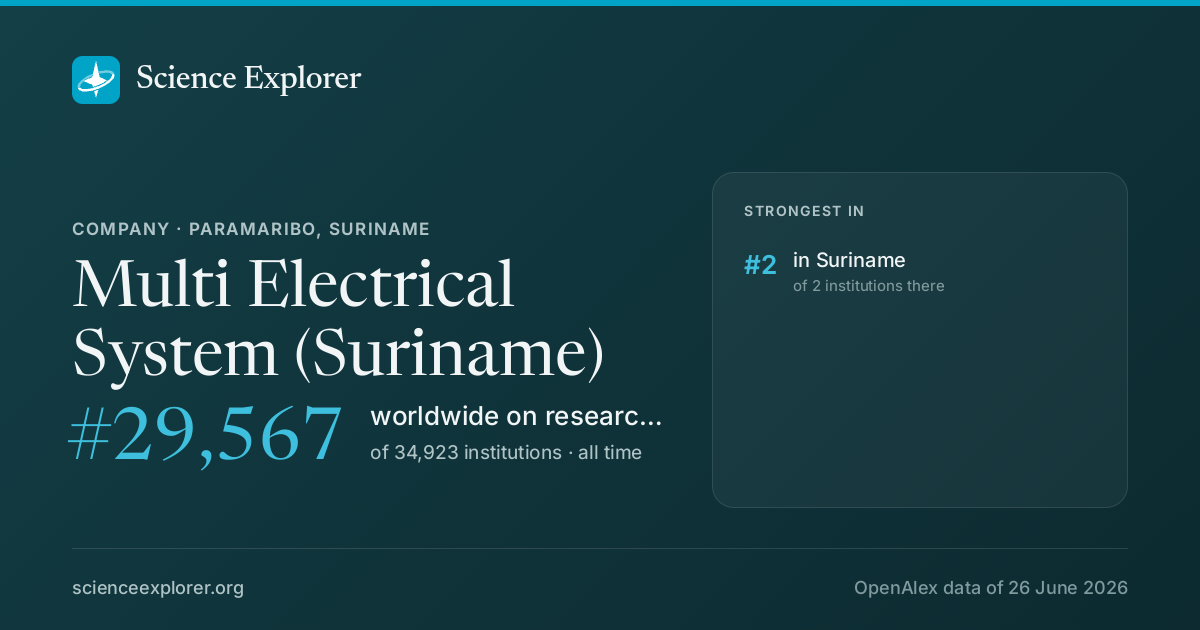
Multi Electrical System (Suriname) on Science Explorer

A card with Multi Electrical System (Suriname)'s standing and the fields it leads in, for a post or a slide. A link to this page previews as the same card.

Download the card

1200 × 630 PNG, sized for social posts, drawn from the latest snapshot.

Badges for a website1Each links back here and updates with every snapshot

Research measures only: rankings here say nothing about teaching, admissions or student experience. Comparable institutions and collaboration partners have tabs of their own, above.

Discussion

Ask a question or share a note about Multi Electrical System (Suriname). Posts are plain text and can be reported.