Science Explorer Back to mapMap
Discussion
University · Nanjing · China

Nanjing Foreign Language School

In research, Nanjing Foreign Language School stands highest in Arts and Humanities (#1,538 of 1,896 worldwide), Social Sciences (#8,506 of 9,585 worldwide) and Social Sciences (#5,723 of 5,988 worldwide), 2022-now. Relative to its size it is most specialised in Business and International Management, Gender Studies and Marketing (Business and International Management is 13.1× its share of world research).

World rank, 2022-now
#15,600
of 22,385 · #21,158 all time
Rank in China
#1,879
of 2,481
Research works
2.3k
▲ 365% vs 2018-21
Citations
5.9k
2.6 per fractional work
Top-10% rate
2.5%
all institutions 10.0%
vs its own fields
0.40×
1.00× is exactly expected
Open access
70%
world 40%
International
8%
world 18%

What is Nanjing Foreign Language School known for in research?

The fields where it stands highest, 2022-now, ranked among every institution above the floor in each field.

FieldWorld rankWhere that sitsTop-10% rateWorksAll time
Arts and HumanitiesField #1,538 of 1,896 8.0%73 #2745
Social SciencesDomain #8,506 of 9,585 2.3%732 #10677
Social SciencesField #5,723 of 5,988 1.9%302 #8399
PsychologyField #2,060 of 2,121 3.1%83 #2996
EngineeringField #5,749 of 5,901 1.6%203 #8912
Life SciencesDomain #6,297 of 6,403 2.1%96 #10237
Economics, Econometrics and FinanceField #1,770 of 1,798 1.0%114 #3081
Economics and EconometricsSubfield #1,290 of 1,307 0.8%85 -
Environmental ScienceField #3,291 of 3,334 2.8%81 -
MedicineField #8,442 of 8,541 2.0%99 #13943

Each strip is that field's whole ranked pool, with the notch where Nanjing Foreign Language School sits in it, in the colour of the band that rank falls in. The track under the rate is the rate itself: it carries no average mark, because the average differs by field (from about 6% in Dentistry to 21% in Economics).

Which of those standings moved

The same fields on both windows: where it stood over the whole record, and where it stands in 2022-now. The distance is the story, and it is the one thing the two rank columns above cannot show.

  1. Arts and Humanities#2,745 #1,538
  2. Social Sciences#10,677 #8,506
  3. Social Sciences#8,399 #5,723
  4. Psychology#2,996 #2,060
  5. Engineering#8,912 #5,749
  6. Life Sciences#10,237 #6,297
  7. Economics, Econometrics and Finance#3,081 #1,770
  8. Medicine#13,943 #8,442
all time2022-now, better2022-now, worse

A dot further right is a better standing. Fields it was not ranked in over the whole record are left out.

Which fields of science does Nanjing Foreign Language School work in?

In 2022-now, 48% of research at Nanjing Foreign Language School is in Social Sciences, 37% in Physical Sciences. Its largest fields are Social Sciences (19%), Engineering (13%), Computer Science (9%). It does 1.9× the world's share of Social Sciences.

Social Sciences: 774 fractional works · 48.0% of its workSocial Sciences: 313 fractional works · 19.4% of its workSociology and Political Science: 125 fractional works · 7.8% of its workEducation: 42 fractional works · 2.6% of its workGender Studies: 34 fractional works · 2.1% of its workPolitical Science and International Relations: 24 fractional works · 1.5% of its workCultural Studies: 24 fractional works · 1.5% of its workDemography: 14 fractional works · 0.8% of its workSafety Research: 10 fractional works · 0.6% of its workUrban Studies: 8 fractional works · 0.5% of its workCommunication: 7 fractional works · 0.4% of its workAnthropology: 6 fractional works · 0.4% of its workTransportation: 4 fractional works · 0.3% of its workLaw: 3 fractional works · 0.2% of its workSmaller subfields together: 10 fractional works · 0.6% of its workBusiness, Management and Accounting: 130 fractional works · 8.1% of its workMarketing: 35 fractional works · 2.1% of its workStrategy and Management: 34 fractional works · 2.1% of its workBusiness and International Management: 22 fractional works · 1.4% of its workManagement Information Systems: 12 fractional works · 0.8% of its workAccounting: 10 fractional works · 0.6% of its workOrganizational Behavior and Human Resource Management: 8 fractional works · 0.5% of its workManagement of Technology and Innovation: 7 fractional works · 0.4% of its workSmaller subfields together: 2 fractional works · 0.1% of its workEconomics, Econometrics and Finance: 118 fractional works · 7.3% of its workEconomics and Econometrics: 87 fractional works · 5.4% of its workFinance: 17 fractional works · 1.1% of its workGeneral Economics, Econometrics and Finance: 13 fractional works · 0.8% of its workPsychology: 95 fractional works · 5.9% of its workSocial Psychology: 31 fractional works · 1.9% of its workClinical Psychology: 23 fractional works · 1.4% of its workDevelopmental and Educational Psychology: 20 fractional works · 1.2% of its workExperimental and Cognitive Psychology: 18 fractional works · 1.1% of its workSmaller subfields together: 4 fractional works · 0.3% of its workArts and Humanities: 84 fractional works · 5.2% of its workLanguage and Linguistics: 21 fractional works · 1.3% of its workLiterature and Literary Theory: 17 fractional works · 1.1% of its workPhilosophy: 11 fractional works · 0.7% of its workVisual Arts and Performing Arts: 8 fractional works · 0.5% of its workArcheology: 6 fractional works · 0.4% of its workMusic: 6 fractional works · 0.4% of its workMuseology: 5 fractional works · 0.3% of its workHistory: 4 fractional works · 0.3% of its workSmaller subfields together: 6 fractional works · 0.4% of its workDecision Sciences: 34 fractional works · 2.1% of its workManagement Science and Operations Research: 24 fractional works · 1.5% of its workInformation Systems and Management: 8 fractional works · 0.5% of its workSmaller subfields together: 2 fractional works · 0.1% of its workPhysical Sciences: 604 fractional works · 37.4% of its workEngineering: 215 fractional works · 13.3% of its workElectrical and Electronic Engineering: 54 fractional works · 3.4% of its workBiomedical Engineering: 28 fractional works · 1.8% of its workAutomotive Engineering: 24 fractional works · 1.5% of its workControl and Systems Engineering: 19 fractional works · 1.2% of its workAerospace Engineering: 18 fractional works · 1.1% of its workMechanical Engineering: 17 fractional works · 1.0% of its workComputational Mechanics: 9 fractional works · 0.5% of its workCivil and Structural Engineering: 8 fractional works · 0.5% of its workIndustrial and Manufacturing Engineering: 8 fractional works · 0.5% of its workBuilding and Construction: 7 fractional works · 0.5% of its workOcean Engineering: 6 fractional works · 0.4% of its workMedia Technology: 6 fractional works · 0.4% of its workSafety, Risk, Reliability and Quality: 5 fractional works · 0.3% of its workMechanics of Materials: 4 fractional works · 0.2% of its workSmaller subfields together: 2 fractional works · 0.1% of its workComputer Science: 149 fractional works · 9.3% of its workArtificial Intelligence: 49 fractional works · 3.0% of its workComputer Vision and Pattern Recognition: 29 fractional works · 1.8% of its workInformation Systems: 25 fractional works · 1.6% of its workHuman-Computer Interaction: 10 fractional works · 0.6% of its workComputer Networks and Communications: 9 fractional works · 0.6% of its workSignal Processing: 9 fractional works · 0.5% of its workComputational Theory and Mathematics: 8 fractional works · 0.5% of its workComputer Graphics and Computer-Aided Design: 7 fractional works · 0.4% of its workComputer Science Applications: 4 fractional works · 0.2% of its workEnvironmental Science: 83 fractional works · 5.2% of its workHealth, Toxicology and Mutagenesis: 16 fractional works · 1.0% of its workGlobal and Planetary Change: 13 fractional works · 0.8% of its workEnvironmental Engineering: 11 fractional works · 0.7% of its workEcology: 11 fractional works · 0.7% of its workWater Science and Technology: 10 fractional works · 0.6% of its workManagement, Monitoring, Policy and Law: 8 fractional works · 0.5% of its workIndustrial and Manufacturing Engineering: 5 fractional works · 0.3% of its workPollution: 4 fractional works · 0.3% of its workSmaller subfields together: 5 fractional works · 0.3% of its workPhysics and Astronomy: 45 fractional works · 2.8% of its workAstronomy and Astrophysics: 19 fractional works · 1.2% of its workStatistical and Nonlinear Physics: 8 fractional works · 0.5% of its workAtomic and Molecular Physics, and Optics: 7 fractional works · 0.4% of its workNuclear and High Energy Physics: 7 fractional works · 0.4% of its workSmaller subfields together: 4 fractional works · 0.3% of its workMaterials Science: 30 fractional works · 1.9% of its workMaterials Chemistry: 17 fractional works · 1.1% of its workBiomaterials: 5 fractional works · 0.3% of its workPolymers and Plastics: 4 fractional works · 0.2% of its workSmaller subfields together: 4 fractional works · 0.2% of its workEnergy: 22 fractional works · 1.4% of its workRenewable Energy, Sustainability and the Environment: 17 fractional works · 1.1% of its workEnergy Engineering and Power Technology: 4 fractional works · 0.2% of its workSmaller subfields together: 1 fractional works · 0.1% of its workMathematics: 21 fractional works · 1.3% of its workStatistics and Probability: 5 fractional works · 0.3% of its workGeometry and Topology: 4 fractional works · 0.2% of its workSmaller subfields together: 12 fractional works · 0.8% of its workChemistry: 18 fractional works · 1.1% of its workOrganic Chemistry: 6 fractional works · 0.4% of its workSmaller subfields together: 12 fractional works · 0.8% of its workEarth and Planetary Sciences: 14 fractional works · 0.9% of its workAtmospheric Science: 6 fractional works · 0.3% of its workOceanography: 4 fractional works · 0.2% of its workSmaller subfields together: 5 fractional works · 0.3% of its workChemical Engineering: 6 fractional works · 0.4% of its workHealth Sciences: 132 fractional works · 8.2% of its workMedicine: 107 fractional works · 6.7% of its workOncology: 12 fractional works · 0.7% of its workPublic Health, Environmental and Occupational Health: 9 fractional works · 0.5% of its workComplementary and alternative medicine: 8 fractional works · 0.5% of its workSurgery: 8 fractional works · 0.5% of its workPhysiology: 7 fractional works · 0.4% of its workEpidemiology: 6 fractional works · 0.4% of its workOrthopedics and Sports Medicine: 6 fractional works · 0.4% of its workPsychiatry and Mental health: 6 fractional works · 0.4% of its workPulmonary and Respiratory Medicine: 6 fractional works · 0.3% of its workPathology and Forensic Medicine: 5 fractional works · 0.3% of its workRadiology, Nuclear Medicine and Imaging: 4 fractional works · 0.3% of its workPharmacology: 4 fractional works · 0.2% of its workInfectious Diseases: 4 fractional works · 0.2% of its workCardiology and Cardiovascular Medicine: 4 fractional works · 0.2% of its workSmaller subfields together: 20 fractional works · 1.2% of its workHealth Professions: 21 fractional works · 1.3% of its workGeneral Health Professions: 10 fractional works · 0.6% of its workHealth Information Management: 6 fractional works · 0.4% of its workSmaller subfields together: 5 fractional works · 0.3% of its workNursing: 3 fractional works · 0.2% of its workVeterinary: 1 fractional works · 0.1% of its workDentistry: 0 fractional works · 0.0% of its workLife Sciences: 103 fractional works · 6.4% of its workBiochemistry, Genetics and Molecular Biology: 46 fractional works · 2.8% of its workMolecular Biology: 27 fractional works · 1.7% of its workGenetics: 6 fractional works · 0.4% of its workSmaller subfields together: 13 fractional works · 0.8% of its workNeuroscience: 28 fractional works · 1.7% of its workCognitive Neuroscience: 20 fractional works · 1.3% of its workSmaller subfields together: 8 fractional works · 0.5% of its workAgricultural and Biological Sciences: 22 fractional works · 1.4% of its workFood Science: 7 fractional works · 0.4% of its workPlant Science: 4 fractional works · 0.3% of its workGeneral Agricultural and Biological Sciences: 3 fractional works · 0.2% of its workSmaller subfields together: 7 fractional works · 0.5% of its workImmunology and Microbiology: 6 fractional works · 0.3% of its workImmunology: 4 fractional works · 0.2% of its workSmaller subfields together: 2 fractional works · 0.1% of its workPharmacology, Toxicology and Pharmaceutics: 2 fractional works · 0.1% of its workALL ITS WORKNanjing ForeignLanguage School1,613fractional works, 2022-now
Life Sciences6%Physical Sciences37%Health Sciences8%Social Sciences48%

Each ring splits the one inside it: the four domains of science, their fields, their subfields. Size is fractional works in 2022-now. Every slice is a page; the interactive view zooms down to single topics and colours each by how much more of it this institution does than the world.

Its 4 domains and 26 fields, with their numbers
    1. Social Sciences31319.4%
    2. Business, Management and Accounting1308.1%
    3. Economics, Econometrics and Finance1187.3%
    4. Psychology955.9%
    5. Arts and Humanities845.2%
    6. Decision Sciences342.1%
    1. Engineering21513.3%
    2. Computer Science1499.3%
    3. Environmental Science835.2%
    4. Physics and Astronomy452.8%
    5. Materials Science301.9%
    6. Energy221.4%
    7. Mathematics211.3%
    8. Chemistry181.1%
    9. Earth and Planetary Sciences140.9%
    10. Chemical Engineering60.4%
    1. Medicine1076.7%
    2. Health Professions211.3%
    3. Nursing30.2%
    4. Veterinary10.1%
    5. Dentistry00.0%
    1. Biochemistry, Genetics and Molecular Biology462.8%
    2. Neuroscience281.7%
    3. Agricultural and Biological Sciences221.4%
    4. Immunology and Microbiology60.3%
    5. Pharmacology, Toxicology and Pharmaceutics20.1%
All of science, and how each field's share has moved since 1950: the Science domain explorer

What does Nanjing Foreign Language School specialise in?

Where its research is concentrated relative to its size: Business and International Management takes 13.1× the share of its output that it takes of world research.

  1. Business and International ManagementSubfield · 22.2 works13×
  2. Gender StudiesSubfield · 34.2 works5.9×
  3. MarketingSubfield · 34.5 works5.1×
← less than its size predicts1×more →

Location quotient, a volume reading rather than an impact one. It surfaces small, lopsided specialities.

Field profile

Location quotient across every field it publishes in: outside the ring is more than an institution of this size would be expected to publish, inside it is less.

Agricultural and Biological Sciences: 0.29× its world share, 22 worksAgricultural and Bio…Biochemistry, Genetics and Molecular Biology: 0.53× its world share, 46 worksBiochemistry, Geneti…Immunology and Microbiology: 0.34× its world share, 6 worksImmunology and Micro…Neuroscience: 1.06× its world share, 28 worksNeurosciencePharmacology, Toxicology and Pharmaceutics: 0.32× its world share, 2 worksPharmacology, Toxico…Chemical Engineering: 1.06× its world share, 6 worksChemical EngineeringChemistry: 0.72× its world share, 18 worksChemistryComputer Science: 1.19× its world share, 149 worksComputer ScienceEarth and Planetary Sciences: 0.55× its world share, 14 worksEarth and Planetary …Energy: 1.49× its world share, 22 worksEnergyEngineering: 0.89× its world share, 215 worksEngineeringEnvironmental Science: 1.04× its world share, 83 worksEnvironmental ScienceMaterials Science: 0.53× its world share, 30 worksMaterials ScienceMathematics: 1.12× its world share, 21 worksMathematicsPhysics and Astronomy: 1.24× its world share, 45 worksPhysics and AstronomyDentistry: 0.05× its world share, 0 worksDentistryHealth Professions: 0.49× its world share, 21 worksHealth ProfessionsMedicine: 0.35× its world share, 107 worksMedicineNursing: 0.35× its world share, 3 worksNursingVeterinary: 0.38× its world share, 1 worksVeterinaryArts and Humanities: 1.81× its world share, 84 worksArts and HumanitiesBusiness, Management and Accounting: 2.51× its world share, 130 worksBusiness, Management…Decision Sciences: 2.16× its world share, 34 worksDecision SciencesEconomics, Econometrics and Finance: 3.41× its world share, 118 worksEconomics, Econometr…Psychology: 1.94× its world share, 95 worksPsychologySocial Sciences: 1.53× its world share, 313 worksSocial Sciences1×world share
more than its size predictsabout as predictedless

Rings at 0.5×, 1× and 2×. Widest outward: Economics, Econometrics and Finance, 3.4×. Every wedge is a field page.

All 26 fields, with their numbers
  1. Economics, Econometrics and Finance3.41×118 works
  2. Business, Management and Accounting2.51×130 works
  3. Decision Sciences2.16×34 works
  4. Psychology1.94×95 works
  5. Arts and Humanities1.81×84 works
  6. Social Sciences1.53×313 works
  7. Energy1.49×22 works
  8. Physics and Astronomy1.24×45 works
  9. Computer Science1.19×149 works
  10. Mathematics1.12×21 works
  11. Neuroscience1.06×28 works
  12. Chemical Engineering1.06×6 works
  13. Environmental Science1.04×83 works
  14. Engineering0.89×215 works
  15. Chemistry0.72×18 works
  16. Earth and Planetary Sciences0.55×14 works
  17. Biochemistry, Genetics and Molecular Biology0.53×46 works
  18. Materials Science0.53×30 works
  19. Health Professions0.49×21 works
  20. Veterinary0.38×1 works
  21. Medicine0.35×107 works
  22. Nursing0.35×3 works
  23. Immunology and Microbiology0.34×6 works
  24. Pharmacology, Toxicology and Pharmaceutics0.32×2 works
  25. Agricultural and Biological Sciences0.29×22 works
  26. Dentistry0.05×0 works

Who are the top researchers at Nanjing Foreign Language School?

Ranked on the quality score, Jifan Zhang, Zhou Yue and Tao Tao lead among researchers whose main affiliation is Nanjing Foreign Language School.

  1. 1 Jifan Zhang China · #1,680,032 worldwide 598 citations · 32 works
  2. 2 Zhou Yue China · #6,079,366 worldwide 9 citations · 16 works
  3. 3 Tao Tao China · #6,211,209 worldwide 17 citations · 28 works
All ranked researchers at Nanjing Foreign Language School

What are the most cited papers from Nanjing Foreign Language School?

The most cited paper from Nanjing Foreign Language School is "Effects of polyethylene glycol on the surface of nanoparticles for targeted drug delivery" (Liwang Shi, Jinqiu Zhang, Man Zhao et al., 2021), with 809 citations. Next come "The evaluation of tourism destination competitiveness by TOPSIS & information entropy – A case in the Yangtze River Delta of China" (449) and "Intelligent cryptography approach for secure distributed big data storage in cloud computing" (257).

Most cited papers
#PaperReleasedCitations
1 Effects of polyethylene glycol on the surface of nanoparticles for targeted drug delivery Liwang Shi, Jinqiu Zhang, Man Zhao et al. · Nanoscale Open access 2021 809
2 The evaluation of tourism destination competitiveness by TOPSIS & information entropy – A case in the Yangtze River Delta of China Hong Zhang, Chaolin Gu, Luwen Gu et al. · Tourism Management 3 Sep 2010 449
3 Intelligent cryptography approach for secure distributed big data storage in cloud computing Yibin Li, Keke Gai, Longfei Qiu et al. · Information Sciences 9 Sep 2016 257
4 Understanding the Quality of Out-of-Class English Learning Chun Yip Lai, Weimin Zhu, Gang Jun Gong · TESOL Quarterly Open access 23 Jun 2014 253
5 Robust estimation of bacterial cell count from optical density Jacob Beal et al. · Communications Biology Open access1,653 authors 17 Sep 2020 246
All 61 most cited papers, with filters and sorting

Which keywords describe research at Nanjing Foreign Language School?

By fractional works in 2022-now, weighted toward what it does more of than the world: Social Media, Deep Learning, Globalization, Economic Growth, Artificial Intelligence, Consumer Behavior, Big Data Analytics and User-Generated Content.

▲ more of its work than of the world's◆ about the world's share▼ less than the world's

Size is fractional works in 2022-now in the topics tagged with each word; colour is the word's share of this institution's work against its share of the world's. The 40 words are chosen for being large and distinctive. Each links to the topic it comes from most.

All 40 words, with their numbers
  1. Deep Learning87▲ 1.56×71 topics
  2. Globalization70▲ 2.2×55 topics
  3. Machine Learning68▲ 1.26×66 topics
  4. Social Media67▲ 3.0×24 topics
  5. Sustainability61▲ 1.55×60 topics
  6. Artificial Intelligence55▲ 2.4×38 topics
  7. Economic Growth51▲ 3.9×20 topics
  8. Neural Networks49▲ 1.96×36 topics
  9. Economic Development41▲ 3.2×23 topics
  10. Consumer Behavior40▲ 4.0×12 topics
  11. Renewable Energy37▲ 1.57×32 topics
  12. Sustainable Development36▲ 1.43×29 topics
  13. Innovation30▲ 1.77×33 topics
  14. Big Data Analytics28▲ 8.3×5 topics
  15. User-Generated Content27▲ 13×2 topics
  16. Consumer Engagement27▲ 14×1 topic
  17. Electronic Word-of-Mouth27▲ 14×1 topic
  18. Gender26▲ 3.0×20 topics
  19. Identity26▲ 2.2×20 topics
  20. Risk Assessment25▲ 2.3×14 topics
  21. Digital Transformation24▲ 2.7×16 topics
  22. Supply Chain24▲ 7.1×6 topics
  23. International Trade23▲ 10×4 topics
  24. Virtual Reality22▲ 2.8×12 topics
  25. Logistics22▲ 8.7×3 topics
  26. Labor Market21▲ 4.7×11 topics
  27. Electric Vehicles20▲ 4.3×4 topics
  28. Urban Development20▲ 3.5×10 topics
  29. Digital Technologies20▲ 9.1×4 topics
  30. Language Teaching20▲ 4.5×5 topics
  31. Regional Planning19▲ 18×2 topics
  32. Cross-Border E-Commerce19▲ 24×1 topic
  33. Fuzzy Theory19▲ 24×1 topic
  34. Monetary Policy18▲ 4.6×10 topics
  35. Stock Market17▲ 4.8×2 topics
  36. Cultural Diplomacy16▲ 13×4 topics
  37. Stereotypes16▲ 11×3 topics
  38. Hallyu16▲ 36×1 topic
  39. Korean Wave16▲ 36×1 topic
  40. Market Efficiency16▲ 14×2 topics

Which research topics does Nanjing Foreign Language School publish most on?

By volume in 2022-now: Digital Marketing and Social Media, E-commerce and Technology Innovations, Asian Culture and Media Studies and EFL/ESL Teaching and Learning.

  1. 1 Digital Marketing and Social Media Sociology and Political Science 27 works
  2. 2 E-commerce and Technology Innovations Business and International Management 19 works
  3. 3 Asian Culture and Media Studies Cultural Studies 16 works
  4. 4 EFL/ESL Teaching and Learning Language and Linguistics 12 works
  5. 5 COVID-19 Pandemic Impacts Economics and Econometrics 12 works
  6. 6 Consumer Behavior in Brand Consumption and Identification Marketing 12 works
  7. 7 Sports Analytics and Performance Economics and Econometrics 10 works
  8. 8 Educational Reforms and Innovations Health, Toxicology and Mutagenesis 10 works
  9. 9 Impact of Technology on Adolescents Sociology and Political Science 10 works
  10. 10 Regional Development and Environment Sociology and Political Science 9 works

How open and international is its research?

Against the world's own shares: the tick on each track. Both are shares of its output, so they sit on one scale and can be read against each other as well as against the world.

openly available69.6%not open30.4%

World: 40% of research is openly available.

with international co-authors8.5%domestic only91.5%

World: 18% is written across borders.

How has Nanjing Foreign Language School's research output changed?

Output in 2022-2025 was 365% higher than in 2018-2021.

still counting1990200020102020
grewheldshrank

The same series as a ribbon: one cell per year, darker for more. The line above answers how much; this answers when.

Its share of all research

Growing output can still be a shrinking share: all of science grows. This is Nanjing Foreign Language School as a percentage of every work published that year, 0.0080% in 2024.

still counting0.0050%0.010%Nanjing Foreign Language School0.0065% in 202519801990200020102020

Fractional works of Nanjing Foreign Language School over all fractional works that year. How the balance of science has shifted.

How much of it reaches the world top 10%

Year by year, against all institutions in the same year.

still counting5%10%15%all institutions10.0% in 2025Nanjing Foreign Language School3.0% in 202520102020

Of each year's output, the share that reached the world's 10% most cited for its field and year. Peak 9.5% in 2018.

Other research institutions in Nanjing

All research institutions in Nanjing

Share Nanjing Foreign Language School's ranking
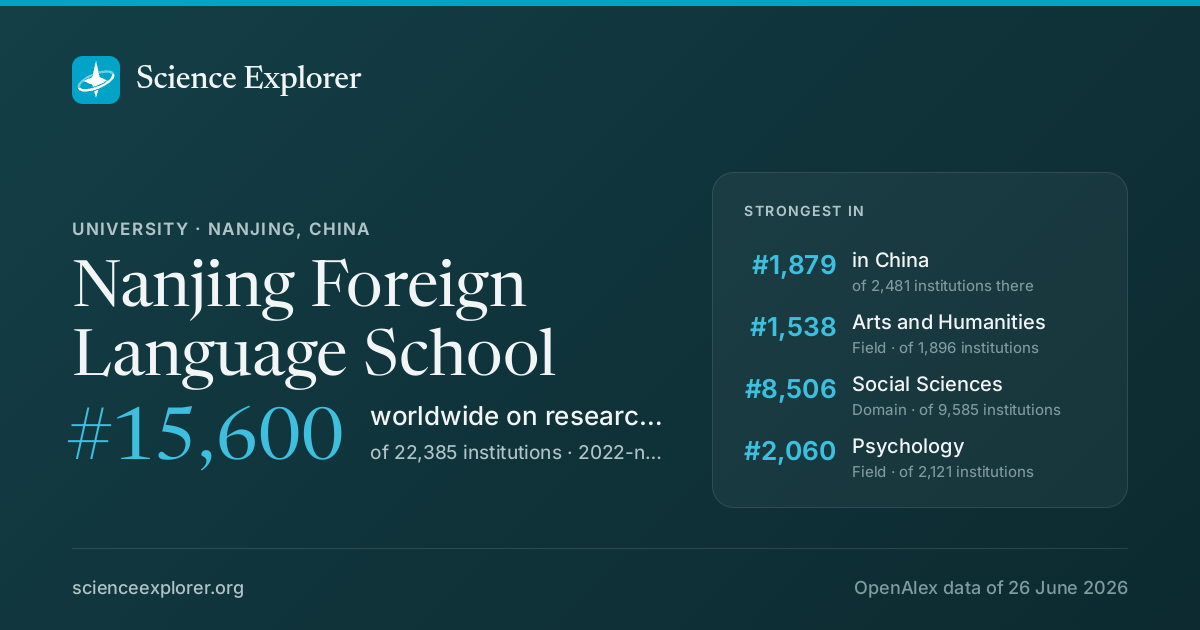
Nanjing Foreign Language School on Science Explorer

A card with Nanjing Foreign Language School's standing and the fields it leads in, for a post or a slide. A link to this page previews as the same card.

Download the card

1200 × 630 PNG, sized for social posts, drawn from the latest snapshot.

Badges for a website1Each links back here and updates with every snapshot

Research measures only: rankings here say nothing about teaching, admissions or student experience. Comparable institutions and collaboration partners have tabs of their own, above.

Discussion

Ask a question or share a note about Nanjing Foreign Language School. Keep it to the research: no personal attacks, advertising or links. Any reader can report a post, which collapses it for everyone until it is opened.