Northeast Forestry University
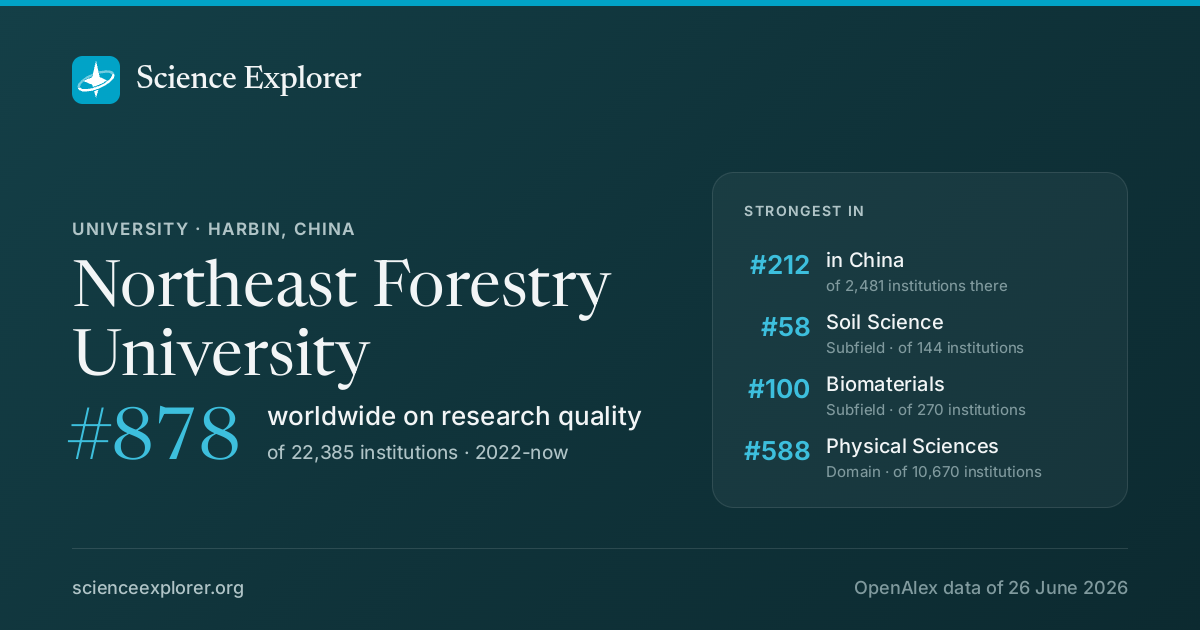
In research, Northeast Forestry University stands highest in Physical Sciences (#588 of 10,670 worldwide), Engineering (#521 of 5,901 worldwide) and Life Sciences (#593 of 6,403 worldwide), 2022-now. Relative to its size it is most specialised in Nature and Landscape Conservation, Polymers and Plastics and Biomaterials (Nature and Landscape Conservation is 7.4× its share of world research).
- World rank, 2022-now
- #878 of 22,385 · #1,260 all time
- Rank in China
- #212 of 2,481
- Research works
- 21k ▲ 107% vs 2018-21
- Citations
- 262k 12.2 per fractional work
- Top-10% rate
- 12.6% all institutions 10.0%
- vs its own fields
- 1.13× 1.00× is exactly expected
- Open access
- 34% world 40%
- International
- 8% world 18%
What is Northeast Forestry University known for in research?
The fields where it stands highest, 2022-now, ranked among every institution above the floor in each field.
| Field | World rank | Where that sits | Top-10% rate | Works | All time |
|---|---|---|---|---|---|
| Physical SciencesDomain | #588 of 10,670 | 12.5% | 4,141 | #951 | |
| EngineeringField | #521 of 5,901 | 12.2% | 1,636 | #918 | |
| Life SciencesDomain | #593 of 6,403 | 12.9% | 1,473 | #1033 | |
| Agricultural and Biological SciencesField | #302 of 3,157 | 14.0% | 825 | #592 | |
| Materials ScienceField | #244 of 2,276 | 14.6% | 725 | #543 | |
| Environmental ScienceField | #462 of 3,334 | 11.7% | 863 | #684 | |
| Plant ScienceSubfield | #202 of 1,317 | 12.9% | 502 | #445 | |
| Health SciencesDomain | #2,301 of 9,902 | 15.0% | 282 | #3127 | |
| Biochemistry, Genetics and Molecular BiologyField | #734 of 2,964 | 11.1% | 564 | #1240 | |
| Electrical and Electronic EngineeringSubfield | #579 of 2,176 | 14.1% | 264 | #1075 |
Each strip is that field's whole ranked pool, with the notch where Northeast Forestry University sits in it, in the colour of the band that rank falls in. The track under the rate is the rate itself: it carries no average mark, because the average differs by field (from about 6% in Dentistry to 21% in Economics).
Which of those standings moved
The same fields on both windows: where it stood over the whole record, and where it stands in 2022-now. The distance is the story, and it is the one thing the two rank columns above cannot show.
- Physical Sciences#951 #588
- Engineering#918 #521
- Life Sciences#1,033 #593
- Agricultural and Biological Sciences#592 #302
- Materials Science#543 #244
- Environmental Science#684 #462
- Plant Science#445 #202
- Health Sciences#3,127 #2,301
- Biochemistry, Genetics and Molecular Biology#1,240 #734
- Electrical and Electronic Engineering#1,075 #579
A dot further right is a better standing. Fields it was not ranked in over the whole record are left out.
Which fields of science does Northeast Forestry University work in?
In 2022-now, 67% of research at Northeast Forestry University is in Physical Sciences, 24% in Life Sciences. Its largest fields are Engineering (27%), Environmental Science (14%), Agricultural and Biological Sciences (13%). It does 1.8× the world's share of Life Sciences.
Each ring splits the one inside it: the four domains of science, their fields, their subfields. Size is fractional works in 2022-now. Every slice is a page; the interactive view zooms down to single topics and colours each by how much more of it this institution does than the world.
Its 4 domains and 26 fields, with their numbers
- Physical Sciences4,78866.7%
- Engineering1,90826.6%
- Environmental Science98213.7%
- Materials Science82311.5%
- Computer Science3595.0%
- Chemistry2423.4%
- Energy1722.4%
- Earth and Planetary Sciences1532.1%
- Mathematics570.8%
- Physics and Astronomy470.7%
- Chemical Engineering450.6%
- Life Sciences1,71123.8%
- Social Sciences3585.0%
- Social Sciences1261.8%
- Business, Management and Accounting751.0%
- Economics, Econometrics and Finance711.0%
- Decision Sciences330.5%
- Psychology300.4%
- Arts and Humanities240.3%
- Health Sciences3254.5%
- Medicine2743.8%
- Nursing300.4%
- Health Professions160.2%
- Veterinary40.1%
- Dentistry10.0%
What does Northeast Forestry University specialise in?
Where its research is concentrated relative to its size: Nature and Landscape Conservation takes 7.4× the share of its output that it takes of world research.
- Nature and Landscape ConservationSubfield · 126.7 works7.4×
- Polymers and PlasticsSubfield · 199.8 works6.9×
- BiomaterialsSubfield · 198.6 works6.5×
- Surfaces, Coatings and FilmsSubfield · 35.9 works5.1×
- Global and Planetary ChangeSubfield · 250.5 works4.6×
- Plant ScienceSubfield · 572.6 works4.6×
- Civil and Structural EngineeringSubfield · 367.1 works4.3×
- Building and ConstructionSubfield · 187.6 works4.2×
Location quotient, a volume reading rather than an impact one. It surfaces small, lopsided specialities.
Field profile
Location quotient across every field it publishes in: outside the ring is more than an institution of this size would be expected to publish, inside it is less.
Rings at 0.5×, 1× and 2×. Widest outward: Materials Science, 3.3×. Every wedge is a field page.
All 26 fields, with their numbers
- Materials Science3.28×823 works
- Agricultural and Biological Sciences2.78×948 works
- Environmental Science2.75×982 works
- Energy2.60×172 works
- Chemistry2.15×242 works
- Chemical Engineering1.80×45 works
- Engineering1.77×1,908 works
- Biochemistry, Genetics and Molecular Biology1.73×664 works
- Earth and Planetary Sciences1.36×153 works
- Nursing0.84×30 works
- Pharmacology, Toxicology and Pharmaceutics0.77×20 works
- Mathematics0.67×56 works
- Computer Science0.64×359 works
- Immunology and Microbiology0.50×36 works
- Decision Sciences0.47×32 works
- Veterinary0.46×4 works
- Economics, Econometrics and Finance0.46×71 works
- Neuroscience0.38×44 works
- Business, Management and Accounting0.32×75 works
- Physics and Astronomy0.29×47 works
- Medicine0.20×274 works
- Psychology0.14×30 works
- Social Sciences0.14×126 works
- Arts and Humanities0.12×24 works
- Health Professions0.08×16 works
- Dentistry0.04×1 works
- Materials Science 3.3×
- Agricultural and Biological Sciences 2.8×
- Environmental Science 2.8×
- Energy 2.6×
- Chemistry 2.1×
- Chemical Engineering 1.8×
- Engineering 1.8×
- Biochemistry, Genetics and Molecular Biology 1.7×
- Earth and Planetary Sciences 1.4×
- Nursing 0.8×
- Pharmacology, Toxicology and Pharmaceutics 0.8×
- Mathematics 0.7×
- Computer Science 0.6×
- Immunology and Microbiology 0.5×
- Decision Sciences 0.5×
- Veterinary 0.5×
- Economics, Econometrics and Finance 0.5×
- Neuroscience 0.4×
- Business, Management and Accounting 0.3×
- Physics and Astronomy 0.3×
- Medicine 0.2×
- Psychology 0.1×
- Social Sciences 0.1×
- Arts and Humanities 0.1×
- Health Professions 0.1×
- Dentistry 0.0×
Who are the top researchers at Northeast Forestry University?
Ranked on the quality score, Haipeng Yu, Wenshuai Chen and Zhenghu Zhou lead among researchers whose main affiliation is Northeast Forestry University.
- 1
Haipeng Yu
 China · #7,591 worldwide
17k citations · 184 works
- 2
Wenshuai Chen
China · #28,413 worldwide
14k citations · 212 works
- 3
Zhenghu Zhou
China · #29,784 worldwide
4.9k citations · 80 works
- 4
Qinqin Xia
China · #41,358 worldwide
5.2k citations · 55 works
- 5
Siqi Huan
China · #51,110 worldwide
5.9k citations · 105 works
- 6
Shouxin Liu
China · #53,043 worldwide
18k citations · 386 works
- 7
Long Bai
China · #56,226 worldwide
8.3k citations · 172 works
- 8
Suqing Zeng
China · #56,631 worldwide
1.3k citations · 31 works
- 9
Wentao Gan
China · #60,505 worldwide
10k citations · 95 works
- 10
Yongzhuang Liu
China · #61,000 worldwide
4.2k citations · 44 works
Which keywords describe research at Northeast Forestry University?
By fractional works in 2022-now, weighted toward what it does more of than the world: Climate Change, Biomedical Applications, Nanocomposites, Mechanical Properties, Nanomaterials, Biomass Estimation, Gene Expression and Transcription Factors.
- Forest Management
- Signal Transduction
- Plant
- MicroRNA
- Epigenetic Regulation
- Ecosystem Services
- Antioxidants
- Ionic Liquids
- Global Change
- Invasive Species
- Energy Storage
- Ecosystem Resilience
- Antioxidant
- Transcription Factors
- Graphene
- Oxidative Stress
- Environmental Impact
- Nanocomposites
- Nanomaterials
- Biomedical Applications
- Climate Change
- Deep Learning
- Mechanical Properties
- Remote Sensing
- Gene Expression
- Biomass Estimation
- Nanoparticles
- Biodiversity Conservation
- Tissue Engineering
- Biodegradable Polymers
- Aboveground Biomass
- Metal-Organic Frameworks
- Ecosystem Functioning
- Reactive Oxygen Species
- Land Use Change
- Polymer Composites
- Recycled Materials
- Auxin
- Anthocyanins
- Hydrology
Size is fractional works in 2022-now in the topics tagged with each word; colour is the word's share of this institution's work against its share of the world's. The 40 words are chosen for being large and distinctive. Each links to the topic it comes from most.
All 40 words, with their numbers
- Climate Change528▲ 2.7×89 topics
- Biomedical Applications393▲ 4.6×36 topics
- Deep Learning342▲ 1.38×79 topics
- Nanomaterials278▲ 3.7×20 topics
- Mechanical Properties273▲ 3.9×37 topics
- Nanocomposites262▲ 4.6×20 topics
- Remote Sensing260▲ 3.0×36 topics
- Environmental Impact255▲ 2.1×51 topics
- Gene Expression213▲ 4.7×17 topics
- Oxidative Stress189▲ 1.60×51 topics
- Biomass Estimation177▲ 16×3 topics
- Graphene176▲ 3.6×11 topics
- Nanoparticles170▲ 1.88×37 topics
- Transcription Factors169▲ 18×5 topics
- Biodiversity Conservation157▲ 5.8×13 topics
- Antioxidant139▲ 2.8×47 topics
- Tissue Engineering137▲ 3.1×12 topics
- Ecosystem Resilience137▲ 12×5 topics
- Biodegradable Polymers134▲ 11×4 topics
- Energy Storage133▲ 2.9×12 topics
- Aboveground Biomass131▲ 21×2 topics
- Invasive Species129▲ 4.2×20 topics
- Metal-Organic Frameworks129▲ 4.3×6 topics
- Global Change128▲ 6.8×7 topics
- Ecosystem Functioning128▲ 8.7×7 topics
- Ionic Liquids123▲ 6.1×10 topics
- Reactive Oxygen Species122▲ 4.1×11 topics
- Antioxidants120▲ 3.8×16 topics
- Land Use Change117▲ 5.5×8 topics
- Ecosystem Services114▲ 4.1×10 topics
- Polymer Composites102▲ 5.3×6 topics
- Epigenetic Regulation100▲ 6.6×5 topics
- Recycled Materials99▲ 12×2 topics
- MicroRNA89▲ 10×2 topics
- Auxin84▲ 25×1 topic
- Plant84▲ 25×1 topic
- Anthocyanins83▲ 17×3 topics
- Signal Transduction83▲ 7.4×6 topics
- Hydrology81▲ 8.8×4 topics
- Forest Management80▲ 18×4 topics
Which research topics does Northeast Forestry University publish most on?
By volume in 2022-now: Plant Molecular Biology Research, Plant Gene Expression Analysis, Forest ecology and management and Advanced Cellulose Research Studies.
Area is fractional works; colour is the subfield each topic belongs to.
- 1 Plant Molecular Biology Research Plant Science 84 works
- 2 Plant Gene Expression Analysis Molecular Biology 73 works
- 3 Forest ecology and management Nature and Landscape Conservation 70 works
- 4 Advanced Cellulose Research Studies Biomaterials 70 works
- 5 Plant Stress Responses and Tolerance Plant Science 67 works
- 6 Lignin and Wood Chemistry Biomedical Engineering 63 works
- 7 Soil Carbon and Nitrogen Dynamics Soil Science 63 works
- 8 Remote Sensing and LiDAR Applications Environmental Engineering 61 works
- 9 Innovative concrete reinforcement materials Civil and Structural Engineering 60 works
- 10 Advanced Photocatalysis Techniques Renewable Energy, Sustainability and the Environment 56 works
How open and international is its research?
Against the world's own shares: the tick on each track. Both are shares of its output, so they sit on one scale and can be read against each other as well as against the world.
World: 40% of research is openly available.
World: 18% is written across borders.
How has Northeast Forestry University's research output changed?
Output in 2022-2025 was 107% higher than in 2018-2021.
The same series as a ribbon: one cell per year, darker for more. The line above answers how much; this answers when.
Its share of all research
Growing output can still be a shrinking share: all of science grows. This is Northeast Forestry University as a percentage of every work published that year, 0.030% in 2024.
Fractional works of Northeast Forestry University over all fractional works that year. How the balance of science has shifted.
How much of it reaches the world top 10%
Year by year, against all institutions in the same year.
Of each year's output, the share that reached the world's 10% most cited for its field and year. Peak 13.4% in 2024.
Other research institutions in Harbin
- Harbin Institute of Technology
- Harbin Engineering University
- Harbin Medical University
- Northeast Agricultural University
- Harbin University of Science and Technology
- Heilongjiang University
- Harbin University of Commerce
- Heilongjiang Institute of Technology
Compare Northeast Forestry University with
- vs
 Murdoch University
- vs
 SickKids Foundation
- vs
 Hamad bin Khalifa University
- vs
 Kyungpook National University
- vs Memorial University of Newfoundland
- vs
 École Polytechnique
Share Northeast Forestry University's ranking



Research measures only: rankings here say nothing about teaching, admissions or student experience. Comparable institutions and collaboration partners have tabs of their own, above.
Discussion
Ask a question or share a note about Northeast Forestry University. Posts are plain text and can be reported.