Harbin Engineering University
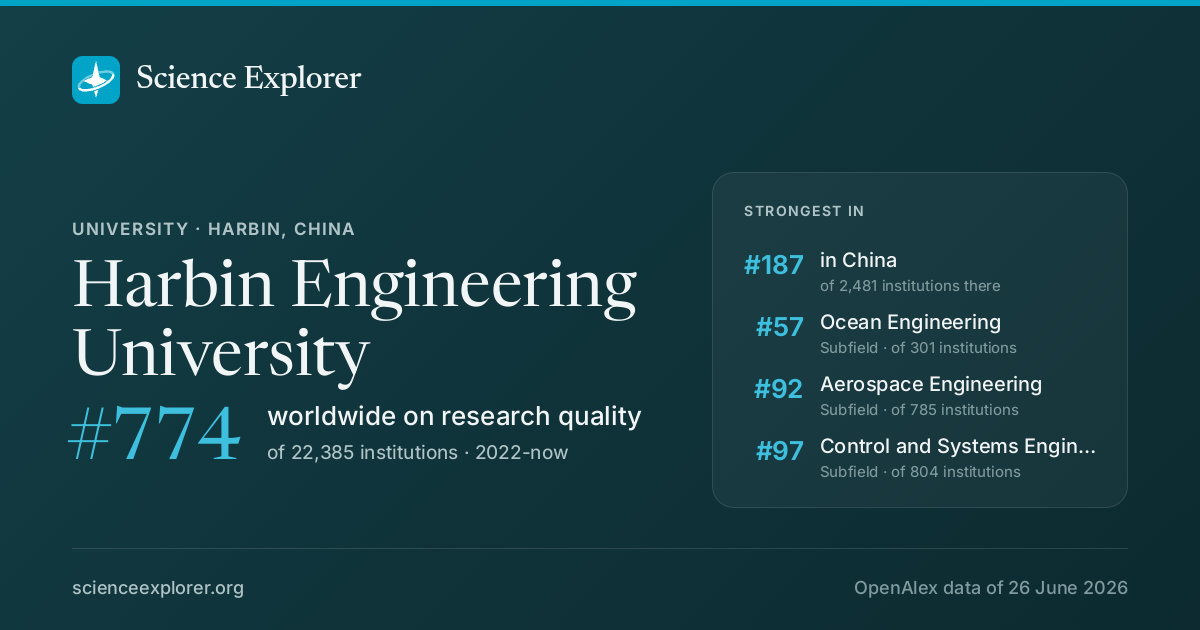
In research, Harbin Engineering University stands highest in Engineering (#184 of 5,901 worldwide), Physical Sciences (#521 of 10,670 worldwide) and Computer Science (#430 of 4,417 worldwide), 2022-now. Relative to its size it is most specialised in Ocean Engineering, Fluid Flow and Transfer Processes and Computational Mechanics (Ocean Engineering is 11.2× its share of world research).
- World rank, 2022-now
- #774 of 22,385 · #965 all time
- Rank in China
- #187 of 2,481
- Research works
- 41k ▲ 45% vs 2018-21
- Citations
- 414k 10.1 per fractional work
- Top-10% rate
- 11.9% all institutions 10.0%
- vs its own fields
- 1.06× 1.00× is exactly expected
- Open access
- 22% world 40%
- International
- 8% world 18%
What is Harbin Engineering University known for in research?
The fields where it stands highest, 2022-now, ranked among every institution above the floor in each field.
| Field | World rank | Where that sits | Top-10% rate | Works | All time |
|---|---|---|---|---|---|
| EngineeringField | #184 of 5,901 | 12.2% | 5,973 | #320 | |
| Physical SciencesDomain | #521 of 10,670 | 11.8% | 9,901 | #606 | |
| Computer ScienceField | #430 of 4,417 | 10.7% | 1,735 | #526 | |
| Mechanical EngineeringSubfield | #133 of 1,319 | 12.5% | 761 | #296 | |
| Aerospace EngineeringSubfield | #92 of 785 | 12.2% | 995 | #143 | |
| Control and Systems EngineeringSubfield | #97 of 804 | 13.9% | 704 | #127 | |
| Materials ScienceField | #286 of 2,276 | 12.6% | 784 | #514 | |
| Materials ChemistrySubfield | #260 of 1,473 | 13.3% | 491 | #436 | |
| Electrical and Electronic EngineeringSubfield | #408 of 2,176 | 9.2% | 922 | #492 | |
| Ocean EngineeringSubfield | #57 of 301 | 13.0% | 623 | #125 |
Each strip is that field's whole ranked pool, with the notch where Harbin Engineering University sits in it, in the colour of the band that rank falls in. The track under the rate is the rate itself: it carries no average mark, because the average differs by field (from about 6% in Dentistry to 21% in Economics).
Which of those standings moved
The same fields on both windows: where it stood over the whole record, and where it stands in 2022-now. The distance is the story, and it is the one thing the two rank columns above cannot show.
- Engineering#320 #184
- Physical Sciences#606 #521
- Computer Science#526 #430
- Mechanical Engineering#296 #133
- Aerospace Engineering#143 #92
- Control and Systems Engineering#127 #97
- Materials Science#514 #286
- Materials Chemistry#436 #260
- Electrical and Electronic Engineering#492 #408
- Ocean Engineering#125 #57
A dot further right is a better standing. Fields it was not ranked in over the whole record are left out.
Which fields of science does Harbin Engineering University work in?
In 2022-now, 92% of research at Harbin Engineering University is in Physical Sciences, 5% in Social Sciences. Its largest fields are Engineering (55%), Computer Science (16%), Materials Science (7%). It does 2.4× the world's share of Physical Sciences.
Each ring splits the one inside it: the four domains of science, their fields, their subfields. Size is fractional works in 2022-now. Every slice is a page; the interactive view zooms down to single topics and colours each by how much more of it this institution does than the world.
Its 4 domains and 26 fields, with their numbers
- Physical Sciences11k92.3%
- Engineering6,69755.3%
- Computer Science1,96316.2%
- Materials Science8907.3%
- Earth and Planetary Sciences4243.5%
- Environmental Science3883.2%
- Physics and Astronomy3082.5%
- Energy1391.2%
- Chemical Engineering1361.1%
- Chemistry1181.0%
- Mathematics1171.0%
- Social Sciences5954.9%
- Social Sciences1431.2%
- Business, Management and Accounting1391.2%
- Decision Sciences1311.1%
- Economics, Econometrics and Finance1020.8%
- Psychology490.4%
- Arts and Humanities300.3%
- Health Sciences1831.5%
- Medicine1471.2%
- Health Professions290.2%
- Nursing30.0%
- Dentistry30.0%
- Veterinary10.0%
- Life Sciences1601.3%
What does Harbin Engineering University specialise in?
Where its research is concentrated relative to its size: Ocean Engineering takes 11.2× the share of its output that it takes of world research.
- Ocean EngineeringSubfield · 707.1 works11×
- Fluid Flow and Transfer ProcessesSubfield · 98.4 works10×
- Computational MechanicsSubfield · 571.2 works8.1×
- Aerospace EngineeringSubfield · 1,141.8 works8.1×
- OceanographySubfield · 228.6 works6.7×
- Control and Systems EngineeringSubfield · 773.4 works5.9×
- Signal ProcessingSubfield · 205.4 works5.6×
Location quotient, a volume reading rather than an impact one. It surfaces small, lopsided specialities.
Field profile
Location quotient across every field it publishes in: outside the ring is more than an institution of this size would be expected to publish, inside it is less.
Rings at 0.5×, 1× and 2×. Widest outward: Engineering, 3.7×. Every wedge is a field page.
All 26 fields, with their numbers
- Engineering3.68×6,697 works
- Chemical Engineering3.22×136 works
- Earth and Planetary Sciences2.23×424 works
- Materials Science2.10×890 works
- Computer Science2.08×1,963 works
- Energy1.25×140 works
- Physics and Astronomy1.14×308 works
- Decision Sciences1.12×131 works
- Mathematics0.82×117 works
- Environmental Science0.64×388 works
- Chemistry0.62×118 works
- Economics, Econometrics and Finance0.39×102 works
- Business, Management and Accounting0.36×140 works
- Neuroscience0.16×32 works
- Psychology0.13×49 works
- Biochemistry, Genetics and Molecular Biology0.12×80 works
- Health Professions0.09×29 works
- Arts and Humanities0.09×30 works
- Social Sciences0.09×143 works
- Agricultural and Biological Sciences0.07×40 works
- Immunology and Microbiology0.06×7 works
- Medicine0.06×146 works
- Pharmacology, Toxicology and Pharmaceutics0.05×2 works
- Dentistry0.05×3 works
- Nursing0.05×3 works
- Veterinary0.03×1 works
- Engineering 3.7×
- Chemical Engineering 3.2×
- Earth and Planetary Sciences 2.2×
- Materials Science 2.1×
- Computer Science 2.1×
- Energy 1.2×
- Physics and Astronomy 1.1×
- Decision Sciences 1.1×
- Mathematics 0.8×
- Environmental Science 0.6×
- Chemistry 0.6×
- Economics, Econometrics and Finance 0.4×
- Business, Management and Accounting 0.4×
- Neuroscience 0.2×
- Psychology 0.1×
- Biochemistry, Genetics and Molecular Biology 0.1×
- Health Professions 0.1×
- Arts and Humanities 0.1×
- Social Sciences 0.1×
- Agricultural and Biological Sciences 0.1×
- Immunology and Microbiology 0.1×
- Medicine 0.1×
- Pharmacology, Toxicology and Pharmaceutics 0.1×
- Dentistry 0.1×
- Nursing 0.1×
- Veterinary 0.0×
Who are the top researchers at Harbin Engineering University?
Ranked on the quality score, Piaoping Yang, Zhuangjun Fan and Yujin Chen lead among researchers whose main affiliation is Harbin Engineering University.
- 1
Piaoping Yang
 China · #4,610 worldwide
44k citations · 567 works
- 2
Zhuangjun Fan
China · #5,431 worldwide
39k citations · 267 works
- 3
Yujin Chen
China · #7,214 worldwide
29k citations · 398 works
- 4
Shili Gai
China · #7,988 worldwide
25k citations · 292 works
- 5
Chunling Zhu
China · #10,829 worldwide
17k citations · 225 works
- 6
Lili Feng
China · #14,136 worldwide
11k citations · 190 works
- 7
Fei He
China · #20,265 worldwide
22k citations · 335 works
- 8
Dan Yang
China · #20,522 worldwide
11k citations · 154 works
- 9
Kai Zhu
China · #34,329 worldwide
23k citations · 475 works
- 10
Shuming Dong
China · #37,834 worldwide
6k citations · 63 works
Which keywords describe research at Harbin Engineering University?
By fractional works in 2022-now, weighted toward what it does more of than the world: Deep Learning, Wireless Sensor Networks, Neural Networks, Numerical Simulation, Heat Transfer, Mechanical Properties, Machine Learning and Acoustic Communications.
- Stability Analysis
- Maritime Transportation
- Seafloor Mapping
- Marine Sediments
- Disturbance Observer
- Emissions
- Robotics
- Nonlinear Dynamics
- Robotic Manipulators
- Sensor Networks
- Vibration Analysis
- Adaptive Control
- Path Planning
- Microstructure
- Convolutional Neural Networks
- Underwater Acoustic Sensor Networks
- Remote Sensing
- Heat Transfer
- Wireless Sensor Networks
- Machine Learning
- Deep Learning
- Neural Networks
- Mechanical Properties
- Numerical Simulation
- Acoustic Communications
- Fluid-Structure Interaction
- Nonlinear Systems
- Multi-Agent Systems
- Collision Avoidance
- Neural Network
- Feedback Control
- Sliding Mode Control
- Turbulent Flow
- Large-Eddy Simulation
- Sparse Representation
- Aerial Vehicles
- Finite-Time Stability
- Acoustic Techniques
- Wireless Communications
- Sensor Fusion
Size is fractional works in 2022-now in the topics tagged with each word; colour is the word's share of this institution's work against its share of the world's. The 40 words are chosen for being large and distinctive. Each links to the topic it comes from most.
All 40 words, with their numbers
- Deep Learning1,204▲ 2.9×85 topics
- Machine Learning673▲ 1.67×89 topics
- Neural Networks620▲ 3.3×38 topics
- Wireless Sensor Networks504▲ 9.3×22 topics
- Mechanical Properties448▲ 3.8×38 topics
- Heat Transfer391▲ 6.6×20 topics
- Numerical Simulation376▲ 11×14 topics
- Remote Sensing342▲ 2.3×32 topics
- Acoustic Communications291▲ 56×1 topic
- Underwater Acoustic Sensor Networks291▲ 56×1 topic
- Fluid-Structure Interaction277▲ 15×6 topics
- Convolutional Neural Networks270▲ 3.1×14 topics
- Nonlinear Systems268▲ 10×8 topics
- Microstructure264▲ 4.2×18 topics
- Multi-Agent Systems254▲ 11×6 topics
- Path Planning253▲ 17×3 topics
- Collision Avoidance244▲ 11×4 topics
- Adaptive Control230▲ 14×7 topics
- Neural Network225▲ 10×9 topics
- Vibration Analysis220▲ 6.8×9 topics
- Feedback Control217▲ 11×8 topics
- Sensor Networks210▲ 7.2×6 topics
- Sliding Mode Control197▲ 24×2 topics
- Robotic Manipulators191▲ 16×3 topics
- Turbulent Flow176▲ 12×4 topics
- Nonlinear Dynamics175▲ 6.5×7 topics
- Large-Eddy Simulation173▲ 7.6×5 topics
- Robotics172▲ 5.8×10 topics
- Sparse Representation171▲ 7.5×6 topics
- Emissions167▲ 7.0×6 topics
- Aerial Vehicles166▲ 27×2 topics
- Disturbance Observer166▲ 28×1 topic
- Finite-Time Stability166▲ 28×1 topic
- Marine Sediments166▲ 21×2 topics
- Acoustic Techniques165▲ 44×1 topic
- Seafloor Mapping165▲ 44×1 topic
- Wireless Communications163▲ 7.7×5 topics
- Maritime Transportation162▲ 24×2 topics
- Sensor Fusion157▲ 12×3 topics
- Stability Analysis154▲ 8.1×5 topics
Which research topics does Harbin Engineering University publish most on?
By volume in 2022-now: Underwater Vehicles and Communication Systems, Adaptive Control of Nonlinear Systems, Underwater Acoustics Research and Fluid Dynamics Simulations and Interactions.
Area is fractional works; colour is the subfield each topic belongs to.
- 1 Underwater Vehicles and Communication Systems Ocean Engineering 291 works
- 2 Adaptive Control of Nonlinear Systems Control and Systems Engineering 166 works
- 3 Underwater Acoustics Research Oceanography 165 works
- 4 Fluid Dynamics Simulations and Interactions Computational Mechanics 125 works
- 5 Robotic Path Planning Algorithms Computer Vision and Pattern Recognition 114 works
- 6 Maritime Navigation and Safety Ocean Engineering 108 works
- 7 Distributed Control Multi-Agent Systems Computer Networks and Communications 103 works
- 8 Advanced Fiber Optic Sensors Electrical and Electronic Engineering 103 works
- 9 Ship Hydrodynamics and Maneuverability Ocean Engineering 100 works
- 10 Nuclear Engineering Thermal-Hydraulics Aerospace Engineering 96 works
How open and international is its research?
Against the world's own shares: the tick on each track. Both are shares of its output, so they sit on one scale and can be read against each other as well as against the world.
World: 40% of research is openly available.
World: 18% is written across borders.
How has Harbin Engineering University's research output changed?
Output in 2022-2025 was 45% higher than in 2018-2021.
The same series as a ribbon: one cell per year, darker for more. The line above answers how much; this answers when.
Its share of all research
Growing output can still be a shrinking share: all of science grows. This is Harbin Engineering University as a percentage of every work published that year, 0.055% in 2024.
Fractional works of Harbin Engineering University over all fractional works that year. How the balance of science has shifted.
How much of it reaches the world top 10%
Year by year, against all institutions in the same year.
Of each year's output, the share that reached the world's 10% most cited for its field and year. Peak 12.7% in 2025.
Other research institutions in Harbin
- Harbin Institute of Technology
- Harbin Medical University
- Northeast Forestry University
- Northeast Agricultural University
- Harbin University of Science and Technology
- Heilongjiang University
- Harbin University of Commerce
- Heilongjiang Institute of Technology
Compare Harbin Engineering University with
- vs
 Pontificia Universidad Católica de Chile
- vs
 Cranfield University
- vs
 Wake Forest University
- vs
 University of Haifa
- vs
 Universidad de Málaga
- vs
 Université Sorbonne Paris Nord
Share Harbin Engineering University's ranking



Research measures only: rankings here say nothing about teaching, admissions or student experience. Comparable institutions and collaboration partners have tabs of their own, above.
Discussion
Ask a question or share a note about Harbin Engineering University. Posts are plain text and can be reported.