Science Explorer Back to mapMap
Discussion
Company · Tokyo · Japan

Organ Technologies (Japan)

World rank, all time
#29,131
of 34,923
Rank in Japan
#1,236
of 1,923
Research works
195
▲ 5% vs 2018-21
Citations
2k
10.3 per fractional work
Top-10% rate
8.5%
all institutions 10.0%
vs its own fields
0.84×
1.00× is exactly expected
Open access
44%
world 40%
International
12%
world 18%

Which fields of science does Organ Technologies (Japan) work in?

In 2022-now, 41% of research at Organ Technologies (Japan) is in Health Sciences, 41% in Physical Sciences. Its largest fields are Medicine (39%), Engineering (18%), Environmental Science (15%). It does 1.5× the world's share of Health Sciences.

Health Sciences: 9 fractional works · 41.0% of its workMedicine: 9 fractional works · 39.5% of its workEpidemiology: 2 fractional works · 10.3% of its workSurgery: 2 fractional works · 7.5% of its workPulmonary and Respiratory Medicine: 1 fractional works · 4.4% of its workPublic Health, Environmental and Occupational Health: 1 fractional works · 3.9% of its workUrology: 1 fractional works · 2.5% of its workTransplantation: 0 fractional works · 2.3% of its workOncology: 0 fractional works · 2.0% of its workHematology: 0 fractional works · 1.5% of its workPhysiology: 0 fractional works · 1.1% of its workHepatology: 0 fractional works · 1.0% of its workInfectious Diseases: 0 fractional works · 0.8% of its workDermatology: 0 fractional works · 0.5% of its workObstetrics and Gynecology: 0 fractional works · 0.5% of its workRadiology, Nuclear Medicine and Imaging: 0 fractional works · 0.5% of its workReproductive Medicine: 0 fractional works · 0.4% of its workEndocrinology, Diabetes and Metabolism: 0 fractional works · 0.2% of its workHealth Professions: 0 fractional works · 0.8% of its workSpeech and Hearing: 0 fractional works · 0.8% of its workDentistry: 0 fractional works · 0.5% of its workPeriodontics: 0 fractional works · 0.5% of its workNursing: 0 fractional works · 0.3% of its workNutrition and Dietetics: 0 fractional works · 0.3% of its workPhysical Sciences: 9 fractional works · 40.8% of its workEngineering: 4 fractional works · 18.0% of its workBiomedical Engineering: 2 fractional works · 7.3% of its workMechanical Engineering: 2 fractional works · 7.0% of its workIndustrial and Manufacturing Engineering: 0 fractional works · 1.5% of its workSafety, Risk, Reliability and Quality: 0 fractional works · 1.5% of its workBuilding and Construction: 0 fractional works · 0.5% of its workSmaller subfields together: 0 fractional works · 0.2% of its workEnvironmental Science: 3 fractional works · 14.5% of its workIndustrial and Manufacturing Engineering: 2 fractional works · 10.3% of its workPollution: 0 fractional works · 1.5% of its workWater Science and Technology: 0 fractional works · 1.5% of its workEnvironmental Chemistry: 0 fractional works · 0.8% of its workEcology: 0 fractional works · 0.3% of its workMaterials Science: 1 fractional works · 4.8% of its workBiomaterials: 1 fractional works · 3.2% of its workSurfaces, Coatings and Films: 0 fractional works · 1.5% of its workChemistry: 0 fractional works · 2.3% of its workAnalytical Chemistry: 0 fractional works · 1.5% of its workElectrochemistry: 0 fractional works · 0.8% of its workChemical Engineering: 0 fractional works · 0.8% of its workBioengineering: 0 fractional works · 0.8% of its workEnergy: 0 fractional works · 0.4% of its workRenewable Energy, Sustainability and the Environment: 0 fractional works · 0.4% of its workLife Sciences: 3 fractional works · 14.3% of its workBiochemistry, Genetics and Molecular Biology: 3 fractional works · 11.9% of its workMolecular Biology: 1 fractional works · 6.5% of its workAging: 1 fractional works · 4.6% of its workGenetics: 0 fractional works · 0.5% of its workBiotechnology: 0 fractional works · 0.2% of its workAgricultural and Biological Sciences: 0 fractional works · 1.0% of its workPlant Science: 0 fractional works · 0.4% of its workAquatic Science: 0 fractional works · 0.3% of its workEcology, Evolution, Behavior and Systematics: 0 fractional works · 0.3% of its workPharmacology, Toxicology and Pharmaceutics: 0 fractional works · 0.8% of its workPharmaceutical Science: 0 fractional works · 0.7% of its workSmaller subfields together: 0 fractional works · 0.1% of its workImmunology and Microbiology: 0 fractional works · 0.6% of its workImmunology: 0 fractional works · 0.5% of its workSmaller subfields together: 0 fractional works · 0.1% of its workSocial Sciences: 1 fractional works · 3.8% of its workArts and Humanities: 0 fractional works · 2.3% of its workLanguage and Linguistics: 0 fractional works · 0.8% of its workLiterature and Literary Theory: 0 fractional works · 0.8% of its workMuseology: 0 fractional works · 0.8% of its workSocial Sciences: 0 fractional works · 1.5% of its workSociology and Political Science: 0 fractional works · 1.5% of its workALL ITS WORKOrganTechnologies…22fractional works, 2022-now
Life Sciences14%Physical Sciences41%Health Sciences41%Social Sciences4%

Each ring splits the one inside it: the four domains of science, their fields, their subfields. Size is fractional works in 2022-now. Every slice is a page; the interactive view zooms down to single topics and colours each by how much more of it this institution does than the world.

Its 4 domains and 16 fields, with their numbers
    1. Medicine939.5%
    2. Health Professions00.8%
    3. Dentistry00.5%
    4. Nursing00.3%
    1. Engineering418.0%
    2. Environmental Science314.5%
    3. Materials Science14.8%
    4. Chemistry02.3%
    5. Chemical Engineering00.8%
    6. Energy00.4%
    1. Biochemistry, Genetics and Molecular Biology311.9%
    2. Agricultural and Biological Sciences01.0%
    3. Pharmacology, Toxicology and Pharmaceutics00.8%
    4. Immunology and Microbiology00.6%
    1. Arts and Humanities02.3%
    2. Social Sciences01.5%
All of science, and how each field's share has moved since 1950: the Science domain explorer

Field profile

Location quotient across every field it publishes in: outside the ring is more than an institution of this size would be expected to publish, inside it is less.

Agricultural and Biological Sciences: 0.21× its world share, 0 worksAgricultural and Bio…Biochemistry, Genetics and Molecular Biology: 2.22× its world share, 3 worksBiochemistry, Geneti…Immunology and Microbiology: 0.61× its world share, 0 worksImmunology and Micro…Pharmacology, Toxicology and Pharmaceutics: 2.40× its world share, 0 worksPharmacology, Toxico…Chemical Engineering: 2.21× its world share, 0 worksChemical EngineeringChemistry: 1.48× its world share, 0 worksChemistryEnergy: 0.42× its world share, 0 worksEnergyEngineering: 1.20× its world share, 4 worksEngineeringEnvironmental Science: 2.92× its world share, 3 worksEnvironmental ScienceMaterials Science: 1.37× its world share, 1 worksMaterials ScienceDentistry: 1.06× its world share, 0 worksDentistryHealth Professions: 0.29× its world share, 0 worksHealth ProfessionsMedicine: 2.05× its world share, 8 worksMedicineNursing: 0.59× its world share, 0 worksNursingArts and Humanities: 0.80× its world share, 0 worksArts and HumanitiesSocial Sciences: 0.12× its world share, 0 worksSocial Sciences1×world share
more than its size predictsabout as predictedless

Rings at 0.5×, 1× and 2×. Widest outward: Environmental Science, 2.9×. Every wedge is a field page.

All 16 fields, with their numbers
  1. Environmental Science2.92×3 works
  2. Pharmacology, Toxicology and Pharmaceutics2.40×0 works
  3. Biochemistry, Genetics and Molecular Biology2.22×3 works
  4. Chemical Engineering2.21×0 works
  5. Medicine2.05×8 works
  6. Chemistry1.48×0 works
  7. Materials Science1.37×1 works
  8. Engineering1.20×4 works
  9. Dentistry1.06×0 works
  10. Arts and Humanities0.80×0 works
  11. Immunology and Microbiology0.61×0 works
  12. Nursing0.59×0 works
  13. Energy0.42×0 works
  14. Health Professions0.29×0 works
  15. Agricultural and Biological Sciences0.21×0 works
  16. Social Sciences0.12×0 works

Who are the top researchers at Organ Technologies (Japan)?

Ranked on the quality score, Miho Ogawa, Koh‐éi Toyoshima and S. Konaka lead among researchers whose main affiliation is Organ Technologies (Japan).

  1. 1 Miho Ogawa Japan · #1,358,629 worldwide 1.2k citations · 42 works
  2. 2 Koh‐éi Toyoshima Japan · #1,678,887 worldwide 716 citations · 18 works
  3. 3 S. Konaka Japan · #4,836,458 worldwide 124 citations · 22 works
  4. 4 Hitoshi Takada Japan · #5,210,402 worldwide 91 citations · 15 works
  5. 5 J. Ashikari Japan · #5,392,516 worldwide 149 citations · 33 works
All ranked researchers at Organ Technologies (Japan)

What are the most cited papers from Organ Technologies (Japan)?

The most cited paper from Organ Technologies (Japan) is "Fully functional bioengineered tooth replacement as an organ replacement therapy" (Etsuko Ikeda, Ritsuko Morita, Kazuhisa Nakao et al., 2009), with 447 citations. Next come "Functional lacrimal gland regeneration by transplantation of a bioengineered organ germ" (263) and "Fully functional hair follicle regeneration through the rearrangement of stem cells and their niches" (252).

Most cited papers
#PaperReleasedCitations
1 Fully functional bioengineered tooth replacement as an organ replacement therapy Etsuko Ikeda, Ritsuko Morita, Kazuhisa Nakao et al. · Proceedings of the National Academy of Sciences Open access 3 Aug 2009 447
2 Functional lacrimal gland regeneration by transplantation of a bioengineered organ germ Masatoshi Hirayama, Miho Ogawa, Masamitsu Oshima et al. · Nature Communications Open access Oct 2013 263
3 Fully functional hair follicle regeneration through the rearrangement of stem cells and their niches Koh‐éi Toyoshima, Kyosuke Asakawa, Naoko Ishibashi et al. · Nature Communications Open access 17 Apr 2012 252
4 Functional Tooth Regeneration Using a Bioengineered Tooth Unit as a Mature Organ Replacement Regenerative Therapy Masamitsu Oshima, Mitsumasa Mizuno, Aya Imamura et al. · PLoS ONE Open access 12 Jul 2011 212
5 Functional salivary gland regeneration by transplantation of a bioengineered organ germ Miho Ogawa, Masamitsu Oshima, Aya Imamura et al. · Nature Communications Open access Oct 2013 211
All 63 most cited papers, with filters and sorting

Which keywords describe research at Organ Technologies (Japan)?

By fractional works in 2022-now, weighted toward what it does more of than the world: Vaccine Development, Human Metapneumovirus, Respiratory Syncytial Virus, Regenerative Medicine, Battery Recycling, Lithium-ion Batteries, Tissue Engineering and Epidemiology.

▲ more of its work than of the world's◆ about the world's share▼ less than the world's

Size is fractional works in 2022-now in the topics tagged with each word; colour is the word's share of this institution's work against its share of the world's. The 15 words are chosen for being large and distinctive. Each links to the topic it comes from most.

All 15 words, with their numbers
  1. Epidemiology2▲ 2.6×5 topics
  2. Vaccine Development2▲ 39×2 topics
  3. Human Metapneumovirus2▲ 199×1 topic
  4. Respiratory Syncytial Virus2▲ 199×1 topic
  5. Battery Recycling2▲ 88×1 topic
  6. Lithium-ion Batteries2▲ 17×1 topic
  7. Regenerative Medicine2▲ 28×5 topics
  8. Tissue Engineering2▲ 11×5 topics
  9. Graft Survival1▲ 66×2 topics
  10. Monitoring1▲ 59×1 topic
  11. Oxidative Stress1▲ 3.5×4 topics
  12. Wastewater1▲ 68×1 topic
  13. Biomaterials1▲ 21×4 topics
  14. Aging1▲ 8.5×1 topic
  15. Longevity1▲ 59×1 topic

Which research topics does Organ Technologies (Japan) publish most on?

By volume in 2022-now: Respiratory viral infections research, Extraction and Separation Processes, Water Quality Monitoring and Analysis and Genetics, Aging, and Longevity in Model Organisms.

  1. 1 Respiratory viral infections research Epidemiology 2 works
  2. 2 Extraction and Separation Processes Mechanical Engineering 2 works
  3. 3 Water Quality Monitoring and Analysis Industrial and Manufacturing Engineering 1 works
  4. 4 Genetics, Aging, and Longevity in Model Organisms Aging 1 works
  5. 5 Chemical Synthesis and Characterization Industrial and Manufacturing Engineering 1 works
  6. 6 Organ Transplantation Techniques and Outcomes Surgery 1 works
  7. 7 3D Printing in Biomedical Research Biomedical Engineering 1 works
  8. 8 Renal Transplantation Outcomes and Treatments Transplantation 0 works
  9. 9 Reproductive Biology and Fertility Public Health, Environmental and Occupational Health 0 works
  10. 10 Tissue Engineering and Regenerative Medicine Surgery 0 works

How open and international is its research?

Against the world's own shares: the tick on each track. Both are shares of its output, so they sit on one scale and can be read against each other as well as against the world.

openly available43.9%not open56.1%

World: 40% of research is openly available.

with international co-authors11.8%domestic only88.2%

World: 18% is written across borders.

How has Organ Technologies (Japan)'s research output changed?

Output in 2022-2025 was 5% higher than in 2018-2021.

still counting1990200020102020
grewheldshrank

The same series as a ribbon: one cell per year, darker for more. The line above answers how much; this answers when.

Its share of all research

Growing output can still be a shrinking share: all of science grows. This is Organ Technologies (Japan) as a percentage of every work published that year, 0.000065% in 2024.

still counting0.00050%0.0010%Organ Technologies (Japan)0.00014% in 202519801990200020102020

Fractional works of Organ Technologies (Japan) over all fractional works that year. How the balance of science has shifted.

Other research institutions in Tokyo

All research institutions in Tokyo

Share Organ Technologies (Japan)'s ranking
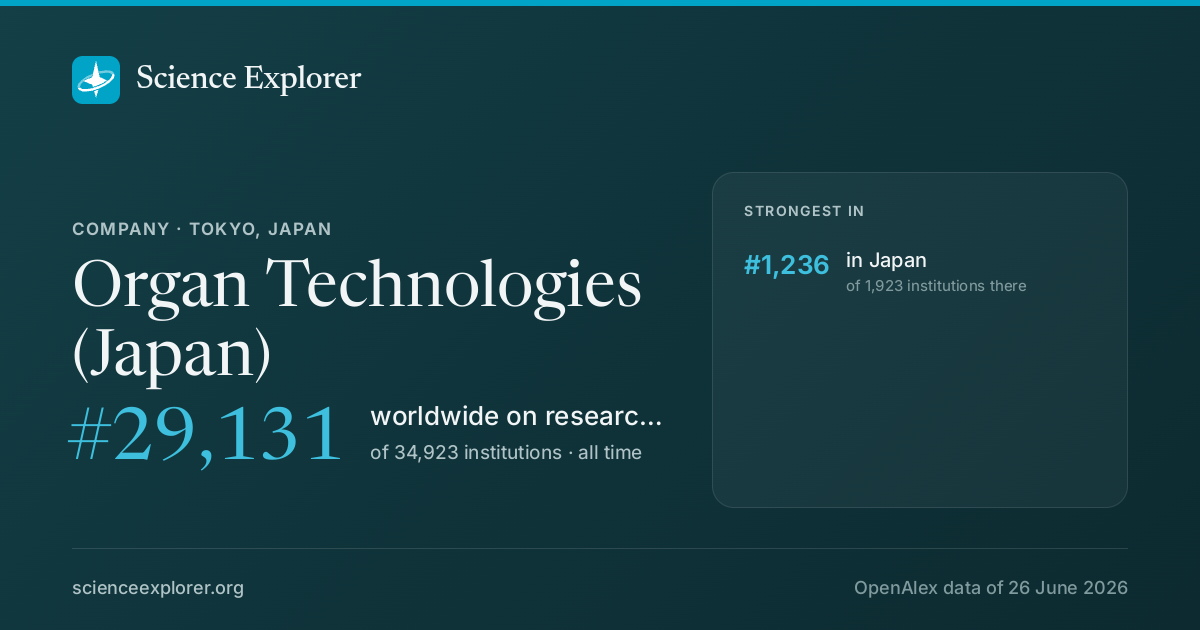
Organ Technologies (Japan) on Science Explorer

A card with Organ Technologies (Japan)'s standing and the fields it leads in, for a post or a slide. A link to this page previews as the same card.

Download the card

1200 × 630 PNG, sized for social posts, drawn from the latest snapshot.

Badges for a website1Each links back here and updates with every snapshot

Research measures only: rankings here say nothing about teaching, admissions or student experience. Comparable institutions and collaboration partners have tabs of their own, above.

Discussion

Ask a question or share a note about Organ Technologies (Japan). Keep it to the research: no personal attacks, advertising or links. Any reader can report a post, which collapses it for everyone until it is opened.