Science Explorer Back to mapMap
Discussion
Hospital / health system · Sanremo · Italy

Ospedale di Sanremo

In research, Ospedale di Sanremo stands highest in Health Sciences (#11,618 of 16,688 worldwide) and Medicine (#10,171 of 14,558 worldwide), over all time.

World rank, all time
#24,479
of 34,923
Rank in Italy
#568
of 743
Research works
260
▼ 72% vs 2018-21
Citations
2.5k
9.7 per fractional work
Top-10% rate
9.4%
all institutions 10.0%
vs its own fields
0.89×
1.00× is exactly expected
Open access
32%
world 40%
International
12%
world 18%

What is Ospedale di Sanremo known for in research?

The fields where it stands highest, over all time, ranked among every institution above the floor in each field.

FieldWorld rankWhere that sitsTop-10% rateWorks
Health SciencesDomain #11,618 of 16,688 7.8%168
MedicineField #10,171 of 14,558 8.1%155

Each strip is that field's whole ranked pool, with the notch where Ospedale di Sanremo sits in it, in the colour of the band that rank falls in. The track under the rate is the rate itself: it carries no average mark, because the average differs by field (from about 6% in Dentistry to 21% in Economics).

Which fields of science does Ospedale di Sanremo work in?

In 2022-now, 67% of research at Ospedale di Sanremo is in Health Sciences, 17% in Life Sciences. Its largest fields are Medicine (66%), Neuroscience (10%), Engineering (6%). It does 2.3× the world's share of Health Sciences.

Health Sciences: 18 fractional works · 67.3% of its workMedicine: 18 fractional works · 65.7% of its workSurgery: 5 fractional works · 17.2% of its workOncology: 2 fractional works · 8.8% of its workPulmonary and Respiratory Medicine: 2 fractional works · 7.1% of its workEpidemiology: 2 fractional works · 6.4% of its workInfectious Diseases: 1 fractional works · 3.8% of its workEndocrinology, Diabetes and Metabolism: 1 fractional works · 2.7% of its workCardiology and Cardiovascular Medicine: 1 fractional works · 2.5% of its workNeurology: 1 fractional works · 2.1% of its workDermatology: 1 fractional works · 2.0% of its workPathology and Forensic Medicine: 0 fractional works · 1.6% of its workNephrology: 0 fractional works · 1.6% of its workEmergency Medicine: 0 fractional works · 1.5% of its workHepatology: 0 fractional works · 1.5% of its workRadiology, Nuclear Medicine and Imaging: 0 fractional works · 1.4% of its workGenetics: 0 fractional works · 0.6% of its workRheumatology: 0 fractional works · 0.6% of its workCritical Care and Intensive Care Medicine: 0 fractional works · 0.6% of its workPhysiology: 0 fractional works · 0.5% of its workPsychiatry and Mental health: 0 fractional works · 0.4% of its workOtorhinolaryngology: 0 fractional works · 0.4% of its workRehabilitation: 0 fractional works · 0.4% of its workGastroenterology: 0 fractional works · 0.3% of its workInternal Medicine: 0 fractional works · 0.3% of its workObstetrics and Gynecology: 0 fractional works · 0.3% of its workOphthalmology: 0 fractional works · 0.3% of its workPharmacology: 0 fractional works · 0.3% of its workSmaller subfields together: 0 fractional works · 0.4% of its workHealth Professions: 0 fractional works · 1.6% of its workGeneral Health Professions: 0 fractional works · 0.6% of its workEmergency Medical Services: 0 fractional works · 0.4% of its workHealth Information Management: 0 fractional works · 0.4% of its workPharmacy: 0 fractional works · 0.3% of its workLife Sciences: 5 fractional works · 16.7% of its workNeuroscience: 3 fractional works · 10.0% of its workCellular and Molecular Neuroscience: 1 fractional works · 5.4% of its workCognitive Neuroscience: 1 fractional works · 4.1% of its workNeurology: 0 fractional works · 0.5% of its workBiochemistry, Genetics and Molecular Biology: 1 fractional works · 2.9% of its workMolecular Biology: 0 fractional works · 0.7% of its workCancer Research: 0 fractional works · 0.5% of its workGenetics: 0 fractional works · 0.5% of its workClinical Biochemistry: 0 fractional works · 0.3% of its workBiophysics: 0 fractional works · 0.2% of its workSmaller subfields together: 0 fractional works · 0.5% of its workAgricultural and Biological Sciences: 1 fractional works · 2.5% of its workPlant Science: 1 fractional works · 1.9% of its workEcology, Evolution, Behavior and Systematics: 0 fractional works · 0.6% of its workImmunology and Microbiology: 0 fractional works · 1.3% of its workVirology: 0 fractional works · 0.9% of its workApplied Microbiology and Biotechnology: 0 fractional works · 0.3% of its workSmaller subfields together: 0 fractional works · 0.1% of its workPhysical Sciences: 3 fractional works · 12.0% of its workEngineering: 2 fractional works · 5.5% of its workBiomedical Engineering: 1 fractional works · 2.9% of its workElectrical and Electronic Engineering: 0 fractional works · 1.7% of its workControl and Systems Engineering: 0 fractional works · 0.6% of its workMechanical Engineering: 0 fractional works · 0.4% of its workEnvironmental Science: 1 fractional works · 2.2% of its workManagement, Monitoring, Policy and Law: 0 fractional works · 1.2% of its workPollution: 0 fractional works · 0.6% of its workIndustrial and Manufacturing Engineering: 0 fractional works · 0.4% of its workMaterials Science: 0 fractional works · 1.8% of its workMaterials Chemistry: 0 fractional works · 1.2% of its workBiomaterials: 0 fractional works · 0.6% of its workEarth and Planetary Sciences: 0 fractional works · 1.2% of its workGeology: 0 fractional works · 1.2% of its workChemistry: 0 fractional works · 1.2% of its workOrganic Chemistry: 0 fractional works · 0.9% of its workElectrochemistry: 0 fractional works · 0.3% of its workComputer Science: 0 fractional works · 0.0% of its workSocial Sciences: 1 fractional works · 4.0% of its workSocial Sciences: 0 fractional works · 1.6% of its workSociology and Political Science: 0 fractional works · 0.9% of its workLaw: 0 fractional works · 0.6% of its workSmaller subfields together: 0 fractional works · 0.1% of its workArts and Humanities: 0 fractional works · 1.2% of its workArcheology: 0 fractional works · 1.2% of its workEconomics, Econometrics and Finance: 0 fractional works · 0.8% of its workEconomics and Econometrics: 0 fractional works · 0.8% of its workPsychology: 0 fractional works · 0.4% of its workClinical Psychology: 0 fractional works · 0.4% of its workALL ITS WORKOspedale diSanremo27fractional works, 2022-now
Life Sciences17%Physical Sciences12%Health Sciences67%Social Sciences4%

Each ring splits the one inside it: the four domains of science, their fields, their subfields. Size is fractional works in 2022-now. Every slice is a page; the interactive view zooms down to single topics and colours each by how much more of it this institution does than the world.

Its 4 domains and 16 fields, with their numbers
    1. Medicine1865.7%
    2. Health Professions01.6%
    1. Neuroscience310.0%
    2. Biochemistry, Genetics and Molecular Biology12.9%
    3. Agricultural and Biological Sciences12.5%
    4. Immunology and Microbiology01.3%
    1. Engineering25.5%
    2. Environmental Science12.2%
    3. Materials Science01.8%
    4. Earth and Planetary Sciences01.2%
    5. Chemistry01.2%
    6. Computer Science00.0%
    1. Social Sciences01.6%
    2. Arts and Humanities01.2%
    3. Economics, Econometrics and Finance00.8%
    4. Psychology00.4%
All of science, and how each field's share has moved since 1950: the Science domain explorer

Field profile

Location quotient across every field it publishes in: outside the ring is more than an institution of this size would be expected to publish, inside it is less.

Agricultural and Biological Sciences: 0.53× its world share, 1 worksAgricultural and Bio…Biochemistry, Genetics and Molecular Biology: 0.53× its world share, 1 worksBiochemistry, Geneti…Immunology and Microbiology: 1.32× its world share, 0 worksImmunology and Micro…Neuroscience: 6.15× its world share, 3 worksNeuroscienceChemistry: 0.74× its world share, 0 worksChemistryComputer Science: 0.01× its world share, 0 worksComputer ScienceEarth and Planetary Sciences: 0.78× its world share, 0 worksEarth and Planetary …Engineering: 0.37× its world share, 2 worksEngineeringEnvironmental Science: 0.45× its world share, 1 worksEnvironmental ScienceMaterials Science: 0.52× its world share, 0 worksMaterials ScienceHealth Professions: 0.62× its world share, 0 worksHealth ProfessionsMedicine: 3.42× its world share, 18 worksMedicineArts and Humanities: 0.42× its world share, 0 worksArts and HumanitiesEconomics, Econometrics and Finance: 0.35× its world share, 0 worksEconomics, Econometr…Psychology: 0.11× its world share, 0 worksPsychologySocial Sciences: 0.13× its world share, 0 worksSocial Sciences1×world share
more than its size predictsabout as predictedless

Rings at 0.5×, 1× and 2×. Widest outward: Neuroscience, 6.2×. Every wedge is a field page.

All 16 fields, with their numbers
  1. Neuroscience6.15×3 works
  2. Medicine3.42×18 works
  3. Immunology and Microbiology1.32×0 works
  4. Earth and Planetary Sciences0.78×0 works
  5. Chemistry0.74×0 works
  6. Health Professions0.62×0 works
  7. Agricultural and Biological Sciences0.53×1 works
  8. Biochemistry, Genetics and Molecular Biology0.53×1 works
  9. Materials Science0.52×0 works
  10. Environmental Science0.45×1 works
  11. Arts and Humanities0.42×0 works
  12. Engineering0.37×2 works
  13. Economics, Econometrics and Finance0.35×0 works
  14. Social Sciences0.13×0 works
  15. Psychology0.11×0 works
  16. Computer Science0.01×0 works

Who are the top researchers at Ospedale di Sanremo?

Ranked on the quality score, Giovanni Cenderello, Antonella De Ceglie and Andrea Raffaele Amato lead among researchers whose main affiliation is Ospedale di Sanremo.

  1. 1 Giovanni Cenderello Italy · #1,706,847 worldwide 1.2k citations · 40 works
  2. 2 Antonella De Ceglie Italy · #1,745,992 worldwide 2.7k citations · 51 works
  3. 3 Andrea Raffaele Amato Italy · #1,828,199 worldwide 1.9k citations · 117 works
  4. 4 Mássimo Conio Italy · #2,109,876 worldwide 7.1k citations · 199 works
  5. 5 Maurizio Abbati Italy · #2,774,479 worldwide 14 citations · 45 works
  6. 6 Sabrina Blanchi Italy · #2,830,818 worldwide 1.8k citations · 66 works
  7. 7 Claudio Rapetto Italy · #3,167,055 worldwide 148 citations · 17 works
  8. 8 Massimo Leoncini Italy · #3,442,621 worldwide 344 citations · 55 works
  9. 9 Federico Ariel Sànchez Italy · #3,531,244 worldwide 188 citations · 24 works
  10. 10 Antonella Loche Italy · #3,918,336 worldwide 467 citations · 16 works
All ranked researchers at Ospedale di Sanremo

What are the most cited papers from Ospedale di Sanremo?

The most cited paper from Ospedale di Sanremo is "Endoscopic submucosal dissection: European Society of Gastrointestinal Endoscopy (ESGE) Guideline" (Pedro Pimentel‐Nunes et al., 2015), with 1,345 citations. Next come "Potentially malignant disorders of the oral cavity and oral dysplasia: A systematic review and meta‐analysis of malignant transformation rate by subtype" (569) and "Accuracy of four intraoral scanners in oral implantology: a comparative in vitro study" (398).

Most cited papers
#PaperReleasedCitations
1 Endoscopic submucosal dissection: European Society of Gastrointestinal Endoscopy (ESGE) Guideline Pedro Pimentel‐Nunes et al. · Endoscopy Open access 28 Aug 2015 1,345
2 Potentially malignant disorders of the oral cavity and oral dysplasia: A systematic review and meta‐analysis of malignant transformation rate by subtype Oreste Iocca, Thomas Peter Sollecito, Faizan Alawi et al. · Head & Neck Review 5 Dec 2019 569
3 Accuracy of four intraoral scanners in oral implantology: a comparative in vitro study Mario Imburgia, Silvia Logozzo, Uli Hauschild et al. · BMC Oral Health Open access 2 Jun 2017 398
4 Esophageal stenting for benign and malignant disease: European Society of Gastrointestinal Endoscopy (ESGE) Clinical Guideline Manon C.W. Spaander, Todd Huntley Baron, Peter Siersema et al. · Endoscopy Open access 14 Sep 2016 329
5 Laparoscopic splenectomy: the clinical practice guidelines of the European Association for Endoscopic Surgery (EAES) Brigitte Habermalz, Stefan Sauerland, G. Anton Decker et al. · Surgical Endoscopy Open access 21 Feb 2008 300
All 60 most cited papers, with filters and sorting

Which keywords describe research at Ospedale di Sanremo?

By fractional works in 2022-now, weighted toward what it does more of than the world: Epidemiology, Percutaneous Coronary Intervention, Clinical Practice Guidelines, Atherosclerosis, Nanomaterials, Tumor Microenvironment, Complications and Electrode Arrays.

▲ more of its work than of the world's◆ about the world's share▼ less than the world's

Size is fractional works in 2022-now in the topics tagged with each word; colour is the word's share of this institution's work against its share of the world's. The 11 words are chosen for being large and distinctive. Each links to the topic it comes from most.

All 11 words, with their numbers
  1. Epidemiology3▲ 2.5×28 topics
  2. Percutaneous Coronary Intervention2▲ 41×4 topics
  3. Clinical Practice Guidelines1▲ 9.3×11 topics
  4. Nanomaterials1▲ 5.0×3 topics
  5. Treatment1▲ 4.1×13 topics
  6. Atherosclerosis1▲ 16×3 topics
  7. Chemotherapy1▲ 6.1×7 topics
  8. Tumor Microenvironment1▲ 9.4×4 topics
  9. Complications1▲ 8.2×10 topics
  10. Electrode Arrays1▲ 91×1 topic
  11. Neural Stimulation1▲ 91×1 topic

Which research topics does Ospedale di Sanremo publish most on?

By volume in 2022-now: Neuroscience and Neural Engineering, Coronary Interventions and Diagnostics, Neural dynamics and brain function and Cardiac and Coronary Surgery Techniques.

  1. 1 Neuroscience and Neural Engineering Cellular and Molecular Neuroscience 1 works
  2. 2 Coronary Interventions and Diagnostics Surgery 1 works
  3. 3 Neural dynamics and brain function Cognitive Neuroscience 1 works
  4. 4 Cardiac and Coronary Surgery Techniques Surgery 1 works
  5. 5 Colorectal Cancer Surgical Treatments Oncology 0 works
  6. 6 Renal and Vascular Pathologies Pulmonary and Respiratory Medicine 0 works
  7. 7 Cancer Immunotherapy and Biomarkers Oncology 0 works
  8. 8 Pancreatic and Hepatic Oncology Research Oncology 0 works
  9. 9 3D Printing in Biomedical Research Biomedical Engineering 0 works
  10. 10 Acute Kidney Injury Research Nephrology 0 works

How open and international is its research?

Against the world's own shares: the tick on each track. Both are shares of its output, so they sit on one scale and can be read against each other as well as against the world.

openly available32.2%not open67.8%

World: 40% of research is openly available.

with international co-authors12.0%domestic only88.0%

World: 18% is written across borders.

How has Ospedale di Sanremo's research output changed?

Output in 2022-2025 was 72% lower than in 2018-2021.

still counting1990200020102020
grewheldshrank

The same series as a ribbon: one cell per year, darker for more. The line above answers how much; this answers when.

Its share of all research

Growing output can still be a shrinking share: all of science grows. This is Ospedale di Sanremo as a percentage of every work published that year, 0.000099% in 2024.

still counting0.00050%0.0010%0.0015%Ospedale di Sanremo0.000050% in 202519801990200020102020

Fractional works of Ospedale di Sanremo over all fractional works that year. How the balance of science has shifted.

Other research institutions in Sanremo

All research institutions in Sanremo

Share Ospedale di Sanremo's ranking
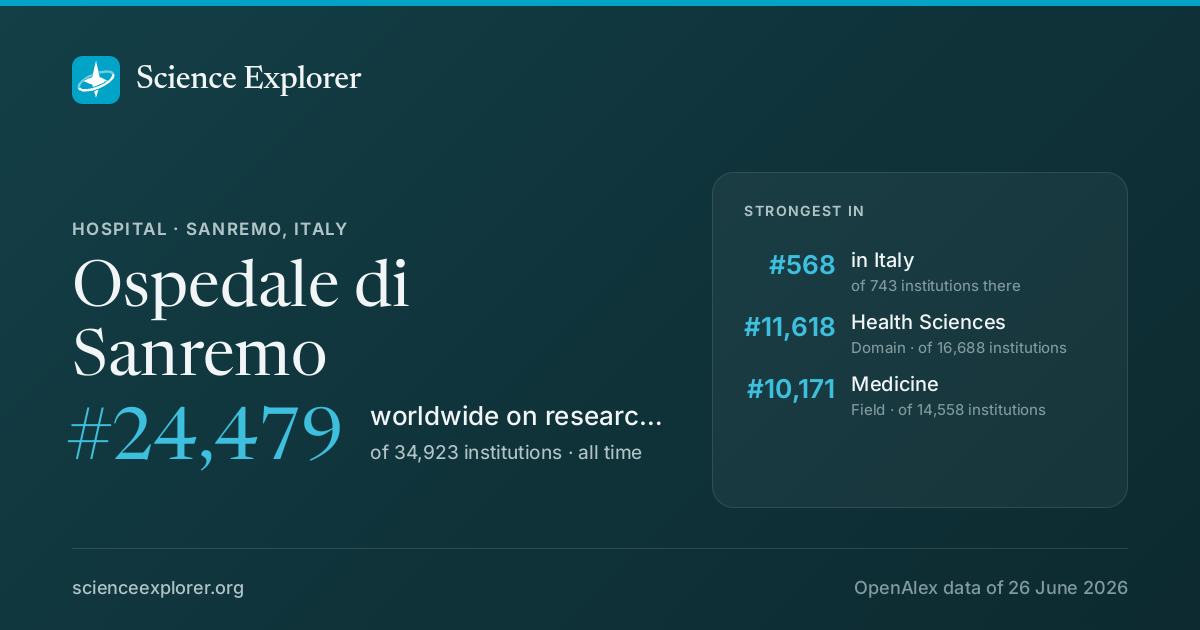
Ospedale di Sanremo on Science Explorer

A card with Ospedale di Sanremo's standing and the fields it leads in, for a post or a slide. A link to this page previews as the same card.

Download the card

1200 × 630 PNG, sized for social posts, drawn from the latest snapshot.

Badges for a website1Each links back here and updates with every snapshot

Research measures only: rankings here say nothing about teaching, admissions or student experience. Comparable institutions and collaboration partners have tabs of their own, above.

Discussion

Ask a question or share a note about Ospedale di Sanremo. Keep it to the research: no personal attacks, advertising or links. Any reader can report a post, which collapses it for everyone until it is opened.
