Padjadjaran University
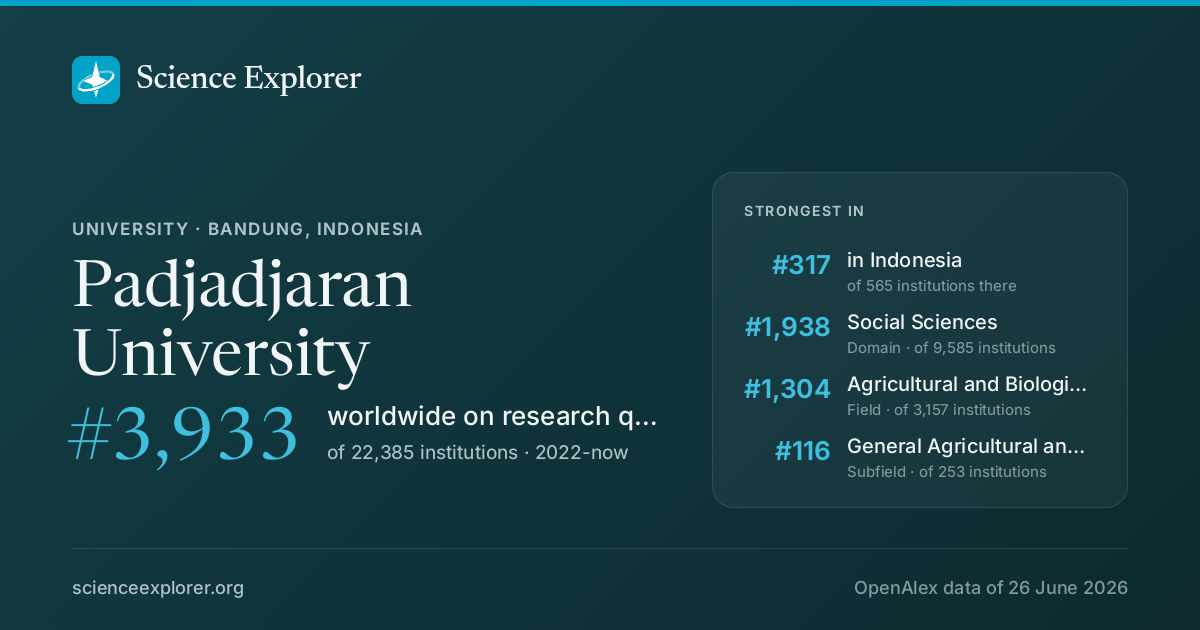
In research, Padjadjaran University stands highest in Social Sciences (#1,938 of 9,585 worldwide), Social Sciences (#1,575 of 5,988 worldwide) and Agricultural and Biological Sciences (#1,304 of 3,157 worldwide), 2022-now. Relative to its size it is most specialised in General Agricultural and Biological Sciences, Law and Aquatic Science (General Agricultural and Biological Sciences is 8.7× its share of world research).
- World rank, 2022-now
- #3,933 of 22,385 · #5,240 all time
- Rank in Indonesia
- #317 of 565
- Research works
- 42k ▲ 28% vs 2018-21
- Citations
- 157k 3.8 per fractional work
- Top-10% rate
- 8.7% all institutions 10.0%
- vs its own fields
- 0.66× 1.00× is exactly expected
- Open access
- 90% world 40%
- International
- 6% world 18%
What is Padjadjaran University known for in research?
The fields where it stands highest, 2022-now, ranked among every institution above the floor in each field.
| Field | World rank | Where that sits | Top-10% rate | Works | All time |
|---|---|---|---|---|---|
| Social SciencesDomain | #1,938 of 9,585 | 10.4% | 7,856 | #2579 | |
| Social SciencesField | #1,575 of 5,988 | 10.8% | 5,241 | #1647 | |
| Agricultural and Biological SciencesField | #1,304 of 3,157 | 9.4% | 2,501 | #1636 | |
| General Agricultural and Biological SciencesSubfield | #116 of 253 | 12.7% | 707 | #132 | |
| Health ProfessionsField | #917 of 1,895 | 10.8% | 702 | #1559 | |
| Sociology and Political ScienceSubfield | #1,306 of 2,526 | 11.6% | 1,400 | #1442 | |
| Business, Management and AccountingField | #1,375 of 2,581 | 10.0% | 1,300 | #1980 | |
| Health Information ManagementSubfield | #78 of 120 | 14.2% | 139 | #148 | |
| Pediatrics, Perinatology and Child HealthSubfield | #325 of 493 | 11.8% | 634 | #565 | |
| Information SystemsSubfield | #897 of 1,321 | 8.8% | 704 | #1218 |
Each strip is that field's whole ranked pool, with the notch where Padjadjaran University sits in it, in the colour of the band that rank falls in. The track under the rate is the rate itself: it carries no average mark, because the average differs by field (from about 6% in Dentistry to 21% in Economics).
Which of those standings moved
The same fields on both windows: where it stood over the whole record, and where it stands in 2022-now. The distance is the story, and it is the one thing the two rank columns above cannot show.
- Social Sciences#2,579 #1,938
- Social Sciences#1,647 #1,575
- Agricultural and Biological Sciences#1,636 #1,304
- General Agricultural and Biological Sciences#132 #116
- Health Professions#1,559 #917
- Sociology and Political Science#1,442 #1,306
- Business, Management and Accounting#1,980 #1,375
- Health Information Management#148 #78
- Pediatrics, Perinatology and Child Health#565 #325
- Information Systems#1,218 #897
A dot further right is a better standing. Fields it was not ranked in over the whole record are left out.
Which fields of science does Padjadjaran University work in?
In 2022-now, 42% of research at Padjadjaran University is in Social Sciences, 24% in Health Sciences. Its largest fields are Social Sciences (28%), Medicine (18%), Agricultural and Biological Sciences (14%). It does 1.7× the world's share of Social Sciences.
Each ring splits the one inside it: the four domains of science, their fields, their subfields. Size is fractional works in 2022-now. Every slice is a page; the interactive view zooms down to single topics and colours each by how much more of it this institution does than the world.
Its 4 domains and 26 fields, with their numbers
- Social Sciences8,52642.4%
- Social Sciences5,63628.1%
- Business, Management and Accounting1,4227.1%
- Economics, Econometrics and Finance5983.0%
- Psychology4382.2%
- Arts and Humanities3041.5%
- Decision Sciences1280.6%
- Health Sciences4,81624.0%
- Medicine3,61118.0%
- Health Professions7863.9%
- Dentistry2481.2%
- Nursing1610.8%
- Veterinary100.1%
- Life Sciences3,63818.1%
- Physical Sciences3,10815.5%
- Computer Science1,1035.5%
- Environmental Science8534.2%
- Engineering5162.6%
- Earth and Planetary Sciences1850.9%
- Materials Science1620.8%
- Chemistry1240.6%
- Mathematics730.4%
- Energy560.3%
- Physics and Astronomy280.1%
- Chemical Engineering70.0%
What does Padjadjaran University specialise in?
Where its research is concentrated relative to its size: General Agricultural and Biological Sciences takes 8.7× the share of its output that it takes of world research.
- General Agricultural and Biological SciencesSubfield · 772.3 works8.7×
- LawSubfield · 791.6 works6.8×
- Aquatic ScienceSubfield · 237.5 works6.5×
- DemographySubfield · 853.6 works6.2×
- Human Factors and ErgonomicsSubfield · 100.4 works4.5×
- Pediatrics, Perinatology and Child HealthSubfield · 669.1 works4.5×
- Geography, Planning and DevelopmentSubfield · 180.4 works4.4×
Location quotient, a volume reading rather than an impact one. It surfaces small, lopsided specialities.
Field profile
Location quotient across every field it publishes in: outside the ring is more than an institution of this size would be expected to publish, inside it is less.
Rings at 0.5×, 1× and 2×. Widest outward: Agricultural and Biological Sciences, 2.9×. Every wedge is a field page.
All 26 fields, with their numbers
- Agricultural and Biological Sciences2.86×2,729 works
- Dentistry2.55×248 works
- Social Sciences2.22×5,636 works
- Business, Management and Accounting2.20×1,422 works
- Pharmacology, Toxicology and Pharmaceutics1.91×136 works
- Nursing1.63×160 works
- Health Professions1.48×786 works
- Economics, Econometrics and Finance1.39×598 works
- Medicine0.94×3,611 works
- Environmental Science0.85×853 works
- Psychology0.72×438 works
- Computer Science0.71×1,104 works
- Decision Sciences0.66×128 works
- Earth and Planetary Sciences0.59×185 works
- Biochemistry, Genetics and Molecular Biology0.55×586 works
- Immunology and Microbiology0.55×111 works
- Arts and Humanities0.52×304 works
- Chemistry0.39×124 works
- Veterinary0.38×10 works
- Mathematics0.31×73 works
- Energy0.30×56 works
- Neuroscience0.24×77 works
- Materials Science0.23×162 works
- Engineering0.17×516 works
- Chemical Engineering0.10×7 works
- Physics and Astronomy0.06×28 works
- Agricultural and Biological Sciences 2.9×
- Dentistry 2.5×
- Social Sciences 2.2×
- Business, Management and Accounting 2.2×
- Pharmacology, Toxicology and Pharmaceutics 1.9×
- Nursing 1.6×
- Health Professions 1.5×
- Economics, Econometrics and Finance 1.4×
- Medicine 0.9×
- Environmental Science 0.8×
- Psychology 0.7×
- Computer Science 0.7×
- Decision Sciences 0.7×
- Earth and Planetary Sciences 0.6×
- Biochemistry, Genetics and Molecular Biology 0.6×
- Immunology and Microbiology 0.6×
- Arts and Humanities 0.5×
- Chemistry 0.4×
- Veterinary 0.4×
- Mathematics 0.3×
- Energy 0.3×
- Neuroscience 0.2×
- Materials Science 0.2×
- Engineering 0.2×
- Chemical Engineering 0.1×
- Physics and Astronomy 0.1×
Who are the top researchers at Padjadjaran University?
Ranked on the quality score, Qorinah Estiningtyas Sakilah Adnani, Rovina Ruslami and Lika Apriani lead among researchers whose main affiliation is Padjadjaran University.
- 1
Qorinah Estiningtyas Sakilah Adnani
 Indonesia · #46,068 worldwide
40k citations · 205 works
- 2
Rovina Ruslami
Indonesia · #110,979 worldwide
6.9k citations · 175 works
- 3
Lika Apriani
Indonesia · #575,351 worldwide
1.8k citations · 55 works
- 4
Bachti Alisjahbana
Indonesia · #666,238 worldwide
9.6k citations · 353 works
- 5
Ahmad Rizal Ganiem
Indonesia · #802,177 worldwide
2.2k citations · 98 works
- 6
Sofiati Dian
Indonesia · #929,078 worldwide
1.8k citations · 81 works
- 7 Yoga Trianzar Malik #1,312,706 worldwide 519 citations · 33 works
- 8 Irkham Irkham #1,371,579 worldwide 1.7k citations · 103 works
- 9
Buntora Pasaribu
Indonesia · #1,551,867 worldwide
1k citations · 67 works
- 10
Rohman Hikmat
Indonesia · #1,576,377 worldwide
589 citations · 76 works
Which keywords describe research at Padjadjaran University?
By fractional works in 2022-now, weighted toward what it does more of than the world: Community Empowerment, Indonesia, Social Media, E-commerce, Economic Impact, Pandemic, COVID-19 and Financial Performance.
- Youth Engagement
- Functional Food
- Restorative Justice
- Agriculture
- Criminal Justice
- Local Wisdom
- Stunting
- Public Health Policy
- Maternal Health
- Breastfeeding
- Economic Development
- Supply Chain Management
- UMKM
- SMEs
- Islamic Banking
- Health Education
- Sustainable Development
- E-commerce
- Indonesia
- Social Media
- Community Empowerment
- COVID-19
- Pandemic
- Economic Impact
- Financial Performance
- Media Literacy
- Human Rights
- Digital Marketing
- Digital Literacy
- Antioxidant Activity
- Corporate Governance
- Non-Communicable Diseases
- Community Participation
- Child Nutrition
- Pandemic Response
- Environmental Law
- Food Security
- Food Safety
- Sustainable Agriculture
- Fatty Acid Composition
Size is fractional works in 2022-now in the topics tagged with each word; colour is the word's share of this institution's work against its share of the world's. The 40 words are chosen for being large and distinctive. Each links to the topic it comes from most.
All 40 words, with their numbers
- Community Empowerment1,754▲ 12×13 topics
- Social Media1,380▲ 5.0×32 topics
- COVID-191,143▲ 4.4×31 topics
- Indonesia1,139▲ 13×5 topics
- Pandemic1,086▲ 5.5×13 topics
- E-commerce960▲ 8.4×10 topics
- Economic Impact940▲ 8.8×8 topics
- Sustainable Development907▲ 2.9×72 topics
- Financial Performance872▲ 7.7×15 topics
- Health Education846▲ 9.7×11 topics
- Media Literacy808▲ 7.6×6 topics
- Islamic Banking768▲ 10×3 topics
- Human Rights727▲ 3.5×47 topics
- SMEs725▲ 11×4 topics
- Digital Marketing723▲ 9.3×4 topics
- UMKM711▲ 13×1 topic
- Digital Literacy657▲ 5.7×11 topics
- Supply Chain Management652▲ 3.6×23 topics
- Antioxidant Activity647▲ 5.2×31 topics
- Economic Development624▲ 3.9×35 topics
- Corporate Governance617▲ 4.2×23 topics
- Breastfeeding562▲ 12×3 topics
- Non-Communicable Diseases558▲ 10×5 topics
- Maternal Health556▲ 11×3 topics
- Community Participation555▲ 7.8×7 topics
- Public Health Policy542▲ 10×4 topics
- Child Nutrition538▲ 14×1 topic
- Stunting538▲ 14×1 topic
- Pandemic Response532▲ 12×3 topics
- Local Wisdom518▲ 5.6×9 topics
- Environmental Law512▲ 12×7 topics
- Criminal Justice496▲ 11×6 topics
- Food Security482▲ 4.4×22 topics
- Agriculture460▲ 6.0×10 topics
- Food Safety438▲ 7.7×17 topics
- Restorative Justice435▲ 16×2 topics
- Sustainable Agriculture398▲ 6.4×14 topics
- Functional Food372▲ 14×3 topics
- Fatty Acid Composition363▲ 17×2 topics
- Youth Engagement359▲ 8.2×3 topics
Which research topics does Padjadjaran University publish most on?
By volume in 2022-now: SMEs Development and Digital Marketing, Public Health and Nutrition, Islamic Finance and Communication and Food and Agricultural Sciences.
Area is fractional works; colour is the subfield each topic belongs to.
- 1 SMEs Development and Digital Marketing Demography 711 works
- 2 Public Health and Nutrition Pediatrics, Perinatology and Child Health 538 works
- 3 Islamic Finance and Communication Sociology and Political Science 357 works
- 4 Food and Agricultural Sciences Food Science 355 works
- 5 Legal Studies and Policies Law 327 works
- 6 Agriculture and Agroindustry Studies General Agricultural and Biological Sciences 282 works
- 7 Indonesian Legal and Regulatory Studies Political Science and International Relations 249 works
- 8 Legal and Policy Analysis in Indonesia Law 239 works
- 9 Management and Optimization Techniques Strategy and Management 232 works
- 10 Educational Methods and Impacts Education 225 works
How open and international is its research?
Against the world's own shares: the tick on each track. Both are shares of its output, so they sit on one scale and can be read against each other as well as against the world.
World: 40% of research is openly available.
World: 18% is written across borders.
How has Padjadjaran University's research output changed?
Output in 2022-2025 was 28% higher than in 2018-2021.
The same series as a ribbon: one cell per year, darker for more. The line above answers how much; this answers when.
Its share of all research
Growing output can still be a shrinking share: all of science grows. This is Padjadjaran University as a percentage of every work published that year, 0.089% in 2024.
Fractional works of Padjadjaran University over all fractional works that year. How the balance of science has shifted.
How much of it reaches the world top 10%
Year by year, against all institutions in the same year.
Of each year's output, the share that reached the world's 10% most cited for its field and year. Peak 10.0% in 2022.
Other research institutions in Bandung
- Indonesia University of Education
- Bandung Institute of Technology
- Telkom University
- Bandung Islamic University
- Sunan Gunung Djati State Islamic University Bandung
- Universitas Informatika dan Bisnis Indonesia
- Parahyangan Catholic University
- Universitas Pasundan

Share Padjadjaran University's ranking
Badges for a website1Each links back here and updates with every snapshot

Research measures only: rankings here say nothing about teaching, admissions or student experience. Comparable institutions and collaboration partners have tabs of their own, above.
Discussion
Ask a question or share a note about Padjadjaran University. Posts are plain text and can be reported.