Science Explorer Back to mapMap
Discussion
Company · Genoa · Italy

Piaggio Aerospace (Italy)

In research, Piaggio Aerospace (Italy) stands highest in Physical Sciences (#8,842 of 17,446 worldwide), over all time.

World rank, all time
#14,636
of 34,923
Rank in Italy
#348
of 743
Research works
304
◆ 1% vs 2018-21
Citations
12k
38.3 per fractional work
Top-10% rate
19.8%
all institutions 10.0%
vs its own fields
1.18×
1.00× is exactly expected
Open access
46%
world 40%
International
31%
world 18%

What is Piaggio Aerospace (Italy) known for in research?

The fields where it stands highest, over all time, ranked among every institution above the floor in each field.

FieldWorld rankWhere that sitsTop-10% rateWorks
Physical SciencesDomain #8,842 of 17,446 19.5%158

Each strip is that field's whole ranked pool, with the notch where Piaggio Aerospace (Italy) sits in it, in the colour of the band that rank falls in. The track under the rate is the rate itself: it carries no average mark, because the average differs by field (from about 6% in Dentistry to 21% in Economics).

Which fields of science does Piaggio Aerospace (Italy) work in?

In 2022-now, 66% of research at Piaggio Aerospace (Italy) is in Physical Sciences, 20% in Life Sciences. Its largest fields are Engineering (37%), Materials Science (12%), Medicine (9%). It does 1.6× the world's share of Physical Sciences.

Physical Sciences: 40 fractional works · 65.6% of its workEngineering: 22 fractional works · 36.6% of its workBiomedical Engineering: 9 fractional works · 14.3% of its workElectrical and Electronic Engineering: 3 fractional works · 4.6% of its workControl and Systems Engineering: 2 fractional works · 3.4% of its workMechanical Engineering: 2 fractional works · 2.8% of its workAerospace Engineering: 2 fractional works · 2.5% of its workCivil and Structural Engineering: 1 fractional works · 2.4% of its workAutomotive Engineering: 1 fractional works · 1.9% of its workMechanics of Materials: 1 fractional works · 1.8% of its workSafety, Risk, Reliability and Quality: 1 fractional works · 1.1% of its workIndustrial and Manufacturing Engineering: 1 fractional works · 1.0% of its workComputational Mechanics: 0 fractional works · 0.5% of its workBuilding and Construction: 0 fractional works · 0.3% of its workMaterials Science: 7 fractional works · 12.1% of its workMaterials Chemistry: 3 fractional works · 4.3% of its workBiomaterials: 2 fractional works · 3.7% of its workElectronic, Optical and Magnetic Materials: 1 fractional works · 2.0% of its workPolymers and Plastics: 1 fractional works · 1.2% of its workSurfaces, Coatings and Films: 0 fractional works · 0.8% of its workSmaller subfields together: 0 fractional works · 0.2% of its workChemistry: 3 fractional works · 5.3% of its workOrganic Chemistry: 1 fractional works · 1.8% of its workInorganic Chemistry: 1 fractional works · 1.7% of its workPhysical and Theoretical Chemistry: 1 fractional works · 0.9% of its workSpectroscopy: 0 fractional works · 0.8% of its workSmaller subfields together: 0 fractional works · 0.1% of its workComputer Science: 3 fractional works · 5.0% of its workArtificial Intelligence: 2 fractional works · 2.5% of its workComputer Vision and Pattern Recognition: 0 fractional works · 0.7% of its workComputational Theory and Mathematics: 0 fractional works · 0.6% of its workInformation Systems: 0 fractional works · 0.3% of its workSignal Processing: 0 fractional works · 0.3% of its workSoftware: 0 fractional works · 0.3% of its workSmaller subfields together: 0 fractional works · 0.3% of its workEnvironmental Science: 2 fractional works · 3.5% of its workGlobal and Planetary Change: 1 fractional works · 2.3% of its workEcology: 0 fractional works · 0.7% of its workSmaller subfields together: 0 fractional works · 0.5% of its workPhysics and Astronomy: 1 fractional works · 1.4% of its workCondensed Matter Physics: 0 fractional works · 0.8% of its workAtomic and Molecular Physics, and Optics: 0 fractional works · 0.3% of its workSmaller subfields together: 0 fractional works · 0.2% of its workEarth and Planetary Sciences: 0 fractional works · 0.8% of its workGeophysics: 0 fractional works · 0.5% of its workSmaller subfields together: 0 fractional works · 0.3% of its workMathematics: 0 fractional works · 0.5% of its workGeometry and Topology: 0 fractional works · 0.4% of its workSmaller subfields together: 0 fractional works · 0.1% of its workEnergy: 0 fractional works · 0.3% of its workRenewable Energy, Sustainability and the Environment: 0 fractional works · 0.3% of its workChemical Engineering: 0 fractional works · 0.1% of its workLife Sciences: 12 fractional works · 20.2% of its workBiochemistry, Genetics and Molecular Biology: 5 fractional works · 7.8% of its workMolecular Biology: 3 fractional works · 4.6% of its workGenetics: 1 fractional works · 1.5% of its workMolecular Medicine: 0 fractional works · 0.4% of its workClinical Biochemistry: 0 fractional works · 0.3% of its workCancer Research: 0 fractional works · 0.2% of its workCell Biology: 0 fractional works · 0.2% of its workSmaller subfields together: 0 fractional works · 0.6% of its workAgricultural and Biological Sciences: 4 fractional works · 5.9% of its workPlant Science: 1 fractional works · 1.7% of its workInsect Science: 1 fractional works · 1.5% of its workFood Science: 1 fractional works · 1.2% of its workEcology, Evolution, Behavior and Systematics: 1 fractional works · 1.1% of its workAquatic Science: 0 fractional works · 0.3% of its workNeuroscience: 3 fractional works · 5.0% of its workCognitive Neuroscience: 1 fractional works · 2.2% of its workCellular and Molecular Neuroscience: 1 fractional works · 1.9% of its workNeurology: 0 fractional works · 0.6% of its workDevelopmental Neuroscience: 0 fractional works · 0.3% of its workSmaller subfields together: 0 fractional works · 0.1% of its workPharmacology, Toxicology and Pharmaceutics: 1 fractional works · 0.9% of its workPharmaceutical Science: 0 fractional works · 0.5% of its workPharmacology: 0 fractional works · 0.4% of its workImmunology and Microbiology: 0 fractional works · 0.6% of its workImmunology: 0 fractional works · 0.4% of its workSmaller subfields together: 0 fractional works · 0.2% of its workHealth Sciences: 6 fractional works · 9.7% of its workMedicine: 6 fractional works · 9.2% of its workEpidemiology: 1 fractional works · 1.5% of its workSurgery: 1 fractional works · 1.0% of its workRehabilitation: 1 fractional works · 0.9% of its workBiochemistry: 0 fractional works · 0.6% of its workNeurology: 0 fractional works · 0.6% of its workOncology: 0 fractional works · 0.6% of its workComplementary and alternative medicine: 0 fractional works · 0.4% of its workPhysiology: 0 fractional works · 0.4% of its workEndocrinology, Diabetes and Metabolism: 0 fractional works · 0.3% of its workCardiology and Cardiovascular Medicine: 0 fractional works · 0.3% of its workInfectious Diseases: 0 fractional works · 0.3% of its workPsychiatry and Mental health: 0 fractional works · 0.3% of its workEmergency Medicine: 0 fractional works · 0.3% of its workPharmacology: 0 fractional works · 0.3% of its workRadiology, Nuclear Medicine and Imaging: 0 fractional works · 0.2% of its workSmaller subfields together: 1 fractional works · 1.2% of its workDentistry: 0 fractional works · 0.5% of its workOral Surgery: 0 fractional works · 0.3% of its workSmaller subfields together: 0 fractional works · 0.1% of its workSocial Sciences: 3 fractional works · 4.4% of its workSocial Sciences: 1 fractional works · 1.6% of its workDemography: 0 fractional works · 0.5% of its workEducation: 0 fractional works · 0.5% of its workSafety Research: 0 fractional works · 0.4% of its workSmaller subfields together: 0 fractional works · 0.1% of its workPsychology: 1 fractional works · 1.4% of its workSocial Psychology: 1 fractional works · 1.1% of its workClinical Psychology: 0 fractional works · 0.3% of its workSmaller subfields together: 0 fractional works · 0.0% of its workBusiness, Management and Accounting: 0 fractional works · 0.7% of its workManagement of Technology and Innovation: 0 fractional works · 0.3% of its workStrategy and Management: 0 fractional works · 0.3% of its workSmaller subfields together: 0 fractional works · 0.1% of its workEconomics, Econometrics and Finance: 0 fractional works · 0.5% of its workEconomics and Econometrics: 0 fractional works · 0.5% of its workDecision Sciences: 0 fractional works · 0.1% of its workArts and Humanities: 0 fractional works · 0.1% of its workALL ITS WORKPiaggio Aerospace(Italy)60fractional works, 2022-now
Life Sciences20%Physical Sciences66%Health Sciences10%Social Sciences4%

Each ring splits the one inside it: the four domains of science, their fields, their subfields. Size is fractional works in 2022-now. Every slice is a page; the interactive view zooms down to single topics and colours each by how much more of it this institution does than the world.

Its 4 domains and 23 fields, with their numbers
    1. Engineering2236.6%
    2. Materials Science712.1%
    3. Chemistry35.3%
    4. Computer Science35.0%
    5. Environmental Science23.5%
    6. Physics and Astronomy11.4%
    7. Earth and Planetary Sciences00.8%
    8. Mathematics00.5%
    9. Energy00.3%
    10. Chemical Engineering00.1%
    1. Biochemistry, Genetics and Molecular Biology57.8%
    2. Agricultural and Biological Sciences45.9%
    3. Neuroscience35.0%
    4. Pharmacology, Toxicology and Pharmaceutics10.9%
    5. Immunology and Microbiology00.6%
    1. Medicine69.2%
    2. Dentistry00.5%
    1. Social Sciences11.6%
    2. Psychology11.4%
    3. Business, Management and Accounting00.7%
    4. Economics, Econometrics and Finance00.5%
    5. Decision Sciences00.1%
    6. Arts and Humanities00.1%
All of science, and how each field's share has moved since 1950: the Science domain explorer

Field profile

Location quotient across every field it publishes in: outside the ring is more than an institution of this size would be expected to publish, inside it is less.

Agricultural and Biological Sciences: 1.24× its world share, 4 worksAgricultural and Bio…Biochemistry, Genetics and Molecular Biology: 1.47× its world share, 5 worksBiochemistry, Geneti…Immunology and Microbiology: 0.61× its world share, 0 worksImmunology and Micro…Neuroscience: 3.10× its world share, 3 worksNeurosciencePharmacology, Toxicology and Pharmaceutics: 2.53× its world share, 0 worksPharmacology, Toxico…Chemical Engineering: 0.36× its world share, 0 worksChemical EngineeringChemistry: 3.36× its world share, 3 worksChemistryComputer Science: 0.65× its world share, 3 worksComputer ScienceEarth and Planetary Sciences: 0.49× its world share, 0 worksEarth and Planetary …Energy: 0.32× its world share, 0 worksEnergyEngineering: 2.44× its world share, 22 worksEngineeringEnvironmental Science: 0.70× its world share, 2 worksEnvironmental ScienceMaterials Science: 3.48× its world share, 7 worksMaterials ScienceMathematics: 0.43× its world share, 0 worksMathematicsPhysics and Astronomy: 0.62× its world share, 1 worksPhysics and AstronomyDentistry: 0.99× its world share, 0 worksDentistryMedicine: 0.48× its world share, 6 worksMedicineArts and Humanities: 0.02× its world share, 0 worksArts and HumanitiesBusiness, Management and Accounting: 0.22× its world share, 0 worksBusiness, Management…Decision Sciences: 0.11× its world share, 0 worksDecision SciencesEconomics, Econometrics and Finance: 0.26× its world share, 0 worksEconomics, Econometr…Psychology: 0.45× its world share, 1 worksPsychologySocial Sciences: 0.13× its world share, 1 worksSocial Sciences1×world share
more than its size predictsabout as predictedless

Rings at 0.5×, 1× and 2×. Widest outward: Materials Science, 3.5×. Every wedge is a field page.

All 23 fields, with their numbers
  1. Materials Science3.48×7 works
  2. Chemistry3.36×3 works
  3. Neuroscience3.10×3 works
  4. Pharmacology, Toxicology and Pharmaceutics2.53×0 works
  5. Engineering2.44×22 works
  6. Biochemistry, Genetics and Molecular Biology1.47×5 works
  7. Agricultural and Biological Sciences1.24×4 works
  8. Dentistry0.99×0 works
  9. Environmental Science0.70×2 works
  10. Computer Science0.65×3 works
  11. Physics and Astronomy0.62×1 works
  12. Immunology and Microbiology0.61×0 works
  13. Earth and Planetary Sciences0.49×0 works
  14. Medicine0.48×6 works
  15. Psychology0.45×1 works
  16. Mathematics0.43×0 works
  17. Chemical Engineering0.36×0 works
  18. Energy0.32×0 works
  19. Economics, Econometrics and Finance0.26×0 works
  20. Business, Management and Accounting0.22×0 works
  21. Social Sciences0.13×1 works
  22. Decision Sciences0.11×0 works
  23. Arts and Humanities0.02×0 works

Who are the top researchers at Piaggio Aerospace (Italy)?

Ranked on the quality score, S. Arcioni, Fulvio Pupilli and Anna Mariani lead among researchers whose main affiliation is Piaggio Aerospace (Italy).

  1. 1 S. Arcioni Italy · #3,446,184 worldwide 5k citations · 159 works
  2. 2 Fulvio Pupilli Italy · #4,118,012 worldwide 1.8k citations · 75 works
  3. 3 Anna Mariani Italy · #4,868,455 worldwide 513 citations · 36 works
  4. 4 Gianvito Apuleo Italy · #5,190,892 worldwide 86 citations · 20 works
All ranked researchers at Piaggio Aerospace (Italy)

What are the most cited papers from Piaggio Aerospace (Italy)?

The most cited paper from Piaggio Aerospace (Italy) is "Highly stretchable electroluminescent skin for optical signaling and tactile sensing" (Chris M. Larson, Bryan N. Peele, Shuo Li et al., 2016), with 1,402 citations. Next come "Soft Robot Arm Inspired by the Octopus" (984) and "Toward Perceptive Soft Robots: Progress and Challenges" (757).

Most cited papers
#PaperReleasedCitations
1 Highly stretchable electroluminescent skin for optical signaling and tactile sensing Chris M. Larson, Bryan N. Peele, Shuo Li et al. · Science 3 Mar 2016 1,402
2 Soft Robot Arm Inspired by the Octopus Cecilia Laschi, Matteo Cianchetti, Barbara Mazzolai et al. · Advanced Robotics 2012 984
3 Toward Perceptive Soft Robots: Progress and Challenges Hongbo Wang, Massimo Totaro, Lucia Beccai · Advanced Science Open access 13 Jul 2018 757
4 Review of assistive strategies in powered lower-limb orthoses and exoskeletons Tingfang Yan, Marco Cempini, Calogero Maria Oddo et al. · Robotics and Autonomous Systems 17 Nov 2014 723
5 Control of Multifunctional Prosthetic Hands by Processing the Electromyographic Signal Massimiliano Zecca, Silvestro Micera, Maria Chiara Carrozza et al. · Critical Reviews in Biomedical Engineering 2002 604
All 59 most cited papers, with filters and sorting

Which keywords describe research at Piaggio Aerospace (Italy)?

By fractional works in 2022-now, weighted toward what it does more of than the world: Biomedical Applications, Nanoparticles, Drug Delivery, Tissue Engineering, Tumor Targeting, Cancer Therapy, Hydrogels and Regenerative Medicine.

▲ more of its work than of the world's◆ about the world's share▼ less than the world's

Size is fractional works in 2022-now in the topics tagged with each word; colour is the word's share of this institution's work against its share of the world's. The 40 words are chosen for being large and distinctive. Each links to the topic it comes from most.

All 40 words, with their numbers
  1. Biomedical Applications6▲ 8.9×22 topics
  2. Nanoparticles5▲ 6.6×16 topics
  3. Drug Delivery4▲ 13×13 topics
  4. Tissue Engineering4▲ 11×11 topics
  5. Deep Learning4▲ 1.78×14 topics
  6. Machine Learning4▲ 1.80×10 topics
  7. Tumor Targeting2▲ 23×2 topics
  8. Cancer Therapy2▲ 6.2×5 topics
  9. Nanomaterials2▲ 3.2×10 topics
  10. Hydrogels2▲ 16×4 topics
  11. Regenerative Medicine2▲ 12×4 topics
  12. Photothermal Therapy2▲ 22×2 topics
  13. Reactive Oxygen Species2▲ 6.8×3 topics
  14. Fluorescence Imaging2▲ 18×2 topics
  15. Photodynamic Therapy2▲ 12×3 topics
  16. Cell Culture2▲ 21×2 topics
  17. Nanocomposites2▲ 3.1×10 topics
  18. Biosensors1▲ 4.8×7 topics
  19. Catalysis1▲ 3.5×11 topics
  20. Metal-Organic Frameworks1▲ 5.6×4 topics
  21. Microfluidic Devices1▲ 19×2 topics
  22. Near-Infrared1▲ 24×1 topic
  23. Risk Assessment1▲ 3.4×3 topics
  24. Alternative Fuels1▲ 54×1 topic
  25. Aviation1▲ 86×1 topic
  26. Bioinks1▲ 37×1 topic
  27. Biomaterials1▲ 9.1×6 topics
  28. Bioprinting1▲ 37×1 topic
  29. Crystal Engineering1▲ 20×2 topics
  30. Chemical Sensors1▲ 8.8×3 topics
  31. Magnetic Nanoparticles1▲ 18×2 topics
  32. Nanocarriers1▲ 35×1 topic
  33. Surface Engineering1▲ 22×1 topic
  34. Environmental Effects1▲ 17×2 topics
  35. Nonlinear Dynamics1▲ 7.9×2 topics
  36. Self-Assembly1▲ 5.5×7 topics
  37. Soft Robotics1▲ 23×2 topics
  38. Collision Avoidance1▲ 9.4×2 topics
  39. Vibration-based Damage Identification1▲ 26×1 topic
  40. Wireless Sensors1▲ 26×1 topic

Which research topics does Piaggio Aerospace (Italy) publish most on?

By volume in 2022-now: Nanoplatforms for cancer theranostics, 3D Printing in Biomedical Research, Advanced Aircraft Design and Technologies and Nanoparticle-Based Drug Delivery.

  1. 1 Nanoplatforms for cancer theranostics Biomedical Engineering 1 works
  2. 2 3D Printing in Biomedical Research Biomedical Engineering 1 works
  3. 3 Advanced Aircraft Design and Technologies Global and Planetary Change 1 works
  4. 4 Nanoparticle-Based Drug Delivery Biomaterials 1 works
  5. 5 Structural Health Monitoring Techniques Civil and Structural Engineering 1 works
  6. 6 Advanced Fiber Optic Sensors Electrical and Electronic Engineering 1 works
  7. 7 Metal-Organic Frameworks: Synthesis and Applications Inorganic Chemistry 1 works
  8. 8 Fault Detection and Control Systems Control and Systems Engineering 1 works
  9. 9 Advanced Sensor and Energy Harvesting Materials Biomedical Engineering 1 works
  10. 10 Air Traffic Management and Optimization Aerospace Engineering 1 works

How open and international is its research?

Against the world's own shares: the tick on each track. Both are shares of its output, so they sit on one scale and can be read against each other as well as against the world.

openly available46.0%not open54.0%

World: 40% of research is openly available.

with international co-authors31.4%domestic only68.6%

World: 18% is written across borders.

How has Piaggio Aerospace (Italy)'s research output changed?

Output in 2022-2025 was 1% higher than in 2018-2021.

still counting1990200020102020
grewheldshrank

The same series as a ribbon: one cell per year, darker for more. The line above answers how much; this answers when.

Its share of all research

Growing output can still be a shrinking share: all of science grows. This is Piaggio Aerospace (Italy) as a percentage of every work published that year, 0.00020% in 2024.

still counting0.00025%0.00050%0.00075%Piaggio Aerospace (Italy)0.00018% in 202519801990200020102020

Fractional works of Piaggio Aerospace (Italy) over all fractional works that year. How the balance of science has shifted.

Other research institutions in Genoa

All research institutions in Genoa

Share Piaggio Aerospace (Italy)'s ranking
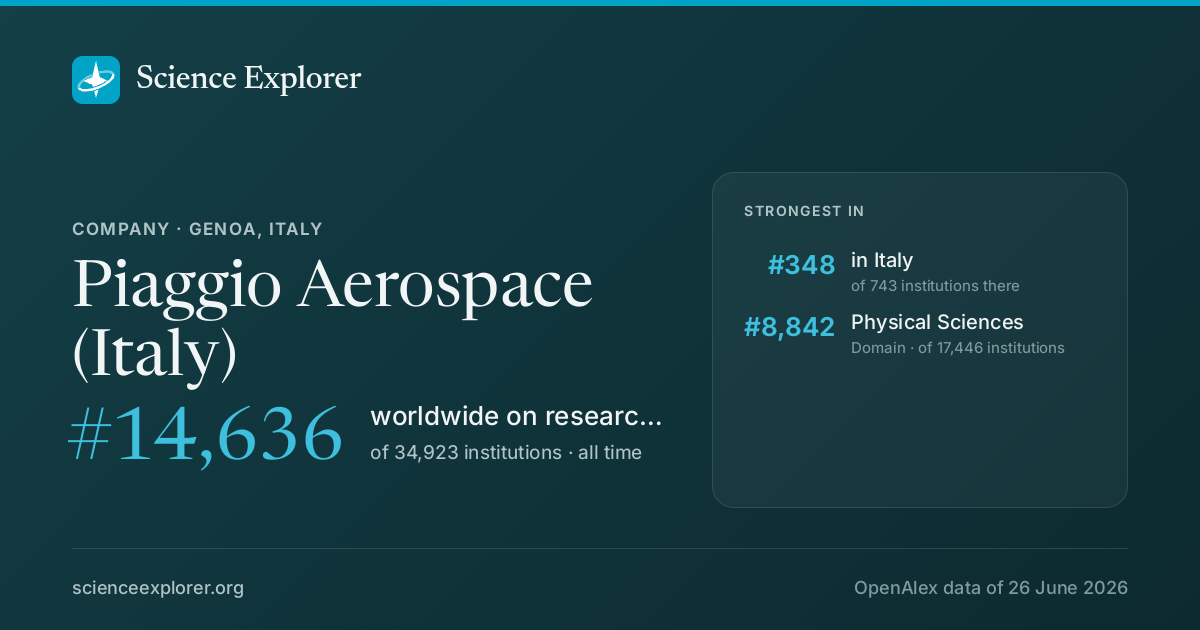
Piaggio Aerospace (Italy) on Science Explorer

A card with Piaggio Aerospace (Italy)'s standing and the fields it leads in, for a post or a slide. A link to this page previews as the same card.

Download the card

1200 × 630 PNG, sized for social posts, drawn from the latest snapshot.

Badges for a website1Each links back here and updates with every snapshot

Research measures only: rankings here say nothing about teaching, admissions or student experience. Comparable institutions and collaboration partners have tabs of their own, above.

Discussion

Ask a question or share a note about Piaggio Aerospace (Italy). Posts are plain text and can be reported.